
The state of LLM referral traffic in 2026 reflects a major shift in how users discover websites, products, and brands online. Just last year, ChatGPT dominated most measurable AI referrals, but the landscape is quickly diversifying with the rise of Claude, Gemini, Perplexity, and other AI platforms. This change matters because AI-driven traffic is proving to be smaller in volume but significantly higher in intent and conversion quality than traditional search traffic.
In this blog, we’ll explore how AI platforms like ChatGPT send traffic to websites, why AI referrals convert differently from organic search, how attribution and tracking are evolving, and what the rise of multi-platform AI discovery means for SEO, content strategy, and growth teams in 2026.
AI traffic converts at an average of 14.2% vs 2.8% for Google organic, a ~5× advantage observed across industries.
How does ChatGPT send Traffic to Websites
ChatGPT drives website traffic through multiple mechanisms that have evolved significantly throughout 2026. The turning point came with what analysts call the "Branded Link Update" in May 2026. That's when ChatGPT started embedding brand homepage URLs inline in its answers at least ~14x more often, with each link serving as a clickable, attributable referral.
0.5% of AI search visitors generated 12.1% of total signups, indicating a ~23× conversion lift in high-consideration purchase journeys where users arrive pre-researched.
Primary Traffic Generation Methods
- Product Page Recommendations: For commercial queries, ChatGPT cites product pages in 20.1% of responses—roughly 50× more often than Perplexity (0.4%). That makes ChatGPT a major discovery channel for ecommerce brands and B2B software companies during purchase evaluation.
- Direct Citations in Responses: When users ask questions, ChatGPT provides clickable source links alongside its answers. But ChatGPT only cites 50% of the pages it retrieves, and when it does cite, 88% of the URLs that end up being cited come directly from search results. This creates a dependency on being discoverable through Google first.
- Search Mode Integration: As of February 2026, ChatGPT activates web search on 34.5% of queries, down from 46% in late 2024. When enabled, it retrieves live web results and surfaces source links, driving referral traffic for timely and news-driven content.
How Does ChatGPT and Claude Impact My Website Traffic?
ChatGPT and Claude influence website traffic through distinctly different mechanisms that reflect their unique design philosophies and user bases. While ChatGPT drives 87.4% of all AI referral traffic to websites by sheer volume, Claude and other emerging platforms like Perplexity and Gemini split the remaining 12.6%. Here's what matters: they often deliver higher-quality, more targeted visitors—sometimes far more valuable than the raw numbers suggest.
Claude's High-Value Traffic Profile
Claude’s impact differs from ChatGPT’s volume-driven referral model by emphasizing higher intent and quality over raw traffic volume.
Higher-Quality Traffic: Claude referrals show the highest average session value at $4.56 per visit, compared to ChatGPT at $2.34, suggesting users arrive more decision-ready after deeper, more deliberative AI interactions.
Enterprise-Weighted Audience: Claude has stronger adoption among enterprise users, making its referral traffic disproportionately valuable in B2B contexts where buying cycles are longer and research-heavy, increasing the likelihood of high-value conversions.
Rapid Growth from a Small Base: Since April 2025, Claude’s referral share has increased with recent spikes linked to broader user migration patterns from ChatGPT, indicating accelerating momentum despite lower overall volume.
High Crawl-to-Referral Inefficiency: A key limitation is efficiency—Anthropic crawls roughly 13,528 pages per 1 referral, compared to OpenAI’s 1,252:1 ratio, meaning a significantly higher volume of content is analyzed for each outbound visit, increasing visibility cost without proportional referral yield.
Traffic Quality vs. Volume Trade-offs
The choice between optimizing for ChatGPT or Claude reveals a fundamental trade-off between traffic volume and visitor quality.
"Claude's recent surge in referral traffic comes amid a widely reported wave of users switching from ChatGPT. Weekly data shows Claude's referral share peaked at 3.6% in week 12 in mid-March before falling back to 2.49% in week 13 of 2026."
For B2B companies specifically, the data suggests a portfolio approach is necessary. You need both broad awareness and high-intent leads, and different platforms deliver each.
Tracking Implementation Strategies
To measure AI-driven traffic accurately, leading organizations rely on structured attribution systems designed to correct widespread misclassification in analytics tools.
“Without the right tools, most AI-driven visits are recorded as direct traffic—unattributable, invisible, and therefore unactionable.”
1. AI Visibility Tracking (Indexly)
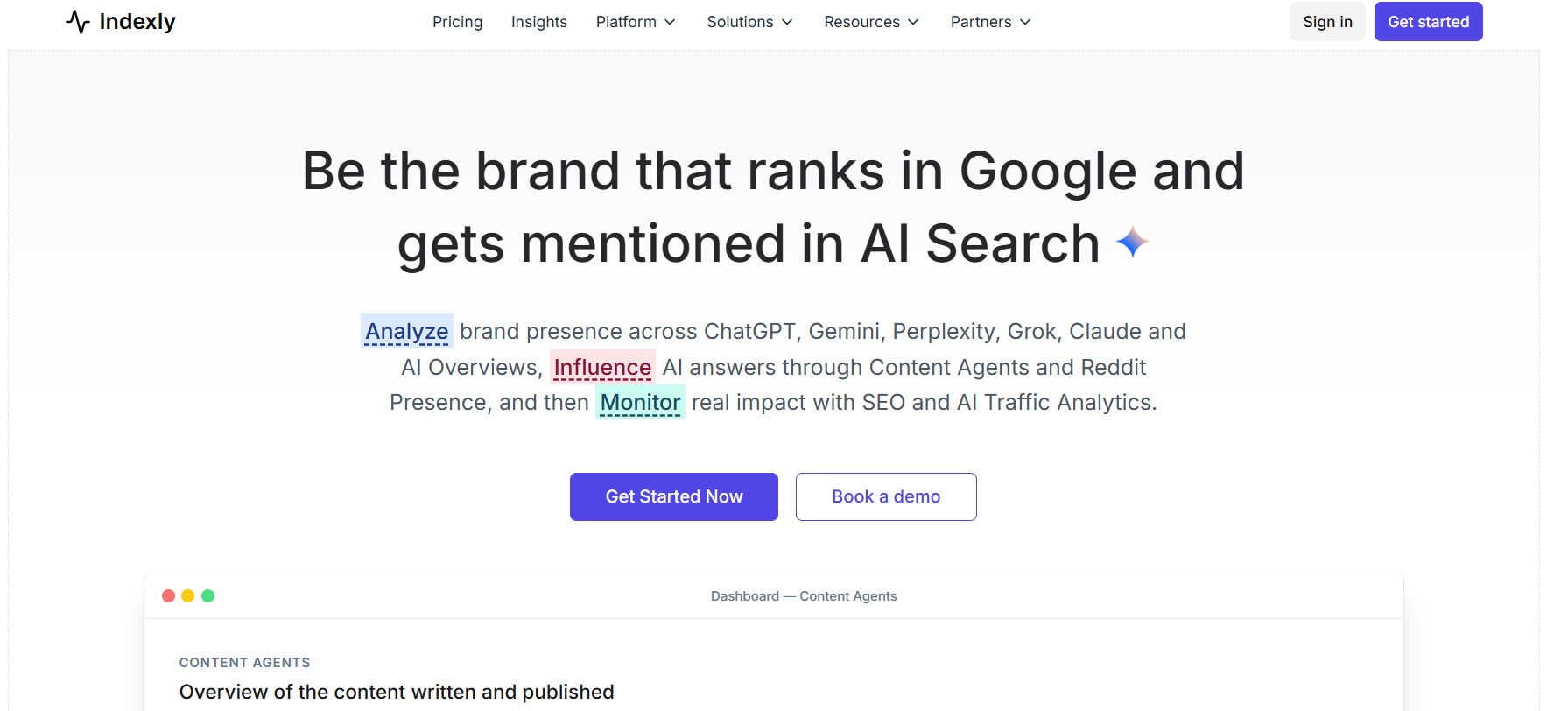
The first layer focuses on AI visibility tracking tools such as Indexly, which monitor how content is discovered, indexed, and surfaced across AI-driven environments. These tools typically track whether pages are referenced in AI answers, how often brand URLs appear, changes in visibility after updates, and indexing behavior across AI crawlers.
Unlike GA4, which focuses on clicks and conversions, this layer captures pre-click visibility signals—helping teams understand if content is even eligible to be selected by AI systems. This matters because much of AI discovery happens before any measurable click, especially in zero-click environments.
Indexly extends this layer by unifying real-time intelligence from search engines, AI platforms, and competitive data sources to identify visibility gaps and turn them into actionable growth opportunities.
It connects discovery, content creation, and optimisation into a single workflow, ensuring content is both Google-ready and LLM-ready. Beyond visibility, it links SEO and content efforts directly to business outcomes such as leads, CAC efficiency, and revenue contribution.
In effect, it replaces fragmented workflows with a unified system for execution and measurement across both traditional search and AI discovery channels, helping teams move from visibility insights to measurable business impact.
2. Custom Channel Groups in GA4
The next method is isolating AI referral traffic by creating custom channel groups in GA4.
This includes filtering known AI and LLM domains such as:
chat.openai.com, perplexity.ai, gemini.google.com, copilot.microsoft.com, claude.ai, and you.com.
This separation is foundational for distinguishing AI-driven referrals from generic referral or direct traffic sources.
3. Dark Traffic Monitoring
A major challenge in AI attribution is “dark traffic”—sessions that arrive without a referrer.
A significant share of AI-originated visits are logged this way and incorrectly categorized as Direct traffic.
- ChatGPT represents ~64.5% of identifiable AI traffic
- A large portion of remaining AI sessions still appear as Direct or Unassigned
This makes dark traffic monitoring essential for capturing true AI influence.
4. UTM Parameter Implementation
UTM tagging is used to improve attribution accuracy when sharing links influenced by AI systems or distributed through AI-driven workflows.
By consistently applying structured UTM parameters, teams can:
- Separate AI-originated campaigns from organic sources
- Reconstruct user journeys more accurately
- Connect content exposure to downstream conversions
5. CRM Tagging and Lead Source Labeling
High-performing teams tag AI-originated leads directly in their CRM systems.
This enables:
- Clear identification of AI-assisted conversions
- Better pipeline attribution
- Sales prioritization of high-intent leads
In many cases, teams report that AI-referred leads close 2–3× faster, largely because users arrive pre-informed and closer to decision-making.
Anyone Else Seeing Higher Conversion from AI Referrals Than Standard Search?
Yes—higher AI conversion rates are widely reported across industries and supported by multiple datasets. AI traffic is not just growing (796% over two years), it also converts better than traditional search in most cases.
In B2B SaaS, Ahrefs data shows AI traffic drove 12.1% of signups from just 0.5% of sessions—a 23× uplift. In e-commerce, AI traffic converts more often but may reduce AOV.
This is driven by pre-qualification: AI users arrive later in the funnel, leading to deeper engagement (48% longer product page time, 13% more pages per visit) but fewer exploratory sessions (1.14 vs 1.18 sessions/user). AI traffic is therefore “decision traffic,” not discovery traffic.
Is Perplexity AI Sending Traffic to My Site
Yes—Perplexity sends lower volume but very high-quality traffic. It now accounts for ~7.07% of AI referrals (behind Gemini at 8.65% in 2026), but its value lies in intent.
Perplexity is citation-first, meaning every answer links directly to sources, producing high-trust clicks. It has ~230M MAUs, with 64% using it for professional work. Its traffic converts ~3.1× better than standard organic search and benefits from a strong crawl-to-referral efficiency (95:1 ratio).
Regionally, usage is strong in professional markets (e.g., 9.1% of UK adults have used it). Despite declining share from a 2025 peak, Perplexity remains a high-intent channel, especially for B2B research audiences.
Does Appearing in AI Answers Actually Bring Traffic?
Yes. AI visibility is increasingly becoming a direct source of website traffic, especially for brands that appear consistently in AI-generated answers and recommendations.
When platforms like ChatGPT, Perplexity, Claude, or Gemini reference a website, users often treat those mentions as trusted recommendations rather than traditional search results. This changes user behavior. Instead of comparing multiple pages, users frequently click through with stronger intent and clearer expectations.
The impact varies depending on how a brand appears inside the AI response. Direct citations and embedded links tend to drive the strongest referral traffic, while product recommendations often attract users who are already evaluating solutions or preparing to make decisions. Even simple brand mentions can improve visibility and influence future clicks over time.
For many companies, especially in B2B and SaaS, AI visibility is evolving from a branding signal into a measurable acquisition channel that influences traffic, engagement, and conversions.
Conclusion
LLM referral traffic is changing how users discover websites, products, and brands. While AI-driven traffic is still smaller than traditional search traffic, it often brings higher-intent visitors who are closer to conversion.
Platforms like ChatGPT, Claude, Gemini, and Perplexity are becoming discovery and recommendation layers, not just answer engines. This shifts SEO from optimizing only for rankings to optimizing for visibility inside AI-generated answers.
Attribution remains a major challenge because much of AI influence happens before the click. Tools like Indexly help teams track AI visibility, monitor brand mentions across LLMs, and connect AI discovery to traffic, leads, and conversions.
FAQs
Can You Actually Track Traffic From ChatGPT?
Yes, but attribution is imperfect. Some ChatGPT referrals appear as standard referral traffic, while others are misclassified as direct or unassigned traffic in analytics tools. Most teams use custom GA4 channel groups, UTM parameters, and AI visibility tools to improve attribution accuracy.
How Do I Track Traffic From ChatGPT and Perplexity to My Site?
The most common approach is creating custom channel groupings in GA4 for AI domains such as chat.openai.com, perplexity.ai, claude.ai, and gemini.google.com. Many teams also use UTM tagging and AI visibility platforms like Indexly to monitor mentions, citations, visibility, and referral patterns across LLMs.
What’s the Difference Between ChatGPT Traffic and Search Engine Traffic?
Traditional search traffic is discovery-driven, where users compare multiple results before clicking. AI traffic is often decision-driven because users arrive after the AI system has already summarized information, compared options, and narrowed intent.
Why should I care about tracking ChatGPT and AI model traffic to my site?
Traffic from platforms like ChatGPT, Claude, Gemini, and Perplexity often comes from users who are already researching solutions and are closer to taking action. As a result, AI referrals can generate stronger engagement and higher conversion rates than traditional search traffic.
Monitoring AI traffic also helps businesses identify which pages and topics are gaining visibility inside AI-generated answers and recommendations.
What are the best tools for measuring AI Search Traffic and Visibility?
Most analytics teams combine GA4 with AI visibility platforms that track mentions, citations, and referral traffic across ChatGPT, Perplexity, Claude, and Gemini. Tools like Indexly help monitor AI visibility alongside traditional SEO performance.
Is Website Traffic Becoming Irrelevant if AI Recommends You Directly?
No—traffic is evolving, not disappearing. Google is becoming more answer-driven, with 40%+ AI Overviews and 65–70% zero-click searches, while AI referrals are growing rapidly (+527% in 5 months), creating new discovery channels alongside reduced clicks.
AI traffic is also higher quality, converting 4.4×–23× better than traditional organic (2.8% baseline). However, attribution is fragmented, and since 85% of AI brand mentions come from third-party sources, external visibility is now critical for being surfaced in AI answers.
Ahrefs launches tracker comparing Google vs. ChatGPT referral traffic , what does this mean for SEO?
It’s Ahrefs’ 44,421-site analysis comparing Google (41.9% of traffic) vs ChatGPT (0.19% in July 2025), showing AI as a measurable referral channel.
Key findings: ChatGPT is growing 3.8× faster than Google, converts ~4.4× better than organic search, and has attribution gaps due to missing referrers, with noticeable month-to-month volatility.
AI traffic from ChatGPT is converting at 6%+ for us. Anyone else tracking this separately from direct/other?
Yes — many companies are seeing higher conversion rates from AI traffic than traditional organic search.
Users arriving from ChatGPT are often more qualified because AI systems filter and summarize information before the click. The challenge is attribution, since many AI-assisted visits still appear as direct or unassigned traffic in analytics tools.