
Imagine your competitor's article gets quoted by ChatGPT every time someone in your industry asks a relevant question. That is not a hypothetical — it is happening right now to thousands of brands.
The rules of search engine visibility are being rewritten by AI, and the brands that understand how to earn AI citations today will own a disproportionate share of organic reach tomorrow.
This blog is built for those who want to understand how to get cited by ChatGPT. You will find the exact tactics that make your content more likely to appear as a source when AI answers questions in your space.
Quick Answer
To get cited in ChatGPT, publish authoritative, well-structured content that directly answers specific questions, cites credible external sources, includes original data, and is indexed by major search engines. ChatGPT's browsing and retrieval systems favour pages with clear definitions, structured headings, and demonstrated expertise.
Read: ChatGPT Citations Explained: Sources, Accuracy, and why my site is not cited by ChatGPT
Why Getting Cited in ChatGPT Matters in 2026
The digital discovery landscape has fundamentally shifted. The focus is now on AEO (Answer Engine Optimisation), which is the practice of optimising content to become the trusted answer that AI delivers directly to users.
This shift is critical because conversational AI has become the primary research channel for millions of people. Gartner projects that traditional search engine traffic will decline by 25% by 2026, meaning the visibility game is changing faster than most brands realise.
ChatGPT serves over 200 million weekly active users, and when those users ask for brand recommendations, being cited is the difference between a warm lead and complete invisibility. This creates a massive opportunity for early adopters who understand this new visibility channel. The catch? Research shows only 16% of brands systematically track their AI search performance, which means most of your competitors aren't even paying attention yet.
By the time someone clicks through after an AI interaction, they've already compared alternatives and built trust in the recommendation. That's why AI-sourced leads are known to convert better than traditional search traffic.
ChatGPT handles over 900 million weekly active users and processes more than 2.5 billion prompts per day, making each AI‑generated mention a high‑volume visibility moment.
Does Getting Cited by ChatGPT Drive Traffic?
Yes — being cited by ChatGPT and other AI tools can drive traffic, but it’s still relatively small compared to traditional search engines like Google.
AI referral traffic is growing quickly (some reports suggest 200%+ year-over-year growth), but it still accounts for only about ~1% of total website visits in most cases.
Users typically reach cited sites in a few ways:
- Clicking links when the AI platform shows them (more common in tools like Perplexity or Copilot)
- Searching the brand on Google afterward
- Manually recalling and visiting the site later
The actual traffic impact depends heavily on the platform. Tools that show clickable sources drive more direct visits, while standard ChatGPT responses usually don’t.
Overall, AI citations are less about immediate traffic and more about brand visibility, trust, and downstream search behavior—users often convert later, not instantly.
Step 1: Check Your Current ChatGPT Citations
First, make your that sure that your site is available in ChatGPT search.
Ranking in ChatGPT Search is based on a number of factors designed to help users find reliable, relevant information. There is no way to guarantee top placement. However, to be included, it is important to allow OAI-Searchbot to crawl your site, and ensure your site host and/or content delivery network allows traffic from our published IP addresses.
Before getting cited in ChatGPT, you need a clear baseline of where your brand currently appears. This step helps you identify whether you’re being mentioned in AI responses, where competitors show up instead, and what gaps exist in your coverage.
How to Do It
Run realistic customer-style questions in ChatGPT using fresh sessions. Focus on prompts like:
- “Best [your category] for [use case]”
- “Top [industry] companies for [need]”
- “What should I use for [specific problem]?”
Track the outputs carefully. Note which brands are mentioned, how they’re described, and in what context they appear. Capture patterns rather than one-off results.
Test 15–20 variations of prompts to reflect different user intents, including:
- comparison queries (e.g., “best tools for X”)
- recommendation queries (e.g., “what should I use for Y”)
- brand queries (e.g., “what does [your brand] do?”)
Optionally, use AI visibility tracking tools like Indexly to automate monitoring across platforms like ChatGPT, Claude, and Perplexity. These tools help you track mentions, sentiment, frequency, and changes over time without manual effort.
Read: Gemini vs ChatGPT vs Perplexity Citations: How AI Citations are generated in 2026
Step 2: Optimize Your Brand Clarity and Positioning
AI models are pattern-matching machines. They work by recognizing consistent themes and information across the web, so if your brand message is fuzzy or scattered, AI will struggle to understand and recommend you.
This step focuses on building strong entity clarity, which is the degree to which an AI model can unambiguously understand what your brand is, what it does, and who it serves. Think of it as giving AI a clear, unmistakable identity to work with.
How to Do It?
| Action Area | What to Do | Why It Matters |
|---|---|---|
| Replace vague positioning | Write a clear 2–3 sentence description covering what you do, who it’s for, and your key differentiator | Helps AI systems correctly categorize your brand instead of guessing |
| Standardize messaging | Use the same brand description across your website, About page, LinkedIn, and directories | Consistency improves trust signals across multiple data sources |
| Use industry terms | Include relevant technologies, methodologies, and certifications (e.g., AWS, Agile, ISO 27001) | Helps AI map your brand to a known industry category |
| Add structured data | Implement Organization schema markup on your website | Makes your brand information machine-readable and easier to extract |
| Strengthen knowledge graph presence | Ensure accurate listings on Wikidata, DBpedia, and industry databases | Increases credibility through trusted external references |
Step 3: Create AI-Optimised Content
Here's the reality: AI models don't read the way humans do. They parse information differently, and they have strong preferences about how content is structured.
Your job in this step is to create content that aligns with how AI models actually process information. This involves producing material that matches ChatGPT's preference for neutral, objective, highly structured prose, often following an "Inverted Pyramid" structure.
How to Optimize Content for AI Citations?
1. Create in-depth, authoritative guides
Write long-form content that fully explores a topic, including both problems and solutions. The goal is to make your page the most complete resource on that subject. AI systems tend to prioritize content that demonstrates depth and expertise.
2. Use clear “Answer Blocks”
Break your content into short, focused paragraphs (around 40–60 words) that directly answer specific questions. These sections are especially important because AI models often extract them as ready-made responses.
3. Use a neutral, educational tone
Avoid overly promotional or sales-heavy language. Instead, focus on explaining concepts clearly, like an encyclopedia or research article. Content that feels factual and unbiased is more likely to be cited by AI systems.
4. Include data, statistics, and examples
Support your content with real numbers, case studies, and concrete examples. This adds credibility and makes it easier for AI models to trust and reuse your content in generated answers.
5. Create comparisons and “best of” content
Develop objective comparison articles and ranking lists. Even when your brand is included, it should be presented fairly alongside competitors. AI systems often rely on structured comparisons when generating recommendations.
6. Publish detailed case studies
Share real results with clear metrics, processes, and outcomes. Step-by-step breakdowns are particularly valuable because they provide structured, evidence-based information that AI can easily reference.
7. Improve AI crawlability
Make sure your website structure is simple and accessible. Avoid hiding important content behind heavy JavaScript or complex layouts, as AI systems need to easily read and extract your text.
Pages with 1,500+ words and 100–150‑word answer‑style sections earn significantly more citations, confirming that long‑form, chunk‑optimized content is favoured by AI retrieval systems.
Step 4: Build Authority Through Strategic Platform Presence
Having strong content alone is not enough to get cited in ChatGPT. AI systems also look for external validation. If your brand is not mentioned or trusted across the wider web, AI models are less likely to treat it as authoritative.
In fact, signals like domain authority, backlinks, and third-party mentions strongly influence whether a brand gets cited. These act as “trust signals” that help AI understand your credibility.
How to Do It?
| Strategy | What to Do |
|---|---|
| Get Featured in Industry Publications | Get mentioned in Forbes, TechCrunch, and niche sites to build authority. |
| Build High-Quality Backlinks | Earn strong links through guest posts, partnerships, and original research. |
| Appear in Comparison Lists | Get included in “best of” articles alongside competitors to improve credibility. |
| Build Expert Relationships | Collaborate with creators and experts for mentions across content and media. |
| Publish Original Research | Create unique data or reports that others reference and cite. |
| Participate in Industry Events | Join webinars and conferences to gain visibility and media coverage. |
Step 5: Engage Strategically on Reddit
Reddit plays a surprisingly important role in AI-generated answers because it reflects real user discussions and opinions. Many AI systems treat Reddit as a valuable source of authentic, experience-based information. This makes it an important platform for building visibility and credibility.
How to Do It
Begin by identifying 5–8 subreddits where your target audience is active. These should be communities where people regularly ask questions or discuss problems related to your industry.
When participating, focus on providing real value rather than promotion. Reddit users are highly sensitive to self-promotion, and overly marketing-driven behavior can damage your credibility.
Instead, answer questions with detailed, practical, and experience-based insights. Your goal should be to genuinely help users solve problems, not to advertise your product.
When relevant, you can reference your experience or company, but only as context—for example, sharing what you learned from real work or case experience. Avoid turning replies into sales messages.
Consistency is also important. Regular participation over time helps build a reputation as a knowledgeable and trusted contributor within the community.
Finally, focus on creating content that earns upvotes, saves, and replies. These engagement signals increase visibility within Reddit and indirectly strengthen your chances of being referenced in AI-generated responses.
Step 6: Track and Measure Your AI Citation Performance
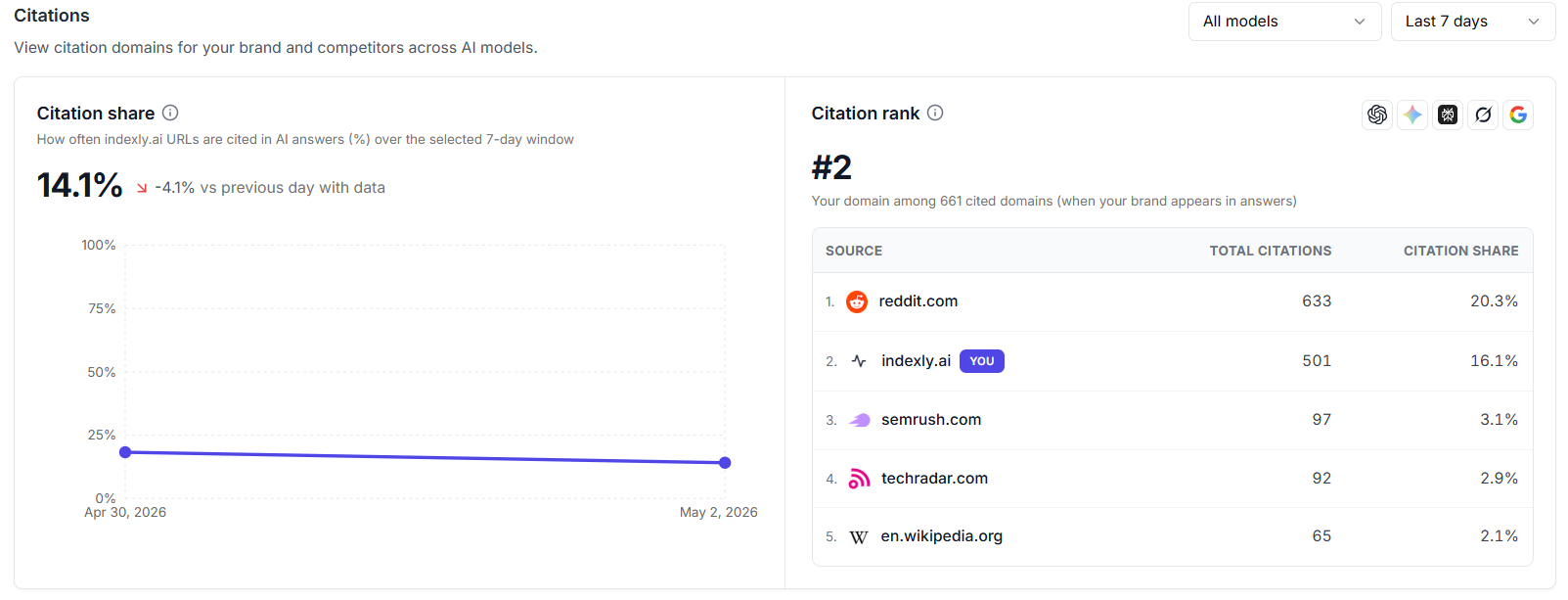
You can't improve what you don't measure. Instead of manually checking AI responses, use a platform like Indexly to monitor how your brand appears across Google and AI search platforms.
Start by tracking baseline metrics such as how often your brand is mentioned, how frequently you appear in competitor comparisons, and the overall sentiment of those mentions.
Set up monitoring for 20–30 high-intent prompts that reflect how customers actually search for solutions in your category.
Track your visibility across multiple AI platforms including ChatGPT, Claude, and Perplexity AI, since each model retrieves and cites information differently.
Focus not only on how often your brand is mentioned, but also on the context of those mentions.
Finally, keep a close eye on competitor visibility to uncover emerging trends, positioning strategies, and new opportunities to improve your AI search presence.
Read: What Are AI Citations? How to Find Which Pages ChatGPT and Perplexity Cite
Step 7: Scale Your Visibility Through Systematic Processes
Achieving AI visibility is exciting. Maintaining it is where the real work happens. AI models and their training data are constantly evolving, which means you can't just set things up once and walk away.
A systematic approach ensures you can adapt and maintain your presence over the long term, turning your initial success into sustained competitive advantage.
How to Do It
Maintain a consistent publishing schedule focused on authoritative content in topics where you want stronger AI citations. Review your AI citation performance monthly or quarterly to identify trends, gaps, and high-performing pages.
Engage regularly in communities like Reddit and industry forums to build authentic visibility and trust signals over time.
At the same time, strengthen relationships with journalists, bloggers, and niche publications to increase mentions across trusted sources.
Monitor brand mentions closely and respond quickly to negative discussions or misinformation before they influence AI-generated narratives.
Continuously refresh your best-performing content to keep it accurate, relevant, and citation-worthy.
Most importantly, track which topics, formats, and strategies generate the strongest AI visibility and scale the approaches that consistently work.
Read: Where AI Cites Reddit for Fintech & B2B Research — April 2026
What to Do After Building Your AI Citation Foundation
Conclusion
Getting cited in ChatGPT is becoming a major competitive advantage in the AI search era. Brands that build clear positioning, authoritative content, and strong trust signals across the web are far more likely to appear in AI-generated recommendations.
Success is no longer just about ranking on Google — it’s about becoming a source AI systems trust enough to reference.
If you want to understand where your brand currently stands, Indexly helps you track AI citations, monitor visibility across platforms like ChatGPT and Perplexity, and uncover opportunities where competitors are being mentioned instead of you.
FAQ
How to Get Cited in ChatGPT?
Build strong digital authority through structured, high-quality content, consistent brand messaging, trusted mentions, and authentic community engagement. AI systems prioritize brands that appear credible across multiple reliable sources.
Does ChatGPT cite sources and how does it choose them?
Yes, ChatGPT can cite sources depending on the query and browsing context. Citations are influenced by authority, freshness, entity clarity, and consensus across trusted websites rather than traditional SEO rankings alone.
Why does ChatGPT cite Reddit so frequently?
AI systems value Reddit because it contains authentic, experience-driven discussions. Consensus and real user opinions often carry more weight than polished marketing copy.
How to rank in ChatGPT compared to traditional Google SEO?
Ranking in ChatGPT is less about optimizing a single page and more about building broad authority across multiple trusted sources. AI systems look for consistent signals and industry consensus.
What tools to track ChatGPT citations and AI search performance?
Tools like Indexly, Otterly AI, and Peec AI help track AI mentions, citation share, sentiment, and visibility across platforms like ChatGPT, Claude, and Perplexity.
How long does it take to see results from ChatGPT optimization efforts?
Initial improvements can appear within 1–3 months, while stronger AI visibility and consistent mentions typically take 3–12 months of sustained authority building.