
AI-referred sessions surged 527% in just a few months, turning AI traffic analyzer tools into a critical part of modern analytics as users increasingly discover websites through platforms like ChatGPT, Claude, Perplexity, and Gemini instead of traditional search engines.
AI traffic analyzer tools are becoming essential because much of this AI-driven traffic is still misclassified or hidden inside tools like Google Analytics, making it difficult for businesses to measure its real impact.
In this blog, we will discuss how AI traffic is generated, how AI traffic analyzers detect and classify it, why AI traffic is often misattributed in analytics platforms, and how businesses can accurately track AI-driven visits, conversions.
What is AI Search Traffic?
AI search traffic refers to users who land on a website after an AI system surfaces, recommends, cites, or references its content.
This traffic is generated through AI chat platforms like ChatGPT, Claude, and Gemini, as well as AI-powered search tools like Perplexity that provide answers with embedded links and citations.
What makes AI search traffic different from traditional search traffic is that discovery happens through AI-generated responses instead of standard search engine result pages or direct browsing.
As AI-powered discovery grows, businesses are increasingly trying to understand how much traffic comes from AI platforms, how users behave after arriving, and how AI-driven visits compare to traditional organic search traffic.
1.08% of website traffic comes from LLMs (ChatGPT, Perplexity, Claude, Gemini) based on analysis of 3.3 billion sessions
What is an AI Traffic Analyzer?
AI traffic analyzers help businesses track, classify, and analyze traffic generated through AI platforms.
They typically:
- Detect traffic from AI platforms using referrer and user-agent signals
- Separate AI-driven visits from organic, direct, and referral traffic
- Track user engagement from AI-sourced visits
- Measure conversions influenced by AI recommendations
- Identify content that receives AI-driven visibility or citations
By doing this, they help businesses understand the growing role of AI in website discovery.
Now that we know what these tools do, let’s break down how AI traffic is actually detected at a technical level.
How does AI Traffic Analysis actually work?
AI traffic analysis works by combining multiple detection and attribution methods to identify traffic generated from AI platforms.
It separates AI-driven visits from Organic, Direct, and Referral traffic using layered detection systems and behavioral modeling.
Detection Layer Architecture
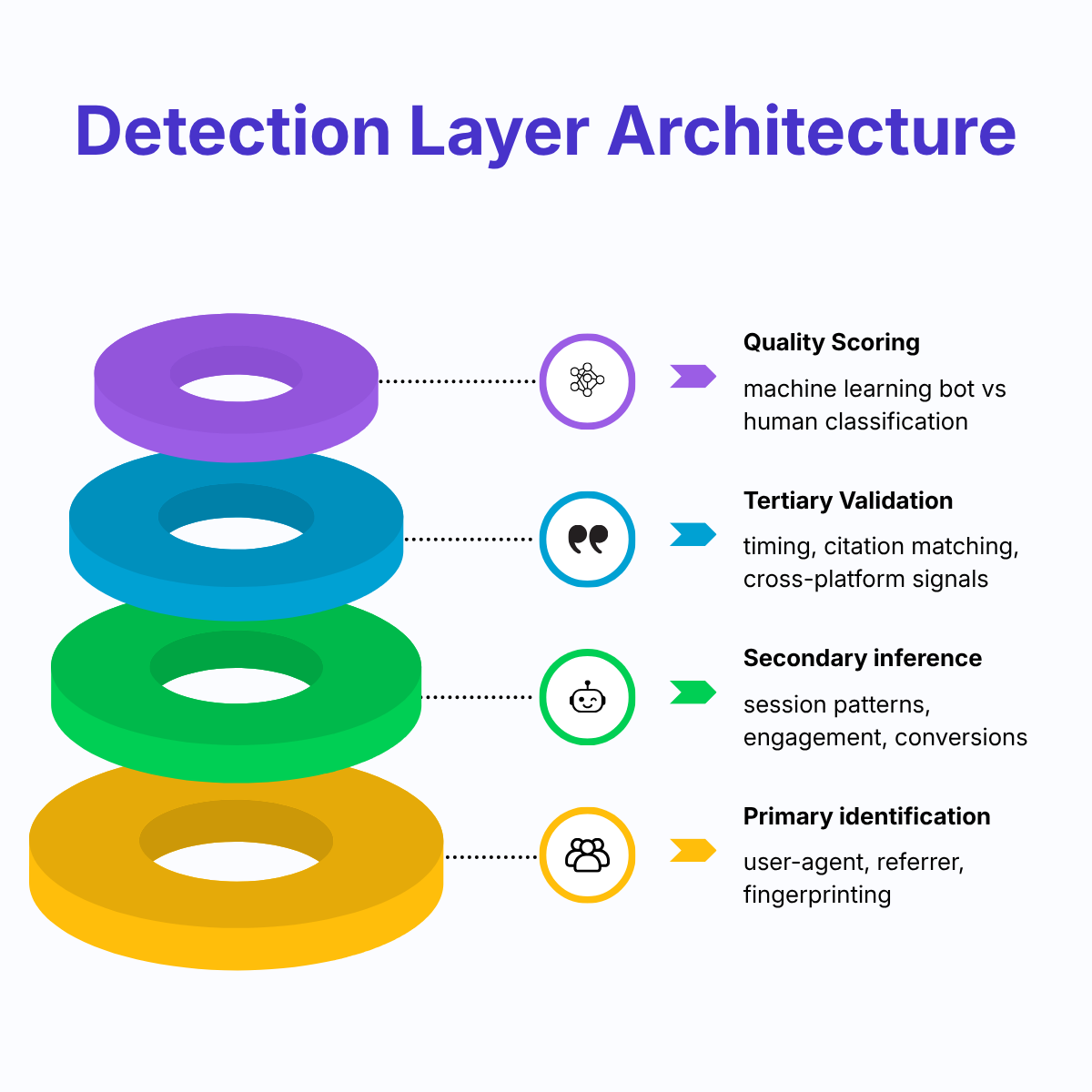
AI traffic is identified through multiple detection layers that work together to improve accuracy.
Primary identification
AI traffic is detected using user-agent strings, referrer headers, and behavioral fingerprinting.
Secondary inference
Systems analyze session patterns, engagement metrics, and conversion behavior to identify unattributed AI referrals.
Tertiary validation
Timing analysis, citation matching, and cross-platform correlation are used to confirm AI-driven visits.
Quality scoring
Machine learning models separate real human AI referrals from automated bot traffic.
After detection, the next step is turning raw signals into structured analytics data that businesses can actually use.
Data Processing Workflow
AI traffic analysis systems process and classify traffic in real time to ensure accurate attribution.
- Real-time classification separates AI traffic into a dedicated “AI Search” channel
- Attribution modeling tracks multi-touch journeys influenced by AI systems
- Conversion tracking measures how AI visitors move through funnels
- Citation correlation connects AI-generated mentions to traffic spikes
Since every AI platform behaves differently, attribution methods also need to be platform-specific.
Platform-Specific Analysis Methods
Different AI platforms behave differently in how they pass referral data, requiring platform-specific tracking strategies.
ChatGPT tracking
ChatGPT often includes clickable citations that enable direct referral tracking.
Google AI Overviews
Traffic from AI Overviews is typically grouped under standard organic or Google traffic.
Perplexity patterns
Perplexity sometimes passes referrer data and sometimes does not, requiring behavioral inference.
Multi-platform correlation
Advanced systems combine timing, engagement patterns, and cross-platform signals to detect AI-influenced sessions.
Once tracking methods are clear, it’s important to separate the two main types of AI-generated traffic.
ChatGPT accounts for 78.16% of all AI chatbot referrals; Gemini is second at 8.65%, Perplexity at 7.07%, Claude at 2.91%
What's the Difference Between AI Bot Traffic and AI Referral Traffic?
AI traffic is generally categorized into two types: provider-side fetch (bots) or real clickthrough visits (humans).
| AI Bot Traffic | AI Referral Traffic |
|---|---|
| Generated by automated AI crawlers and fetcher bots | Generated by real users clicking links in AI-generated answers |
| No human interaction involved | Human-driven visits with real intent |
| Used for training models or retrieving content | Used for research, comparison, or transactions |
| Does not generate direct conversions or revenue | Often delivers high-converting traffic |
| Usually identified through bot user-agents and server logs | Tracked through referrals, GA4, and AI analytics tools |
| Includes bots like GPTBot, ClaudeBot, and PerplexityBot | Includes traffic from ChatGPT, Claude, Gemini, and Perplexity citations |
| Helps influence future AI visibility and citations | Directly impacts engagement, leads, and sales |
| Considered machine activity | Considered real website traffic |
Understanding this distinction is critical before analyzing why companies are now actively investing in AI traffic tracking.
Why are Companies Tracking AI Traffic now?
Companies are prioritizing AI traffic tracking because AI-generated referrals are often small in volume but extremely high in value.
Even when AI traffic is lower than traditional organic search, it can produce significantly higher conversion rates due to stronger user intent.
AI users typically arrive after receiving a pre-answered recommendation from systems like ChatGPT, Claude, Gemini, or Perplexity, which makes their click-through behavior more deliberate and high-intent.
This shift is not happening in isolation — it is part of a broader transformation in digital discovery and attribution.
Market Shift Driving Adoption
The adoption of AI traffic tracking is being driven by a clear shift in how discovery and revenue attribution are changing across digital channels.
Revenue impact priority
Businesses may lose up to 30% of organic search traffic while gaining AI citations that convert at significantly higher rates, sometimes up to 4.4x higher, resulting in equal or higher total revenue.
Competitive intelligence shift
A brand can appear as the top recommendation in one AI system like Gemini, be absent in ChatGPT, and be ranked differently in Perplexity within the same period, requiring multi-platform monitoring.
Future-proofing strategy
Traffic from AI-powered search experiences is expected to surpass traditional organic search traffic by 2028, and this shift may accelerate if AI-first search interfaces expand further.
Attribution accuracy gap
Many companies observe a significant rise in “direct” traffic, sometimes around 126% year-over-year, which is often caused by AI traffic being misattributed in analytics systems.
Business Driver | Impact Level | Timeline | Action Required |
|---|---|---|---|
Revenue concentration | High | Immediate | Track conversion rates |
Traditional traffic decline | Medium | 6-12 months | Diversify channels |
Brand visibility shifts | High | Ongoing | Multi-platform monitoring |
Attribution gaps | Medium | Immediate | Upgrade analytics |
Competitive advantage | High | 3-6 months | Early optimization |
Even with this growth, tracking AI traffic correctly remains one of the most challenging parts of modern analytics.
"By 2026, traditional search engine volume will drop 25%, with search marketing losing market share to AI chatbots and other virtual agents." -Gartner
Common Mistakes When Tracking AI-Generated Traffic for a Content Site
The most significant challenge in tracking AI-generated traffic is that standard analytics tools like Google Analytics 4 often misclassify it.
This creates fragmented attribution, where AI traffic cannot be reliably isolated or measured.
As a result, content sites frequently underestimate the true impact of AI-driven discovery.
Attribution and Classification Errors
- Relying solely on referrer data
Reporting AI traffic using only GA4 referrer data leads to undercounting because AI referrals are often partially hidden or misattributed. - Ignoring dark traffic signals
An estimated 70.6% of AI referral traffic is not directly visible in GA4 and is often classified as “direct” traffic instead. - Single-platform focus
Organizations often analyze only one AI model, such as ChatGPT, while ignoring differences in Perplexity, Gemini, and other systems. - Mixing bot and human traffic
Combining automated AI crawlers and real user clickthrough traffic distorts conversion and engagement analysis.
Measurement Setup Mistakes
Default analytics configuration
Traditional analytics depends on referrer data, which is often inconsistent across AI platforms.
Bot filter misconfiguration
Incorrect filtering rules or privacy settings can unintentionally remove valid AI referral traffic.
Inconsistent tracking periods
Short analysis windows fail to capture long-term AI traffic patterns and seasonal variation.
Common Mistake | Impact | Fix Complexity | Business Cost |
|---|---|---|---|
GA4-only tracking | 70% traffic invisible | Medium | High |
Bot/human mixing | Conversion rate dilution | Low | Medium |
Platform blind spots | Competitive disadvantage | High | High |
Attribution gaps | Budget misallocation | Medium | Very High |
Many of these issues come from deeper strategic and technical misalignments, not just tracking errors.
Content Strategy Misalignment
- Keyword-centric optimization: Optimizing only for Google misses how platforms like Perplexity AI Perplexity rank and cite content differently.
- Quality signal ignorance: Publishing unedited AI-generated content creates thin, repetitive pages that lose visibility.
- Citation tracking blindness: AI visibility requires dedicated citation tracking beyond traditional SEO analytics.
"Many business websites are now invisible in AI search because large language models rely on structured data, authority signals, entity clarity, and topical depth."
To understand why this matters even more, we need to compare AI traffic directly with traditional search analytics.
What’s the Difference Between AI Traffic and Organic Search Traffic Analytics
Traditional organic search analytics measures traffic from search engines such as Google and Bing, where users search keywords and click on standard search results.
AI traffic analytics measures visits from AI-powered platforms such as ChatGPT, Claude, Perplexity, and AI-generated search experiences like AI Overviews.
U.S. organic search traffic dropped 2.5% YoY (Jan 2026); publisher Google traffic fell 38% YoY .
Key difference: user intent
The main difference between the two traffic types is user intent.
Traditional search traffic is generally exploratory and keyword-driven.
AI referral traffic is typically research-driven and high-intent.
Users coming from AI platforms often receive summarized answers or recommendations before clicking a link, which makes them more qualified visitors.
Attribution differences
Attribution works differently across the two systems.
Organic search traffic is easier to measure because search engines consistently pass referral data.
AI platforms often strip, reroute, or inconsistently pass attribution signals.
As a result, AI traffic is frequently misclassified as “Direct” traffic in tools like Google Analytics 4.
Behavior and performance differences
AI traffic and organic traffic also differ in user behavior and scale.
- Organic search still drives significantly higher overall traffic volume
- AI traffic is growing rapidly but remains smaller in share
- AI visitors tend to spend more time on site
- AI visitors often show higher engagement and conversion rates
| Traffic Source | Traffic Volume | User Intent | Attribution Accuracy | Conversion Quality |
|---|---|---|---|---|
| Traditional Organic Search | Very High | Broad and exploratory | High | Standard |
| AI Referral Traffic | Lower but growing | High-intent and research-driven | Inconsistent | High |
| AI Overviews | Embedded in search | Mixed intent | Limited visibility | Medium-High |
| Dark AI Traffic | Hidden or unattributed | High-intent | Low | High |
Once the differences are clear, the final step is understanding what metrics actually matter when analyzing AI traffic performance.
What Metrics Should I Be Tracking for AI Search Traffic as a Content Creator?
As AI-powered discovery grows, tracking the right metrics is essential for understanding performance.
Key metrics include:
- Traffic from AI platforms such as ChatGPT, Claude, Gemini, and Perplexity
- Engagement metrics such as session duration and interaction depth
- Conversion rates from AI-referred visitors
- Citation and mention frequency in AI-generated responses
- Assisted conversions influenced by AI discovery
Comparison with traditional organic search is also important to understand relative performance and attribution gaps.
Conclusion
AI traffic is becoming a significant source of website discovery, but it is still often misclassified by traditional analytics tools.
Because platforms like ChatGPT, Claude, Perplexity, and Gemini do not consistently pass referral data, AI-driven visits are frequently recorded as direct or organic traffic, creating a major attribution gap.
As AI search grows, tracking this traffic is essential for understanding real acquisition channels, improving attribution accuracy, and measuring AI-influenced conversions.
Want to track AI search traffic from ChatGPT, Perplexity, Claude, and Gemini more accurately? Tools like Indexly help businesses identify AI-driven visits, attribution gaps, and AI-powered conversions.
FAQs
Do AI chatbots actually send real visitors to websites?
Yes, but at much lower volumes than traditional search. Click-through rates are low, but the traffic is highly intent-driven and often converts better because users click after receiving an AI-generated answer.
How much traffic do websites actually get from AI search engines?
AI traffic currently represents a small share of total website traffic but is growing rapidly. A significant portion is also misclassified as direct traffic due to missing referral data.
Why do people say AI traffic is growing so fast?
AI adoption is increasing across search and research behavior. Users rely on AI tools for faster answers and recommendations, leading to more high-intent referral visits over time.
How can I track AI traffic if it's invisible in Google Analytics?
AI traffic can be tracked by combining referrer detection, custom channel grouping, and behavioral signals in Google Analytics. Since many AI platforms do not pass consistent referral data, advanced setups also use tagging rules and AI-specific filters to separate AI-driven visits from direct traffic.
Does Indexly track traffic from ChatGPT?
Yes. Indexly helps detect and attribute traffic coming from AI platforms like ChatGPT by identifying AI-specific referral and behavior signals.
How do I track traffic coming from AI search engines?
AI search traffic is tracked by identifying referrals and patterns from platforms like ChatGPT, Claude, Perplexity, and Gemini. This is typically done using analytics tools like Indexly.
Is there any AI Traffic Analyzer for SaaS SEO Managers tracking brand mentions in ChatGPT?
Yes. AI traffic tools track brand mentions, citations, and referrals from ChatGPT, Claude, Perplexity, and Gemini. Tools like Indexly also connect AI visibility with traffic and conversions.
What's the best way to monitor AI traffic to your website?
Use a mix of GA4 referrer tracking, custom “AI Search” channels, UTMs, server logs, and AI analytics tools. This helps capture AI traffic that is often hidden in “Direct.”
Are there any Indexly alternatives for monitoring AI search engine traffic?
Yes—GA4, Looker Studio, and server logs can help, but they are limited. Most tools don’t fully support AI citation tracking. Indexly is purpose-built for AI traffic and visibility tracking.