
If your business isn't cited in AI-generated responses, you effectively don't exist for that user's query. Tools like Claude, ChatGPT, and Perplexity are now deciding which brands get mentioned directly in answers, not just which ones rank on Google.
Only 16% of brands systematically track AI search performance across platforms like Claude, Perplexity, and ChatGPT. The other 84% are either completely unaware of their AI visibility gap or lack a coherent methodology to measure and close it.
Claude, in particular, does not rely only on traditional SEO signals. It prioritises external validation, content structure, and entity consistency across the web.
To improve your chances of being cited, you need to optimise for how AI systems retrieve, interpret, and trust information.
For deeper context on how AI citations work differently from traditional search, see why your site might not be cited in ChatGPT. You might also find it helpful to understand how AI citations differ from Google search results, backlinks, and featured snippets, and to compare how Gemini, ChatGPT, and Perplexity handle citations differently.
Step 1: Make Your Website Fully Accessible to AI Crawlers
The first step is ensuring AI systems can actually access your content.
Many websites unintentionally block crawlers through robots.txt, CDNs, or firewall rules. If AI systems cannot access your pages, they cannot cite them.
You should ensure that important pages return proper status codes, are not hidden behind scripts, and are accessible without restrictions. Technical accessibility is the foundation—without it, nothing else matters.
Here's something that surprised us: research shows 79% of sites block at least one AI training bot, but 71% of those same sites also block at least one retrieval or search bot.
Step 2: Structure Content for Easy Extraction
Once your site is accessible, the next priority is making your content easy for AI systems to extract, interpret, and reuse.
Claude does not evaluate pages as a whole. They extract specific segments of text that directly match user intent.
To improve citation likelihood, your content should follow a simple but strict structure framework designed for machine readability.
1. One Idea Per Paragraph
Each paragraph should communicate only one concept. When multiple ideas are combined, extraction becomes less reliable because the model cannot isolate a clean answer unit.
A single paragraph should be understandable even when removed from its surrounding context. This increases its likelihood of being selected as a citation-ready passage.
2. One Intent Per Section
Each section should address a single user intent or question. Mixing informational, procedural, and promotional content in the same section reduces clarity for retrieval systems.
When a section has one clear intent, AI systems can confidently map it to a specific type of query. This improves both relevance matching and citation probability.
3. Early Signal Placement
Key information should appear at the beginning of each section rather than being delayed or buried.
AI systems tend to prioritise early sentences when determining relevance and summarising content. The first few lines of a section often carry more weight than supporting details later in the paragraph.
This means the main answer or insight should always appear first, followed by explanation or context.
4. Direct Heading Mapping
Headings should clearly describe the exact question or concept being answered. Abstract or creative headings reduce retrieval accuracy because they do not map cleanly to user queries.
A strong heading structure helps AI systems align content with search intent more precisely, improving section-level citation matching.
5. Neutral, Extractable Language
Language should remain factual, direct, and informational. Overly promotional or ambiguous phrasing reduces the likelihood of citation because it is harder to interpret as a reliable knowledge source.
AI systems prefer content that reads like a clear explanation rather than a marketing message.
Research shows 86.7% citation overlap between Claude's responses and Brave Search top results, meaning your Brave Search visibility determines your Claude citation eligibility far more than your Google rankings ever will.
Step 3: Build Strong External Validation Signals
AI systems do not trust self-referential content as strongly as they trust third-party mentions.
If your brand only appears on your own website, it is harder for models to treat it as authoritative. When your brand is mentioned across review platforms, industry publications, forums, and independent articles, it becomes more trustworthy.
This includes listings on review sites, mentions in editorial content, and real user discussions in communities. The more consistent these references are, the easier it is for AI systems to recognise your brand as a single, reliable entity.
External validation is one of the strongest drivers of AI citations.
Step 4: Ensure Entity Consistency Across the Web
AI systems rely heavily on entity recognition. This means they try to understand whether different mentions across the web refer to the same brand.
If your brand name, descriptions, or positioning vary too much across platforms, it becomes harder for AI to unify those signals.
Consistency across your website, directories, social platforms, and third-party mentions improves the likelihood that AI systems will correctly identify and cite your brand.
Think of it as making your brand easy to “recognise everywhere it appears.”
Step 5: Monitor and Track Claude AI Citations Using Indexly
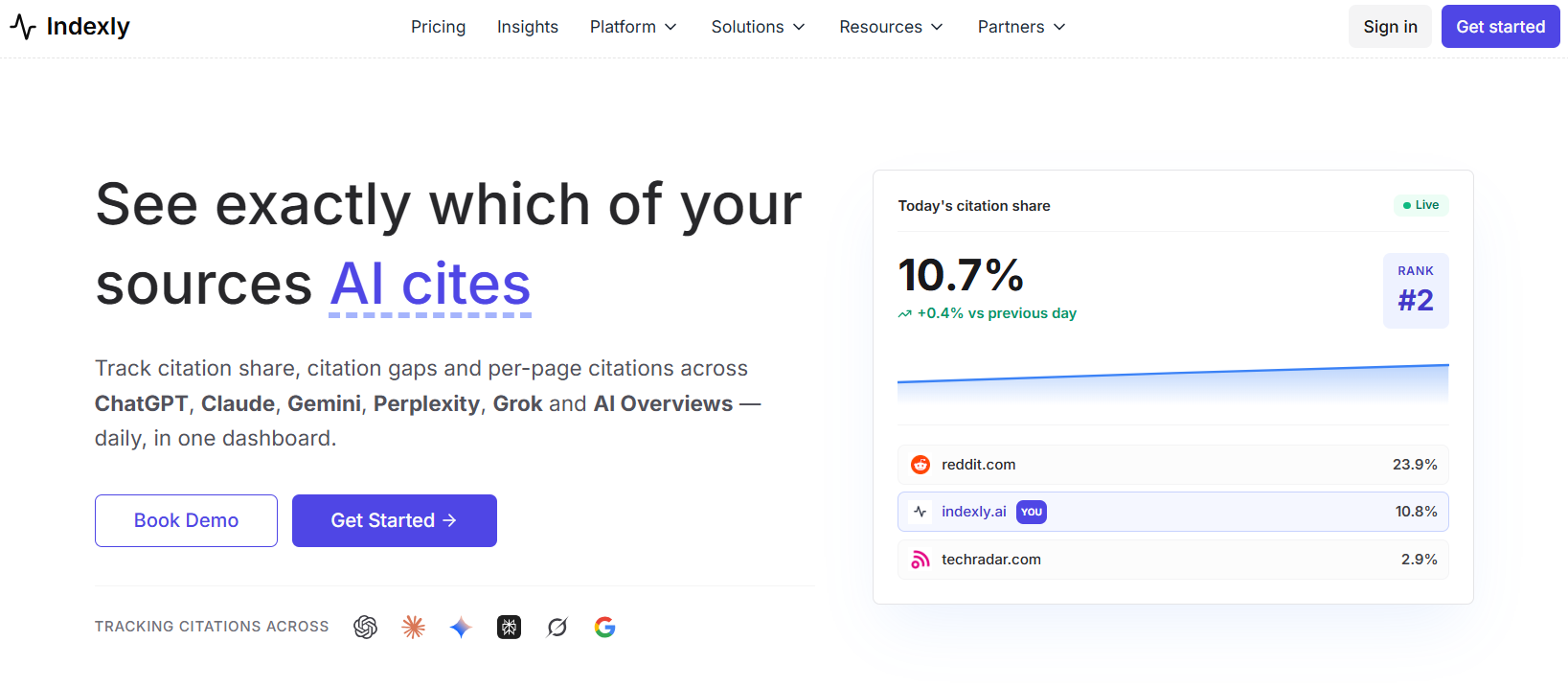
Indexly is the AI Citation Tracker that analyses data at both the domain and URL level. It reveals which pages from your site are being referenced, along with “Citation Gaps” that show competitor domains appearing instead of yours.
You can also view “My Page Citations” to identify exactly which URLs are being picked up by AI systems.
How to do it?
- Connect your website in Indexly AI
- Open the AI Citation Tracker
- Check citation data across models like ChatGPT, Perplexity, and Gemini
- View “Citation Share” to see how often you appear in AI answers
- Use “Citation Rank” to compare against competitors
- Explore “Citation Gaps” to find missing visibility opportunities
- Check “My Page Citations” for exact URLs being referenced
- Filter by model, date, and page for deeper insights
- Use findings to improve content and AI visibility
What Success Looks Like
When optimised correctly, your brand begins appearing consistently in AI-generated answers across multiple platforms. Not because it ranks highest in search engines, but because it is easy to understand, widely validated, and consistently represented across the web.
AI systems start treating your content as a reliable reference source for specific topics.
Conclusion
Claude AI citations represent a major shift in how online visibility works. Instead of ranking pages, AI systems now decide which brands are worth mentioning in generated answers.
To succeed, you need to move beyond traditional SEO and focus on:
- Strong external validation
- Clean technical accessibility
- Structured, extractable content
- Consistent brand identity across the web
Brands that adapt early will dominate AI-driven discovery. Those that don’t will gradually disappear from how users find information altogether.
FAQs
What are Claude AI citations?
Claude AI citations are references used in AI-generated answers that point to external sources. They depend on content clarity, authority signals, and third-party validation rather than traditional SEO rankings.
Why isn’t my website appearing in Claude AI responses?
Most websites fail to appear because they lack structured, extractable content, strong external validation, or visibility in search indexes used by AI systems like Brave Search.
How long does it take to get cited by AI systems?
Technical improvements can show results in 2–6 weeks, while authority-building efforts typically take several months to influence citations consistently.
Can I optimise for AI citations without harming SEO?
Yes. In most cases, improving structure, clarity, and authority signals helps both traditional SEO and AI visibility.