
Consumers are increasingly using AI tools like ChatGPT, Gemini, Claude, and Perplexity to research products, compare vendors, and evaluate companies before making purchasing decisions. Instead of visiting multiple websites, users now ask direct questions such as “What’s the best CRM for startups?” or “Is this cybersecurity company reliable?” In many cases, the AI-generated response becomes a consumer’s first impression of a brand.
67% of B2B buyers prefer a rep-free buying experience.(Gartner)
This shift is reshaping online reputation management. Unlike traditional search engines that display links, AI systems synthesize information from multiple sources into a single narrative. As a result, AI-generated summaries can significantly influence trust, perception, and buying behavior — especially in B2B markets where buyers increasingly rely on self-service research.
Conversations on platforms like Reddit, LinkedIn, review websites, and industry forums are becoming more influential because they contribute heavily to AI-driven brand perception.
Community-driven trust signals are becoming more influential in shaping brand growth. (Gartner)
How do AI Assistants form Opinions about Brands?
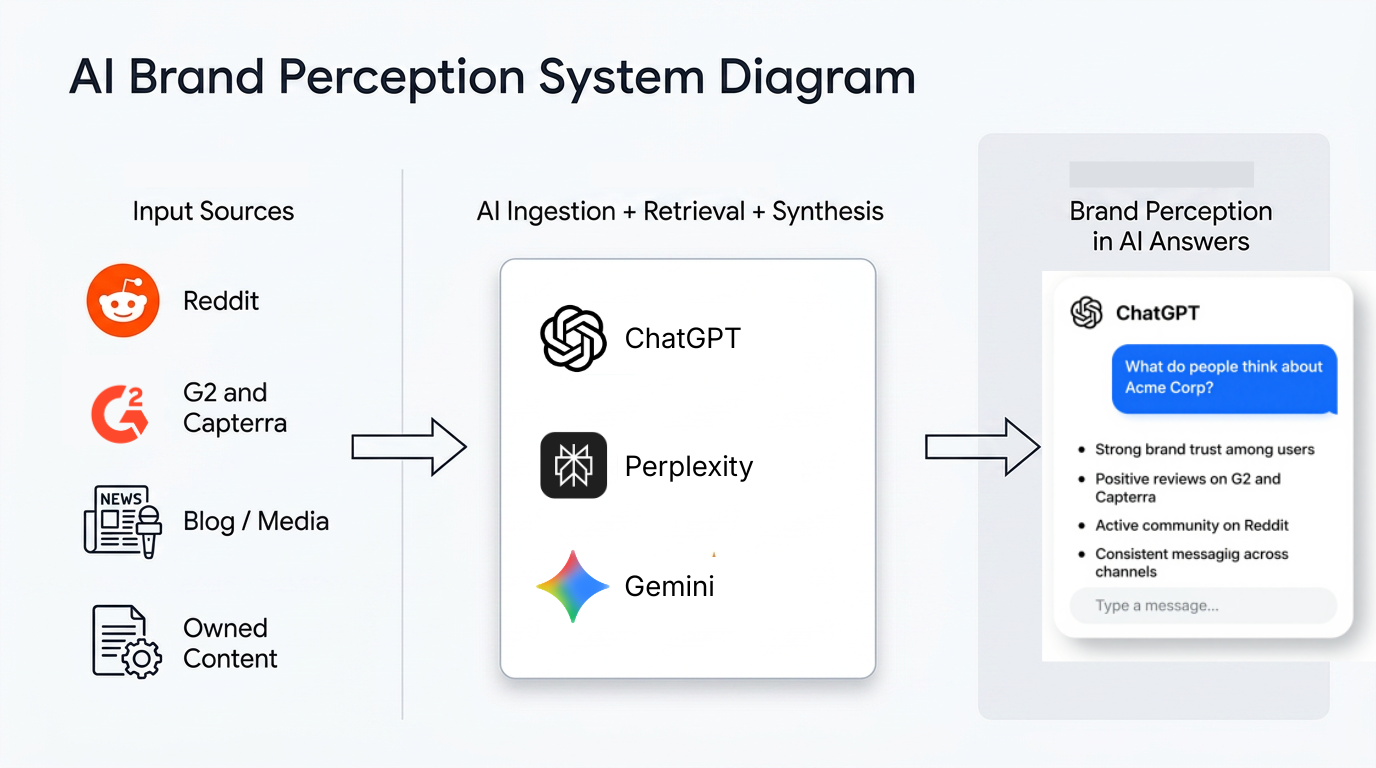
AI assistants develop brand perceptions by analyzing large volumes of publicly available content, including customer reviews, articles, blogs, forums, and social media discussions. They detect recurring themes, patterns, and brand sentiment associated with companies over time. For example, Apple is frequently associated with innovation and premium design, while Toyota is commonly linked to reliability and trustworthiness. These associations are based on data patterns rather than personal opinions.
AI-generated responses are also shaped by alignment training, safety policies, and real-time information sources that encourage balanced and evidence-based outputs. Companies with a stronger online presence and larger volumes of public discussion — such as Google and Amazon — provide AI systems with richer context and clearer brand sentiment signals. As AI-powered search and discovery continue to grow, brands will need to actively monitor how AI systems interpret and represent their business online. This blog explains how to improve your brand sentiment in five steps.
45% of B2B buyers already use AI during purchasing journeys. (Gartner)
5 Steps to Enhance your Brand Sentiment
Step 1: Audit Current AI Sentiment
Before improving AI brand sentiment, establish a baseline of how AI platforms currently describe your brand. This helps identify visibility gaps, recurring themes, and competitor positioning across different customer queries.
What to Do
Test your brand across the AI platforms most relevant to your audience, including: ChatGPT, Perplexity, Google AI Overviews, Gemini, Claude, and Copilot.
Build a prompt library using real customer-style searches:
- “What’s the best CRM for startups?”
- “Compare [your brand] vs [competitor].”
- “Best tools for [specific use case]?”
Run queries in fresh chat sessions or incognito mode to reduce personalization bias.
For each response, track:
- sentiment (positive, neutral, negative)
- competitor positioning
- missing features or strengths
- outdated or inaccurate information
Calculate a Net Sentiment Score (NSS) by comparing positive vs negative mentions across prompts and platforms.
90% of consumer brands show a negative sentiment skew in AI-generated answers. (Pulp Strategy)
Brands managing this at scale can use tools like Indexly to automate prompt testing, track AI sentiment trends, monitor visibility across models, and identify negative brand associations.
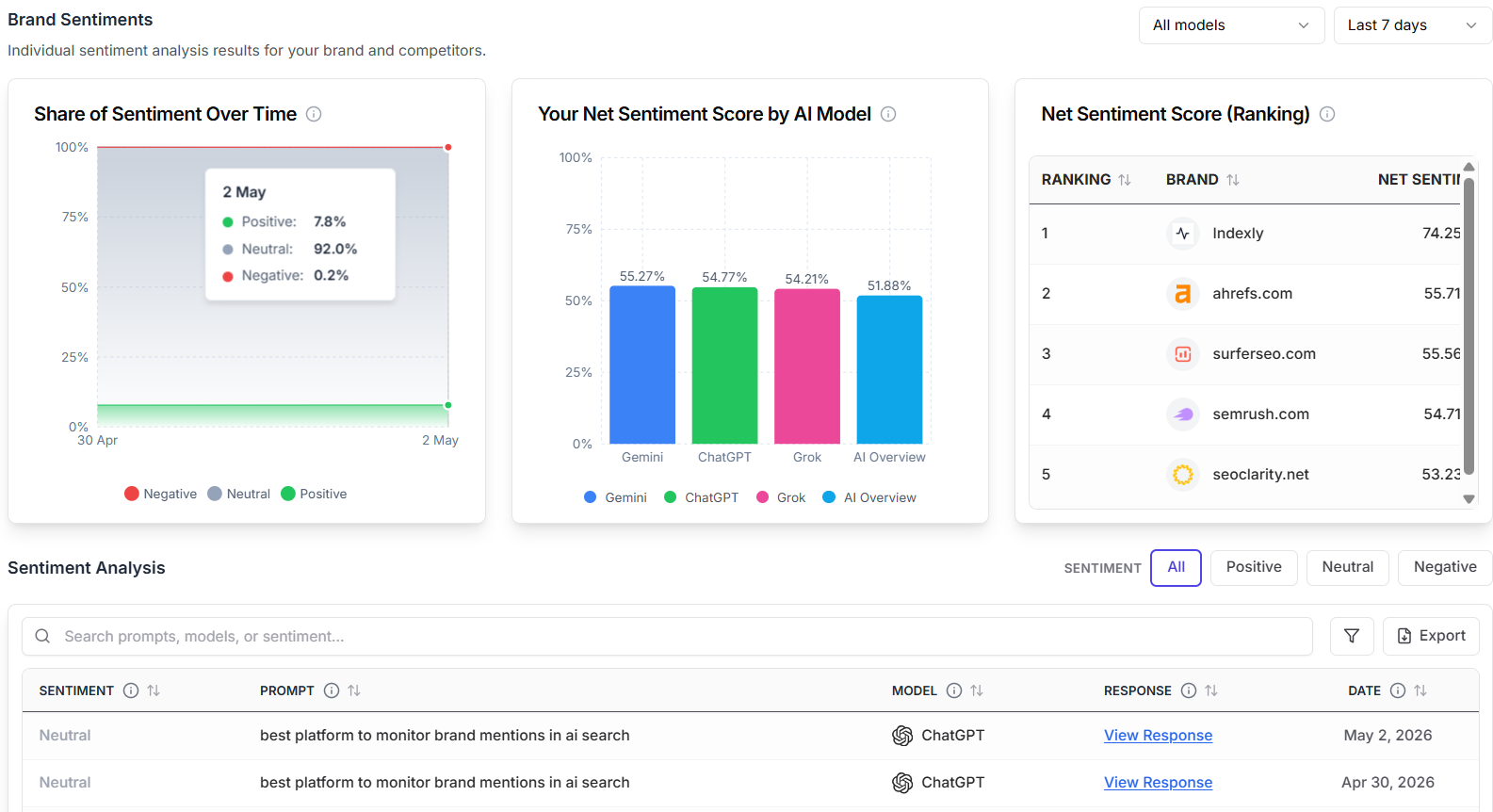
Example Audit Table
| Platform | Query | Sentiment | Position | Key Issue |
|---|---|---|---|---|
| ChatGPT | “Best CRM for startups” | Neutral | 3rd | Weak feature positioning |
| Perplexity | “CRM integration with Slack” | Not Mentioned | N/A | Missing integration visibility |
| Gemini | “What is [Brand]?” | Positive | 1st | Outdated pricing info |
Success Signal
You have a clear baseline showing:
- how AI systems describe your brand
- where competitors outperform you
- which inaccuracies or visibility gaps need improvement
Step 2: Map Source Attribution
What to do
Once you understand how AI systems describe your brand, the next step is identifying why those perceptions exist. AI models rely heavily on external sources like articles, forums, review sites, and industry publications to generate responses. Your goal is to map exactly which sources influence those outputs.
Start by analyzing citation patterns across AI platforms such as ChatGPT, Perplexity, and Google AI Overviews. Tools like Indexly, Conductor, or OtterlyAI can help surface which domains are most frequently referenced in AI-generated answers for your category.
What to focus on
Look for repeating patterns across:
- Reddit and community discussions (often highly influential in AI responses)
- Industry blogs and comparison sites
- Review platforms like G2 or Capterra
- Earned media coverage in publications
- Competitor mentions that consistently appear in answers
You’re not just collecting links — you’re building a map of what shapes perception.
Read: 11 Best AI Citation Tracking Tools for B2B Marketing Teams (UPDATED 2026)
Step 3: Fix Content Accuracy Issues
What You’re Doing
Once you know where AI gets its information, the next step is correcting anything outdated, inconsistent, or misleading. AI systems heavily rely on publicly available brand information, especially owned content and high-authority third-party sources.
Start with your own digital footprint — website pages, product documentation, pricing, and case studies should reflect your current positioning clearly and consistently.
Then expand outward to third-party platforms such as LinkedIn, Crunchbase, Wikipedia, and major review sites. Even small inconsistencies across these sources can distort AI-generated summaries.
Key areas to improve
Focus on:
- outdated pricing or feature descriptions
- inconsistent company positioning across platforms
- missing or unclear product information
- weak or unstructured content that AI can’t easily interpret
You should also implement structured data (schema markup) so AI systems can extract accurate information more reliably.
Best Practices
| Best Practice | Why It Matters |
|---|---|
| Use the BLUF method | Present the most important information first so AI systems can quickly identify and extract key facts without scanning long explanations. |
| Optimize for scannability | Use short paragraphs, bullet points, headings, and bold text to make content easier for both users and AI models to process. |
| Address misconceptions directly | Create FAQs, blog posts, or help pages that clarify negative themes, outdated information, or inaccuracies discovered during your AI sentiment audit. |
Outcome
Over time, AI-generated responses begin reflecting updated, consistent, and accurate information about your brand instead of outdated or incomplete data.
Step 4: Optimize Reddit Presence for AI Citation
What You’re Doing
Reddit plays a disproportionately large role in AI-generated answers because it contains high-density, real-world user discussions. Many AI systems treat it as a trusted signal for sentiment and product feedback.
The goal here is not promotion — it’s participation. You want your brand to appear naturally in relevant discussions where users are already asking questions about your category.
Start by identifying high-impact subreddits and recurring threads using tools like GummySearch or Brandwatch. Then observe how your category is being discussed and where sentiment gaps exist.
How to improve presence
Focus on:
- contributing helpful, non-promotional insights
- answering real user questions with expertise
- addressing misconceptions or outdated claims
- participating consistently in relevant discussions
- tracking how your brand is referenced over time
Avoid anything that feels like marketing — Reddit is extremely sensitive to it and will penalize it socially and algorithmically.
Outcome
Your brand begins appearing more naturally in relevant discussions, improving both community trust and AI citation signals.
Step 5: Secure Strategic Earned Media Coverage
What You’re Doing
AI systems heavily weight trusted third-party publications when forming brand summaries. This makes earned media one of the strongest levers for improving AI sentiment.
Your goal is to increase high-authority mentions in sources that AI systems already rely on for category understanding.
Focus on publications that cover your industry, product comparisons, and “best tools” lists, as these are frequently cited in AI-generated answers.
What to prioritize
Effective earned media typically includes:
- product launches or major updates
- original research or data reports
- thought leadership from executives
- customer success stories with measurable outcomes
- inclusion in comparison or roundup articles
Consistency matters more than volume — repeated presence in trusted sources compounds AI visibility.
Best Practices
| Best Practice | Why It Matters |
|---|---|
| Maintain consistent messaging | Ensure positioning is aligned across your website, social channels, and third-party coverage so AI systems receive clear signals. |
| Use measurable outcomes | Include metrics, ROI data, and quantified results in case studies and PR content to provide stronger AI-citable evidence. |
| Build long-term media relationships | Ongoing relationships with journalists and editors create more opportunities for future coverage and authority building. |
Step 6: Track Sentiment Changes and Iterate
What You’re Doing
I brand perception is not static — it changes as new content is indexed and new discussions emerge. This step ensures you continuously measure and refine your strategy based on real data.
Track how AI systems describe your brand across different platforms using a consistent set of prompts. Monitor changes in sentiment, visibility, and competitor positioning over time.
What to track
Focus on:
- sentiment shifts across AI platforms
- changes in brand visibility in responses
- which sources are newly influencing outputs
- competitor gains or losses in citations
- impact of PR, Reddit, and content updates
Tools like Indexly can automate much of this tracking across multiple AI models.
Best Practices
| Best Practice | Why It Matters |
|---|---|
| Maintain consistent tracking | Using the same prompts and scoring methodology ensures accurate long-term sentiment comparisons. |
| Set realistic expectations | Meaningful AI sentiment improvements usually happen gradually over several months, not overnight. |
Outcome
You develop a clear feedback loop between actions (content, PR, community engagement) and AI perception changes.
Conclusion
AI search is changing how brands earn visibility, trust, and market influence. Instead of simply ranking webpages, AI platforms now summarize opinions, compare competitors, and shape buying decisions through generated responses. This makes AI sentiment an important part of modern brand and reputation strategy.
Brands that consistently appear with accurate, trustworthy, and positive positioning across AI systems will gain a stronger advantage as AI-assisted discovery grows. Platforms like Indexly help companies monitor sentiment trends, track AI citations, and understand how different AI models interpret their brand across the web.
FAQs
How do LLMs determine positive or negative brand sentiment?
LLMs determine brand sentiment by analyzing patterns in publicly available content such as reviews, articles, blogs, forums, social media discussions, and industry publications. They identify recurring themes like product quality, reliability, pricing, and customer support to form an overall perception of a brand. This is based on statistical patterns, not human opinions.
What is AI Reputation Risk Monitoring for Global Brands?
AI reputation risk monitoring is the process of tracking how AI systems describe your brand across different prompts and platforms. It helps identify negative sentiment, misinformation, visibility gaps, and competitor positioning in AI-generated answers.
How to respond when an LLM describes your brand negatively?
The best approach is to identify the source of the negative information, such as outdated reviews, inaccurate articles, or biased discussions. Then improve the underlying content ecosystem by correcting errors, updating owned content, strengthening third-party coverage, and engaging in relevant communities. Improving source quality is more effective than trying to influence AI outputs directly.
How to audit AI sentiment for a company?
AI sentiment audits involve testing your brand across multiple AI tools using real buyer-style prompts (e.g., comparisons, “best tools” queries). Responses are analyzed for sentiment, accuracy, visibility, and competitor mentions to establish a baseline.
How to optimize for positive AI sentiment?
Optimizing AI sentiment requires improving the quality and consistency of information available about your brand. This includes updating website content, fixing outdated third-party listings, improving review sentiment, publishing authoritative content, earning media coverage, and participating in relevant online discussions.
How to Benchmark AI Brand Sentiment Against Competitors?
Benchmarking involves comparing how AI systems describe your brand versus competitors using the same prompts. Key metrics include visibility, sentiment, ranking position, citation sources, and recurring themes. This helps identify positioning gaps and competitive advantages.
What are the Hidden Signals Behind AI Brand Perception?
AI brand perception is shaped by multiple signals including review sentiment, Reddit discussions, media coverage, backlink authority, social engagement, and consistency of messaging across platforms. These signals combine to form the overall reputation reflected in AI-generated responses.
Why Brand Sentiment in ChatGPT and Gemini matters more than Google Rankings in 2026?
Because AI tools now surface direct answers instead of listing links, they shape brand perception using aggregated online opinions, making sentiment more influential than traditional search position.
How to track and improve Brand Sentiment across ChatGPT, Claude, and Perplexity?
Use consistent prompts on ChatGPT, Claude, and Perplexity to evaluate how your brand is portrayed and the sentiment behind it. Then refine perception by improving your content, fixing outdated external data, and strengthening reviews and authority signals so AI tools reflect a clearer, more positive brand image.
What are the Best AI tools for Reddit Brand Monitoring?
Reddit brand monitoring tools help track what people are saying about your brand and how those discussions influence AI-generated responses. Indexly offers AI-focused analytics and Reddit signal tracking to measure brand visibility in AI search. Brandwatch provides enterprise-level monitoring with large-scale conversation data, while Apify Reddit Monitor is a more affordable option for tracking mentions across subreddits. Tools like Brand24 and Mention also support real-time alerts and sentiment tracking across Reddit and other platforms.