

More people use AI models every day, which means prompts are increasing faster than keywords, and that shift is changing how digital content is planned, produced, and measured.
As teams scale AI-generated content across blogs, landing pages, and campaigns, it’s becoming clear that it’s no longer just about what content is created, but how it is instructed. The prompt behind the output is now just as important as the content itself.
Yet most organisations still don’t track prompts in a structured way. This creates limited visibility into why some content ranks, why some underperforms, and how brand voice is interpreted by AI systems. AI Prompt Tracking addresses this by turning prompts into a measurable layer of your content strategy—connecting inputs directly to SEO performance, AI visibility, and brand consistency.
In this blog, we will discuss what AI Prompt Tracking is, key metrics to measure it, and how startups and marketing teams can implement it to improve SEO outcomes and AI-driven visibility.
What is AI Prompt Tracking and Why should I care?
AI Prompt Tracking is the structured process of monitoring and improving the prompts used in generative AI tools to create content.
Instead of treating prompts as one-off instructions, they become a trackable layer in your content system—linked to outcomes like:
- Organic rankings
- AI-generated visibility
- Brand tone consistency
- Conversion performance
- Content production speed
In short: it connects what you ask AI to do with what actually happens after publishing.
What is the State of AI Prompt Tracking in 2026?
By 2026, AI prompt tracking has become a fundamental part of SEO and marketing analytics. Rather than relying solely on keyword rankings, companies now evaluate how often their brand appears in AI-generated answers and the context in which it is presented across different models, regions, and user situations. The key focus is AI visibility—whether the brand is mentioned, how it is described, and how it compares with competitors in conversational responses.
This has led to a more advanced way of measuring performance that includes signals such as entity recognition, authority perception, regional and persona-based variations, and changes in visibility over time.
To manage this, marketing teams combine prompt tracking tools, AI visibility platforms, and SEO analytics systems to understand how AI models interpret and surface their brand.
As a result, prompt tracking has become a core element in aligning SEO strategy, content planning, and overall brand positioning in AI-driven search ecosystems.
What metrics matter most when tracking AI Prompts?
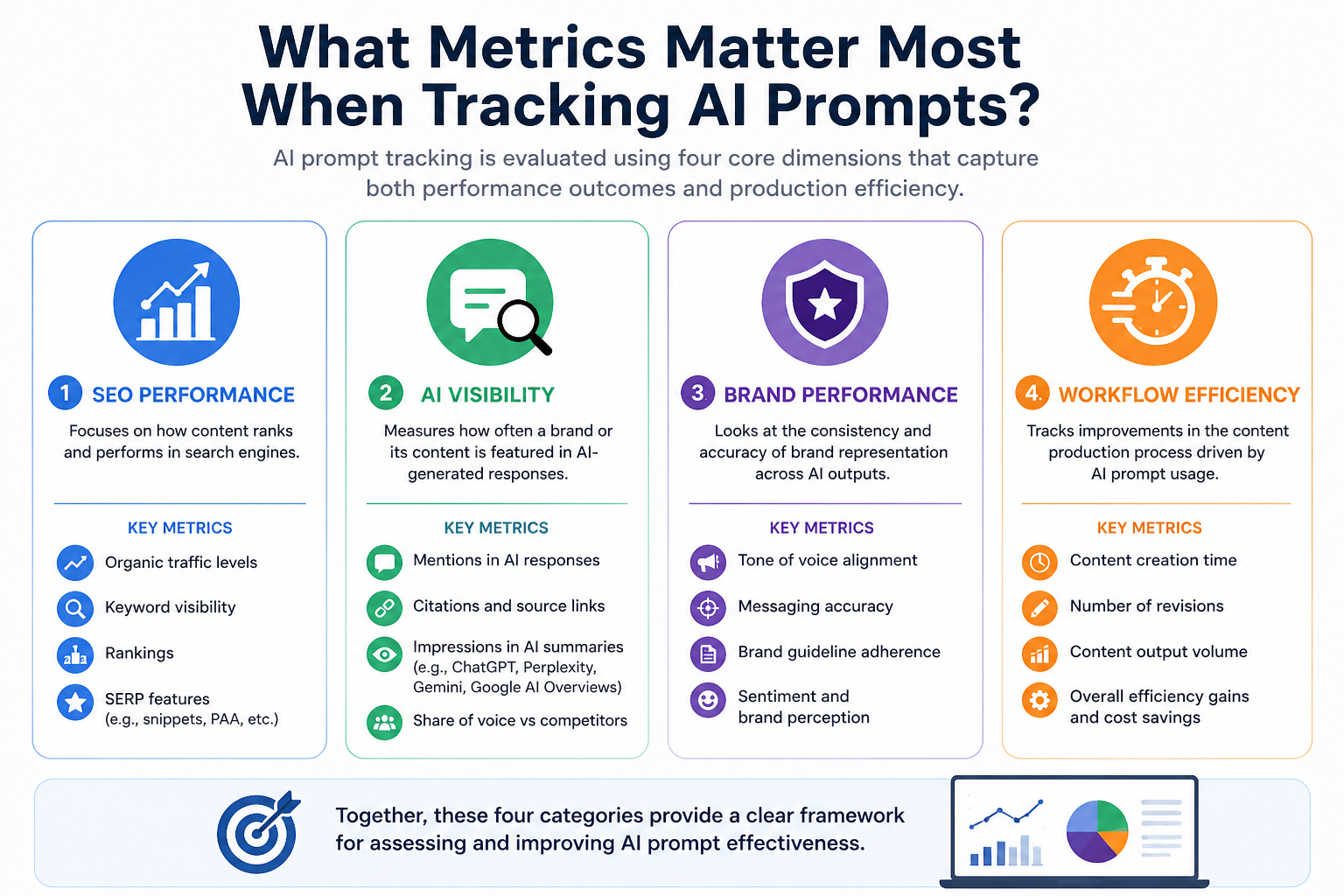
AI prompt tracking is typically evaluated using four core dimensions that capture both performance outcomes and production efficiency.
- SEO Performance focuses on how content ranks and performs in search engines, including organic traffic levels, keyword visibility, and appearance in SERP features such as snippets.
- AI Visibility measures how often a brand or its content is featured in AI-generated responses from tools like ChatGPT, Perplexity, or Google AI Overviews, reflecting discoverability in AI search environments.
- Brand Performance looks at the consistency and accuracy of brand representation across AI outputs, including messaging alignment, tone of voice, and sentiment.
- Workflow Efficiency tracks improvements in the content production process, such as faster turnaround times, fewer revisions, and overall efficiency gains driven by AI prompt usage.
Together, these four categories provide a clear framework for assessing and improving AI prompt effectiveness.
Difference between Prompt Tracking and Regular Analytics
| Prompt Tracking | Regular Analytics |
|---|---|
| Evaluates AI prompts and generated content outputs | Analyses the performance of published content and marketing campaigns |
| Improves AI discoverability and content alignment | Measures website traffic, engagement, and conversions |
| Uses prompt data, AI outputs, and citation signals | Uses SEO metrics and audience behaviour data |
| Supports optimisation for AI-driven search experiences | Supports optimisation for traditional search performance |
| Implemented during the content generation process | Implemented after content goes live |
| Often uses tools such as Indexly and prompt tracking platforms | Often uses tools such as GA4, Search Console, and Semrush |
How are companies using AI Prompt data for SEO
Companies are using AI prompt data from tools as a way to see exactly how users phrase real decisions. These prompts often include specific constraints—budget limits, feature trade-offs, and comparison intent—that don’t show up in traditional keyword research. Instead of guessing intent from search volume, teams can now see full “thinking-out-loud” queries like comparing tools, asking what to choose, and refining requirements in real time.
Because of this, SEO work is becoming more about matching those exact question formats. Companies are creating pages that directly answer scenario-based prompts, structuring content so AI systems can easily extract comparisons and recommendations, and testing which phrasing actually triggers their brand to appear in AI responses. The focus is shifting from ranking for terms to being the default answer inside AI-generated explanations.
Around 86% of SEO professionals now use AI tools in their workflow, showing how quickly AI has moved from experimental to standard practice in marketing teams.
How to set up Prompt Tracking for your Startup?
In this section, we’ll cover how startups can build a structured AI Prompt Tracking workflow to monitor prompt performance, AI visibility, and SEO outcomes.

Training marketing and SEO teams to create and document effective prompts
To successfully implement AI Prompt Tracking, teams first need a clear understanding of how prompts influence SEO performance, AI visibility, and content quality. Short training sessions and practical workshops can help marketers learn how prompt structure affects rankings, click-through rates, brand tone, and engagement in AI-generated content.
Teams can use tools like OpenAI ChatGPT, Anthropic Claude, or Jasper to create blog outlines, metadata, landing page copy, and product descriptions while documenting which prompts generate the best results.
It is also important to maintain a central prompt library using tools such as Notion, Airtable, or Confluence. Each prompt should include details like target keyword, content type, workflow stage, and performance outcomes so successful prompt patterns can be reused across campaigns.
How to implement Prompt Tracking across our Content Workflow
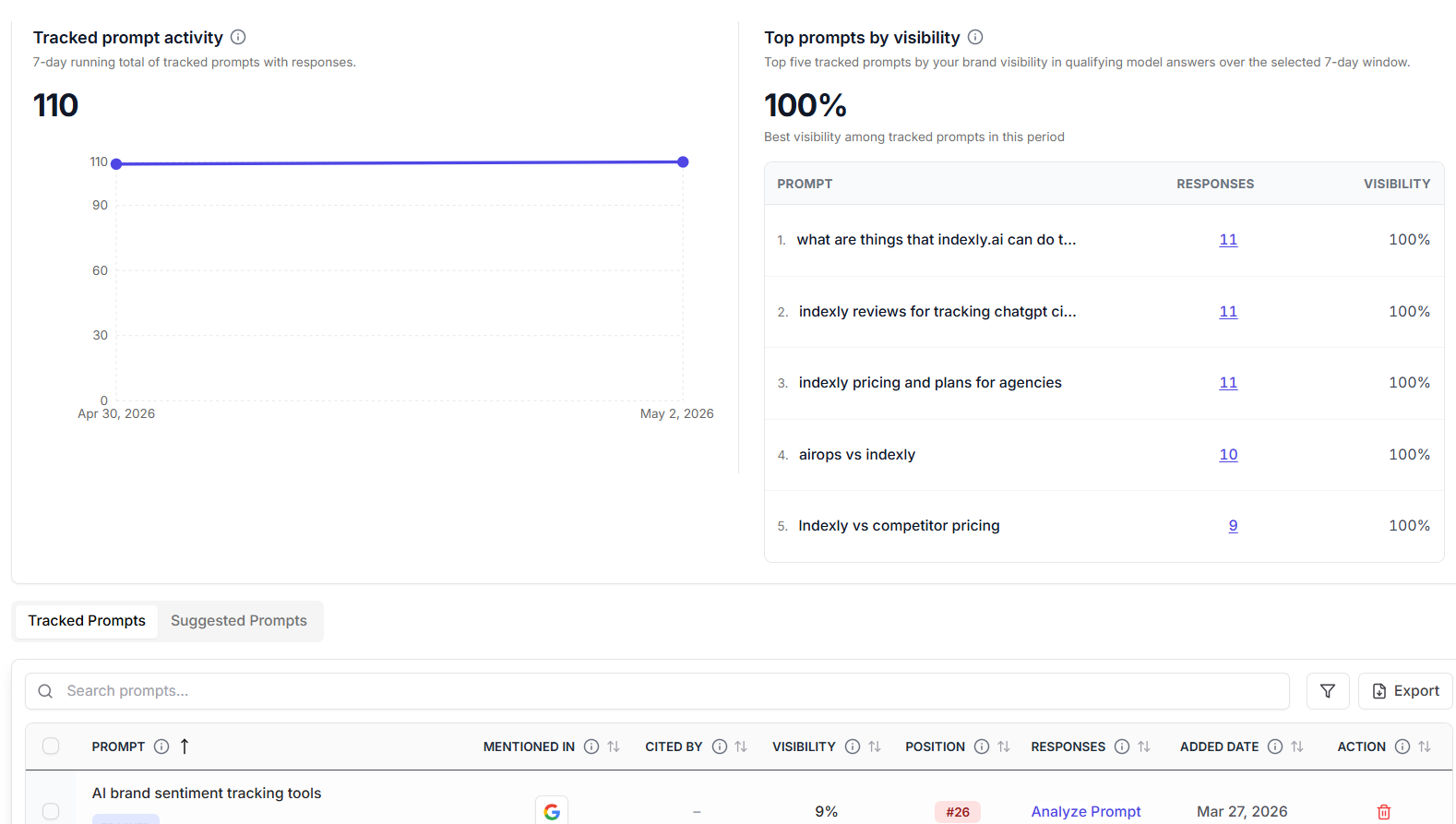
Implementing prompt tracking with Indexly starts by identifying how your brand appears across AI-generated search experiences. Inside Indexly’s Prompt Tracking dashboard, teams can view tracked prompts that mention their brand, products, competitors, or target topics across AI platforms such as ChatGPT, Gemini, Claude, and Perplexity.
One of the most valuable features is the ability to discover suggested prompts. These are prompts where AI systems already cite your website or mention your brand in generated responses. Instead of treating these citations as passive visibility, they can be used as actionable SEO and content opportunities.
For example, if Indexly detects that your brand is being referenced in prompts related to “best CRM software for startups” or “SEO tools for ecommerce brands,” those prompts can become content targets for future articles, landing pages, FAQs, or comparison pages.
Teams can then use the Indexly Content Engine to build content around those prompt opportunities. This helps create pages that are better aligned with real AI search behavior, user intent, and conversational queries already appearing in AI-generated answers.
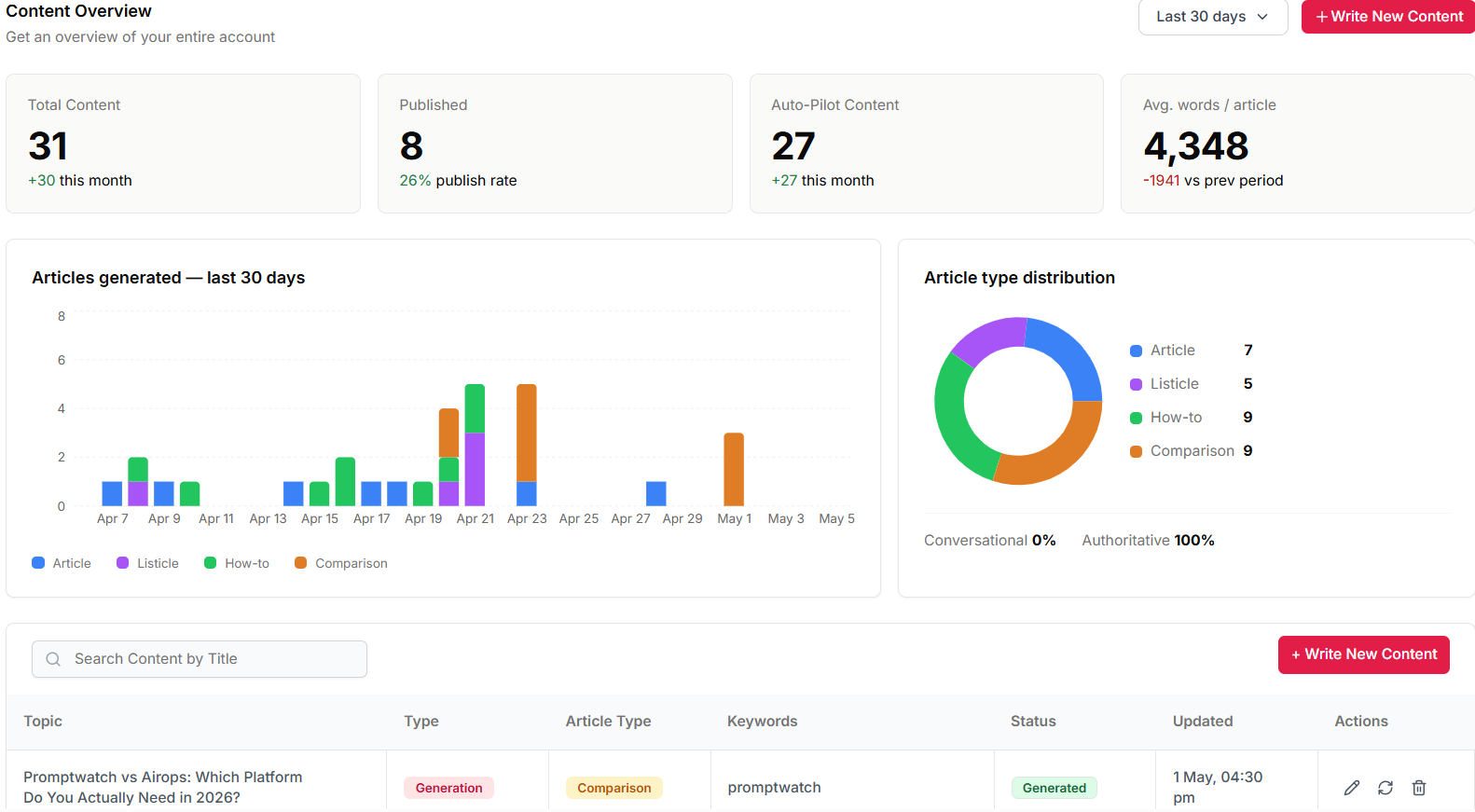
A typical workflow looks like this:
- Monitor tracked prompts mentioning your brand or target keywords
- Identify suggested prompts and AI citation opportunities
- Analyse which prompts generate visibility across AI platforms
- Turn high-opportunity prompts into content briefs or SEO topics
- Create optimized content using the Indexly Content Engine
- Track how new content performs across AI search and traditional SEO results
This approach helps businesses move beyond traditional keyword tracking and optimize content for both search engines and AI-driven discovery platforms. Instead of guessing what users may ask AI systems, teams can build content directly from real prompts already generating citations and visibility.
Reviewing and improving prompt performance
AI prompts should be reviewed regularly to ensure they remain aligned with changing search trends, algorithms, and user intent. Monthly or quarterly reviews can help teams identify which prompts improve rankings, engagement, AI citations, and conversions.
Using tools like GA4, Google Search Console, or Indexly businesses can compare the performance of AI-assisted pages and refine prompts that consistently produce stronger SEO outcomes.
Teams should also update prompts for high-priority campaigns, seasonal topics, and important commercial keywords to maintain visibility across both search engines and AI-driven discovery platforms.
Reporting prompt impact to stakeholders
AI Prompt Tracking becomes more valuable when tied directly to business outcomes. Instead of focusing only on prompts themselves, teams should report how optimized prompts influence traffic, rankings, lead generation, publishing speed, and AI visibility.
Simple dashboards and reports can highlight improvements in organic traffic, AI citations, content production efficiency, and featured snippet visibility. Sharing these insights helps leadership teams understand the long-term value of structured AI content workflows and prompt optimization.
Conclusion
AI Prompt Tracking helps bring structure and visibility to how AI-generated content is created and performs. Instead of relying on guesswork, teams can understand which prompts lead to better SEO results, stronger AI visibility, and more consistent brand messaging.
As AI becomes a core part of content and search, tracking prompts turns into a practical way to continuously improve performance and scale content more effectively.
Learn more and start tracking your AI prompts with Indexly.
FAQs
How to implement AI Prompt Tracking for a startup with limited budget?
Start with tools like Google Sheets, Notion, or Airtable to track prompts and performance metrics. As your workflow scales, platforms like Indexly can automate AI visibility and prompt tracking, with plans starting around $99/month for growing teams.
What do people say about Indexly for Prompt Monitoring?
Indexly is commonly used for tracking AI visibility, discovering AI-cited prompts, and monitoring how brands appear across platforms like ChatGPT, Gemini, Claude, and Perplexity. Many SEO teams use it to identify prompt opportunities and build content aligned with real AI search behavior.
What's the best way to track AI Prompt Performance for a 15-person marketing team?
Create a shared prompt library with naming conventions, version tracking, and SEO tags. Connect prompts to GA4, Search Console, and AI visibility tools to monitor rankings, engagement, AI citations, and workflow efficiency across campaigns.
For larger teams or growing operations, enterprise platforms like Indexly Enterprise can help centralize prompt tracking, AI visibility monitoring, workflow management, and cross-team collaboration at scale.
How to integrate Prompt tracking into my existing SEO workflow?
Start by identifying where AI tools are already used in your SEO process, such as blog creation, keyword research, metadata generation, and content optimization. Track the prompts behind these tasks, measure their impact on rankings and AI visibility, and refine high-performing prompts to improve content quality and search performance over time.
How to monitor if your content is being used by AI models?
Run relevant prompts in AI tools like ChatGPT, Gemini, Claude, and Perplexity to check whether your brand or webpages appear in responses or citations. You can also use AI tracking tools to automate this process and track how frequently your content is referenced in AI-generated answers.