
In a world where every review, comment, and customer interaction carries valuable insight, ChatGPT sentiment analysis has become a game-changer for businesses. ChatGPT makes this possible by turning raw, unstructured text into fast, context-aware insights into how people feel, think, and respond—helping organizations move from guesswork to data-driven understanding of emotion, opinion, and intent.
In this blog, we will discuss how ChatGPT performs sentiment analysis, how it detects emotions in text, its underlying mechanisms, real-world use cases, and 50 ChatGPT Prompts for Sentiment Analysis.
Can ChatGPT Do Sentiment Analysis?
ChatGPT can effectively serve as a universal sentiment analyzer. Research demonstrates its ability to understand opinions, sentiments, and emotions contained in text with impressive consistency.
In fact, studies show ChatGPT outperformed FinBERT by 35% in sentiment classification and demonstrated 36% higher correlation with market returns. This indicates strong performance across financial and business contexts—domains where nuance and accuracy matter most to decision-makers.
How ChatGPT Detects Emotions in Text
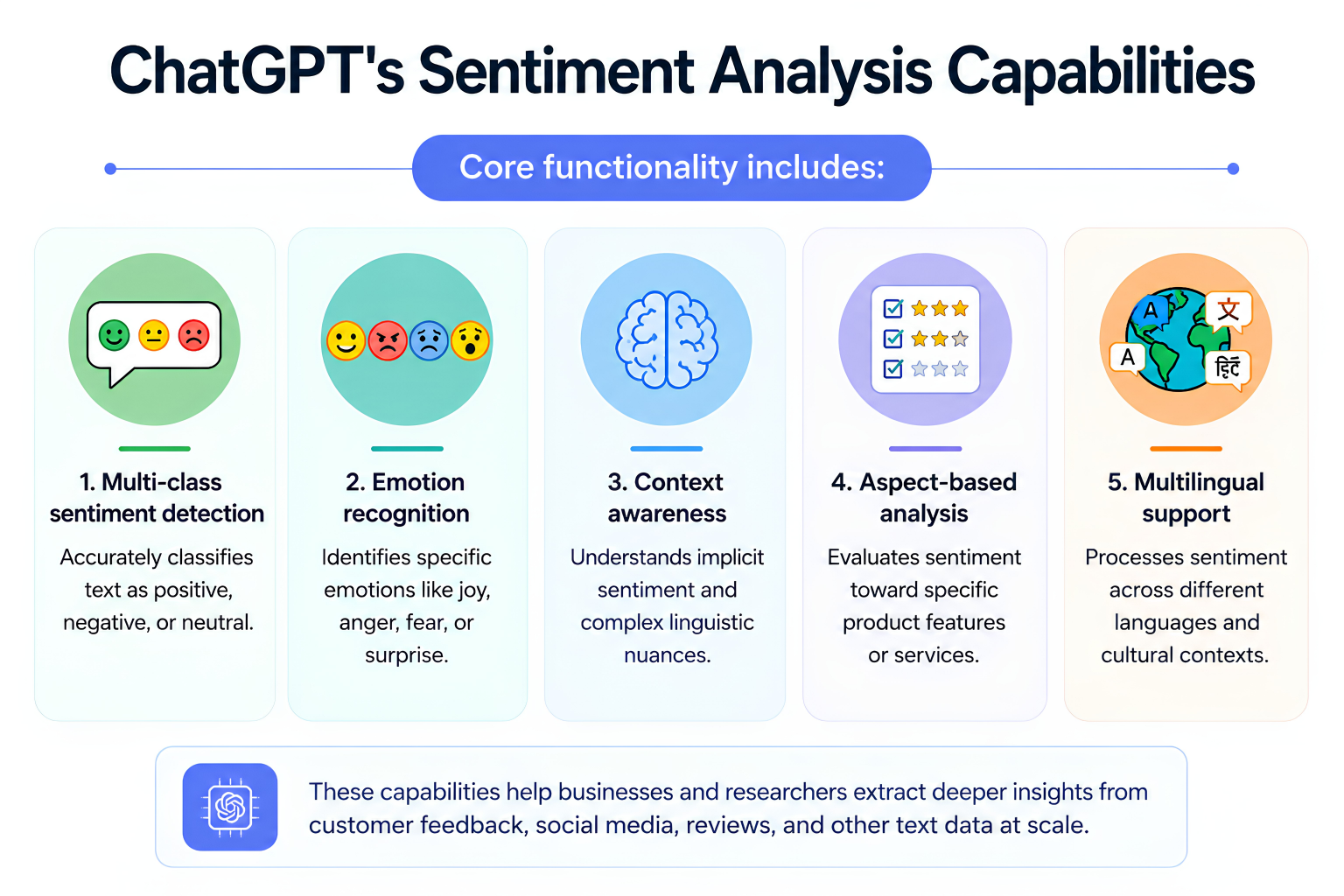
ChatGPT detects emotions using advanced natural language processing techniques that analyze how words, phrases, and sentences relate to each other in context. Instead of focusing only on keywords, it evaluates the overall meaning of the text.
It identifies emotional signals through multiple layers:
- Emotion-related vocabulary (e.g., happy, angry, disappointed)
- Sentence structure and tone
- Contextual relationships between words
- Intensity indicators such as modifiers and emphasis
ChatGPT also maps emotional patterns into structured psychological models such as Plutchik’s wheel of emotions, which includes categories like joy, sadness, fear, anger, surprise, and anticipation.
This layered approach allows it to interpret both explicit and subtle emotional expressions more effectively than traditional keyword-based systems.
Domain-Specific Detection
ChatGPT’s sentiment analysis becomes significantly more powerful through its ability to understand context within language. Instead of treating words in isolation, it analyzes domain-specific knowledge, industry jargon, and the relationship between businesses and customers. This allows it to interpret sentiment more accurately—for example, a complaint in healthcare may carry a very different implication than a similar complaint in retail.
Contextual Understanding in Sentiment Analysis
One of ChatGPT’s key strengths is contextual understanding. Instead of analyzing words in isolation, it evaluates meaning based on the situation, domain, and communication context.
Domain Awareness
Different industries express sentiment differently. A complaint in healthcare may carry more seriousness than a similar complaint in retail. ChatGPT adapts interpretation based on such contextual differences.
Language Context
The same sentence can have different meanings depending on surrounding text. ChatGPT considers full context rather than isolated phrases, improving accuracy in complex feedback.
This makes it particularly useful for analyzing real-world business data where tone and meaning vary widely.
Implicit Emotion Recognition
Not all emotions are directly expressed. In many cases, users imply their feelings without clearly stating them. ChatGPT is capable of identifying these hidden emotional signals.
Sarcasm and Irony
ChatGPT can detect sarcasm and ironic statements where literal meaning differs from intended meaning.
Cultural and Situational Factors
Emotional expression varies across cultures and situations. ChatGPT considers these variations to better interpret sentiment.
Relationship Context
The relationship between the sender and receiver influences tone. For example, feedback from a long-term customer may differ in tone from that of a new user, even if the issue is similar.
By analyzing these subtle factors, ChatGPT can extract deeper emotional meaning from text.
How the Sentiment Analysis Process Works
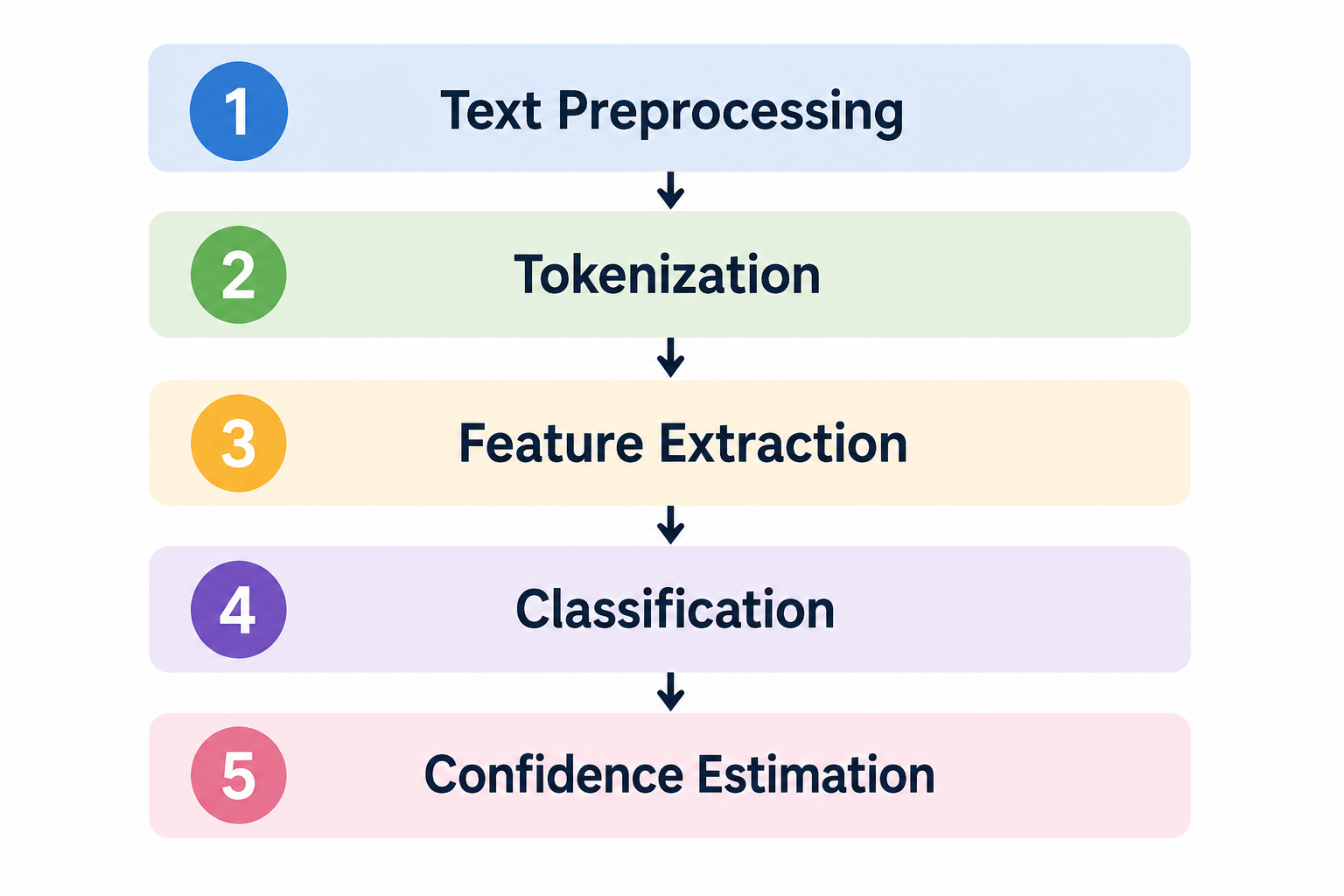
ChatGPT follows a structured pipeline to analyze sentiment:
- Text Preprocessing: The input text is cleaned and prepared for analysis by removing noise and standardizing format.
- Tokenization: The text is broken into smaller units (tokens) so the model can process language more effectively.
- Feature Extraction: Key linguistic features such as tone, sentiment indicators, and emotional cues are identified.
- Classification: The model classifies sentiment into categories such as positive, negative, neutral, or mixed.
- Confidence Estimation: ChatGPT evaluates how strongly a sentiment is expressed, helping indicate reliability.
This structured approach allows it to transform raw text into actionable insights.
ChatGPT Sentiment Analysis Examples
| Customer Comment | Sentiment Type | Emotion Recognized | Key Insight |
|---|---|---|---|
| “Your support team resolved my issue incredibly fast.” | Positive | Satisfaction | Demonstrates efficient customer support |
| “The software is helpful, but the initial setup was difficult.” | Mixed | Frustration | Suggests onboarding challenges |
| “This update has been extremely disappointing.” | Negative | Anger | Indicates negative customer reaction |
| “I was unsure about switching, but the experience turned out great.” | Positive | Trust / Relief | Builds confidence in the brand |
| “I honestly didn’t expect the dashboard to be this effective.” | Positive | Surprise | Shows the product exceeded expectations |
| “Perfect… another downtime issue during work hours.” | Negative | Sarcasm / Frustration | Reflects hidden negative sentiment |
| “The pricing may be too expensive for smaller teams.” | Negative | Concern | Highlights cost-related objections |
| “The AI suggestions are more accurate than I expected.” | Positive | Satisfaction | Reinforces trust in AI capabilities |
| “I contacted support multiple times without getting a solution.” | Negative | Frustration | Reveals customer service inefficiencies |
| “The platform performs well overall, but analytics can improve.” | Neutral / Mixed | Mild dissatisfaction | Identifies opportunities for product enhancement |
How Accurate Is ChatGPT Sentiment Analysis?
Research conducted in 2025 using deep learning approaches showed that CNN models achieved 96.48% accuracy in sentiment classification tasks, with near-perfect classification of negative reviews. However, ChatGPT's real-world accuracy varies significantly based on implementation approach, data quality, and domain specificity. The gap between theoretical benchmarks and production performance is real and worth understanding.
Accuracy Benchmarks Across Domains
Performance variations by application:
- Financial sentiment: 87-94% accuracy with strong correlation to market outcomes.
- Customer reviews: 89% accuracy for standard product feedback analysis.
- Social media content: 78% accuracy due to informal language and context limitations.
- Survey responses: 88-93% accuracy for structured feedback formats.
Factors Affecting Accuracy
- Text quality: Well-formatted, clear text yields 10-15% higher accuracy than raw social media content.
- Context availability: Sufficient background information improves accuracy by 8-12%.
- Domain specificity: Industry-specific prompts can increase accuracy by 5-10%.
- Sample length: Optimal length (50-300 words) provides the best accuracy; very short or long texts reduce performance.
- Language complexity: Formal language shows higher accuracy than slang-heavy informal text.
Parts of it are reasonable, but a lot of the numbers look overly precise and would be difficult to verify reliably without specific published sources. For a blog, it’s better to avoid presenting unsupported benchmark percentages as hard facts.
Factors That Improve Accuracy
Several implementation strategies can significantly improve sentiment analysis performance:
- Better prompt engineering for clearer classification instructions
- Few-shot examples to guide model behavior
- Domain-specific context and terminology
- Structured output formatting for consistency
- Human review for edge cases and ambiguous sentiment
Real-World Sentiment Analysis Use Cases
Sentiment analysis is now widely adopted across industries to transform massive amounts of customer feedback, digital conversations, and public opinion into actionable insights. Rather than manually sorting through thousands of reviews, comments, or survey responses, businesses use AI-driven sentiment analysis to quickly understand how audiences feel about their products, services, and brand reputation. This helps organizations uncover customer satisfaction trends, identify emerging issues, improve marketing efforts, and make faster, data-informed decisions.
Customer Support
Companies use sentiment analysis to evaluate reviews, support tickets, live chats, and customer surveys to detect dissatisfaction and recurring problems. Identifying negative sentiment early allows support teams to respond faster, prioritize critical cases, and improve the overall customer experience. It also helps businesses monitor customer satisfaction more efficiently at scale.
Social Media Monitoring
Brands analyze conversations across platforms such as X, LinkedIn, Reddit, Instagram, and Facebook to understand public reactions to campaigns, launches, announcements, and trending discussions. Positive sentiment often signals successful engagement, while increasing negative sentiment may indicate reputation concerns or potential PR challenges.
Product Development
Customer feedback provides valuable insight into product performance and user expectations. Through sentiment analysis, companies can identify feature requests, usability concerns, pricing objections, and common complaints. These insights help teams improve products, refine messaging, and deliver stronger customer experiences.
Crisis Management
Sentiment analysis enables businesses to identify reputation risks before they escalate into major public relations problems. Sudden spikes in negative sentiment may indicate service outages, product failures, or customer backlash. Early detection allows organizations to react quickly, manage communication strategies, and reduce reputational impact.
Market Research
Businesses rely on sentiment analysis to better understand consumer preferences, industry trends, and competitor perception. Reviews, forums, and online discussions reveal what customers value most, helping companies identify opportunities and strengthen market positioning.
Finance and Investing
Financial analysts and investors use sentiment analysis to measure market mood and public perception surrounding companies, industries, and economic events. News coverage, earnings discussions, and online conversations can significantly influence investor confidence and market behavior.
Healthcare
Healthcare organizations analyze patient reviews, surveys, and feedback to improve communication, treatment quality, and patient experiences. Sentiment insights help providers identify recurring concerns and improve overall care satisfaction.
Political Campaigns
Political teams monitor public sentiment across social media, news platforms, and online communities to understand voter reactions to speeches, campaigns, debates, and policy decisions. These insights help campaigns refine messaging and address public concerns more effectively.
OpenAI API for Sentiment Analysis
The OpenAI API makes it easier for businesses to build advanced sentiment analysis systems using models like GPT-4. Unlike traditional sentiment analysis tools that rely on fixed rules or keyword matching, GPT models can understand context, tone, sarcasm, and nuanced customer opinions more effectively.
Businesses use the OpenAI API to analyze:
- customer reviews,
- support tickets,
- survey responses,
- and social media conversations.
OpenAI Models for Sentiment Analysis
| Model | Best Use Case | Speed | Cost Efficiency |
|---|---|---|---|
| GPT-4 | Complex sentiment analysis | Moderate | Medium |
| GPT-4 Turbo | Balanced performance | Fast | Better |
| GPT-3.5 Turbo | High-volume analysis | Very fast | High |
| Batch API | Large-scale processing | Slower | Most cost-effective |
The accuracy of sentiment analysis largely depends on prompt quality. Clear instructions, structured outputs, and example classifications usually improve consistency and reliability. Many companies also use batch processing to analyze thousands of reviews or customer interactions at lower cost.
The OpenAI API is commonly integrated into:
- customer support platforms,
- social listening systems,
- review monitoring tools,
- and AI brand monitoring workflows.
For enterprise use cases, businesses often combine API automation with validation systems, retry logic, and monitoring tools to improve reliability and maintain consistent sentiment analysis performance.
50 ChatGPT Prompts for Brand Sentiment Analysis
Basic Sentiment Analysis Prompts
These prompts help quickly classify and understand general emotional tone.
- Classify this feedback as positive, negative, or neutral.
- Identify the emotional tone in this review.
- Summarize the sentiment expressed in this text.
- Evaluate customer satisfaction from this response.
- Provide sentiment classification with a brief explanation.
- Detect emotions present in this feedback.
- Analyze sentiment trends across multiple reviews.
- Determine whether sentiment is improving or declining.
- Highlight positive and negative expressions in the text.
- Assign a sentiment score between -1 and +1.
Advanced Sentiment Analysis Prompts
These prompts focus on deeper emotional interpretation and nuance.
- Break down mixed emotions in this review.
- Detect sarcasm or ironic tone in the message.
- Identify hidden dissatisfaction not directly stated.
- Provide sentiment classification with confidence scoring.
- Compare sentiment between two different reviews.
- Measure emotional intensity in this text.
- Identify urgency in negative feedback.
- Summarize key drivers of sentiment across reviews.
- Group similar emotional themes from feedback.
- Identify recurring customer complaints.
Reddit Sentiment Analysis Prompts
Reddit is a powerful source of raw sentiment because users express opinions freely without brand influence. This leads to more honest, unfiltered feedback that often includes sarcasm, humor, and strong opinions.
You can explore Reddit here:
Reddit Official Platform.
Prompts:
- Analyze sentiment in this Reddit discussion about our brand.
- Summarize community opinions from Reddit comments.
- Determine whether sentiment toward this brand is positive or negative.
- Extract key concerns from Reddit threads.
- Identify sentiment changes across discussions.
- Compare sentiment between Reddit and Twitter.
- Highlight brand reputation issues mentioned in posts.
- Summarize major praise and complaints from users.
- Detect sarcasm or meme-based sentiment in Reddit content.
- Classify sentiment in this subreddit discussion.
Can AI detect Community Perception?
Yes. AI can analyze large-scale conversations and identify patterns that represent overall community perception.
Instead of focusing on individual opinions, it detects collective emotional trends, which reveal how a brand is viewed over time.
This is especially useful for tracking:
- Changes in trust levels
- Early warning signs of backlash
- Loyalty versus dissatisfaction patterns
- Long-term sentiment shifts
Community Insight Prompts
- Evaluate overall brand perception in the community.
- Measure trust levels in online discussions.
- Identify reputation signals from conversations.
- Summarize sentiment trends across platforms.
- Track changes in public opinion over time.
- Detect early signs of negative sentiment.
- Extract themes shaping brand perception.
- Compare sentiment between competing brands.
- Identify loyalty versus dissatisfaction patterns.
- Summarize emotional tone across discussions.
Business Applications of Sentiment Analysis
Sentiment analysis is widely used across marketing, customer support, and product strategy to turn feedback into actionable insights.
Many organisations integrate AI sentiment systems through APIs such as
OpenAI API Documentation.
Business Prompts:
- Analyze sentiment in product reviews.
- Identify main causes of negative feedback.
- Summarize brand perception from surveys.
- Track customer satisfaction trends over time.
- Analyze sentiment in support interactions.
- Detect potential churn signals in feedback.
- Summarize sentiment from marketing campaigns.
- Evaluate response to product launches.
- Compare sentiment before and after updates.
- Generate an executive sentiment summary report.
Conclusion
Sentiment analysis has become a crucial part of understanding customers, markets, and digital conversations at scale. ChatGPT plays a powerful role in this space by interpreting text with strong contextual understanding, making it highly effective for analyzing emotions, opinions, and nuanced feedback in individual inputs.
However, as organizations move toward larger and more complex data environments, structured tools become essential for consistent and scalable insights. Indexly is a sentiment analysis tool designed for this purpose, helping businesses track, measure, and benchmark sentiment across multiple AI models, competitors, and content sources.
While ChatGPT is excellent for deep, flexible language understanding, Indexly functions as a dedicated tool that extends sentiment analysis into a system of continuous monitoring, comparison, and data-driven intelligence. This makes it especially useful for real-world applications where consistency, scale, and automation matter.
FAQs
Can GPT Analyze Customer Complaints?
Yes, GPT-4 can analyze customer complaints by identifying sentiment, urgency, recurring issues, and emotional tone in reviews, support tickets, and feedback. Its contextual understanding makes it more effective than traditional keyword-based systems for handling nuanced customer conversations.
How GPT-4 Performs Sentiment Classification?
GPT-4 performs sentiment classification by analyzing context, tone, sentence structure, and emotional cues within text. It can detect positive, negative, neutral, and mixed sentiment while also understanding sarcasm and implicit emotions.
How to Classify Customer Sentiment With ChatGPT?
ChatGPT classifies customer sentiment by analyzing reviews, surveys, support tickets, and social media conversations. Businesses use prompts and API workflows to categorize sentiment as positive, negative, neutral, or mixed.
ChatGPT vs Traditional Sentiment Analysis Tools: What is the Difference?
Traditional sentiment analysis tools rely on rules, keywords, or trained models to classify text as positive, negative, or neutral. They are fast and scalable but often struggle with context, sarcasm, and nuanced meaning.
ChatGPT, on the other hand, understands sentiment through context and language meaning, allowing it to capture subtle emotions like irony, mixed sentiment, and implied feelings more effectively in complex text.
What are the limitations of ChatGPT sentiment analysis?
ChatGPT sentiment analysis may struggle with sarcasm, ambiguity, and domain-specific language. Its performance can vary based on input quality and it may reflect biases from training data. It is also less reliable for large-scale processing, precise numerical tasks, and can produce inconsistent results across runs.
Can ChatGPT analyze Brand sentiment from Reddit?
Yes. ChatGPT can analyze Reddit discussions to understand brand sentiment, emotional tone, and overall community perception.