

Your brand might look strong in rankings, but what if the conversations shaping those clicks are quietly holding it back? Search engines, review platforms, and AI-driven assistants increasingly reflect brand perception through signals like reviews, content quality, and user engagement.
AI-powered sentiment analysis combined with SEO can help identify signals that correlate with visibility and engagement. It also demands smarter workflows, real-time monitoring, and tighter collaboration across teams to turn sentiment signals into measurable search gains.
Your brand perception often begins forming the moment it appears in search results, based on snippets, reviews, and surrounding context. This shift makes sentiment analysis an important indicator of brand perception that can indirectly influence rankings, clicks, and trust through user behavior and engagement signals.
To understand why sentiment matters so much, it’s important to first break down what AI brand sentiment actually means and how it is interpreted at scale.
The sentiment analytics industry was worth about $4.68 billion in 2024 and is expected to grow significantly, reaching nearly $17.93 billion by 2034.
Understanding AI Brand Sentiment
AI brand sentiment refers to how artificial intelligence analyzes and interprets people’s opinions, emotions, and attitudes toward a brand using data from reviews, social media, surveys, forums, and customer feedback. It uses machine learning and natural language processing (NLP) to identify whether public sentiment is positive, negative, or neutral at scale.
Now that we understand the core idea of brand sentiment, let’s look at how AI-driven analysis differs from traditional manual review methods.
AI Sentiment Analysis vs Manual Review Analysis: Differences
The table compares AI sentiment analysis and manual review analysis based on speed, scalability, accuracy, and efficiency.
| AI Sentiment Analysis | Manual Review Analysis |
|---|---|
| Leverages artificial intelligence to assess public opinion automatically. | Depends on human reviewers to interpret and evaluate feedback. |
| Quickly analyzes large amounts of customer conversations and reviews. | Reviewing extensive feedback manually requires more time and effort. |
| Provides fast sentiment detection and ongoing monitoring capabilities. | Feedback evaluation is slower because it relies on manual assessment. |
| Uses trained models to maintain consistency in analysis results. | Findings can differ based on the reviewer’s judgment or perspective. |
| Helps uncover recurring issues, trends, and customer preferences efficiently. | Identifying patterns usually takes additional manual review and observation. |
| Automatically labels sentiment into categories such as positive, neutral, or negative. | Human analysis is better at understanding subtle emotions and contextual meaning. |
| Streamlines repetitive analysis tasks through automation. | Requires continuous involvement from review teams or staff members. |
Beyond traditional analysis methods, it’s also important to distinguish sentiment tracking from broader social listening approaches.
Read: 10 Best Brand Sentiment Tracking Tools for B2B Companies in 2026
What is the difference between Social Listening and AI Sentiment Tracking?
| Category | Social Listening | AI Sentiment Tracking |
|---|---|---|
| Main Function | Observes and tracks online conversations about topics or brands | Evaluates emotional tone expressed in text data |
| Coverage Area | Broad monitoring of discussions, mentions, and trending subjects | Focused interpretation of sentiment and opinions |
| Type of Output | Keywords, hashtags, brand references, and trend patterns | Sentiment classification such as positive, negative, neutral, plus emotion signals |
| Primary Goal | Understand what is being discussed in digital spaces | Understand how users feel about a brand, product, or topic |
| Data Handling | Aggregates information from multiple online channels | Uses AI to analyze and interpret textual meaning |
| Technology Used | Monitoring dashboards and analytics platforms | Natural Language Processing combined with machine learning models |
| Example Result | “High volume of online discussion around the brand” | “Overall sentiment leans positive with some negative responses” |
Once the differences are clear, the next step is to understand how AI systems actually process and interpret sentiment from raw text data.
How does AI Sentiment Analysis work?
Data Collection and Preprocessing
AI sentiment analysis starts by collecting large volumes of text from real-world sources such as social media posts, online reviews, surveys, emails, chat conversations, forums, and feedback forms. This helps the model understand how people naturally express opinions and emotions.
Before analysis, the data is cleaned and standardized by removing noise like emojis, links, spelling errors, punctuation, and extra spaces.
For example:
“OMG!!! This app is SUPERB 😍” → “omg this app is superb”
Text Representation: Tokenization and Embeddings
Once the data is cleaned, the text is broken into smaller units called tokens. These tokens can be words or subword parts.
For example:
“I really enjoy this product” →
I / really / enjoy / this / product
After tokenization, the text is converted into numerical form so machines can process it. Modern systems use word embeddings that represent meaning instead of just word counts. Words like happy, excited, and joyful are placed close together in vector space because they share similar sentiment.
Understanding Context with Transformers
Transformer-based models help AI understand context by analyzing how words relate to each other in a sentence. Instead of treating words individually, they focus on relationships and meaning.
For example:
“The movie was not bad.” → interpreted as positive or mildly positive
“I liked the camera but disliked the battery life.” →
liked → camera
disliked → battery
This allows the model to understand sentiment at a deeper contextual level.
Model Training with Labeled Data
AI models are trained using datasets where text is paired with sentiment labels such as positive, negative, or neutral. This helps the system learn correct classifications over time.
For example:
| Text | Sentiment |
|---|---|
| “Great service experience” | Positive |
| “Very bad support” | Negative |
During training, the model improves by continuously correcting its predictions.
Sentiment, Emotion, and Aspect-Based Outputs
Once trained, the model can analyze new text and generate detailed outputs, including sentiment classification, emotion detection, and aspect-based insights.
For example:
“No one responded to my complaint for days.” → Negative, frustration, high urgency
“The screen quality is excellent, but the battery drains quickly.” →
Screen → Positive
Battery → Negative
This helps businesses understand not just overall sentiment but also specific product feedback.
Continuous Model Improvement
Language is constantly evolving with new slang, emojis, and expressions. To stay accurate, sentiment models must be regularly updated and retrained.
For example:
Expressions like “this is fire 🔥” need to be learned over time to ensure correct interpretation.
Modern AI systems continuously improve by adapting to new language patterns and reducing prediction errors.
How to Track AI Brand Sentiment using Indexly?
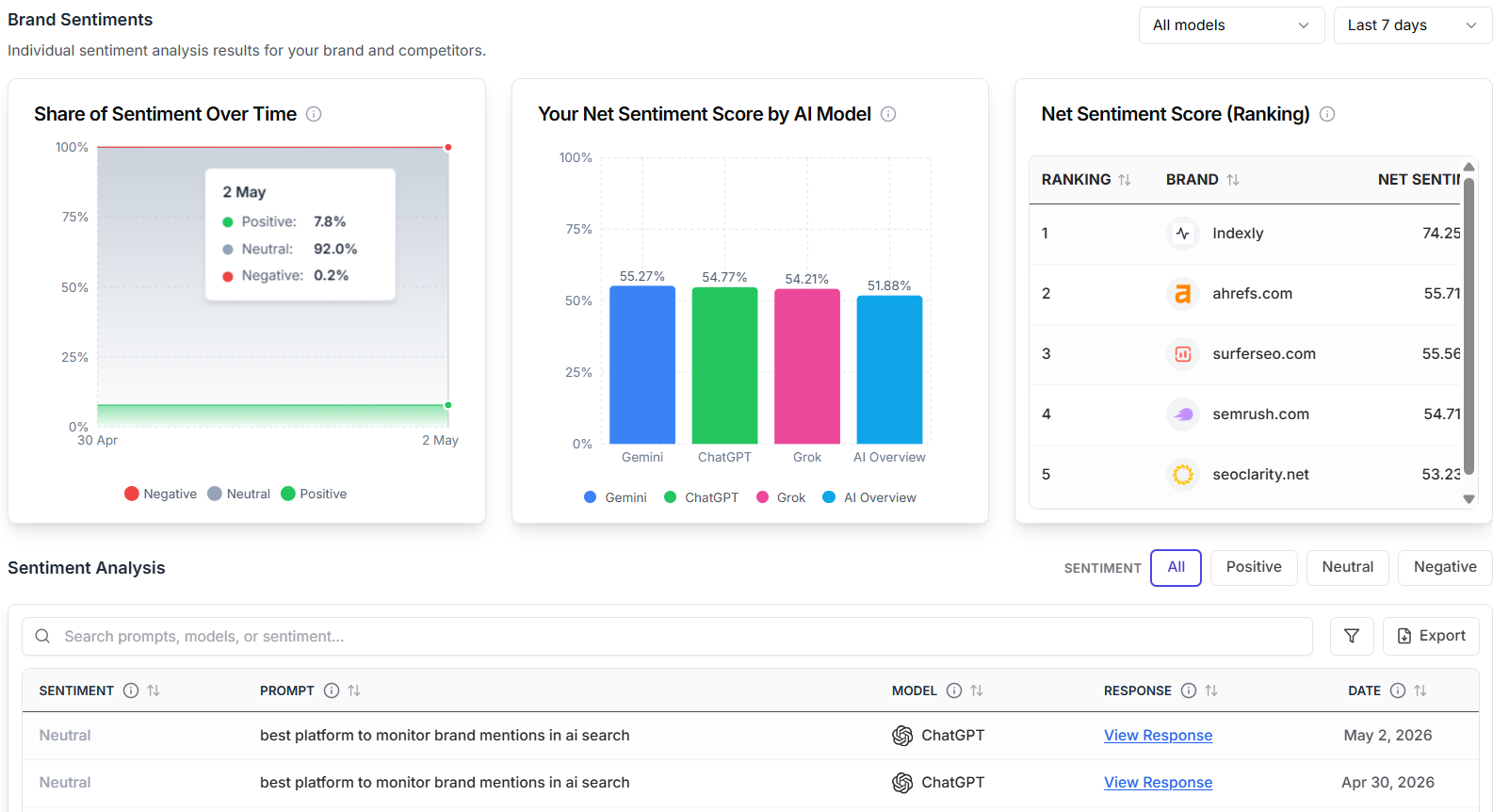
Tracking brand sentiment across AI systems with Indexly is a structured process that helps you understand how different AI models perceive your brand in real time.
- Connect your brand and set up tracking in Indexly
Start by adding your brand, website, or keywords inside Indexly so it can begin monitoring mentions across AI models like ChatGPT, Grok, Perplexity, Gemini, and AI Overviews. - Run AI prompt tracking across multiple models
Indexly automatically checks how your brand appears in different AI responses by running relevant search prompts (like “best SEO tools” or “brand monitoring platforms”) across models. - Monitor sentiment distribution over time
Use the dashboard to view how sentiment changes across days (Positive, Neutral, Negative) with visual charts like “Share of Sentiment Over Time.” - Analyze AI model-wise sentiment scores
Compare how each model perceives your brand using Net Sentiment Score breakdowns (e.g., ChatGPT vs AI Overviews vs Perplexity) to see where perception is strong or weak. - Track prompts, responses, and visibility gaps
Review individual AI responses linked to each prompt to understand why sentiment is positive or negative, then optimize your content and SEO strategy accordingly.
What are the best metrics for Brand Sentiment?
Best brand sentiment is evaluated through AI-based measures that reflect emotional signals, prediction balance, and how public perception shifts over time. The following are the brand sentiment metrics:
- Overall Sentiment Score – Combined outcome of positive and negative predictions produced by the AI system
- Sentiment Distribution – Proportion of AI classifications across positive, negative, and neutral categories
- Net Sentiment (NSR) – Calculated ratio or difference between positive and negative model outputs
- Brand Mention Volume – Total number of text instances processed for sentiment evaluation by the model
- Share of Voice (SOV) – Relative visibility of the brand within the AI-analyzed dataset
- Sentiment Trend Over Time – How AI-generated sentiment results change across different time periods
With these metrics in place, it becomes clear how deeply sentiment influences both brand perception and digital performance.
Conclusion
AI sentiment is becoming a visibility signal that influences how AI systems, search engines, and users perceive your brand.
As search continues to shift toward AI-driven answers, tracking sentiment in real time is becoming essential for staying discoverable, trusted, and competitive.
Tools like Indexly help brands turn these signals into actionable visibility improvements across AI search ecosystems.
FAQs
What are the limitations of AI Sentiment Analysis?
AI sentiment analysis is effective for large-scale text evaluation, but it is not flawless. It can misinterpret sarcasm, irony, or context-heavy statements, especially when emotions are mixed within the same sentence. Accuracy also depends on the quality of training data and how well the model understands specific industries or languages.
What is AI Reputation Management?
AI reputation management is the use of artificial intelligence to monitor and analyze how a brand is perceived online. It combines sentiment analysis, review tracking, and social listening to identify negative trends early and strengthen positive brand signals across digital platforms.
How to monitor Brand Reputation across LLMs?
Monitoring brand reputation across large language models involves checking how AI systems describe your brand in generated responses. This includes testing prompts, reviewing AI outputs, and ensuring consistent messaging across websites, structured data, and reviews so that AI systems reflect accurate brand perception.
Is AI actually reliable for Brand Sentiment and Visibility?
AI is highly effective at identifying broad sentiment trends across large datasets like reviews and social media. However, it may struggle with nuance, sarcasm, and cultural differences. Because of this, many systems combine AI analysis with human review to improve accuracy and reliability.
What are the alternatives to Otterly.ai for monitoring Brand Sentiment across llms?
A strong alternative is Indexly, which tracks brand visibility and sentiment across LLMs like ChatGPT, Gemini, and Perplexity. It helps monitor how AI systems describe your brand, measure sentiment distribution, and identify gaps in AI-generated responses to improve SEO and brand perception.
How accurate is AI Sentiment Analysis?
AI sentiment analysis is accurate for clear, structured text like reviews and social posts, but can struggle with sarcasm, irony, and mixed emotions. It works best for trend detection at scale and is most reliable when combined with human review for critical decisions.
How PR Teams Use AI Sentiment Alerts?
PR teams use AI sentiment alerts to detect sudden spikes in negative sentiment, monitor campaign reception, and respond quickly to emerging crises. These alerts help them prioritize communication efforts, manage brand risk, and adjust messaging in real time.
What is the best White-Label AI Sentiment Platforms for Agencies?
White-label AI sentiment platforms typically offer API access, customizable dashboards, and branding options so agencies can present insights under their own name. The best platforms usually support multi-channel monitoring (social, reviews, news), real-time alerts, and LLM-based sentiment tracking for modern AI search visibility.
Mention tracking vs Sentiment tracking: What is the difference?
Mention tracking focuses on where and how often a brand is being discussed. Sentiment tracking focuses on how people feel about those mentions. In short: mentions = visibility, sentiment = perception.
Why Traditional Social Listening Is No Longer Enough?
Traditional social listening mainly tracks keywords, hashtags, and mentions. It misses deeper interpretation like emotional tone or AI-generated summaries. With AI search and LLMs shaping brand discovery, businesses now need sentiment-aware systems that understand context, not just volume.
Social Listening vs AI Brand Monitoring: What is the difference?
Social listening monitors conversations across platforms to detect trends and brand mentions. AI brand monitoring goes further by analyzing sentiment, interpreting meaning with NLP, and tracking how AI systems (like chatbots and search assistants) describe your brand. This makes AI monitoring more aligned with today’s AI-driven discovery ecosystem.
What is the difference between Sentiment Analysis and Brand Monitoring?
Sentiment analysis focuses on how people feel about your brand by analyzing text data and classifying opinions as positive, negative, or neutral using AI or NLP.
Brand monitoring is broader — it tracks where and how often your brand is mentioned across platforms like social media, news, reviews, and search results.
In simple terms: sentiment analysis measures emotion, while brand monitoring measures visibility and presence (often using sentiment analysis as one of its components).