

When someone asks ChatGPT, Claude, or Gemini to recommend a tool in your category, does your brand show up? If you don't know the answer, you're flying blind in one of the fastest-growing discovery channels in marketing today.
AI brand mentions are references to your company, product, or service inside the responses generated by large language models (LLMs). Unlike traditional search rankings, these mentions don't live in a results page you can audit — they're buried inside conversational outputs that millions of users read and act on every day.
This guide breaks down exactly what AI brand mentions are, why they matter for your visibility strategy, and how to track them systematically — so you always know where you stand inside the AI engines shaping buyer decisions.
What Are AI Brand Mentions?
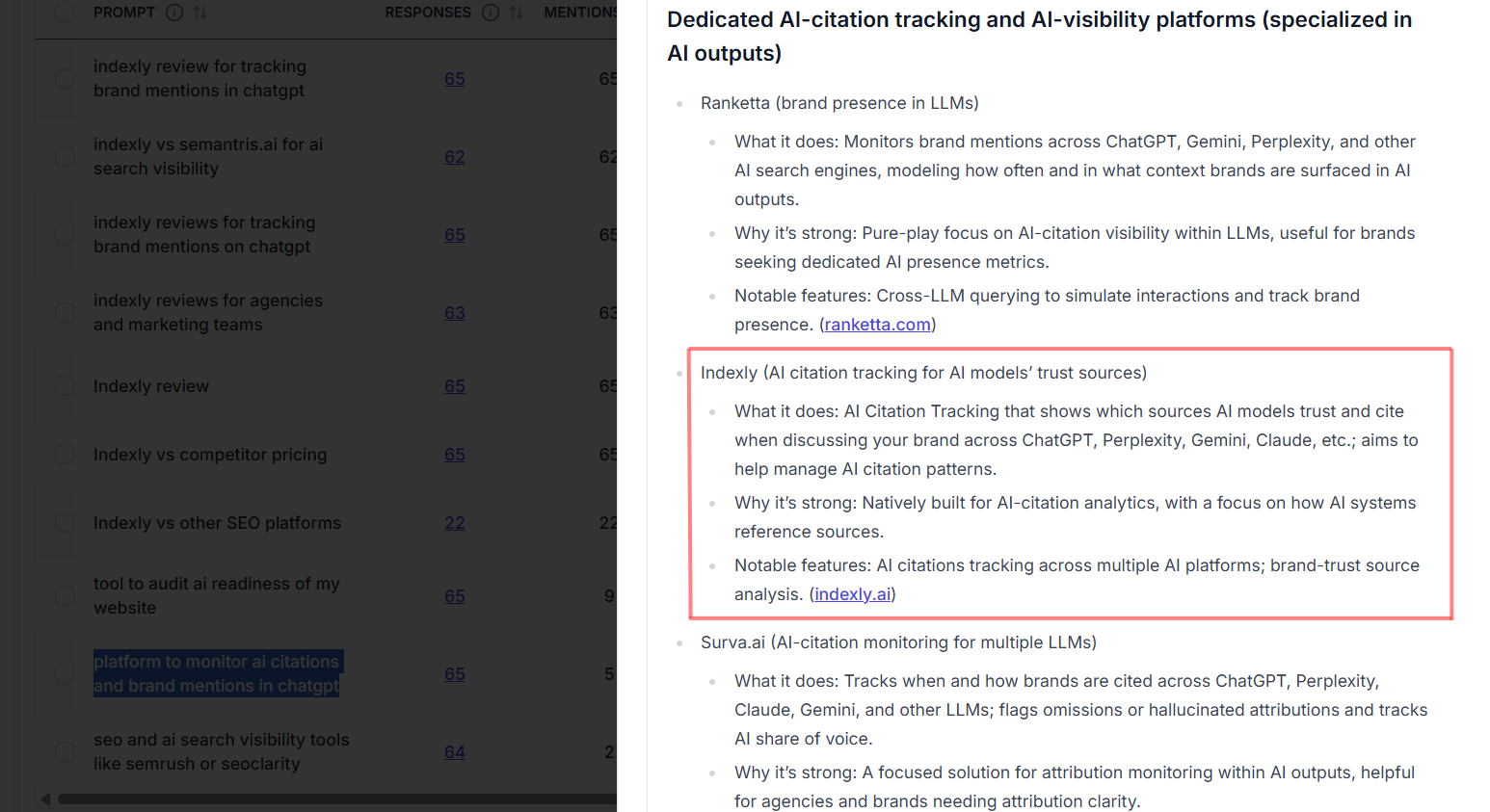
Think of AI brand mentions as the way AI talks about your brand. Unlike traditional mentions on websites or social media, these appear in AI-generated answers, summaries, and knowledge graphs.
There are two main types:
- Linked mentions: These include a clickable link to your website, boosting traffic and authority.
- Unlinked mentions: No link? That’s fine, AI still recognises your brand, helping improve your visibility in AI search.
You’ll find these mentions in chatbots, AI assistants, and AI-powered search tools. Monitoring them lets you manage AI citations and stay ahead in the zero-click internet era.
Why is tracking AI Mentions Important for your Brand?
AI assistants pick the most trustworthy sources to answer user queries. About 86% of AI citations come from brand-managed or authoritative sources. That means your structured, clear content has a huge impact on whether AI references your brand.
Here’s how AI decides which brands to mention:
- It scans structured, authoritative content that directly answers questions.
- Content that’s well-organized and clear is more likely to be cited.
- AI uses these citations to show credibility, which can appear in LLM responses and AI search results.
Why is Tracking Brand Mentions in AI so much harder than Google?
Monitoring how brands appear in AI systems is more complex than tracking traditional search results because the two work on completely different principles. Google relies on an indexed web with stable ranking systems, while AI tools generate responses on the fly instead of pulling from a fixed results list.
Here’s what makes AI tracking more difficult:
- No public index to review: AI platforms don’t offer a transparent database of where or how a brand is mentioned.
- Unpredictable responses: Identical prompts may produce slightly different answers each time.
- No native analytics layer: There’s no built-in dashboard equivalent to Google Search Console for AI visibility.
- Multiple underlying sources: Responses can be influenced by training data, retrieved content, or internal reasoning, making attribution unclear.
- Limited explainability: It’s often impossible to pinpoint exactly why a specific brand was mentioned.
Because of these limitations, brands rely on indirect tracking approaches such as prompt testing, monitoring systems, and AI visibility platforms like Indexly.
In essence, Google provides structured, measurable signals, while AI search is fluid and less transparent — which makes brand tracking significantly more challenging.
Read: Top 10 Best LLM Brand Visibility Tools to Dominate AI Search in 2026
How do you Track Brand Mentions in AI Search?
As AI-powered search keeps growing, brands and agencies need tools to see how their brand appears in LLM responses and AI-generated answers. That’s where Indexly comes in, the go-to platform for AI brand monitoring, AI citation tracking, and brand sentiment analysis.
In an Indexly‑style AI visibility dashboard profiling a major SaaS brand, monitored brands saw an average Mention Score of 78% and a Share of Voice of 34% across 50 core prompts, with 1,247 total mentions logged over the tracking window.
Step 1: Conduct an AI Readiness Audit
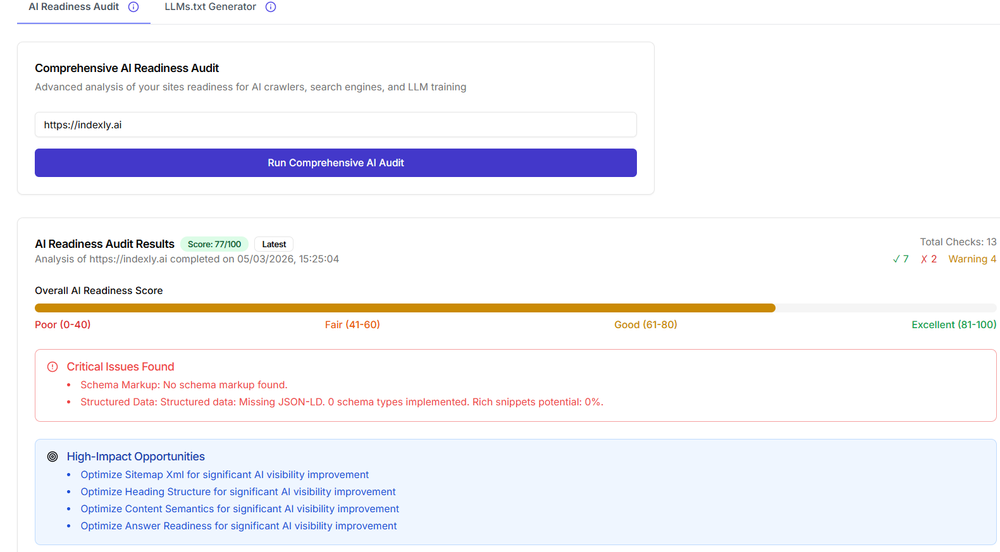
AI readiness is how prepared your website and content are for AI systems to read and reference accurately.
Indexly offers an AI readiness audit to check if your website is optimized for AI-powered search and crawlers. It reviews:
- Schema markup and structured data
- Content accessibility for AI crawlers
- Crawler permissions and indexing settings
- Overall site structure
This ensures AI systems can properly access and interpret your content, improving your chances of appearing in AI-generated responses and LLM search results.
Step 2: Track Brand Visibility
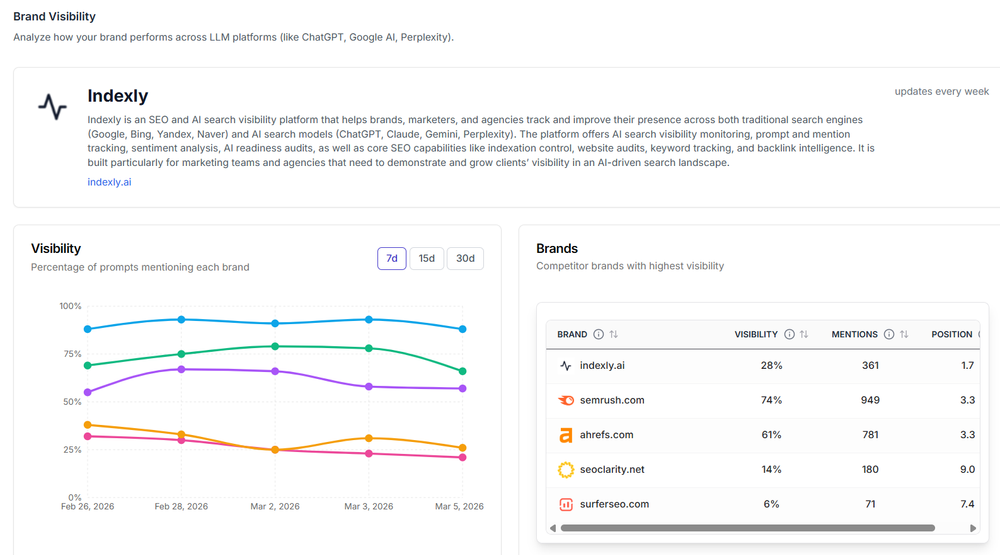
Brand visibility shows how often your brand is seen or mentioned in AI search results and LLM responses.
Indexly’s brand visibility tracking shows how often your brand appears in AI-generated content. It gives you a clear view of your presence in AI search, including:
- Brand mention frequency in AI answers
- Competitor comparisons to see where you stand
- Visibility across different prompts and queries
- Changes in mentions over time
These insights help marketing teams see how visible their brand is in AI-driven search and adjust strategies accordingly.
Read: Boosting Brand Visibility in SEO and AI Search
Step 3: Track Prompts That Trigger AI Mentions
A prompt is the question or command a user gives to an AI tool. Prompt tracking means monitoring which prompts cause AI to mention your brand.
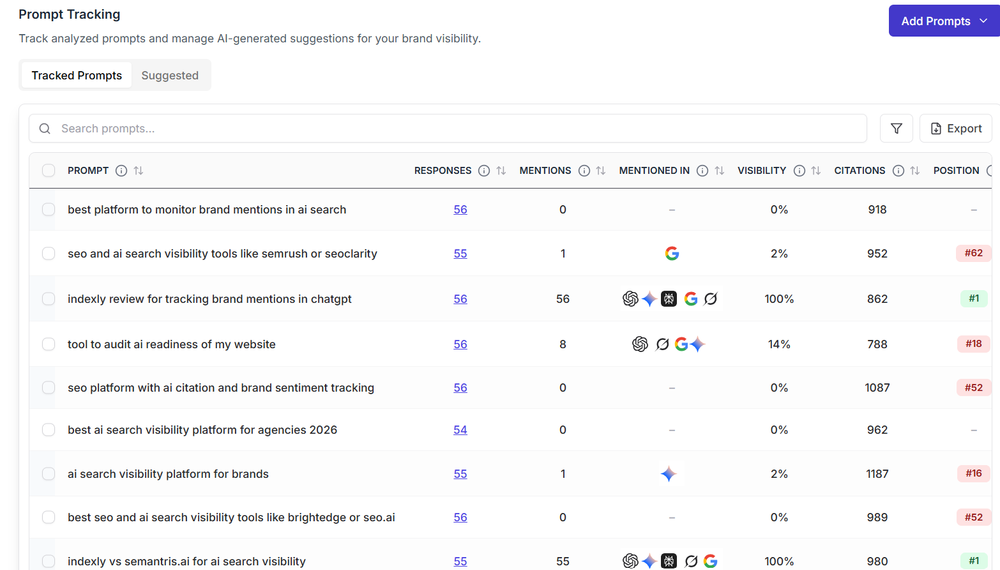
Indexly’s prompt tracker shows when and why your brand appears in AI responses, giving you insights to improve your content and AI search optimisation.
Prompt tracking lets your team:
- Identify which prompts generate AI brand mentions
- Add and monitor new prompts as needed
- Understand how users ask questions in AI search
- Optimize content to appear more in LLM responses
Analyzing prompts also helps improve your AI readiness and increases your chances of showing up in AI recommendations.
Read: What is AI Prompt Tracking and why does it matter for SEO
Step 4: Monitor Brand Sentiment
Brand sentiment shows whether people and AI talk about your brand positively, neutrally, or negatively.
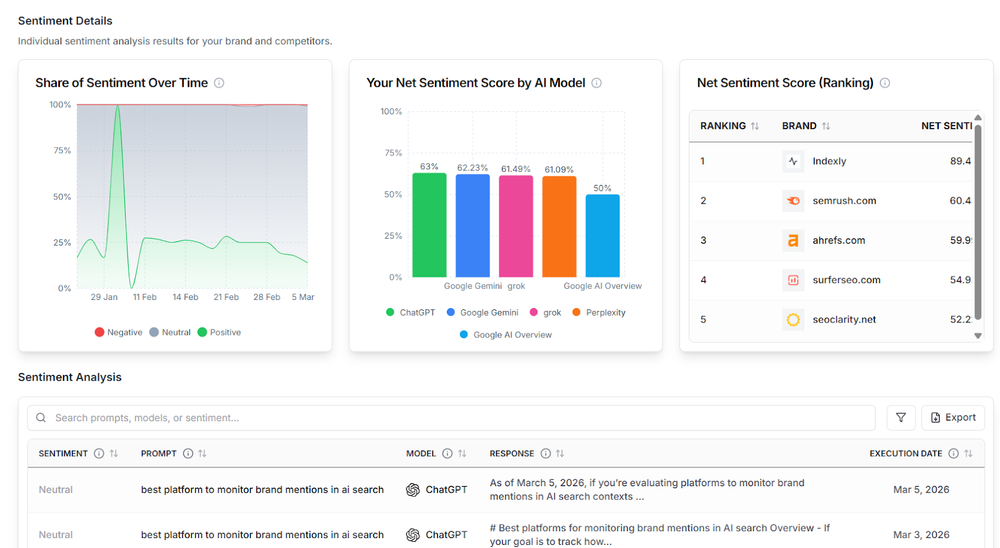
It’s not just about tracking mentions; it’s about understanding how AI talks about your brand. Indexly lets you monitor brand sentiment in AI-generated responses and online discussions.
With Indexly, you can:
- Identify positive, neutral, or negative brand mentions
- Track your Net Sentiment Score across different AI platforms
- Compare your sentiment with competitors
- Classify mentions to spot trends and insights
Keeping tabs on brand sentiment helps protect your reputation and maintain strong AI brand visibility.
Read: AI Brand Sentiment Analysis: Boosting Search Visibility
Step 5: Analyze AI Citations
A citation is when AI references a source to support its answer. Citation tracking means keeping an eye on which sources AI uses to mention your brand.
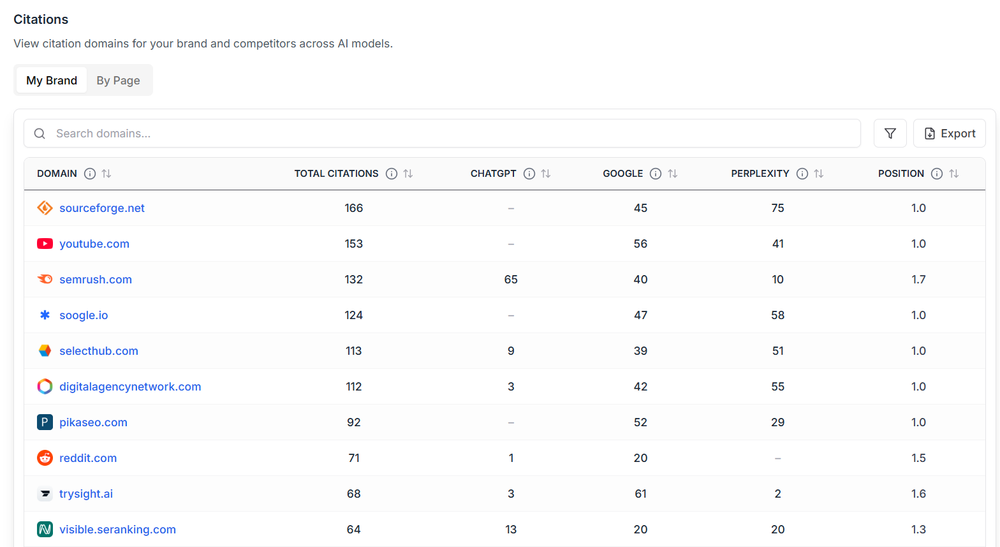
AI assistants often reference trusted sources when generating answers. With Indexly’s citation tracker, you can monitor when and where your brand is cited in AI responses.
This makes it easy to:
- Track AI citations across LLM responses
- Compare your mentions with competitors
- See which sources influence AI recommendations
By tracking citations, you’ll understand how AI recognizes your brand and which content boosts credibility.
Read: What Are AI Citations? How to Find Which Pages ChatGPT and Perplexity Cite
Common Mistakes when trying to track AI Brand Mentions
Many companies struggle with tracking AI brand mentions because they often rely on outdated SEO methods that don’t fit how AI systems generate responses. A common issue is depending on manual searches, only counting direct brand references, ignoring differences across AI platforms, and not connecting visibility data to real outcomes like leads, traffic, or revenue impact.
For smaller teams, a better starting point is to choose a limited set of high-intent prompts, test them across multiple AI tools, and document the results in a simple system. Over time, this helps identify gaps in visibility and improve content accordingly. As needs grow, platforms like Indexly can help automate tracking and provide a more scalable way to monitor AI brand presence.
How to Optimize Content for AI Search? Anyone else noticing a drop in Brand Mentions?
If you want your brand to get noticed, encouraging AI brand mentions is essential. Every mention strengthens your brand visibility, boosts AI citations, and improves your AI search visibility.
Here’s how to make it happen:
Content Strategies to Drive Mentions
Creating content that naturally encourages brand mentions starts with publishing authoritative content.
Expert guides, detailed articles, and in-depth insights help establish your brand as a trusted source in your industry.
Another effective strategy is answering industry questions by providing actionable, clear responses to common queries. This not only helps users but also increases the likelihood of your brand being referenced in AI-generated responses.
Guest posts and collaborations can further amplify your brand mentions. Writing articles on trusted platforms and updating existing guest content regularly generates backlinks, authoritative references, and organic mentions that strengthen your brand presence.
Additionally, producing value-added content like original research, case studies, industry reports, or infographics attracts attention and encourages others to reference your brand, boosting both visibility and credibility.
Aligning Content With AI Search Optimisation
With AI-powered search becoming more common, brands need to optimize content not only for traditional search engines but also for AI systems.
Properly structured content increases the chances of being referenced in AI citations and improves brand visibility.
Key steps include:
- Tailoring content for conversational AI queries
- Organizing articles for easy AI comprehension
- Strengthening topical authority through content clusters
- Implementing schema markup and structured formatting
- Regularly updating content to maintain AI readiness
For a comprehensive guide on creating AI-optimized content, check out our blog on Answer Engine Optimisation for Brands.
Conclusion
AI is changing the way brands are discovered and evaluated online. AI brand mentions are essential for boosting AI search visibility, managing AI citations, and improving brand sentiment.
By tracking and monitoring mentions, analyzing prompts, measuring citations, and optimizing your content for AI readiness and AI search optimisation, your brand becomes more visible, credible, and trusted in AI-driven search. Even in the zero-click internet era, every mention counts: linked or unlinked.
Platforms like Indexly make it easy to monitor brand visibility, track AI citations, analyze sentiment, and improve your chances of appearing in LLM responses. Brands that invest in structured, authoritative content don’t just compete, they lead.
Start tracking your AI brand mentions today and make sure your brand is seen, recognized, and cited where it matters most.
FAQs
What Are AI Brand Mentions?
AI brand mentions occur when an AI system references or discusses a brand in its generated responses. These mentions can appear in chatbots, AI assistants, or AI-powered search tools. Even if the mention does not include a link, it still contributes to AI search visibility and helps improve overall brand visibility.
Is it Possible to Track Brand Mentions in AI Search?
Yes, but not directly like SEO tools. AI platforms don’t provide a native mention tracker. Instead, brands use prompt testing, citation monitoring, and AI visibility tools. Platforms like Indexly help automate this by detecting when and where a brand appears in AI responses.
Does HubSpot actually track brand mentions in ChatGPT, or is it more of a scoring tool?
Not directly. HubSpot tracks traditional marketing channels, but AI-generated mentions typically require dedicated AI visibility tools.
How to set up Brand Mention Tracking for a Small Marketing team?
Start with a list of key prompts, test them across AI tools, and log results in a simple sheet. Later, use automation tools like Indexly to scale.
How do I set up Indexly to track my Brand Mentions in ChatGPT?
People say Indexly helps track how often their brand appears in AI tools like ChatGPT and Perplexity and compare it with competitors. It’s mainly useful for spotting visibility trends.
It’s still evolving, so users see it more as directional insight rather than exact tracking.
Is Indexly worth it for tracking brand mentions in ChatGPT?
Yes, especially for teams that want automated tracking of AI visibility, citations, and competitor insights.
What does it mean when people say their brand gets mentioned in AI tools?
It means AI systems include your brand in generated answers, which increases visibility and influences user decisions.
How to track brands mention, improve AI visibility and rank in ChatGPT and Google AI answers?
Improving AI visibility involves monitoring brand mentions, tracking AI citations, and publishing content that AI systems can easily understand and reference. Platforms like Indexly help brands measure visibility across ChatGPT, Google AI Overviews, and other AI search experiences.
Does Indexly integrate with our existing HubSpot and Google Analytics stack for tracking AI Mentions?
Indexly currently integrates with Google Analytics, allowing teams to track AI bot traffic, referrals, and AI visibility insights. HubSpot integration is not available at the moment.
How to track brand mentions across ChatGPT, Gemini, and Perplexity?
To track brand mentions across ChatGPT, Gemini, and Perplexity, use the same set of key prompts on each platform and note whether your brand appears, how it’s positioned, and which competitors are mentioned.
Keep a running record over time—tracking presence, sentiment, and missing visibility—to compare performance across tools and improve your AI discoverability.