
Updated: June 2026 | Difficulty: Beginner | Time Required: 3–6 hours of setup + 4–6 weeks of consistent publishing | Written for: Marketing teams, brand managers, digital agencies, and businesses focused on AI-driven lead generation
AI systems like ChatGPT, Perplexity, and Gemini are now actively pulling and referencing LinkedIn content at scale, reshaping how visibility works in B2B marketing. In fact, recent analysis shows LinkedIn URLs are already appearing in a meaningful share of AI-generated responses, meaning the way you structure and publish content directly affects whether your perspective shows up or gets replaced by someone else’s.
The good news is that AI citation isn’t random. It follows clear patterns in structure, format, consistency, and topic alignment. Brands that understand these patterns are already gaining disproportionate visibility inside AI answers.
In this blog, you’ll learn how to:
- Optimize your LinkedIn profile and Company Page for AI readability
- Publish content formats that match AI citation patterns
- Build topic clusters aligned with real buyer prompts
- Maintain a consistent publishing system that improves visibility over time
- Track and improve your citation presence across AI platforms
By the end, you’ll have a practical system for making your LinkedIn content discoverable, structured, and consistently eligible to be cited in AI-generated answers.
Why Getting Your LinkedIn Content Cited by AI Matters in 2026
LinkedIn has emerged as the #1 platform for professional queries across major AI systems, making it a critical source for AI-generated answers. According to Indexly’s May 2026 analysis, which examined 110,000 prompt responses and 3,077,153 citation URLs across ChatGPT, Gemini, Perplexity, Grok, Google Search, and Google AI Overviews, 9,767 citations (0.32%) came from LinkedIn.
Posts and Pulse articles generated 67.5% of all LinkedIn citations. By surface, Posts/Activity URLs accounted for 34.42% (3,362 citations), Pulse articles for 33.08% (3,231), and Company pages for 22.15% (2,163). Together, these three surfaces represented nearly 90% of all LinkedIn citations.
Within Pulse articles, Listicle/Best-of formats contributed 26.71% (863 citations), while Comparison/Versus articles contributed 6.41% (207 citations), demonstrating that structured, scannable content performs best in AI retrieval.
By AI engine, Grok generated 6,707 LinkedIn citations (68.67%), while ChatGPT generated 2,872 citations (29.41%), underscoring LinkedIn’s growing importance as a source for AI answers.
The Process at a Glance
| Step | Action | Time | Outcome |
|---|---|---|---|
| 1 | Audit and optimize your LinkedIn profile | 1–2 hours | AI-readable author authority established |
| 2 | Optimize your LinkedIn Company Page | 1–2 hours | Brand entity recognized by AI retrieval |
| 3 | Identify AI-query-mapped content topics | 2–3 hours | Topic clusters aligned to buyer prompts |
| 4 | Publish long-form articles in citation format | 3–5 hours per article | Primary citation-eligible asset published |
| 5 | Publish consistent mid-length feed posts | 30–60 min per post | Regular citation signals across platforms |
| 6 | Activate employee advocacy and amplification | 1–2 hours setup | Broader citation surface across profiles |
| 7 | Track, measure, and iterate on citations | 30 min/week | Citation rate monitored and improved |
Total time to initial citation eligibility: Approximately 8–14 hours of setup work, then 4–6 weeks of consistent publishing before citation signals begin to compound.
Step 1: Audit and Optimize Your LinkedIn Profile for AI Readability
What You're Doing
Before AI systems cite your content, they evaluate who is publishing it. A complete, focused LinkedIn profile helps establish your expertise and makes your posts and articles more trustworthy.
How to Do It
- Write a clear headline. Include your role, expertise, and value. For example:
B2B Content Strategist | Helping SaaS companies get cited in ChatGPT and AI search. - Update your About section. Explain who you help, what you do, and the topics you write about. Use the same industry terms your audience uses.
- Complete your experience section. Focus on measurable results instead of generic job descriptions.
- Turn on Creator Mode. This gives more visibility to your posts and articles.
- Keep your profile complete. Add a professional photo, banner image, and up-to-date contact information.
Best Practices
- Use the same keywords and phrases your customers would type into ChatGPT or Google.
- Stay focused on one or two areas of expertise.
- Publish consistently on related topics to build authority.
Common Mistakes
- Using vague titles like Marketing Manager instead of describing your speciality.
- Writing an About section filled with buzzwords but no clear expertise.
- Leaving Creator Mode off.
- Publishing about too many unrelated topics.
What Done Looks Like
When someone visits your profile, they should immediately understand what you do and what topics you are an expert in. A clear profile makes it easier for AI systems to connect your content with relevant questions and increases the chances of your posts and articles being cited.
For deeper context on AI visibility and citation tracking, see how the leading AI visibility platforms compare for LinkedIn citation tracking, and also explore the broader mechanics of getting cited in ChatGPT.
You might also find it helpful to understand why some sites don't get cited despite strong content.
Step 2: Optimize Your LinkedIn Company Page as an AI-Readable Brand Entity
What You're Doing
Your LinkedIn Company Page is your brand identity (how AI systems understand your business as a single entity). AI tools use it to decide what your company does and when to include it in answers.
A complete and active page increases your chances of showing up in AI citations (when AI systems mention your brand in generated answers).
How to Do It
- Write a clear tagline and About section. Explain what your company does, who it helps, and the problems it solves. Use the same language your customers use.
- Post consistently. Aim to publish content several times a week to keep your page active.
- Share original content. Publish case studies, research, industry insights, and customer success stories. Unique content gives AI systems useful material to cite. Distribute this content across both your Company Page and employee profiles.
- Complete all company details. Fill in your industry, specialities, company size, website, and other relevant fields. These act as structured signals (organized information that helps AI systems correctly understand and categorize your business).
- Connect employees to the company page. Make sure team members list your company in their Experience section. This strengthens the connection between your brand and the people creating content.
- Ensure consistent brand linking across profiles. Link your Company Page in employee Experience sections so AI systems can clearly understand the relationship between individual authors and your company (your brand entity).
Example:
| AI Platform | What Gets Cited Most (Indexly Insight) | Company Page vs Personal Profile Insight |
|---|---|---|
| ChatGPT | Posts + Pulse Articles dominate | Personal profiles slightly stronger than company pages |
| Google AI Mode | Posts + Company Pages mixed | Balanced: both personal + company content appear |
| Perplexity | Company Pages + structured sources | Company pages slightly stronger than personal profiles |
What Done Looks Like
Your Company Page reads like an authoritative resource on your category, not a marketing brochure and publishes content consistently enough that AI retrieval systems can identify your brand as an active, credible source for professional queries in your industry.
Step 3: Identify and Map Content Topics to AI Buyer Queries
What You're Doing
This step is about aligning your content with the exact questions people ask inside AI tools like ChatGPT, Perplexity, and Gemini. According to Indexly’s LinkedIn AI citation analysis, AI systems mainly cite content that is structured, question-based or answer-driven, and focused on clear professional intent rather than broad or vague topics. This means citation is not random and depends heavily on how closely your content matches real buyer questions.
How to Do It
- Collect real AI buyer questions. Use ChatGPT, Perplexity, and Gemini to find 10–15 real questions your customers would ask. Focus on intent-driven queries like how to get cited in ChatGPT or how B2B brands appear in AI search.
- Find content gaps. Identify where your brand is missing, where competitors appear, and where AI answers are weak. These gaps are your best content opportunities.
- Create 2–3 topic clusters. Group related questions into small focused themes like LinkedIn AI visibility, B2B content for AI search, or SaaS positioning. Narrow focus improves clarity and citation chances.
- Plan content for each cluster. Create 1 detailed flagship article and 4–6 supporting posts that answer smaller related questions within the same topic.
- Focus on expert content. Use real examples, case studies, and practical insights. AI systems prefer structured, experience-based content over generic advice.
Best Practices
- Write content that sounds like a direct response to a prompt someone would type into ChatGPT Search or Google AI Mode. This structural alignment increases the chance your content is retrieved as a matching source.
- Use consistent terminology across all content in your cluster. AI retrieval works by identifying named entities—companies, people, products, concepts—and understanding their relationships. LinkedIn content that clearly defines its core entities and uses accurate terminology is more likely to be incorporated into AI responses accurately.
What Done Looks Like
You have a documented content map of 2–3 topic clusters, each anchored by a flagship article topic and supported by 4–6 post angles, all tied directly to real buyer prompts you have observed in ChatGPT, Perplexity, or Gemini.
Step 4: Publish Long-Form Articles in AI Citation Format
What You're Doing
This step focuses on publishing long-form LinkedIn Pulse articles, which are one of the strongest content formats for AI citations.
According to Indexly’s May 2026 analysis of LinkedIn AI citations, Posts and Pulse articles together account for 67.5% of all LinkedIn citations, making long-form content a core driver of visibility in AI-generated answers.
You can create and publish these articles using Indexly LinkedIn Writer.
How to Do It
- Open Indexly → LinkedIn Presence → Writer → Article Generator. This is where you create AI-optimized LinkedIn articles designed for better visibility and citations using Indexly’s LinkedIn content tools.
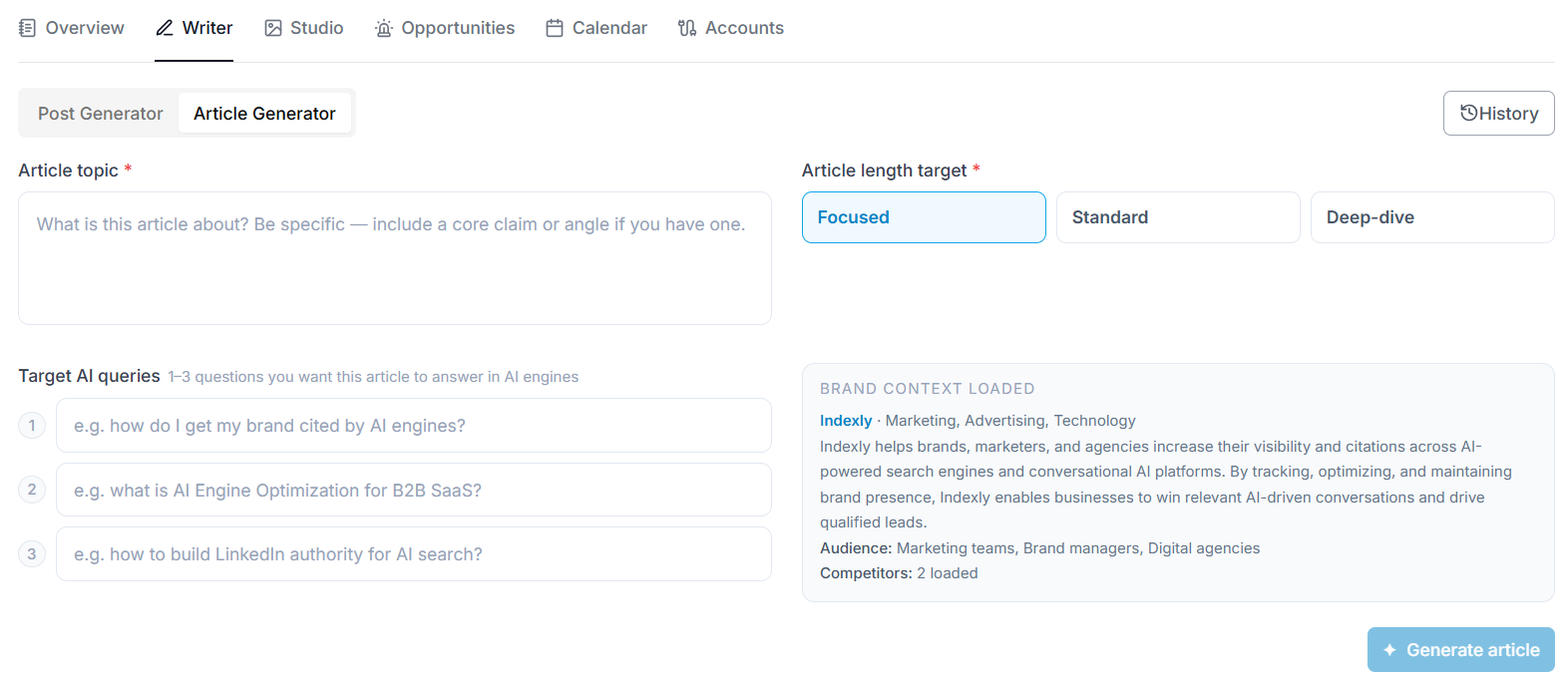
- Enter your article topic. Add the main topic you want to write about. This should be related to your expertise, product, or target audience.
- Choose article length. Select the depth of your article: Focused, Standard, or Deep-dive depending on how detailed you want the content.
- Add AI target queries. Enter 1–3 real questions your audience would ask in AI tools like ChatGPT or Perplexity. These guide the structure of the article for AI visibility.
- Review brand context (auto-loaded). Indexly automatically applies your brand context, including industry, audience, and competitors, so the content is aligned with your positioning.
- Click Generate Article. Generate the article. Indexly will create a structured LinkedIn post optimized for AI citation and LinkedIn performance.
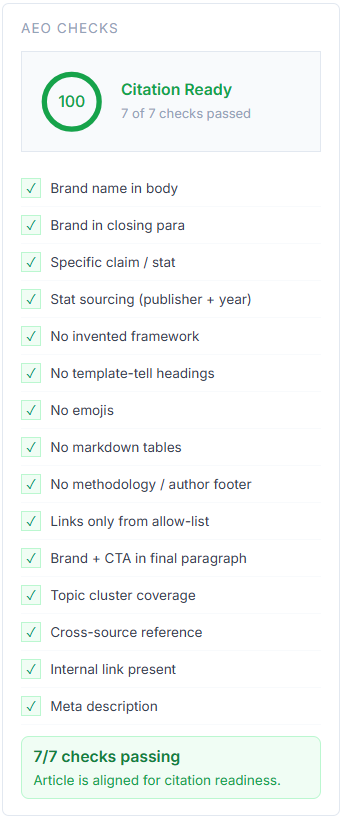
- Review AEO checks. After generation, the article is evaluated using AEO (Answer Engine Optimization) checks. You will see a 100/100 Citation Ready score with 7/7 checks passed, ensuring the content meets AI citation standards like brand presence, structured formatting, factual accuracy, and clean optimization.
- Edit and refine if needed. You can adjust tone, regenerate sections, or improve clarity before publishing.
- Publish or copy to LinkedIn. Once ready, publish directly or copy the article into LinkedIn Pulse.
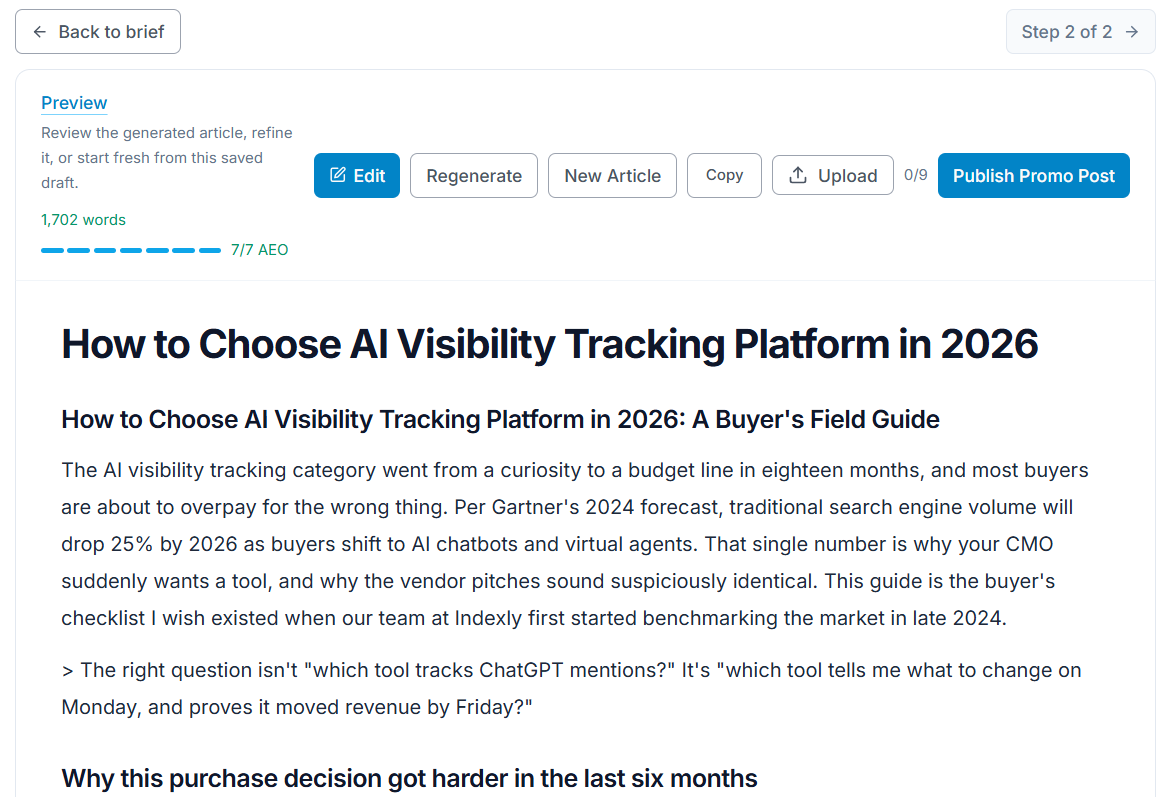
Example of a Long-form article generated by Indexly
Common Mistakes
- Publishing fully AI-generated text at volume: Publishing authentic content, rather than fully AI-generated text, can help you avoid being flagged or blocked from indexing. Use AI as a drafting aid, not as a replacement for original perspective.
- Optimizing for virality over extractability: LinkedIn's algorithm rewards engagement, while AI search rewards clarity, structure, and consistency. A post with 500 likes but no clear, extractable answer will not be cited as often as a structured 900-word article with 20 reactions.
What Done Looks Like
You have published at least one long-form LinkedIn article per topic cluster, each 500–2,000 words, structured with clear headings, specific data, and an opening that directly answers the target query, making it straightforward for an AI engine to extract and cite the content.
Step 5: Publish Consistent Mid-Length Feed Posts on a Regular Cadence
What You're Doing
Feed posts act as your consistency layer. While long-form articles build depth and authority, feed posts maintain regular activity and help cover smaller, specific sub-questions that don’t need full articles. Consistent posting helps AI systems recognize ongoing expertise and improves your chances of being included in AI-generated answers over time.
How to Do It
- Publish 5+ posts per month. Maintain a steady posting rhythm so your content signals ongoing activity around your core topics.
- Keep posts 50–299 words. Each post should focus on one clear idea, question, or insight. Avoid mixing multiple topics in one post.
- Start with the main point immediately. Open with your key insight in the first sentence, so AI systems can quickly extract the core answer.
- Keep formatting simple and clean. Use short paragraphs and plain text. Avoid unnecessary emojis, hashtags, or engagement bait, as they do not improve AI citation chances.
- Use timely references when relevant. Include current insights or dates where needed to signal freshness and improve relevance in AI systems.
What Done Looks Like
You are publishing at least 5 original feed posts per month per active author, each 50–299 words, each answering a specific professional question—establishing the publishing consistency that is a key predictor of AI citation frequency.
Step 6: Activate Employee Advocacy to Expand Your Citation Surface
What You're Doing
This step is about increasing your reach by having employees publish content under their own LinkedIn profiles. When multiple people from your company share expertise, your brand appears across more sources, increasing the chances of being cited in AI-generated answers. Individual creators often receive more visibility in AI systems than company pages alone.
How to Do It
- Choose 3–5 employees to participate. Select team members who understand your core topics and are willing to share insights regularly. They don’t need large followings, expertise matters more than audience size.
- Give each person clear content direction. Provide simple briefs with topic ideas, target questions, and key points so they can create focused content without confusion.
- Publish in their own voice. Encourage employees to write naturally based on their experience. Avoid corporate-style language; authentic and personal insights perform better.
- Connect content back to your company. Where relevant, employees should mention or link to the company to strengthen the connection between personal expertise and the brand.
- Encourage engagement between employees. Have team members comment on and support each other’s posts with meaningful insights to increase content depth and visibility.
What Done Looks Like
You have at least 3 employees actively publishing original LinkedIn content within your core topic clusters, their profiles are linked to your Company Page, and their content is coordinated (but not identical) around the same buyer queries your brand is targeting.
Step 7: Track, Monitor, and Iterate on Your LinkedIn AI Citation Rate
What You're Doing
Measurement closes the loop. This step helps you understand which LinkedIn content is getting cited by AI tools, which topics perform best, and how your brand compares to competitors.
Citation frequency is a strong signal of AI search authority and shows whether AI systems recognize your content as a trusted source.
How to Do It
- Build a prompt list. Create a set of 10–20 real questions your buyers would ask in tools like ChatGPT, Perplexity, Gemini, or Google AI Mode.
- Test regularly. Run these prompts weekly and check whether your LinkedIn content appears in AI-generated answers.
- Track your citation rate. Calculate how often your content is cited compared to total prompts tested. Monitor this weekly to spot improvements or drops.
- Use Indexly Citation Tracker. Use Indexly Citation Tracker to monitor how your brand and LinkedIn content appear across AI engines like ChatGPT, Perplexity, Gemini, AI Overviews, and Grok. It helps you track mentions, citations, and visibility trends in one place.
- Find gaps and improve content. Identify “ghost citations” (when your content is used but your brand is not mentioned) and update your content by clearly reinforcing your brand within key insights.
- Update underperforming content. Refresh older articles and posts regularly so they stay relevant for 2026 queries and continue to get picked up by AI systems.
What Done Looks Like
You have a weekly prompt-testing routine, a citation rate dashboard tracking your performance across major AI platforms, and a monthly content review process that connects citation data back to your editorial calendar decisions.
What to Do After Getting Your First LinkedIn Citations
Phase 1 — Solidify your citation base (Weeks 4–8): Once your first articles begin appearing in AI responses, focus on deepening your coverage within your 2–3 core topic clusters. Publish supporting posts that answer follow-up questions around each cited article. The goal is to make your content the default reference point for your category—not just a one-time citation.
Phase 2 — Expand to cross-platform reinforcement (Months 2–3): AI tools synthesize information from multiple sources. A brand that is consistently mentioned and cited across LinkedIn, industry publications, and other platforms builds a reinforcing body of evidence that AI tools use to construct authoritative answers. LinkedIn alone is powerful; LinkedIn as part of a multi-channel presence is more powerful still. Begin publishing similar content to your website's blog and contributing guest articles to industry publications that AI engines already cite.
Phase 3 — Systematize and scale (Month 3 and beyond): Formalize your content brief process so that every employee author, content manager, and agency partner is operating from the same AI-citation playbook. Build quarterly content audits into your workflow—reviewing which LinkedIn URLs are earning citations, which are dormant, and where competitor content is filling gaps your brand should own.
Conclusion
In 2026, getting your LinkedIn content cited by AI engines like ChatGPT and Perplexity comes down to publishing structured, consistent, and original content built around real buyer questions, with clear formatting that AI systems can easily extract and trust. When you apply this system end-to-end, your LinkedIn presence becomes a reliable source for AI-generated answers, increasing your visibility across professional search experiences.
To execute this at scale, you can use Indexly to plan, generate, publish, and optimize AI-ready LinkedIn content while also tracking your citation performance across major AI platforms through Indexly Citation Tracker, helping you continuously improve what gets you discovered and cited.
FAQ
How do you get your LinkedIn content cited by ChatGPT?
Publish original LinkedIn content consistently. Focus on long-form articles (500–2,000 words) that start with a direct answer, use clear headings, and fully address one specific question. Support this with regular feed posts and maintain an active, credible profile. Consistency, structure, and clarity are what drive AI citations. You can also use Indexly to plan, generate, and optimize your LinkedIn content so it is better structured for AI visibility and easier to get cited across ChatGPT, Perplexity, and other AI engines.
How to get your LinkedIn content cited by ChatGPT and Perplexity in 2026?
Use a dual approach. ChatGPT favors individual creator content, while Perplexity often cites company pages. Publish structured long-form articles, maintain consistent posting, and keep content fresh. A mix of personal profiles and company pages gives the highest visibility across both platforms.
Does LinkedIn engagement (likes, comments) affect how often ChatGPT cites your content?
No. Engagement has little to no impact on AI citations. AI systems prioritize structure, clarity, originality, and authority, not likes or comments. Even low-engagement posts can be heavily cited if they clearly answer a query.
What LinkedIn content format gets cited most by AI engines?
LinkedIn Pulse articles perform best. Long-form content (500–2,000 words) with a direct answer, clear headings, and specific insights is most likely to be cited. Posts also contribute, but articles dominate citation share.
How long does it take for LinkedIn content to start appearing in ChatGPT responses?
Typically 4–8 weeks with consistent publishing. Perplexity can reflect changes faster, while ChatGPT responds more gradually. Sustained content output matters more than one-off posts.
How do I know if my LinkedIn content is being cited in AI responses?
Use a set of buyer questions and test them across AI tools weekly. Track when your LinkedIn URLs appear in responses. You can also use tools like Indexly Citation Tracker to monitor AI visibility and citation frequency.
What is a "ghost citation" and how do I fix it?
A ghost citation happens when AI uses your content but doesn’t mention your brand. Fix it by naturally adding your brand name into key statements, examples, and conclusions so attribution is clearer in AI responses.