
Your brand is already being mentioned in AI answers—even if you’ve never tracked a single citation. Chatbots, AI search results, and answer engines are pulling data from across the web, referencing your content, products, and competitors in ways most analytics dashboards never show.
The challenge is clear: if you can’t see where and how AI is citing you, you can’t influence visibility, authority, or traffic. By understanding what AI citations are, how they affect SEO and brand perception, and how platforms like Indexly surface and measure them, you’ll be able to monitor mentions, optimize content for AI answers, and build a repeatable process for staying visible as AI search keeps evolving.
Reference: Best Tips For AI Model Citation Tracking: Guide To Success
Understanding AI Citations and Why They Matter for Modern SEO
What are AI citations?
AI citations are the sources AI systems reference when generating answers, summaries, or recommendations. Instead of traditional blue links, tools like Google AI Overviews and Microsoft Copilot surface source references directly inside responses.
These citations appear as:
- Inline links
- Footnote-style references
- Source panels like Perplexity’s “Sources”
For example, ChatGPT may cite industry blogs, research reports, or product pages when answering informational queries.
What Makes a Great AI Citation Tracking Tool?
- Multi-engine monitoring with consistent methodology — Covers ChatGPT, Gemini, Perplexity, Google AI Mode, and Google AI Overviews at minimum
- Clear mention vs. citation separation — Distinguishes between being named in a response and being linked as an authoritative source
- Competitive context built in — Calculates share of voice and identifies which competitors dominate AI responses for your target queries
- Prompt-level granularity — Tracks performance at the individual question level, not just aggregate metrics
- Action path from insight to execution — Connects monitoring data to content creation, refresh, or outreach workflows
Is AI Citation Tracking Worth It?
Yes. AI answers increasingly shape discovery before users ever click a search result. If AI systems consistently cite competitors instead of your brand, you lose visibility and authority during high-intent searches.
Tracking citations helps identify:
- Which prompts mention your brand
- Which competitors dominate AI answers
- Which pages AI systems prefer citing
Is it okay to use AI for Citations?
Yes — AI tools are widely used today to assist with citations, research, and source discovery.
However, AI-generated citations should not be accepted without verification. AI systems may occasionally produce inaccurate references, outdated information, or sources that do not actually exist. Reviewing and validating citations manually is still necessary to ensure accuracy and credibility. It helps accelerate research and content creation while human editors ensure the reliability of the final output.
At the same time, understanding how AI platforms choose sources is becoming increasingly important.
How do AI Models Choose Sources to Cite
AI models rely on two distinct layers of information: what they learned during pre-training and what they fetch in real time.
For live answers, retrieval-augmented generation (RAG) kicks in. Systems like Perplexity and Bing pull in fresh documents based on your query, then generate a summary grounded in those texts. This is where structured, well-labelled pages and strong internal linking help your content get retrieved and considered for citation.
Once documents are retrieved, AI systems run relevance and quality checks before surfacing citations. They look at keyword and entity overlap with the query, content depth, and page structure.
Read: How to Get Cited in ChatGPT?
How to Fix Missing AI Citations
- Strong Google rankings alone do not guarantee AI citations. AI systems often prioritize content quality, structure, topical depth, and authority over traditional rankings.
- Common reasons for missing citations include thin content, outdated information, weak entity signals, unsupported claims, and poor formatting.
- Detailed, well-structured pages with FAQs, comparisons, examples, and clear explanations are more likely to be cited than generic product or pricing pages.
- Sites with stronger topical authority and better schema markup can outrank competitors in AI-generated answers, even if they rank lower in traditional search.
- AI systems also favor information consistently mentioned across trusted sources such as industry publications, research reports, Reddit discussions, and expert content.
- Monitoring AI mentions and citation patterns helps identify visibility gaps so you can improve content depth, authority signals, and citation performance.
Implementing an AI Citation Tracking Workflow with Indexly
Configuring Indexly for AI citation tracking
Effective AI citation tracking starts with properly setting up your brand, domains, and products in Indexly so mentions can be accurately identified across AI platforms.
Begin by adding your primary domains, branded terms, and key product or category names. For example, a retailer could track brand variations and core product categories to monitor how AI systems reference their content.
To improve reporting, organize projects by market, language, or business segment. Custom dashboards showing citations, source URLs, and prompts help teams quickly identify visibility trends, competitor gaps, and citation opportunities.
Using AI mentions, prompts, and citation logs
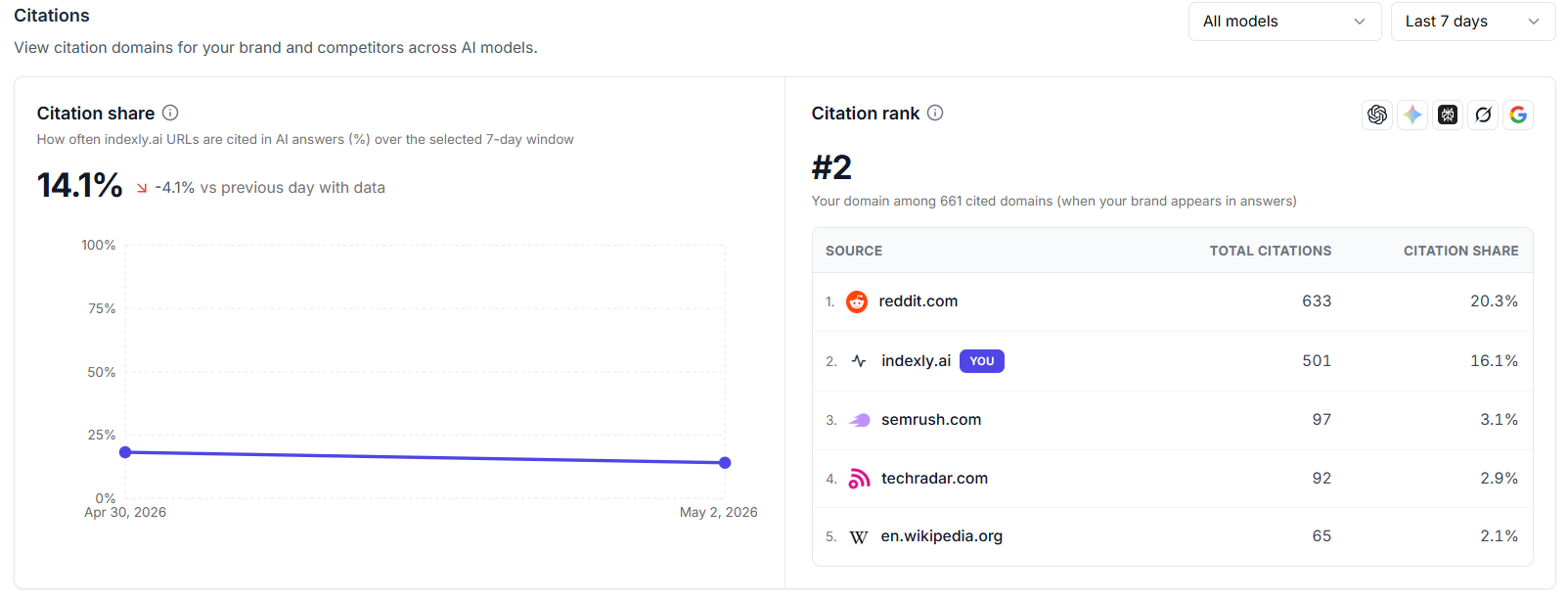
AI mentions and prompt data reveal how users actually encounter your brand in AI-driven search. Indexly’s AI mentions feature shows when ChatGPT, Claude, or Perplexity reference your brand or links to your pages.
Pair this with prompt and query logs to understand the real questions triggering those mentions, such as “best project management tools for agencies” leading to a ClickUp comparison that cites your content.
Indexly’s citation logs then help you identify which URLs, assets, and topics AI systems source most often. A B2B cybersecurity company might see repeated citations to a ransomware benchmark report or incident response playbook. Those insights can guide content refreshes, schema optimization, and link architecture, ensuring high-citation assets stay authoritative and aligned with emerging AI-generated queries.
Segmenting AI citation data for insight
Raw citation counts alone provide limited insight. Segmenting AI citations by platform helps reveal how visibility differs across Google AI Overviews, Bing, Perplexity, and other AI systems.
Businesses can also segment data by topic, user intent, and funnel stage to understand which content types are being cited most often.
Filtering by geography, language, or device further helps connect AI visibility trends with broader SEO and performance metrics.
AI Citation Dashboards for Clients
AI visibility can feel abstract to non-specialists, so your Indexly dashboards should translate citation analytics into clear business context. Build high-level views that summarize citation volume, top-cited pages, and sentiment trends so executives can quickly see whether AI systems position your brand positively on key topics.
For example, an online lender could track sentiment around “fees,” “approval speed,” and “customer support” across AI answers and monitor whether branded mentions skew favorable or critical.
Then, create recurring reports that map AI citation metrics to familiar KPIs such as organic sessions, assisted conversions, and pipeline value. Tailor views for SEO leads focusing on gaps versus competitors, for content strategists prioritizing update roadmaps, and for brand teams watching message consistency. This stakeholder-focused reporting turns Indexly into a shared source of truth for how AI search surfaces and shapes your brand’s narrative.
Read: Top 10 LLM Tracking Tools: Enhance Your Business ...
How to Improve Your AI Citation Rate
Use descriptive H2–H4 headings, short paragraphs, and concise summaries for key sections. Structuring content with scannable subheads and direct answers makes it easier for AI systems to extract relevant information.
Adding short Q&A-style answer blocks for common queries like “What is AI citation tracking?” or “How does Indexly measure AI mentions?” can further improve your visibility in AI-generated responses.
Leveraging schema, entities, and sourcing signals
Structured data helps AI systems understand what your page is about and when it’s trustworthy to cite. Implement schema types like Article, FAQ, HowTo, and Product using JSON-LD so Google, Bing, and AI search tools can reliably interpret your content and associate it with specific intents.
Maintain consistent entity naming around your brand, products, and core topics. If you use “Indexly AI Citation Tracking” in titles, schema, and internal links, AI models are more likely to recognize it as a distinct feature instead of a generic phrase, similar to how “Ahrefs Site Explorer” or “Semrush Domain Overview” are treated as clear entities.
Support key claims with outbound links to credible sources, such as Pew Research, McKinsey reports, or official product documentation. These references signal depth and reliability, which can make your page a safer citation target for AI systems that try to avoid low-quality or unsupported content.
Creating topic authority clusters
Building authority clusters tells both traditional search engines and AI that your brand owns a topic. Instead of one page on “AI search visibility,” create a pillar plus multiple focused articles that cover strategy, tools, measurement, and industry examples.
For instance, a pillar guide on “AI Search Visibility for SaaS Brands” can link to subpages on AI mentions tracking, prompt monitoring, and AI sentiment analysis using Indexly data. Each subpage links back to the pillar, creating a clear web of topical relevance that AI models can follow.
Within each cluster, target different intent stages: an educational piece like “What Are AI Citations?” (informational), a comparison such as “Indexly vs Traditional Rank Trackers for AI Search” (navigational), and a conversion-focused page like “Pricing for AI Visibility and Citation Tracking” (transactional).
Refreshing content based on AI citation gaps
AI search trends change quickly, and outdated content can lose citations to competitors. Use tools like Indexly to identify prompts where AI platforms cite competitors instead of your brand.
Update existing pages with clearer definitions, fresh data, FAQs, and sections that match common AI-generated answers. If important topics are missing entirely, create focused content targeting those recurring prompts to improve your chances of being cited.
Am I Showing Up in AI Answers? (Tracking Visibility & Mentions)
Using Indexly’s sentiment and mentions capabilities
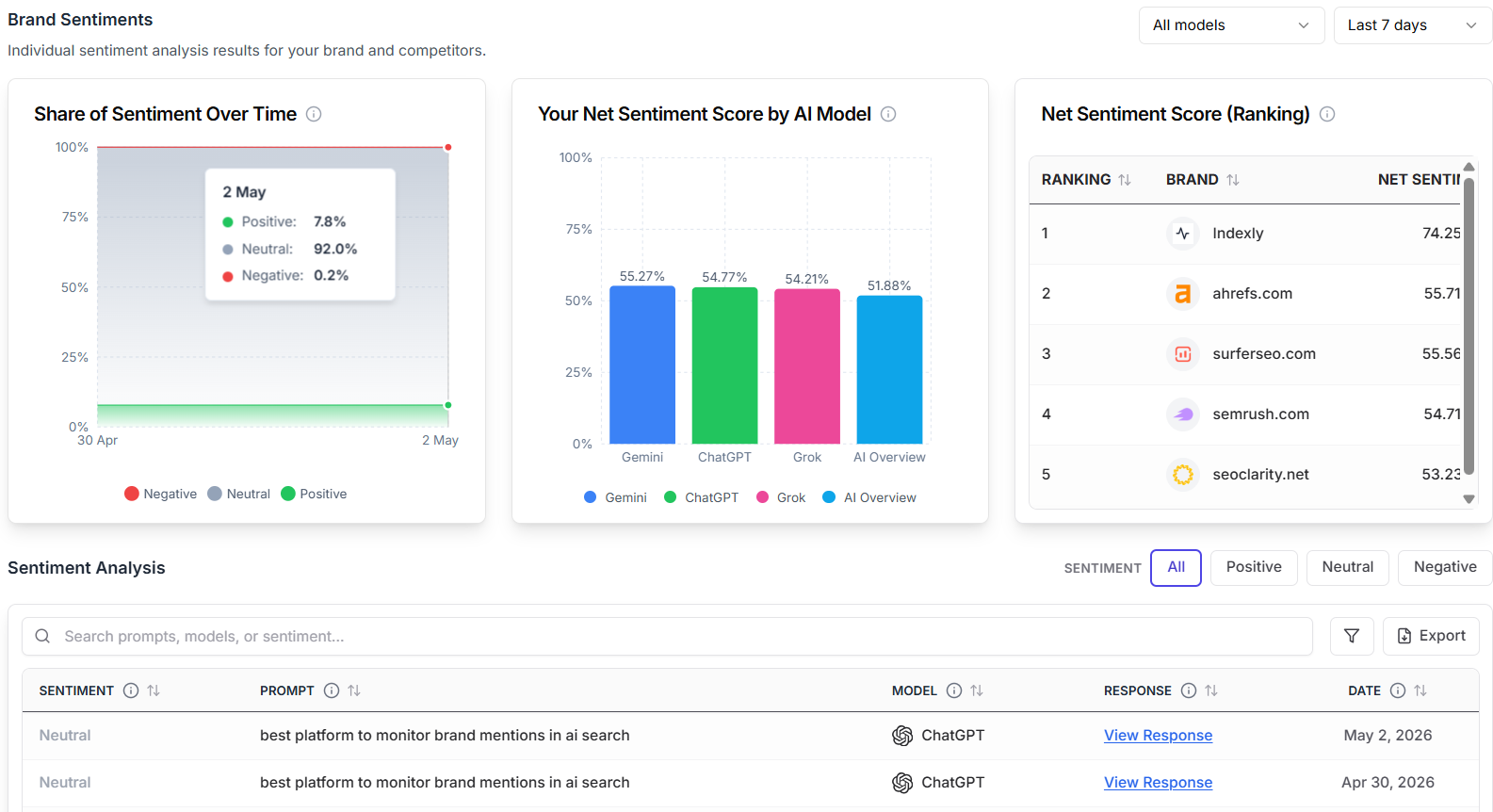
Indexly’s AI Mentions and Brand Sentiments features help you move from manual spot-checking to systematic monitoring. Instead of randomly testing prompts, you can see where and how AI systems are talking about your brand at scale.
Start by using sentiment filters to surface negative or mixed-tone mentions across Google AI Overviews, Bing Copilot, and Gemini. This quickly isolates risky narratives that need human review.
Filter logs for branded and high-intent queries such as “Indexly pricing,” “Indexly vs Semrush,” or “best AI SEO platform for agencies.” These queries often sit closest to conversion, so inaccuracies here hit revenue hardest.
Compare trends week over week to see if new angles appear, like “Indexly is only for small businesses,” which might conflict with your enterprise positioning.
Set Indexly alerts for sudden sentiment shifts or spikes in negative mentions. For example, if Perplexity responses turn negative after a TechCrunch article, alerts ensure your team reacts before the narrative hardens.
Route these alerts into Slack or email so marketing, SEO, and customer success all see issues in real time.
Read: ChatGPT Citations Explained: Sources, Accuracy, and why my site is not cited by ChatGPT
Prioritizing issues to correct or escalate
Not all AI citation errors require the same response. Teams should prioritize issues based on visibility, severity, and business impact.
High-risk inaccuracies on major platforms like Google AI Overviews — especially around compliance, security, or core product claims — should be addressed first. Minor issues, such as outdated feature details, can usually be fixed through updated content and documentation.
Serious misinformation that could affect legal, security, or brand trust should be escalated immediately to relevant internal teams.
Creating a feedback and outreach playbook
Build a clear process for handling inaccurate AI citations so teams can respond quickly and consistently. The playbook should outline how to capture evidence, verify claims internally, and submit feedback to platforms like Google, OpenAI, or Microsoft.
For serious issues, align legal, PR, and support teams on consistent messaging. Maintaining accurate profiles, reviews, and structured content across trusted industry sites also helps improve how AI systems represent your brand over time.
How to Track AI Citation Trends?
Defining KPIs for AI citation performance
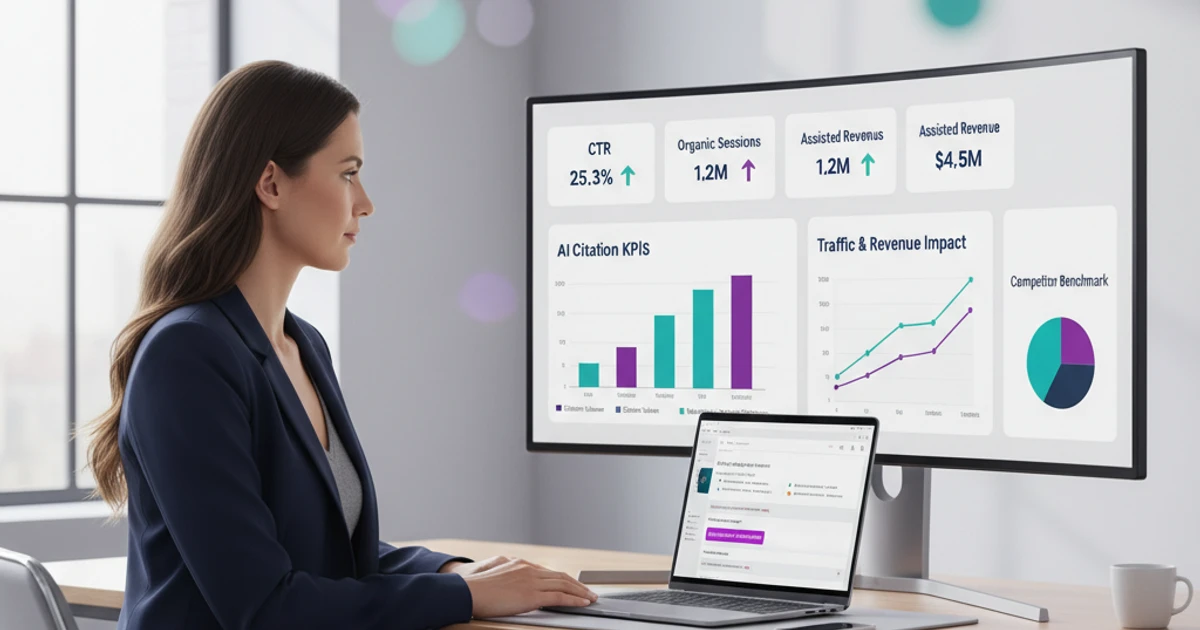
Clear KPIs turn AI citation tracking from a curiosity into a measurable growth lever.
Start by tracking citation volume across platforms and topics for branded and non-branded queries. For example, a SaaS brand might aim to increase AI citations for “SOC 2 compliant CRM” by 40% over a quarter, then compare that against content and PR pushes focused on security thought leadership.
Share of voice in AI answers is just as critical. If HubSpot appears in 60% of AI answers for “marketing automation platforms” while your platform appears in 10%, that gap becomes a concrete optimization target. Sentiment KPIs help too: monitor what percentage of mentions are positive or neutral, and set thresholds for investigation if negative framing rises above, say, 15% of total AI citations.
Connecting citations to traffic and revenue signals
AI citations rarely drive direct conversions, so businesses should track broader signals like branded search growth, direct traffic, and assisted conversions. Combining AI citation tracking with analytics tools helps connect AI visibility to real business outcomes.
Qualitative feedback also matters. Sales and support teams can help identify when prospects discover the brand through AI platforms like ChatGPT or Perplexity.
Benchmarking against competitors and tracking over time
AI citations are inherently comparative: if an AI answer lists five vendors and you are missing, that’s an immediate competitive signal. Benchmarking turns this into an ongoing intelligence stream instead of a one-off audit.
Use Indexly to monitor which competitors are cited for the same prompts and topics. If Perplexity consistently recommends Shopify, BigCommerce, and Wix for “DTC eCommerce platform” while excluding your brand, you’ve identified a content and authority gap. Track share of AI voice monthly, similar to SERP share of voice reporting.
Over a few quarters, patterns emerge. You might dominate AI citations for “enterprise SEO platform” but lag for “AI content optimization.” Those insights should influence product marketing, backlink strategy, and PR focus, guiding where you double down and where you need new content or partnerships to close the visibility gap.
Conclusion
AI citations are quickly becoming a core part of digital visibility. As platforms like ChatGPT, Perplexity AI, and Google AI Overviews reshape how users discover information, brands that monitor and optimize their AI presence will gain a major competitive advantage.
By tracking AI mentions, improving content structure, strengthening authority signals, and using tools like Indexly, businesses can increase their chances of being cited, trusted, and discovered across AI-driven search experiences.
FAQs
What are the best AI SEO tools for citations?
AI SEO tools like Indexly, Otterly AI, and Peec AI help brands track AI citations and monitor visibility across platforms such as ChatGPT, Claude, and Perplexity. These tools can identify which prompts mention your brand, which pages get cited, and how your AI visibility compares to competitors.
How to beat Competitors in AI Citations?
To outperform competitors in AI citations, create more authoritative and structured content around the topics your audience searches for. AI systems tend to favor pages with strong topical depth, clear formatting, trusted references, and consistent authority signals across the web.
Monitoring competitor mentions with tools like Indexly can also help identify citation gaps and improve your AI search visibility strategy.
How can Indexly automate AI citation tracking for different teams?
Indexly centralizes AI mentions, citations, and sentiment across platforms, giving teams a single view of visibility. It also enables reporting and integrations so agencies and in-house teams can connect AI visibility with SEO, traffic, and revenue metrics.
Who is getting cited instead of me?
AI tools may surface competitors or alternative sources when they offer more complete, clearer, or better-structured information on a topic. This highlights where your content may be underperforming in visibility.
Will AI cite my content?
Your content may be cited if it is trustworthy, well-organized, and contextually relevant. However, AI citations vary by query, so inclusion is not guaranteed or consistent.
Which queries trigger citations?
Citations are most often triggered by intent-heavy queries such as comparisons, explanations, and decision-based searches. Monitoring these helps you see where your content has the highest chance of being included in AI answers.
How AI Search Engines Rank Sources?
AI search engines generate answers using sources they see as relevant, trustworthy, and authoritative. They typically favor content that is clear, well-structured, updated, and strongly connected to a topic.
How to Generate AI Prompts for Citation Tracking?
AI citation tracking uses prompts instead of keywords because users search with natural-language questions. Converting keywords into conversational prompts helps measure brand visibility more accurately across AI platforms.
How to Monitor AI Citations for My Brand?
Businesses can monitor AI citations by testing prompts across platforms like ChatGPT, Gemini, and Perplexity through Indexly. This helps track mentions, citations, and competitor visibility to identify opportunities for improvement.
How AI Search Engines Rank Sources?
AI search engines rank sources based on relevance, authority, freshness, and content quality rather than traditional keyword rankings alone. They prioritize content that is well-structured, trustworthy, easy to understand, and closely aligned with the user’s query. Strong entity signals, clear headings, internal linking, and evidence-backed information also improve the chances of being cited in AI-generated answers.