
Managing AI prompts without tracking is like running paid ads without analytics—you can’t measure what’s actually working. As marketing teams scale AI-driven workflows in 2026, prompt tracking has become a core part of content, SEO, and AI visibility strategy.
This blog reviews the best AI prompt tracking tools based on version control, collaboration, analytics depth, and integration capabilities.
Read: 5 Common Mistakes when setting up AI Prompt Tracking
The Best Prompt Tracking Tools
Indexly
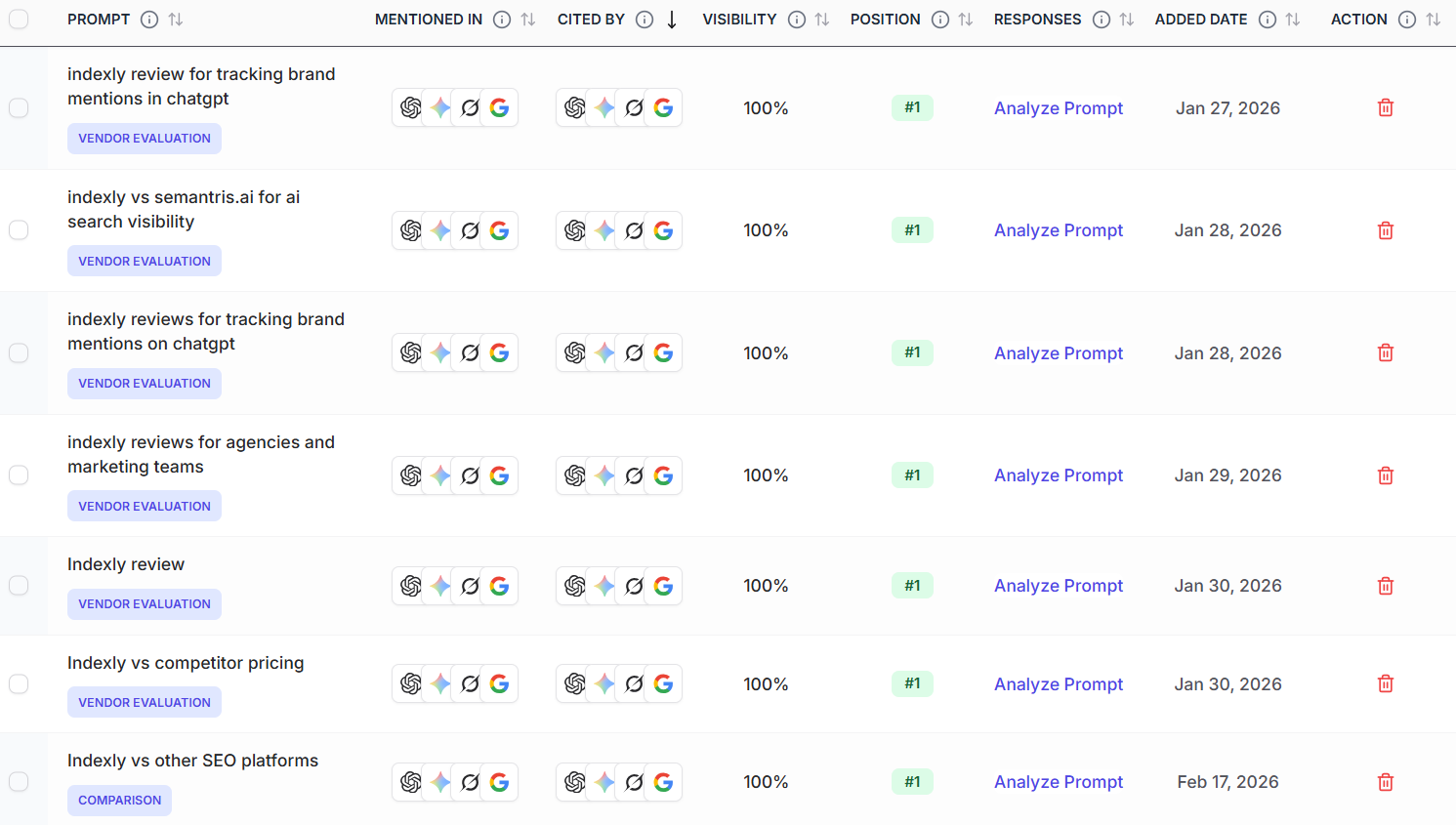
Indexly is one of the best tools for AI prompt tracking and visibility monitoring. It is designed for marketing teams seeking a unified solution for prompt management, AI content monitoring, and performance analytics.
It serves as a centralised hub for organising prompts and connecting AI-generated content directly to measurable business outcomes like traffic and conversions. Unlike developer-centric tools, Indexly is built around core marketing workflows, from content creation to ROI reporting.
For better understanding read: How Indexly Approaches Prompt Research for AI Visibility
Key Features
| Feature | Description |
|---|---|
| Centralised Prompt Library | Stores and organises AI prompts so teams can manage prompts in one centralised system. |
| Prompt Performance Analytics | Tracks how individual prompts impact SEO performance, and AI visibility. |
| AI Citation & Model Tracking | Analyses which AI models like ChatGPT, Gemini, Claude, and Copilot cite or mention your brand, including citation position, frequency, and timing. |
| Suggested Prompt Opportunities | Identifies high-potential prompts and AI search queries your brand should target to improve AI visibility and discoverability. |
| AI Content Generation | Helps teams create optimised content for tracked prompts and AI search queries directly within the platform. |
| SEO & GEO Optimisation | Supports SEO and Generative Engine Optimisation (GEO) by identifying content gaps, AI search opportunities, and prompt-driven ranking trends. |
| AI Content Monitoring | Monitors AI-generated content for brand consistency, compliance, tone accuracy, and content quality before publishing. |
| Role-Based Access and Workspaces | Provides separate workspaces, user permissions, and audit logs for agencies, teams, and multi-brand organisations. |
Pros
- Purpose-built for marketers with a UI aligned to content and SEO workflows.
- Direct mapping from prompts to business KPIs—search traffic, conversions, and revenue—through native GA4 and CRM integrations.
- Supports multi-model LLM environments, so teams using a mix of ChatGPT, Gemini, and Copilot are not locked into one ecosystem.
- Governance workflows and audit logs make it viable for regulated industries or agencies with strict client content standards.
Cons
- Not designed for deep ML experimentation or technical model evaluation; teams with heavy engineering needs will find dev-focused tools more appropriate.
- Advanced governance features such as SSO and custom approval workflows appear to be gated behind higher-tier enterprise plans.
Is Indexly Worth It for AI Prompt Tracking?
For marketing teams and agencies operating AI-assisted content programs at scale, this focus on closed-loop reporting provides a significant operational advantage that most other prompt management tools lack.
While teams seeking a simple prompt scratchpad or a highly technical LLM evaluation environment may find Indexly ill-suited to their needs, it excels for its target audience.
Overall, Indexly is the recommended prompt tracking tool for marketing teams that prioritise measurable ROI from their AI content initiatives.
PromptLayer

PromptLayer is a prompt management and logging platform designed for technical teams that need to track and version control every AI interaction. It acts as a middleware layer between applications and LLM providers to capture all data automatically. Its developer-centric features, such as granular logging and version control, are why technical marketing teams increasingly rank it among the top prompt management tools.
Key Features
| Feature | Description |
|---|---|
| Automatic Prompt and Response Logging | Automatically captures and stores every prompt and AI response across OpenAI, Anthropic, and other LLM providers through API integrations. |
| Tagging and Search | Organizes prompts using custom tags, campaigns, channels, or client labels for faster search and workflow management. |
| Usage and Latency Analytics | Tracks token usage, response times, and output quality metrics to help teams analyze prompt performance and API efficiency. |
| API-First Architecture | Integrates directly with custom workflows, dashboards, and internal tools through flexible API-based infrastructure. |
Pros
- Detailed, centralised logs provide engineering and marketing teams with a shared source of truth for every AI interaction, improving cross-functional collaboration.
- The version control makes structured prompt experimentation reproducible, which is critical for systematically iterating on ad copy or email subject line generators to improve performance.
Cons
- The platform has no native marketing KPI reporting, meaning teams must build their own dashboards or export data to BI tools to surface campaign-level insights like conversion rates or engagement.
- It offers limited out-of-the-box governance workflows compared to enterprise platforms focused on AI content monitoring, which is the process of ensuring AI-generated content adheres to brand and legal guidelines.
Humanloop
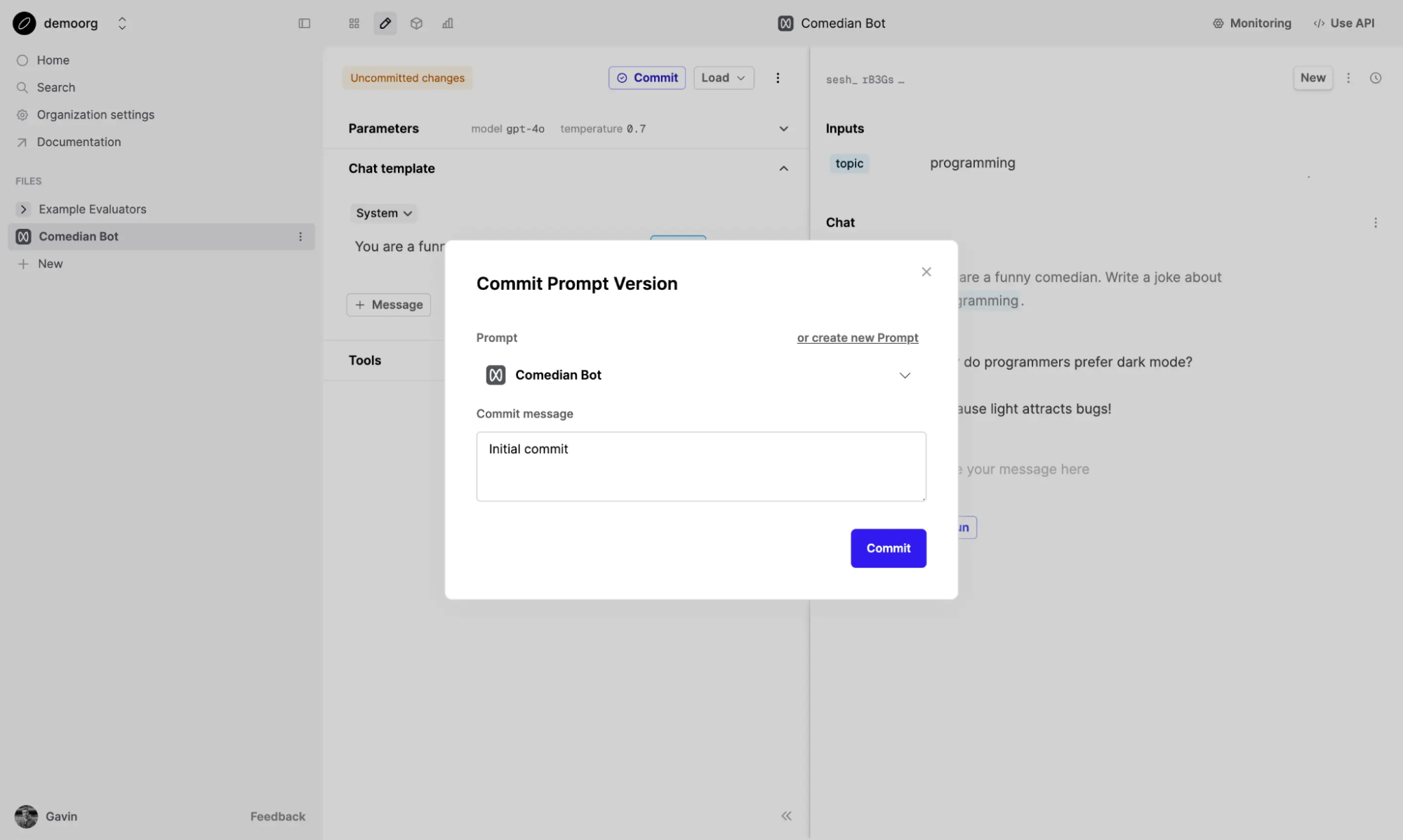
Humanloop is an AI experimentation and prompt management platform designed for teams that treat prompts as a core component of their product and growth strategy. This type of platform brings the same analytical rigor used for landing page A/B testing to the optimization of prompts that power AI features, making it a key tool for data-driven organizations.
Key Features
| Feature | Description |
|---|---|
| Central Prompt Library | Stores, organizes, and versions prompts in a centralized system with built-in experiment and evaluation workflows. |
| Multi-Model Support | Compares prompt performance across OpenAI, Anthropic, Gemini, and other LLM providers side-by-side. |
| A/B Testing Workflows | Tests and compares prompt variations using structured evaluation pipelines and performance metrics. |
| Feedback Collection Loops | Collects human feedback and ratings on AI outputs to continuously improve prompt quality and response accuracy. |
| Analytics Integrations | Connects with BI and analytics tools to measure prompt performance alongside broader business KPIs. |
Pros
- Features a strong experimentation framework that mirrors how data-driven teams already think about and execute product testing.
- Multi-model benchmarking allows teams to avoid vendor lock-in by objectively comparing outputs from models like OpenAI, Anthropic, and others.
- The integrated feedback loops create a compounding improvement cycle, ensuring prompt quality enhances continuously over time.
Cons
- Offers limited native integrations with common marketing platforms such as HubSpot or Salesforce directly out of the box.
- Connecting prompt experiment results to downstream marketing KPIs, like Customer Acquisition Cost (CAC) or Lifetime Value (LTV), requires custom instrumentation and development effort.

Otterly AI

In OtterlyAI, AI Prompt Research is a feature that converts keywords, brand names, or website URLs into realistic AI search questions. It helps you understand the kinds of prompts users are likely to enter in tools like ChatGPT, Gemini, Perplexity, or Copilot.
Rather than focusing on traditional keyword lists, it shifts the focus to natural, conversational queries, making it easier to identify how your brand or content can appear in AI-generated responses.
Key Features
| Feature | Description |
|---|---|
| Prompt Discovery | Generates and identifies real-world AI-style questions from keywords, brand names, or URLs to reflect how users may interact with AI tools. |
| Prompt Monitoring | Continuously tracks selected prompts to analyze where and how a brand shows up in AI-generated responses over time. |
| AI Visibility Tracking | Assesses whether a brand, competitor, or content is being mentioned or recommended across different AI platforms. |
| Citation Tracking | Detects and records the sources or webpages that AI systems reference in their generated answers. |
| Prompt Performance Analysis | Examines which prompts contribute to stronger visibility, mentions, or presence in AI search results. |
| Competitor Prompt Mapping | Compares brand visibility against competitors across shared prompts to highlight gaps and opportunities. |
| GEO Optimization Insights | Offers recommendations to improve visibility in Generative Engine Optimization (AI search environments). |
| Multi-Platform Coverage | Monitors AI visibility across multiple systems such as ChatGPT, Gemini, Perplexity, and Copilot. |
Pros
- Helps uncover how users are likely to frame AI-style questions around a keyword, brand, or URL.
- Identifies intent-focused queries that can enhance visibility in AI search environments (GEO).
Cons
- Generated prompts may not always align perfectly with real user behavior across AI platforms.
- Provides a narrower scope compared to full-scale SEO keyword research tools.
Weights & Biases
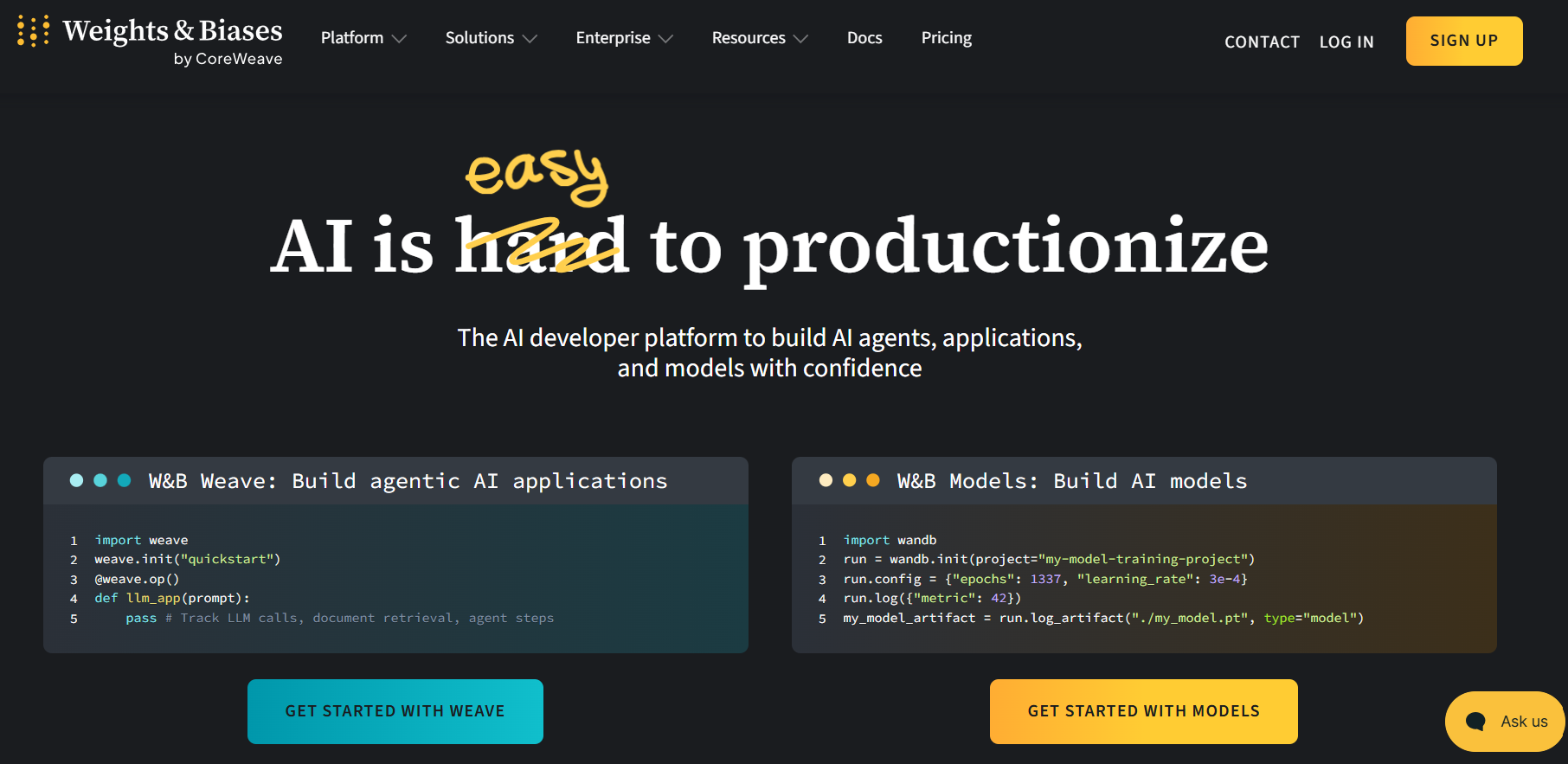
Weights & Biases (W&B) is an enterprise MLOps and experiment tracking platform designed for the rigorous, reproducible tracking of AI experiments. It provides a centralised system for data science and engineering teams to log everything from prompt variants and model comparisons to traditional machine learning pipelines, ensuring a complete and auditable history of development.
Key Features
| Feature | Description |
|---|---|
| Prompt and Hyperparameter Experiment Tracking | Logs prompt variants, model versions, and parameter configurations to maintain a complete audit-ready record of all AI experiments and results. |
| Custom Performance Dashboards | Creates real-time dashboards linked to marketing KPIs such as conversion rate and CAC by integrating external business data sources. |
| Team Collaboration Tools | Enables shared reporting and dashboards so cross-functional teams can review experiment results and insights in one place. |
| Enterprise Governance and Audit Trails | Provides role-based access control (RBAC), audit logs, and compliance-ready data handling for secure enterprise AI operations. |
| Data Warehouse and BI Integrations | Connects with tools like Snowflake, BigQuery, and Tableau to map AI experiment performance directly to revenue and customer metrics. |
Pros
- Offers enterprise-grade infrastructure with robust audit trails and security controls built in from day one, meeting the needs of regulated industries.
- Highly flexible platform that supports prompt tracking alongside traditional ML experiments in a single unified platform, preventing tool fragmentation.
- Strong integrations with data warehouses allow teams to connect prompt performance directly to revenue outcomes, proving ROI.
Cons
- Represents significant overkill for small marketing teams without dedicated engineering or data science support to manage the platform.
- Not purpose-built for marketers, as the interface and workflows assume a high degree of technical fluency and familiarity with data science concepts.
- Implementation requires a meaningful upfront investment in setup, data source integrations, and comprehensive internal team training.
Semrush
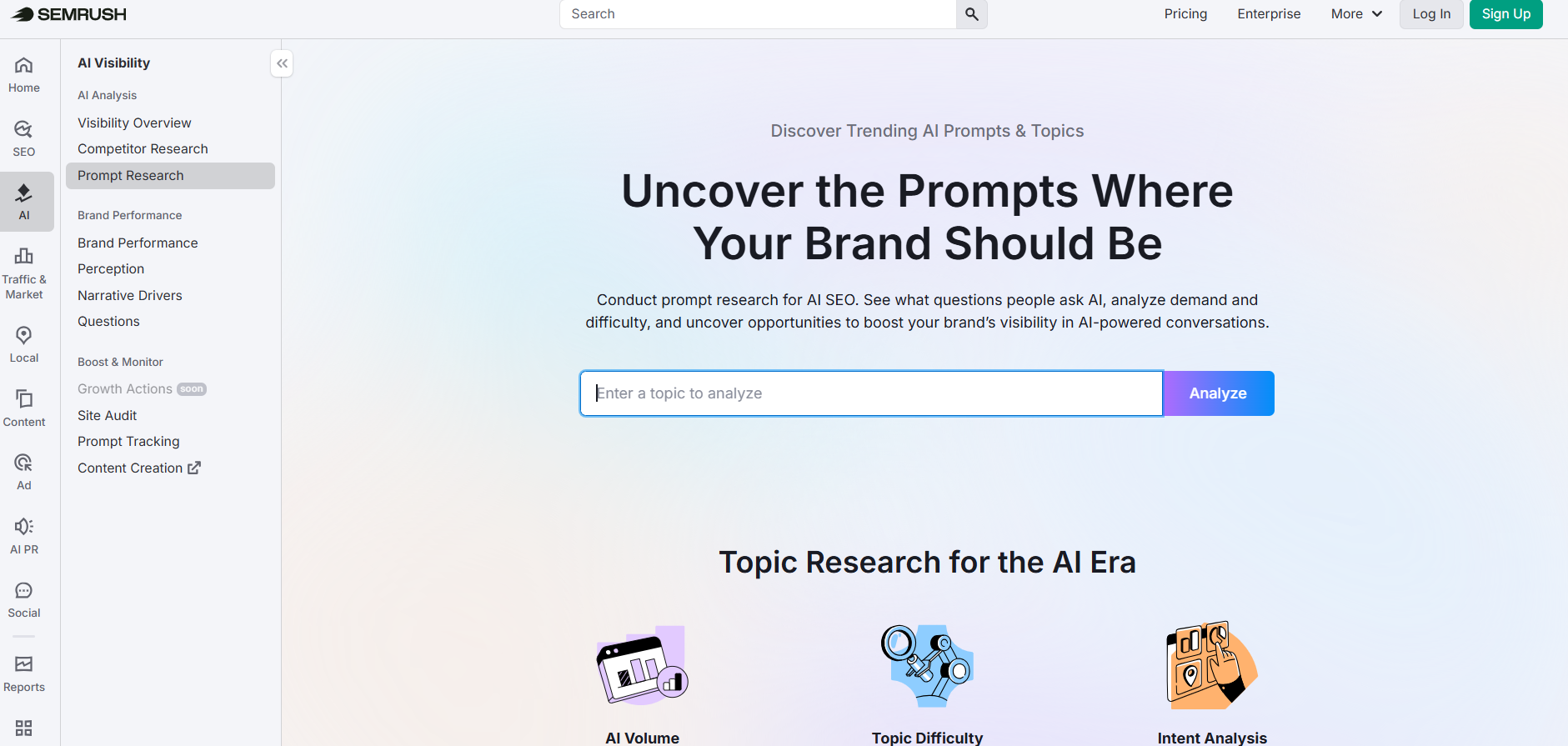
Semrush Prompt Research is an AI SEO tool that analyses the questions and prompts people type into AI platforms like ChatGPT and Google AI Mode. It shifts focus from traditional keyword research to conversational search behavior inside AI systems.
It helps marketers understand what users are asking, which topics are trending in AI-generated answers, and how often brands appear or get missed in those responses.
Read: Semrush Review 2026: Features, Pros, and Cons
Key Features
| Feature | Description |
|---|---|
| Prompt discovery system | Identifies real user prompts from AI platforms to uncover search intent. |
| Topic demand insights | Evaluates interest levels across prompt themes to spot high-value opportunities. |
| Intent grouping | Classifies prompts into informational, commercial, and transactional categories. |
| AI visibility insights | Tracks how often brands are mentioned in AI-generated answers for specific prompts. |
| High-intent prompt filters | Highlights decision-stage queries like comparisons, “best”, and “vs” searches. |
| Prompt tracking | Monitors selected prompts over time to measure changes in visibility. |
| Content ideation tools | Converts prompt data into SEO topics and content ideas. |
Pros
- Useful for identifying high-intent, conversion-focused prompts
- Supports faster content ideation for AI search optimisation
Cons
- Dataset is still evolving and not fully mature
- Requires a Semrush subscription for full access
- Can feel complex for beginners
- Not a standalone tool outside the Semrush ecosystem
- Prompt volume and demand estimates may lack precision
Arthur AI
Arthur AI is an AI performance and governance platform designed to monitor, evaluate, and manage risk across machine learning (ML) models and large language model (LLM) systems.
It provides structured oversight for enterprises that have scaled their AI initiatives beyond experimentation and now require robust compliance and performance tracking for how those systems behave at scale.
Key Features
| Feature | Description |
|---|---|
| AI Performance Monitoring Dashboards | Provides a unified view of model performance, fairness metrics, and data drift across both ML models and LLMs. Fairness metrics measure bias in outputs, while data drift refers to changes in real-world data patterns over time. |
| Output Evaluation Tools | Evaluates AI-generated outputs for quality, toxicity, bias, and policy compliance before and after deployment in production environments. |
| Governance Workflows | Offers audit trails, approval processes, and automated compliance documentation to meet legal, security, and regulatory requirements. |
| Multi-Model Pipeline Support | Enables monitoring and coordination of multiple interconnected AI models working together within complex workflows or customer journeys. |
| Enterprise Integrations | Integrates with data platforms, MLOps systems, and enterprise security tools to fit into existing organizational tech stacks. |
Pros
- Enterprise-grade governance infrastructure with robust audit trail capabilities for full accountability
- Strong focus on managing risk, ensuring fairness, and meeting regulatory compliance across live AI systems
- Supports complex, multi-model environments that most standard monitoring tools are not equipped to handle
Cons
- Not a marketing-native tool — it lacks a prompt library, campaign templates, or content-specific workflows
- Requires deep cross-functional buy-in from data science, legal, and risk teams to extract its full value
HoneyHive
.png)
HoneyHive is an LLM operations (LLMOps) platform, which is a specialized toolset designed to help teams manage the entire lifecycle of AI applications. It enables product and marketing teams to collaboratively build, test, and monitor prompt-driven applications without requiring a dedicated machine learning engineer for every project.
Key Features
| Feature | Description |
|---|---|
| Visual Prompt Studio | Allows users to build and test prompt workflows using a drag-and-drop interface without needing to write complex code or manage infrastructure. |
| Multi-Model Evaluation | Enables side-by-side comparison of outputs from different LLMs such as GPT-4, Claude, and Gemini based on quality and performance metrics. |
| Logging and Analytics | Tracks prompt usage and output performance across live systems to help understand user behavior and model effectiveness. |
Pros
- Highly accessible to non-ML specialists, such as marketers and product managers, who are managing AI features.
- Supports comprehensive multi-model testing within a single, unified workspace for direct comparisons.
Cons
- Lacks native marketing attribution integrations with common platforms like GA4 or Salesforce.
- Connecting prompt performance data to financial metrics like CAC or LTV requires custom configuration and development effort.
PromptHub

PromptHub is a prompt management platform designed for teams to organise, version, and share AI prompts across multiple projects and collaborators. It acts as a centralized prompt library, replacing scattered text files and documents, which is particularly useful for agencies managing campaigns for several clients.
Key Features
| Feature | Description |
|---|---|
| Shared Prompt Libraries | Provides a structured system to store and organize prompts using folders, tags, and metadata, making it easier to filter and retrieve prompts by campaign, client, or channel. |
| Version Control | Maintains a full history of prompt changes and approvals, allowing teams to restore earlier versions and track edits for consistency and quality control. |
| Collaboration Tools | Enables team members to comment, suggest edits, and refine prompts together within the platform for smoother collaborative workflows. |
| Basic Usage Analytics | Offers basic insights into prompt usage and performance when connected with external data sources, helping identify which prompts are most effective. |
| Role-Based Access Control | Allows teams to create separate workspaces with controlled access, ensuring users only see prompts relevant to their assigned projects or clients. |
Pros
- The platform features an intuitive prompt library that significantly reduces onboarding time for new team members.
- It offers a strong fit for agencies tasked with managing prompts across several client brands simultaneously, keeping assets organized and secure.
- Built-in collaboration workflows help reduce back-and-forth communication over email or disparate shared documents.
Cons
- Its analytics capabilities are lighter than what is found in dedicated AI observability tools like Weights and Biases, focusing more on basic usage metrics.
- Achieving deeper KPI tracking and performance analysis requires external BI integration to connect prompt usage to specific business outcomes.
Conclusion
Choosing the right AI prompt tracking tool depends on your team size, goals, and how deeply you want to connect prompts to performance metrics. Simple tools like PromptHub and PromptLayer are ideal for basic prompt organisation, while Indexly offers a more advanced platform with AI visibility, SEO/GEO insights, and performance-driven tracking.
Otterly AI focuses mainly on monitoring brand mentions across AI systems but provides limited support for optimisation or ROI analysis. The right choice depends on whether you need lightweight tracking or a full AI visibility and analytics solution.
Frequently Asked Questions
How to Set Up AI Prompt Tracking in Indexly for Enterprise SEO Under $1000/Month?
To set up AI prompt tracking in Indexly, select a suitable plan such as Growth or Scale, then start by adding and grouping SEO-focused prompts based on campaigns or keyword themes. Turn on AI visibility tracking to monitor how your brand appears across models like ChatGPT and Gemini, and integrate tools like GA4 or CRM to connect prompt activity with traffic and conversions. Use these insights to create and optimise SEO content while continuously tracking performance across AI platforms.
Which tool is better: Indexly vs Semrush for AI Prompt Tracking?
Indexly focuses on unified prompt tracking, AI content workflows, and ROI attribution across prompts and business metrics. Semrush Prompt Research, on the other hand, focuses more on identifying AI-style search queries and turning them into SEO content opportunities. In short, Indexly is execution + tracking, while Semrush is primarily research + ideation.
What is the top AI Prompt Monitoring Software for SEO Teams?
Top AI prompt monitoring tools for SEO teams include Indexly, Semrush Prompt Research, Otterly.ai, and PromptLayer. These platforms help identify how prompts perform across AI systems, track brand visibility in AI-generated answers, and uncover opportunities for optimisation in generative search environments.
What is Indexly pricing for AI Prompt Tracking and how many Prompts you get?
Indexly pricing generally depends on team size, usage volume, and required integrations. Higher-tier plans typically support larger prompt volumes, advanced analytics, and multi-workspace management. Exact prompt limits vary by plan and are usually customised for enterprise and agency requirements.
What are the Best AI Prompt Tracking tools for a 10 person marketing team under $100/mo?
For teams under $100/month, tools like PromptHub and basic PromptLayer are best for simple prompt storage, version control, and basic analytics. Indexly ($99/month) sits above this tier, adding AI visibility, SEO/GEO insights, and prompt-to-ROI tracking.
What do users say about Indexly's prompt tracking features?
Users generally highlight Indexly’s ability to connect prompts directly to marketing outcomes such as traffic, conversions, and AI visibility. It is often praised for combining prompt management, SEO insights, and content workflows in one platform, making it more suitable for marketing teams compared to developer-focused tools.
How much does Indexly cost for Prompt monitoring and does it work with our Martech Stack?
Indexly starts at $99/month (Starter plan), with higher tiers like Growth ($299/month) and Scale ($499/month) depending on prompt volume, features, and integrations. Enterprise pricing is custom.
Yes, Indexly works with modern Martech stacks by integrating with tools like GA4, CMS platforms, CRM systems, and BI/data warehouses, allowing teams to connect prompt tracking with SEO performance, traffic, and conversion data.
Which tool is better: Indexly vs Otterly AI for Prompt Tracking?
Indexly is the more comprehensive platform, combining prompt tracking with AI visibility, SEO/GEO insights, and performance measurement tied to traffic and conversions. Otterly AI is primarily focused on tracking brand mentions across AI platforms and offers limited capabilities for SEO depth or ROI-based analysis.