
Semrush has changed dramatically from what it originally set out to be. What once focused mainly on keyword research and competitor analysis has now evolved into a full ecosystem shaped by AI visibility, content intelligence, and changing search behaviour. Alongside this evolution, Semrush pricing has also shifted—from straightforward SEO plans to a more layered, modular system that scales with different tools and capabilities.
As AI-generated answers are reshaping how users discover brands, tools like Semrush are adapting to track and optimise this new layer of visibility.
Semrush pricing reflects this shift. Instead of a single fixed plan, it now combines traditional SEO, AI visibility, content optimisation, and multiple marketing toolkits into a modular system. This makes it powerful, but also slightly more complex to navigate.
In this blog, we’ll break down how Semrush pricing works, explore its plans and features, and help you decide whether it delivers the right value for your needs in 2026.
Read: Semrush Review 2026: Features, Pros, and Cons
How Semrush Pricing Works
Semrush follows a subscription-based pricing structure, where what you pay depends on the plan and toolkits you select—not on a credit or usage system. Each plan includes set monthly limits, such as the number of projects, keywords you can track, reports, and overall data access.
The platform is structured around SEO Classic plans and Semrush One, along with additional toolkits like Local Plans, Social Plans, Content Plans, and Advertising Plans. These can be used on their own or combined to match different marketing needs.
Rather than offering a single all-in-one plan, Semrush uses a modular setup. Most users begin with a core plan and then expand by upgrading tiers or adding more toolkits. As you move to higher plans, limits increase, and more advanced features become available, including API access, content optimisation, keyword cannibalisation analysis, and daily monitoring.
Pricing starts at around $139.95 per month for the Pro plan under SEO Classic, with Guru and Business plans offering higher limits and additional features at increased costs. Semrush One and Semrush Enterprise follow separate pricing models, with Enterprise plans offering custom pricing based on business size, integrations, and data needs.
Overall, this model makes Semrush scalable and fairly predictable, since pricing is based on fixed plans. However, total costs can increase as you add more toolkits, users, or advanced capabilities over time.
Semrush Pricing Plans
Semrush structures its pricing across SEO Classic plans, Semrush One, and Enterprise solutions, with additional flexibility provided through add-on toolkits such as Local Plans, Social Plans, Content Plans, and Advertising Plans.
SEO Classic Plans
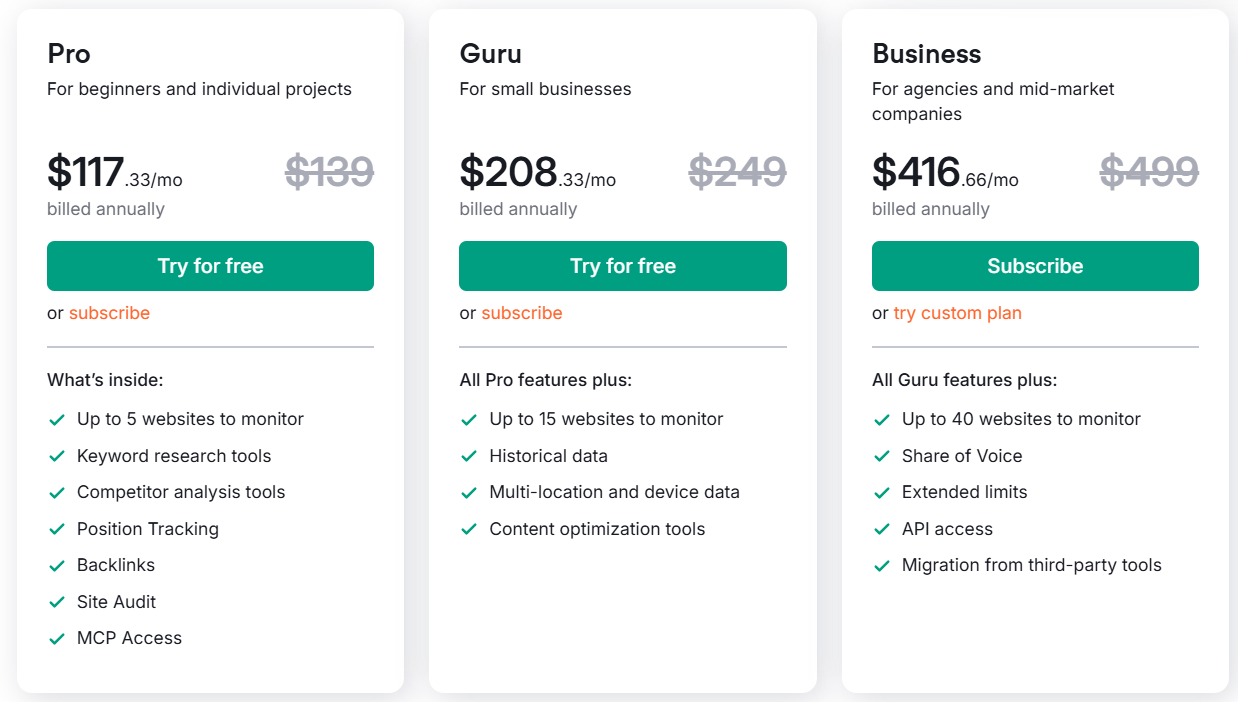
The SEO Classic Plans are the core of Semrush, built for traditional SEO tasks like keyword research, backlink analysis, site audits, and competitor tracking.
Pro Plan
The Pro Plan is the starting tier, suited for freelancers, startups, and smaller teams.
It includes essential SEO features such as keyword research, domain analytics, and site audits, along with limited project capacity and keyword tracking (typically up to 5 projects and 500 keywords). This makes it ideal for basic SEO use cases.
The plan also includes content optimisation tools and daily monitoring of keyword rankings. However, advanced features like API access and extended reporting are not part of this tier.
Guru Plan
The Guru Plan is designed for growing teams and agencies that need more advanced functionality and higher limits.
It builds on the Pro plan by increasing project limits and keyword tracking (up to around 1,500 keywords), while also unlocking historical data for deeper insights.
This plan improves content optimisation capabilities and includes keyword cannibalisation analysis, helping teams refine their SEO structure. It also offers better reporting and broader data access, though full API access is still not available.
Business Plan
The Business Plan is the highest tier within SEO Classic, intended for large businesses and enterprise SEO teams.
It provides significantly higher limits across projects, keyword tracking (up to around 5,000 keywords), and reporting. A key feature is full API access, allowing integration with internal systems and automated workflows.
It also includes advanced analytics, deeper competitive insights, and supports large-scale daily monitoring, making it suitable for complex and high-volume SEO operations.
Semrush One
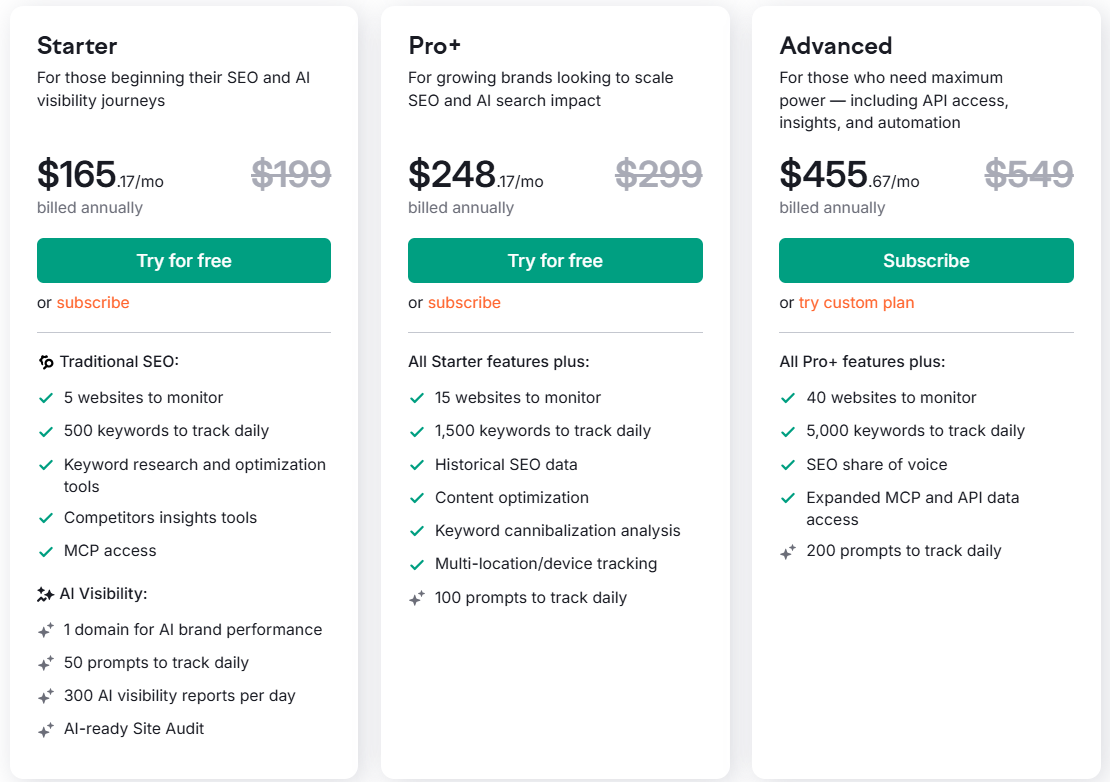
Semrush One is an integrated solution that combines traditional SEO with AI visibility tracking, reflecting the shift toward AI-driven search environments.
It merges core SEO tools with features that track how brands appear across AI-generated platforms like ChatGPT and other LLMs.
The platform is available in multiple tiers:
- Starter → Covers basic SEO and AI visibility tracking
- Pro+ → Adds higher limits, content optimization, and keyword cannibalization analysis
- Advanced → Includes expanded limits, automation, and full API access
Semrush One also offers daily monitoring across both search engines and AI platforms, along with multi-location tracking and unified performance reporting.
Overall, it is built for teams managing both search rankings and AI visibility in one place.
Semrush Enterprise
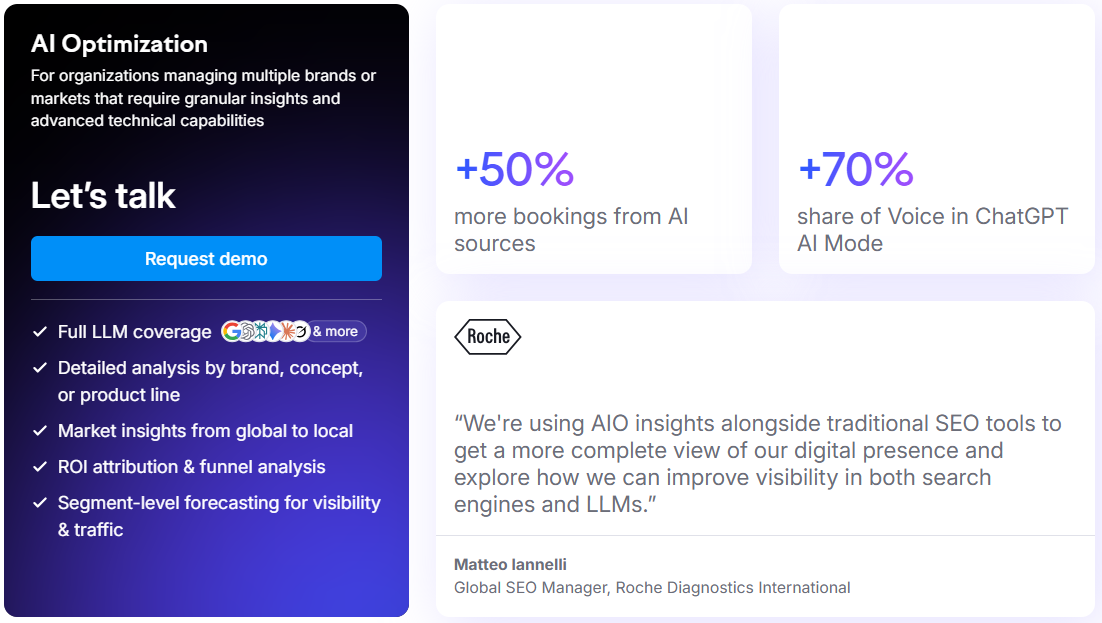
The Semrush Enterprise plan is a custom-built solution designed for large organisations, global brands, and agencies operating at scale.
It includes all standard features, along with flexible limits tailored to business requirements. This allows teams to handle large datasets, manage multiple markets, and run complex SEO strategies efficiently.
A major benefit is full API access, enabling deep integration with internal systems, reporting tools, and data pipelines. It also supports advanced automation, large-scale daily monitoring, and cross-region tracking.
Additional features include dedicated support, onboarding assistance, and custom reporting for enterprise-level operations.
Additional Toolkits (Add-On Plans)
Semrush also provides specialised toolkits that can be added to any core plan, expanding its capabilities across different marketing functions.
Local Plans
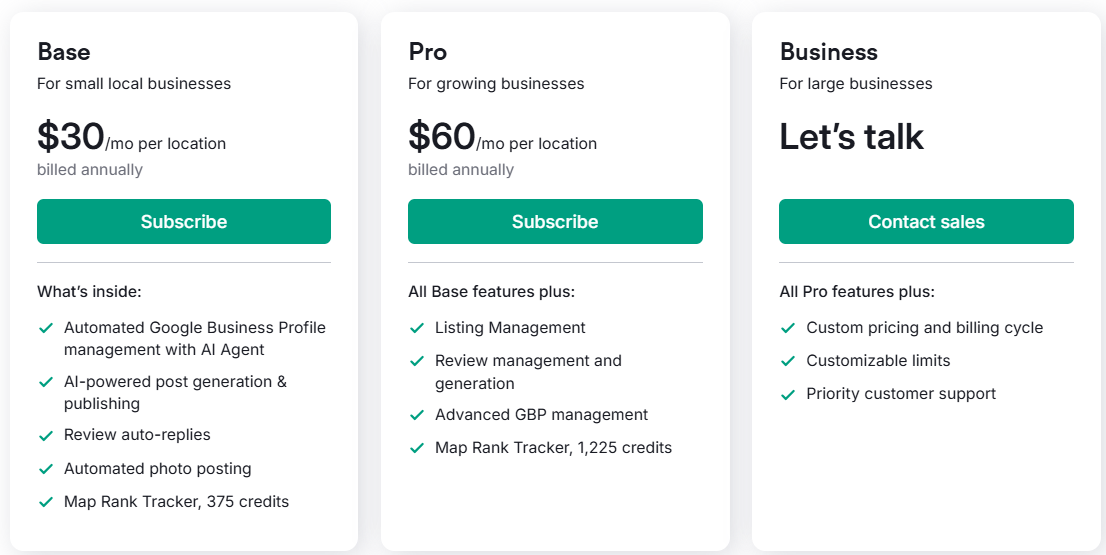
The Local Plans are focused on improving visibility in local search results. They include tools for managing business listings, monitoring reviews, and tracking local keyword rankings, helping businesses maintain accurate information and strengthen their local presence.
Social Plans
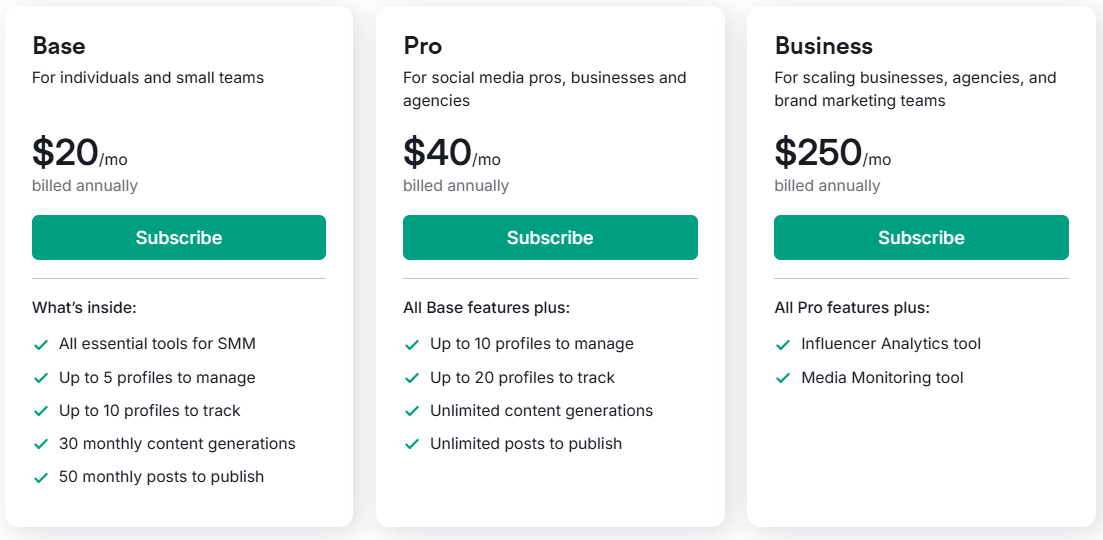
The Social Plans are designed for social media management, offering features for scheduling posts, analysing engagement, and tracking performance. They also include competitor benchmarking to help refine social strategies.
Content Plans
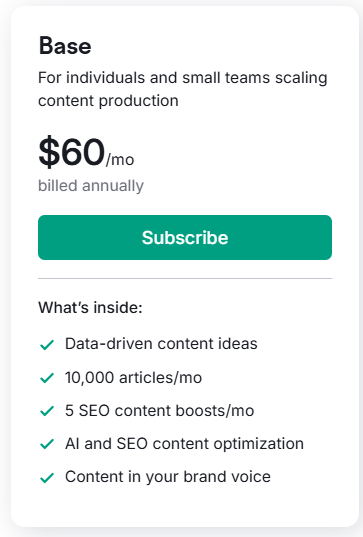
The Content Plans are centred around content optimization, providing tools like SEO writing assistance, topic research, and content audits to improve visibility and engagement.
Advertising Plans
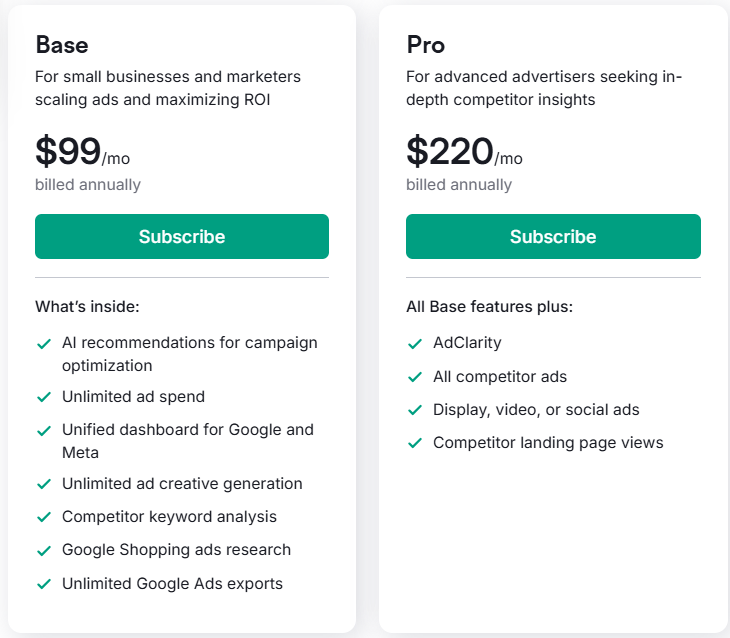
The Advertising Plans support paid campaigns with tools for PPC keyword research, competitor ad analysis, and performance tracking, helping businesses optimise ad spend and campaign results.
AI PR Toolkit
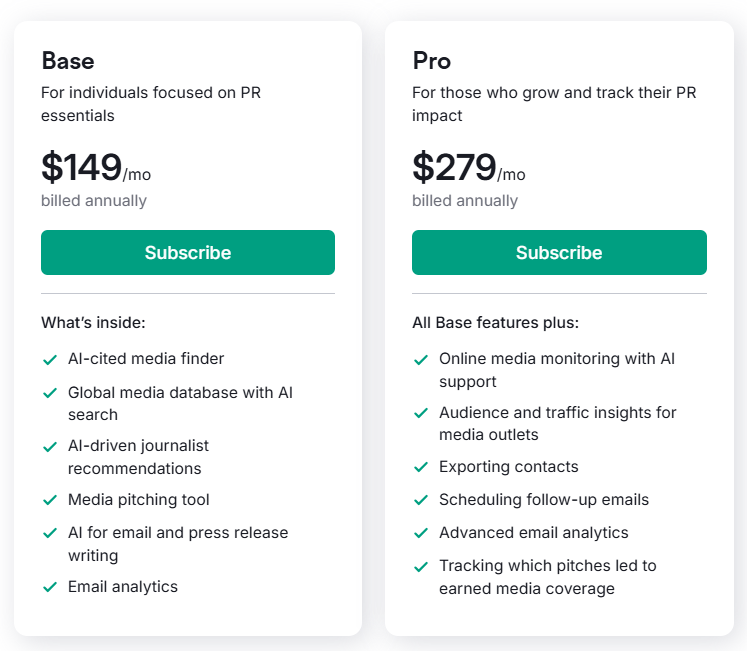
The AI PR Toolkit helps improve brand visibility through digital PR by enabling journalist discovery, outreach, and performance tracking. The Base Plan covers core outreach tools, while the Pro Plan adds monitoring, alerts, and analytics. It strengthens AI PR visibility by increasing citations in sources used by large language models.
Overall, Semrush pricing plans are designed to scale from individual users to large enterprises, combining traditional SEO, AI visibility, content optimisation, and multi-channel marketing tools within a flexible and modular framework.
Pros of Semrush Pricing
Semrush pricing reflects its positioning as a high-end SEO and digital marketing platform, offering solid value for teams that depend on detailed data and insights.
One of its biggest strengths is the all-in-one toolkit. Even the Pro plan provides access to a wide range of features like keyword research, competitor analysis, and site audits, reducing the need for multiple tools.
The platform also delivers strong ROI, especially for agencies and experienced marketers. Its data and insights can help drive better rankings, higher traffic, and improved conversions when used effectively.
Another advantage is the free trial, which lets users explore the platform before committing. Plus, annual billing discounts make it more cost-effective for long-term use.
Semrush pricing is also highly scalable, with plans designed to support everyone from freelancers to large enterprises.
Read: Understanding Promptwatch Pricing: A Complete Overview
Cons of Semrush Pricing
Despite its benefits, Semrush pricing may not suit all users, particularly those with limited budgets.
The most notable downside is the high starting price, which begins at over $130 per month—making it less accessible for individuals or small businesses.
Another drawback is limited user access, as most plans include only one seat. Adding extra users can quickly increase overall costs.
Semrush also relies on paid add-ons for certain features, meaning tools like AI writing assistants or advanced analytics may require additional fees.
The free version is quite restricted, offering only a limited number of searches per day, which can be insufficient for regular use.
Lastly, historical data access is only available in higher-tier plans like Guru and above, limiting deeper analysis for entry-level users.
Read: AI Visibility Tracking Tools Pricing Comparison 2026 Guide
Is Semrush Pricing Worth It?
Semrush pricing is justified—if you make full use of its features.
It brings together keyword research, competitor analysis, site audits, content optimisation, and AI visibility in one platform. For agencies and performance-driven teams, this can deliver strong ROI by boosting rankings, traffic, and conversions while reducing reliance on multiple tools.
However, its value largely depends on how often and how deeply you use it.
If you’re:
- Running multiple campaigns
- Tracking extensive keyword lists
- Regularly working on content optimisation
Then Semrush can easily pay for itself.
But if you’re:
- A beginner or solo user
- Managing a small website
- Using SEO tools only occasionally
The pricing may feel excessive for your needs.
Read: Understanding AthenaHQ Pricing: A Complete Overview
Conclusion
Semrush pricing ultimately comes down to how you structure and scale your usage. With multiple plans, toolkits, and add-ons, it offers a high level of flexibility—but also requires careful selection to avoid unnecessary costs.
Rather than being a one-size-fits-all solution, Semrush works best when aligned with clear marketing goals and defined workflows. Choosing the right combination of plans and features is key to getting the most value without overspending.
For teams that can strategically leverage its ecosystem, Semrush becomes less of an expense and more of a long-term growth investment.
FAQs
1. How much does Semrush cost?
Semrush pricing starts at approximately $139.95 per month for the Pro plan under SEO Classic.
2. What is Semrush One?
Semrush One is an integrated platform that combines traditional SEO tools with AI visibility tracking, helping users monitor both search engine rankings and AI-generated results.
3. Is API access included in Semrush plans?
Yes, API access is available in higher-tier plans such as the Business plan and advanced Semrush One tiers.
4. Are there extra costs with Semrush?
Yes, Semrush includes optional add-ons like Local Plans, Social Plans, Content Plans, and Advertising Plans, which can increase overall pricing.
5. Is Semrush good for beginners?
While beginners can use Semrush, its pricing and advanced capabilities make it more suitable for professionals, agencies, and businesses with ongoing SEO needs.