
AI search is changing how brands get seen—fast. This is where AthenaHQ positions itself—as a specialised platform focused on AI visibility, citation intelligence, and Generative Engine Optimisation (GEO).
Unlike traditional SEO tools with fixed pricing structures, AthenaHQ uses a credit-based system tied directly to platform usage. This means costs are not just determined by the plan you choose, but by how actively you monitor, analyse, and optimise your presence across AI ecosystems.
In this blog, we’ll break down how AthenaHQ pricing works, what each plan includes, and whether the platform offers enough value to justify its premium, usage-driven model.
How AthenaHQ Pricing Works
AthenaHQ follows a usage-linked credit system, where platform activity determines overall cost. Each subscription includes a fixed number of monthly credits, and these are consumed based on actions performed within the platform.
Credits are used for activities such as AI visibility tracking, citation analysis, AI crawling, competitor benchmarking, and multi-model response evaluation. Because each function draws from the same credit pool, overall usage directly impacts monthly expenditure.
Pricing begins at approximately $295 per month for the Self-Serve plan, while Enterprise pricing is customised based on operational scale, integrations, and data requirements.
This structure makes AthenaHQ inherently scalable, but also variable, as higher monitoring intensity naturally leads to increased credit consumption.
Read: AthenaHQ Review 2026: Features, Pros, and Cons
AthenaHQ Pricing Plans
AthenaHQ offers two main pricing tiers: Self-Serve and Enterprise, with usage-based scaling through credits.
Self-Serve Plan
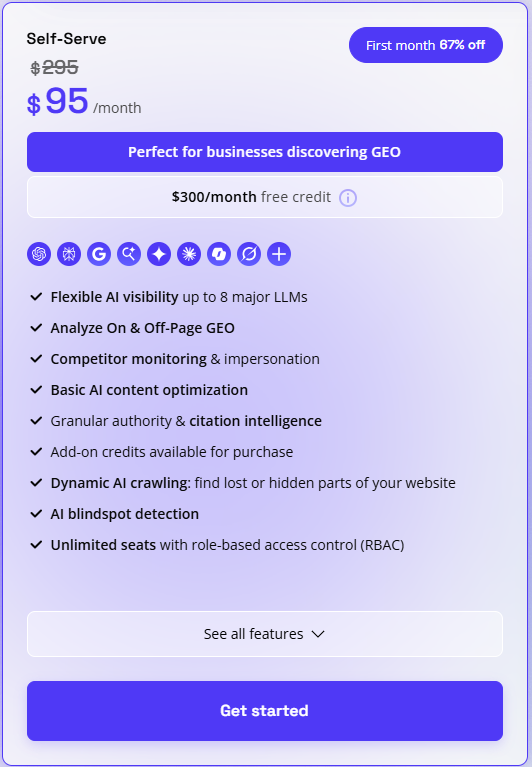
The Self-Serve Plan is AthenaHQ’s entry-level tier, intended for small businesses and teams beginning with AI visibility tracking and GEO (Generative Engine Optimisation). It provides coverage across major AI models such as ChatGPT, Perplexity, Gemini, Claude, Copilot, Grok, and others, enabling users to monitor how their brand is represented in LLM-generated responses.
The plan includes a monthly credit pool (around $300 in usage credits) that is used for activities like AI visibility searches, citation intelligence analysis, AI crawling, and competitor monitoring. It also offers on-page and off-page GEO analysis, helping teams evaluate both content performance and external visibility signals.
Key features include AI blindspot detection, which highlights missing or weak visibility areas in AI results, and dynamic AI crawling, which helps uncover hidden or unindexed pages. It also includes basic AI content optimisation tools, competitor tracking, and impersonation monitoring for brand protection.
The plan supports unlimited users with role-based access control (RBAC) for team collaboration. However, it does not include advanced features such as API Access, automation workflows, deep AI traffic analytics, or the Athena Citation Engine, making it more suitable for foundational AI visibility use cases rather than enterprise-level GEO operations.
Enterprise Plan
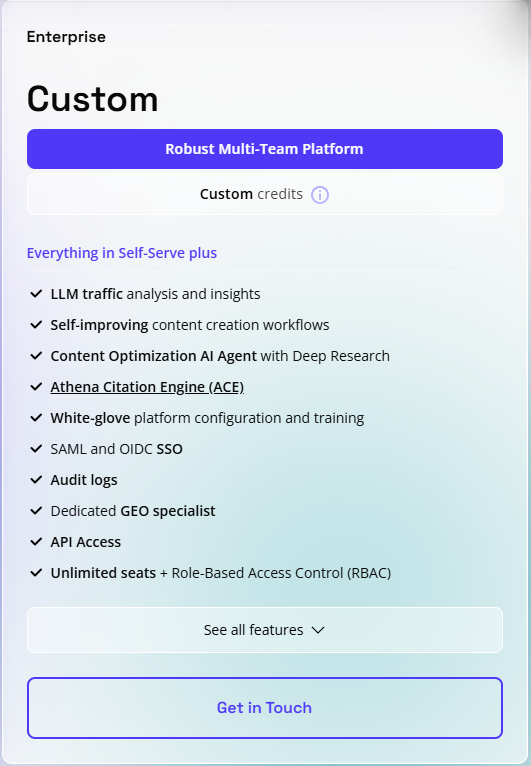
The Enterprise Plan is AthenaHQ’s highest tier, designed for large organisations, agencies, and enterprise SEO teams operating complex AI visibility and GEO systems at scale. It focuses on advanced analytics, automation, and multi-market coverage.
It includes all Self-Serve features, along with custom credit allocation based on operational needs, allowing flexible scaling across high-volume usage and multiple regions. It also adds LLM traffic analysis, providing deeper insight into how AI systems process and surface brand information.
A key component is the AI Content Optimization Agent, which uses deep research to automate content improvements and streamline GEO execution. The plan also includes the Athena Citation Engine (ACE), which delivers advanced citation intelligence for tracking and improving brand visibility in AI-generated responses.
Users get full API Access for integration with internal platforms, reporting systems, and automated workflows. It also supports multi-region and multi-language AI visibility tracking, making it suitable for global brands.
Additional features include SAML and OIDC SSO for secure enterprise authentication, dedicated GEO specialist support, white-glove onboarding, and full setup assistance. It also provides executive dashboards with BI tool integrations such as Power BI, Tableau, and Looker, along with unlimited seats and advanced RBAC permissions for structured team management.
Overall, the Enterprise Plan is built for organisations that need a scalable AI visibility and GEO infrastructure combining automation, intelligence, and enterprise-grade control.
Pros of AthenaHQ Pricing
AthenaHQ pricing is structured as a premium AI visibility and GEO solution, offering strong value for teams focused on improving brand presence across AI-generated search results.
One of its main advantages is the complete, unified feature stack, which includes AI bot analytics, citation intelligence, LLM tracking, and the Olympus dashboard for centralised monitoring. This reduces the need to rely on multiple separate tools.
The platform also supports unlimited users with role-based access control (RBAC), making it more cost-effective for agencies and large organisations compared to per-user pricing systems.
AthenaHQ is generally viewed as competitive in value compared to its price, offering a broader and more advanced feature set than many similar tools in the same pricing category.
It also provides strong ROI potential through AI-driven insights and automation, helping teams minimize manual SEO effort while improving decision-making through intelligent recommendations and agents.
Overall, the pricing is well-aligned for teams scaling into advanced GEO and AI visibility strategies, with enterprise-level capabilities available without immediate forced upgrades.
Cons of AthenaHQ Pricing
Despite its strengths, AthenaHQ pricing can feel expensive, with the entry point around $295 per month, which may be a barrier for smaller teams or early-stage users.
The platform uses a credit-based system, where usage directly consumes credits. Because multi-model tracking and frequent monitoring can quickly deplete credits, overall costs may fluctuate and become harder to control.
There is also no free trial option, limiting the ability for users to test the platform before committing to a paid plan.
Several advanced capabilities, including deeper analytics and automation features, are restricted to higher-tier plans, reducing functionality for users on lower packages.
Additionally, extra credit usage charges can increase monthly expenses, especially for teams with growing workloads or unpredictable monitoring needs.
Read: Understanding Promptwatch Pricing: A Complete Overview
Is AthenaHQ Pricing Worth It?
AthenaHQ pricing is a strong fit for teams that actively work on AI visibility, citation intelligence, and GEO-driven growth strategies, where presence in AI-generated answers is a continuous priority rather than a one-off task.
It adds value by bringing together AI visibility tracking, citation insights, competitor analysis, and AI bot data in a single platform. This makes it easier to understand how a brand is represented across LLM outputs and quickly detect missing citations or content gaps without switching between multiple tools.
The platform is most effective when used for ongoing optimisation, where insights are regularly applied to improve content performance and strengthen GEO outcomes. Its AI-driven recommendations also help streamline workflows and reduce manual analysis effort.
That said, it may not be ideal for small teams or infrequent users, as its pricing structure delivers the best results only when the platform is used consistently as part of an active AI optimisation strategy.
Conclusion
AthenaHQ pricing starts at a premium level and follows a credit-based system rather than a fixed flat fee, which makes the actual monthly cost dependent on usage patterns.
While the Self-Serve plan provides a structured entry point, expenses can increase with higher monitoring activity, additional credits, or expanded usage across AI models. The lack of a free trial and gated advanced features also means most cost justification comes only after active adoption.
Overall, the pricing is best understood as usage-driven and scalable rather than fixed and predictable, making it more suitable for teams comfortable managing variable monthly spend.
FAQs
1. How much does AthenaHQ cost?
AthenaHQ pricing starts at around $295 per month for the Self-Serve plan, while Enterprise pricing is custom and depends on usage, credits, and required integrations.
2.Is AthenaHQ one of the best AI search visibility tools?
Yes. AthenaHQ is one of the leading AI search visibility tools for tracking brand visibility, share of voice, and competitor performance across AI search platforms. Teams looking for a simpler, action-focused workflow with AI citation tracking, prompt tracking, and content optimisation find Indexly a better fit.
3. Does AthenaHQ use a usage-based pricing model?
Yes. AthenaHQ follows a credit-based system, where credits are consumed based on activities like AI visibility tracking, citation analysis, AI crawling, and multi-model response monitoring.
4. Is there a free trial for AthenaHQ?
No, AthenaHQ does not currently offer a free trial, meaning users need to subscribe to a plan to access the platform.
5. What is included in the Self-Serve plan?
The Self-Serve plan includes AI visibility tracking across multiple LLMs, citation intelligence, competitor monitoring, AI blindspot detection, dynamic AI crawling, and RBAC-based team access.
6. Who should use AthenaHQ pricing plans?
AthenaHQ is best suited for marketing teams, agencies, and enterprises focused on AI visibility, GEO strategies, and citation intelligence, rather than small or occasional users.