
Choosing the wrong Generative Engine Optimisation (GEO) tool can weaken your AI visibility and limit growth opportunities. The challenge is that AI search results are constantly evolving, with sources and citations frequently shifting across platforms. In such a fast-changing environment, traditional tracking methods often fall short of capturing your true presence in AI search.
This is where the Peec AI vs AthenaHQ comparison becomes important. While both platforms help you track your presence across AI tools, they take very different approaches. Peec AI is built for clear, reliable visibility tracking, helping teams understand where they stand. AthenaHQ goes further by combining insights with automation, optimisation, and performance tracking to drive measurable outcomes.
In this blog, we’ll break down Peec AI vs AthenaHQ, exploring their features, differences, and use cases to help you choose the right tool for your needs.
What Is Peec AI?
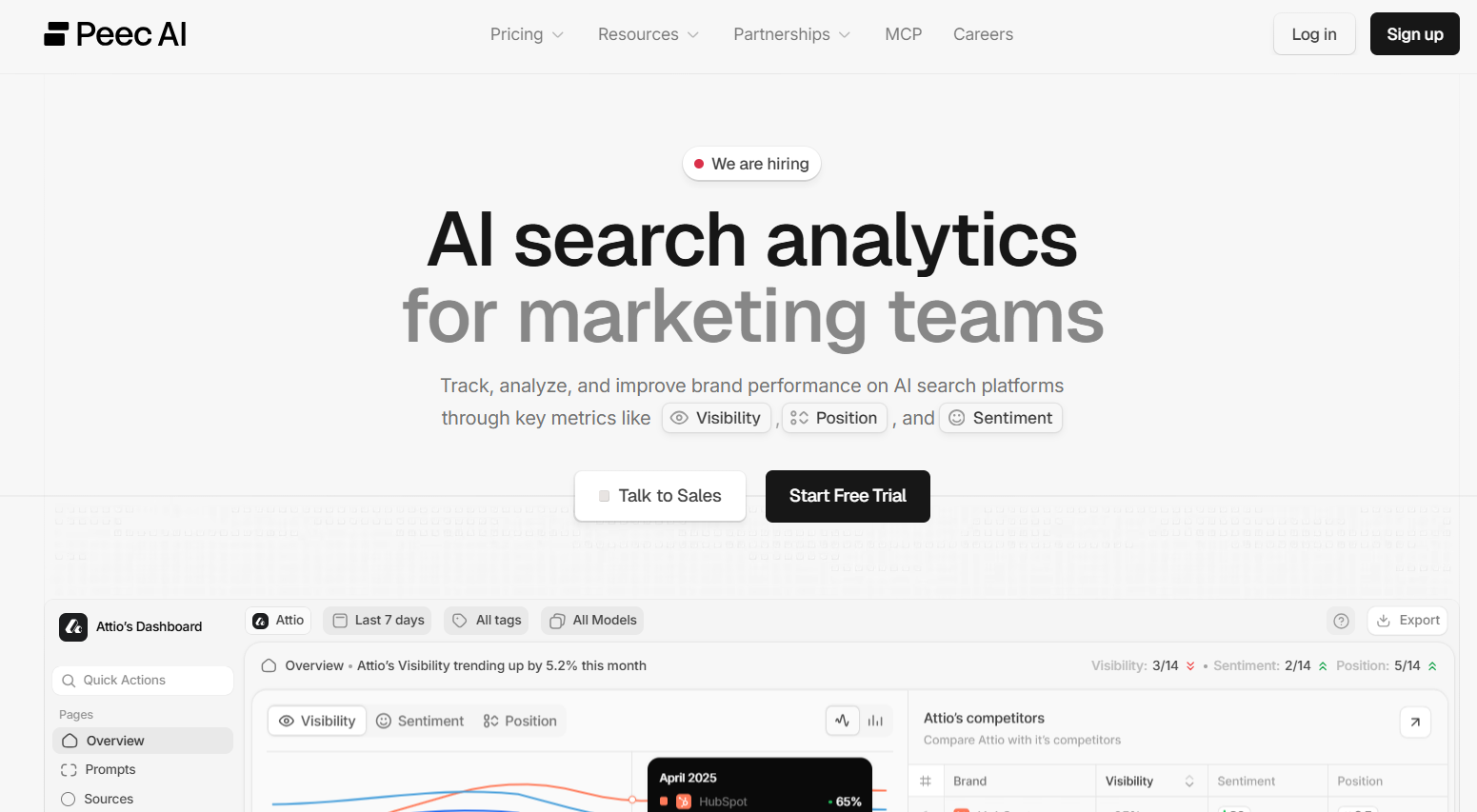
Peec AI solves a specific problem: How do you track brand visibility in AI search? Unlike traditional SEO tools that focus on Google rankings, Peec AI specialises in monitoring how your brand appears in ChatGPT, Perplexity, Google AI Overviews, and other generative platforms. The company calls this Generative Engine Optimisation (GEO) or Answer Engine Optimisation (AEO)—essentially the practice of ensuring your brand gets mentioned when AI models generate responses.
The platform tracks three core metrics that actually matter: How often your brand gets mentioned (visibility), where it appears in those mentions (position), and whether the tone is positive or negative (sentiment). These metrics are calculated at the prompt level, so you see exactly which search queries are driving your visibility.
Read: Peec AI Review: Features, Pricing, Pros, and Cons
What Is AthenaHQ?
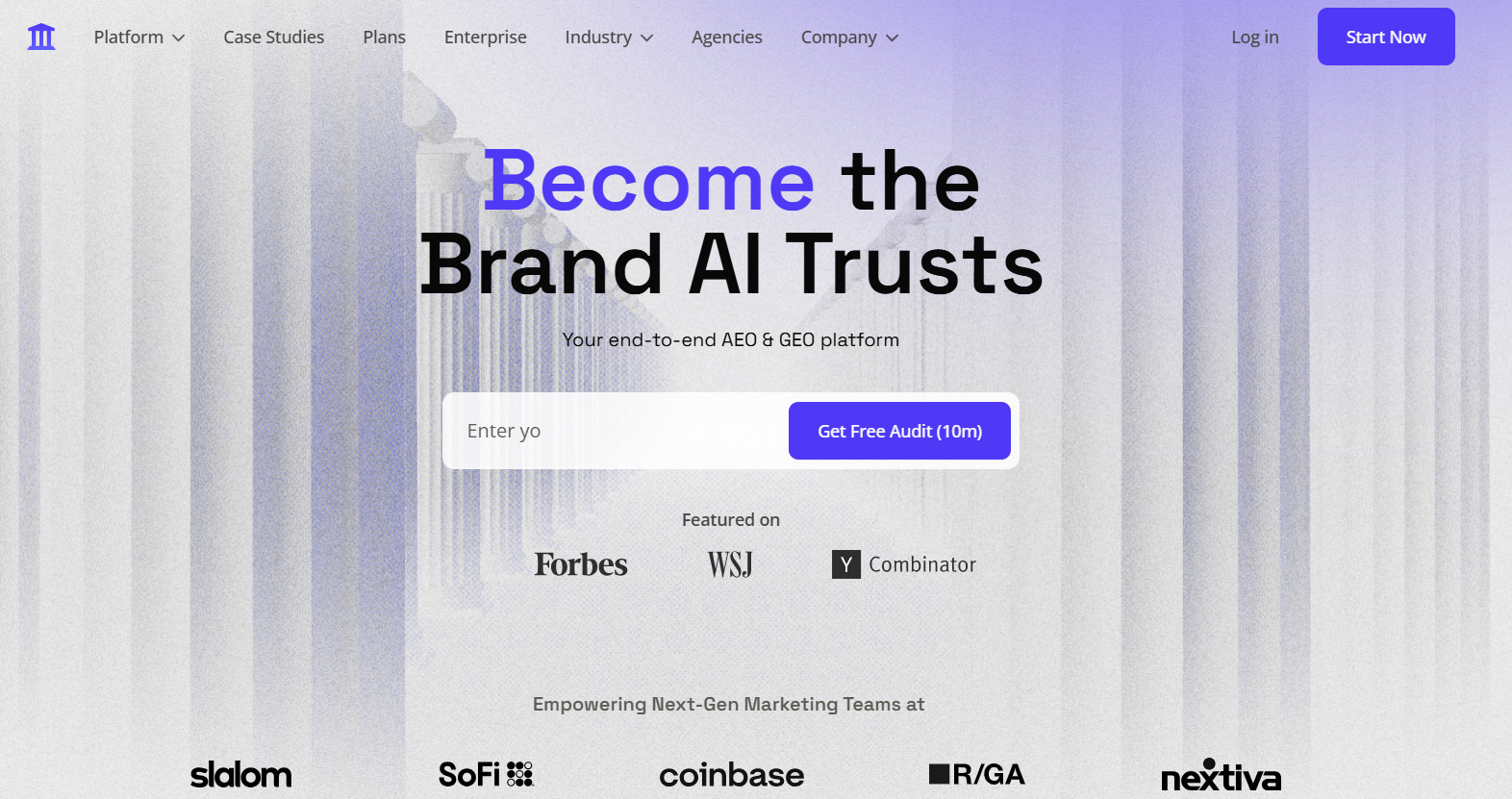
AthenaHQ takes a different angle. Founded by Andrew Yan and Alan Yao—both former Google Search and DeepMind engineers with $2.2M in Y Combinator funding—the platform doesn't just monitor visibility. It acts on it. The company positions itself as the premium, results-focused option in a growing market of AI visibility tools.
Think of AthenaHQ's workflow as a three-step loop: First, it monitors your brand mentions across AI platforms. Then it analyses the data to surface content gaps and competitive benchmarks. Finally, it deploys autonomous content agents to draft and optimise pages, while integrating with Shopify and Google Analytics 4 to show you the actual revenue impact. The entire system is designed around one goal: turning visibility into measurable business outcomes.
Read: AthenaHQ Review 2026: Features, Pros, and Cons
Feature Comparison: Deep Dive
AI Platform Coverage
Peec AI's base plans track ChatGPT, Perplexity, and Google AI Overviews. Want to add Claude, Gemini, or other platforms? That costs €20-30 per platform each month. For many brands, this works fine—most traffic comes from ChatGPT and Perplexity anyway. But if you're managing multiple AI channels, those add-ons stack quickly.
AthenaHQ includes ChatGPT, Perplexity, Claude, Gemini, Copilot, and Google AI Overviews in every plan. No hidden fees. All of its analysis tools—gap detection, prompt volume estimation, competitive benchmarking—work across all six platforms simultaneously. If you're serious about owning your presence across the AI landscape, this built-in breadth saves both money and complexity.
Winner: AthenaHQ. You get more platforms included and avoid the nickel-and-diming that comes with Peec AI's add-ons.
Read: 10 Best Peec AI Alternatives you should know in 2026
Content Optimization Capabilities
Here's where the two platforms diverge most sharply. Peec AI is honest about what it does: it monitors. It doesn't generate content, suggest optimizations, or connect to your CMS. You get visibility data, and then you figure out what to do with it. That's actually fine if you have a solid content team already. But if you're expecting the tool to help you act on its insights, you'll be disappointed.
AthenaHQ's autonomous content agents are the opposite. These AI-powered tools analyse your industry-specific knowledge gaps, see what competitors are ranking for, and then generate optimisation recommendations tailored to how each AI platform's citation logic actually works.
The On-Brand Content Agents go further—they can rewrite underperforming pages at scale while trying to keep your brand voice intact. You're not just seeing the problem; you're getting a solution you can actually implement.
Winner: AthenaHQ. The gap between monitoring and acting is where AthenaHQ creates real value.
Analytics and Reporting
Peec AI's dashboard is clean and focused. You get four main views: a dashboard showing your overall visibility percentage and industry ranking, a prompts section drilling into specific searches, a sources view showing where mentions come from, and a competitors section for benchmarking. It's well-designed for quickly understanding where you stand.
AthenaHQ takes a different approach; its Action Centre prioritises opportunities by impact. When one client found themselves consistently excluded from "first-time homebuyer" recommendations, AthenaHQ didn't just flag the problem—it laid out exactly how to fix it. This prescriptive angle transforms raw analytics into a roadmap.
Winner: AthenaHQ. Actionable insights beat pretty dashboards when you're trying to move the needle.
Revenue Attribution and Business Impact
Peec AI measures visibility. That's genuinely useful—you want to know if your brand is getting mentioned. But it stops there. You might see a 15% increase in mentions and think "great," but you won't know if that translates to a single customer. The data is valuable for competitive positioning, less so for proving ROI to your CFO.
AthenaHQ closes that loop. Its Shopify integration lets e-commerce brands see exactly which AI citations led to sales, down to the SKU level. For non-e-commerce businesses, the GA4 integration tracks how AI visibility connects to leads and conversions. You're not guessing whether your GEO efforts matter. You're watching revenue move.
Winner: AthenaHQ. If you need to justify your marketing spend with actual revenue numbers, this feature alone might pay for the platform.
Ease of Use and Learning Curve
Peec AI keeps things deliberately simple. Set up your prompts, watch your visibility numbers, and act on top mentions. There's no overwhelming feature set to master. New users typically get productive within hours, not days. This simplicity is intentional—the founders believe the tool should stay out of your way.
AthenaHQ has more moving parts. Users consistently report an initial learning curve, especially when setting up autonomous agents or understanding the credit-based consumption model. That said, once you're past the setup phase, the investment pays off. Users repeatedly mention that the actionable insights and productivity gains make the initial complexity worthwhile.
Winner: Peec AI. If your team is new to AI visibility tools, Peec AI gets you started faster.
Read: 10 Best AthenaHQ Alternatives you should know in 2026
Customer Support Quality
Peec AI's support model is unusual: direct Slack access to the founding team. You're not emailing a support queue; you're messaging the people who built the product. This level of founder involvement is consistently cited in reviews as a major differentiator, especially impressive given that the company has already scaled to serve enterprise customers.
AthenaHQ's support team is structured more like a traditional enterprise product—responsive, professional, and frequently shipping product improvements based on user feedback. Users consistently praise the team's responsiveness and the quality of guidance they receive.
Winner: Tie. Both excel at support, just with different models. Peec AI offers founder access; AthenaHQ offers structured enterprise support. Pick whichever appeals more to your team's communication style.
Pricing Transparency and Value
Peec AI starts at $95/month for its Starter plan. Scale to the Advanced plan at $425/month, and you unlock Looker integration for deeper analysis. Every plan includes unlimited seats—add your entire team at no extra cost. This pricing model is refreshingly simple, and the unlimited seats feature alone makes it a bargain for growing agencies managing multiple clients.
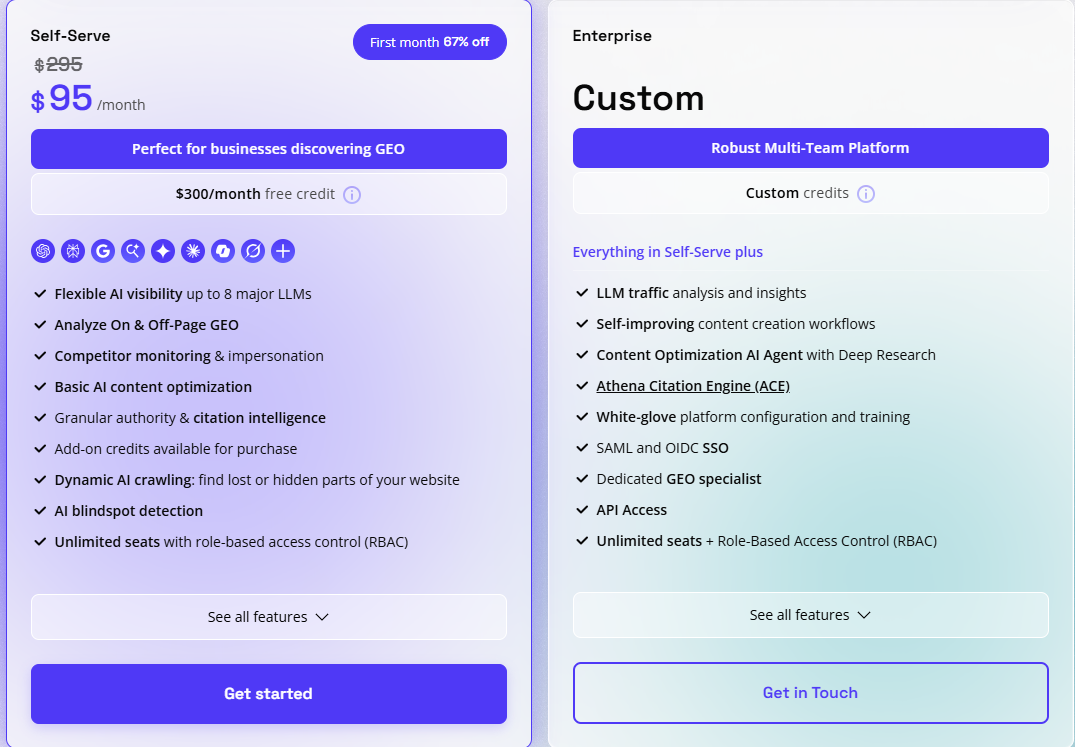
AthenaHQ's pricing reflects its premium positioning. The Self-Serve plan starts at $295/month (or $95 for your first month). The credit-based consumption model means pricing scales with your usage and the value you extract from automation features. This approach is designed for organisations with dedicated marketing budgets that want to scale their efforts. You're paying more, but you're also getting more—autonomous agents, revenue attribution, and enterprise support.
Winner: Peec AI. If the budget is tight or you're just starting with AI visibility, Peec AI offers better entry-level value. The unlimited seats model alone makes it compelling for agencies.
Pricing Comparison
Plan | Peec AI | AthenaHQ |
|---|---|---|
Starter/Self-Serve | $95/month (50 prompts) | $245/month (3,500 credits) |
Pro/Growth | $199/month (150 prompts) | Custom pricing |
Advanced | $495/month (350 prompts) | Custom pricing |
Free trial | Available | First month for $95 |
You could run a cheaper alternative like Airefs for several months on what you'd spend on one month of Peec AI. But here's the catch: those tools aren't built specifically for generative AI analytics. They're trying to do everything and doing nothing particularly well.
The real question isn't "what's cheapest?" It's "what solves my actual problem?" Peec AI's pricing is accessible if you need monitoring. AthenaHQ's premium pricing reflects the value of automation and revenue attribution—features that pay for themselves if you actually implement the recommendations.
Who Should Choose Peec AI?
- Analytics-focused teams – Need clear AI visibility data and competitor benchmarking
- SEO agencies – Manage multiple clients with multi-project tracking and unlimited users
- Support-focused teams – Value fast, direct support (e.g., Slack access)
- Global brands – Track AI search performance across multiple regions
Who Should Choose Airops?
- High-volume content teams – Publish 20+ articles/month with workflow automation
- E-commerce businesses – Scale product and marketing content with Shopify + Brand Kits
- Agencies – Manage multiple brands with bulk workflows and reusable setups
- Execution-driven teams – Turn AI visibility insights into content and publishing actions
What About Other Alternatives?
Alternative | Starting Price | Best For | Key Advantage |
|---|---|---|---|
Contact for pricing | Unified SEO + AI visibility | Combines traditional SEO metrics with AI search tracking | |
$29/month | Budget-conscious teams | Most affordable entry-point for basic monitoring | |
$99/month | Enterprise analytics | Advanced conversation explorer and deep analytics features | |
$129/month | Integrated SEO suites | Adds AI visibility tracking within a broader SEO platform |
Indexly deserves a closer look if you're trying to manage both traditional SEO and AI visibility from one platform. It tracks your presence across ChatGPT, Perplexity, Gemini, Claude, and AI Overviews, but it does so within a unified interface that also handles your Google rankings.
The Content Agents and Reddit Signals features let you influence how AI talks about your brand, not just monitor it. If you're tired of juggling multiple tools, Indexly's integrated approach simplifies the picture.
Final Verdict: Peec AI vs AthenaHQ
Peec AI excels at clean, reliable AI visibility tracking, making it a strong choice for teams that need monitoring at a predictable cost. With pricing starting around $95/month and unlimited users, it’s a solid foundation for building your AI search strategy.
AthenaHQ, on the other hand, focuses on turning insights into action. Its automation, revenue attribution, and prescriptive recommendations justify the higher price point for teams focused on optimization and measurable ROI.
The decision is straightforward: Choose Peec AI if you need monitoring and cost control. Choose AthenaHQ if you have the budget to act on data and the need to prove ROI. Both excel in their respective niches. For additional context on alternatives in this space, explore AthenaHQ alternatives, Peec AI alternatives, and read our full AthenaHQ review for deeper analysis.
FAQ
What's the main difference between Peec AI vs AthenaHQ in terms of platform coverage?
Peec AI covers ChatGPT, Perplexity, and Google AI Overviews by default, but you pay extra (€20-30/month each) to add Claude, Gemini, or other platforms. AthenaHQ includes ChatGPT, Perplexity, Claude, Gemini, Copilot, and Google AI Overviews in all plans at no additional cost. If you care about comprehensive coverage, AthenaHQ's approach is cleaner and ultimately more cost-effective.
Which platform offers better value for small marketing teams?
Peec AI wins on value for smaller teams. It starts at $95/month and crucially includes unlimited team seats at no extra cost. That means you can add your entire team—or multiple clients if you're an agency—without your bill growing. AthenaHQ's $295/month entry point is designed for organisations with bigger budgets and the ability to invest in automation and ROI measurement.
Can either platform help with content optimisation for AI search?
Peec AI is monitoring-only; it won't help you optimise content. AthenaHQ is built for this. Its autonomous content agents analyse knowledge gaps, generate optimisation recommendations, and can even rewrite pages at scale while maintaining your brand voice. If content improvement is your goal, AthenaHQ is the clear choice.
Which tool provides better revenue attribution capabilities?
Only AthenaHQ offers revenue attribution. It connects AI citations directly to sales through Shopify integration (for e-commerce) or to leads and conversions through GA4 integration (for all businesses). If proving ROI is critical to your decision-making process, this feature alone might justify the premium pricing.
How do the learning curves compare between these platforms?
Peec AI prioritises simplicity—you set up prompts, check your visibility, and act on insights. New users typically get productive within hours. AthenaHQ has a steeper initial learning curve, especially around autonomous agent setup, but users consistently report that the investment pays off once you understand the system.
Are there viable alternatives to both platforms?
Yes. Otterly AI is the most budget-friendly entry point at $29/month. SE Ranking integrates AI visibility tracking into a broader SEO suite if you're managing both traditional and AI search. Profound offers deeper enterprise analytics for teams that need advanced conversation analysis. And Indexly provides a unified platform for both SEO and AI visibility if you want to consolidate your tools.