
AI search visibility platforms vary significantly in the quality of analytics they provide. While some focus on basic mention tracking, others offer prompt-level insights, citation monitoring, competitor intelligence, AI traffic attribution, and reporting.
About 68% of Google searches ended without a click in early 2026, according to SparkToro's analysis of Similarweb clickstream data, while ChatGPT reached approximately 900 million weekly active users in February 2026. 58% of consumers now use generative AI instead of traditional search for recommendations. At that scale, understanding which AI search visibility platform has the best analytics is a strategic one that directly affects revenue.
This comparison evaluates five leading platforms to help marketing teams choose the best AI search analytics solution for their needs in 2026.
"Measurement is the biggest gap in most GEO strategies today. Marketers who've spent years refining Google Analytics dashboards often have no comparable visibility into AI search performance." — Search Engine Land, 2026
Quick Verdict: Best AI Search Visibility Platforms at a Glance
For marketing teams, brand managers, and AEO agencies, while evaluating AI search visibility platforms, the decision comes down to analytics depth vs platform breadth.
An LLM-optimized platform is the top choice for teams that need a complete organic marketing solution, combining prompt research, citation gap analysis, GEO-optimised Content Agents, Reddit and LinkedIn influence signals, and AI Traffic Analytics that attribute sessions and revenue back to specific AI engines. The table below gives a fast-scan verdict before the full reviews.
Platform | Best For | Analytics Rating | Starting Price | Overall Rating |
|---|---|---|---|---|
Indexly | Full-funnel AI visibility — prompt tracking, citation gap analysis, GEO content, AI traffic attribution | 9.4 / 10 | $99/month | 9.4 / 10 |
SEO teams that want traditional rank tracking with AI visibility monitoring | 8.0 / 10 | $39/month + $99/month AI add-on | 7.9 / 10 | |
Peec AI | Agencies wanting fast prompt and citation monitoring across the Big Three AI engines | 7.5 / 10 | From ~$85/month | 7.5 / 10 |
Profound | Enterprise brands requiring deep crawler analytics, SOC 2 compliance, and GA4 attribution | 8.8 / 10 | $99/month (Starter, ChatGPT only) | 8.6 / 10 |
Teams already on Semrush needing AI visibility layered onto existing SEO workflows | 7.8 / 10 | $99/month per domain (add-on) | 7.7 / 10 |
Read: 4 Best SEO AI Search Visibility Platforms For Brands 2026.
How We Evaluated These Platforms
Evaluating which AI search visibility platform delivers the strongest analytics requires a consistent scoring framework applied across the same capability dimensions.
The most effective AI search visibility platforms help teams understand how brands, pages, and competitors are represented inside AI-generated answers across major platforms.
Analytics Depth
Analytics depth is a measure of whether a platform surfaces raw metrics only or provides layered insight. Platforms were scored on how thoroughly they address the three key metrics for any AI visibility program:
- Citation Share of Voice: How often your brand is cited versus competitors for a given set of prompts.
- Source URL Inclusion: Which specific pages from your domain are being pulled into AI answers.
- Mention Sentiment: The context and tone (positive, negative, neutral) when your brand is mentioned.
Citation Tracking
Citation tracking was evaluated on its ability to turn the AI answer layer into a reportable asset. The best tools track prompts, citations, source URLs, mention frequency, and competitive share of voice over time. Key evaluation points included:
- Granularity: Whether tracking is at the URL-level versus only the domain-level.
- Refresh Frequency: How often the data is updated (daily is preferred over weekly).
- Attribution: Whether the platform links specific citations back to the exact prompt inputs that triggered them.
Prompt-Level Insights
Prompt-level insight is the ability to see which exact queries trigger brand mentions and which ones send users to a competitor instead. Platforms were scored on the quality and actionability of their prompt-level reporting, including:
- Prompt Libraries: The quality of pre-built and suggested prompt libraries.
- Custom Tracking: The ability to create and monitor custom prompts relevant to specific campaigns.
- Actionability: How easily reports identify competitive gaps and content opportunities at the prompt level.
Competitor Intelligence
Competitor intelligence measures how easily a team can see which rival brands dominate specific prompts, what their citation sources are, and how their share of voice has trended. Platforms were rated on:
- Tracking Depth: The ability to see competitor citation sources and sentiment.
- Volume: The number of simultaneous competitors that can be tracked.
- Alerts: The availability of automated alerts for significant competitive shifts in visibility.
AI Model Coverage
Coverage was tested across ChatGPT, Claude, Gemini, Perplexity, and Google AI Overviews. Broader coverage gives a more complete picture, as a brand frequently cited in Perplexity may be invisible in Claude. Multi-model coverage is a critical differentiator because LLM outputs vary significantly by platform.
Reporting and Dashboards
Dashboard quality was evaluated on clarity, customisability, and whether reports can be exported or white-labeled for client delivery. The best dashboards consolidate data from multiple AI platforms into a single interface and allow users to generate presentation-ready slides, saving time for professionals looking to showcase AI-driven insights.
Ease of Use
Ease of use matters most for marketing teams without dedicated analytics staff. Platforms were rated on time-to-first-insight, onboarding friction, and whether non-technical marketers can action the data without engineering support. Fast setup and intuitive navigation were weighted heavily.
Pricing and Value
Pricing was evaluated against the analytical output delivered at each tier. Value scoring factored in per-seat costs, prompt volume limits, AI engine coverage at entry-level plans, and whether the analytics depth justifies the monthly cost, particularly for US-based SMBs, agencies, and mid-market brands.
5 AI Search Visibility Platforms with Best Analytics
Below are five AI visibility platforms that provide analytics for measuring brand presence across AI search engines.
Indexly
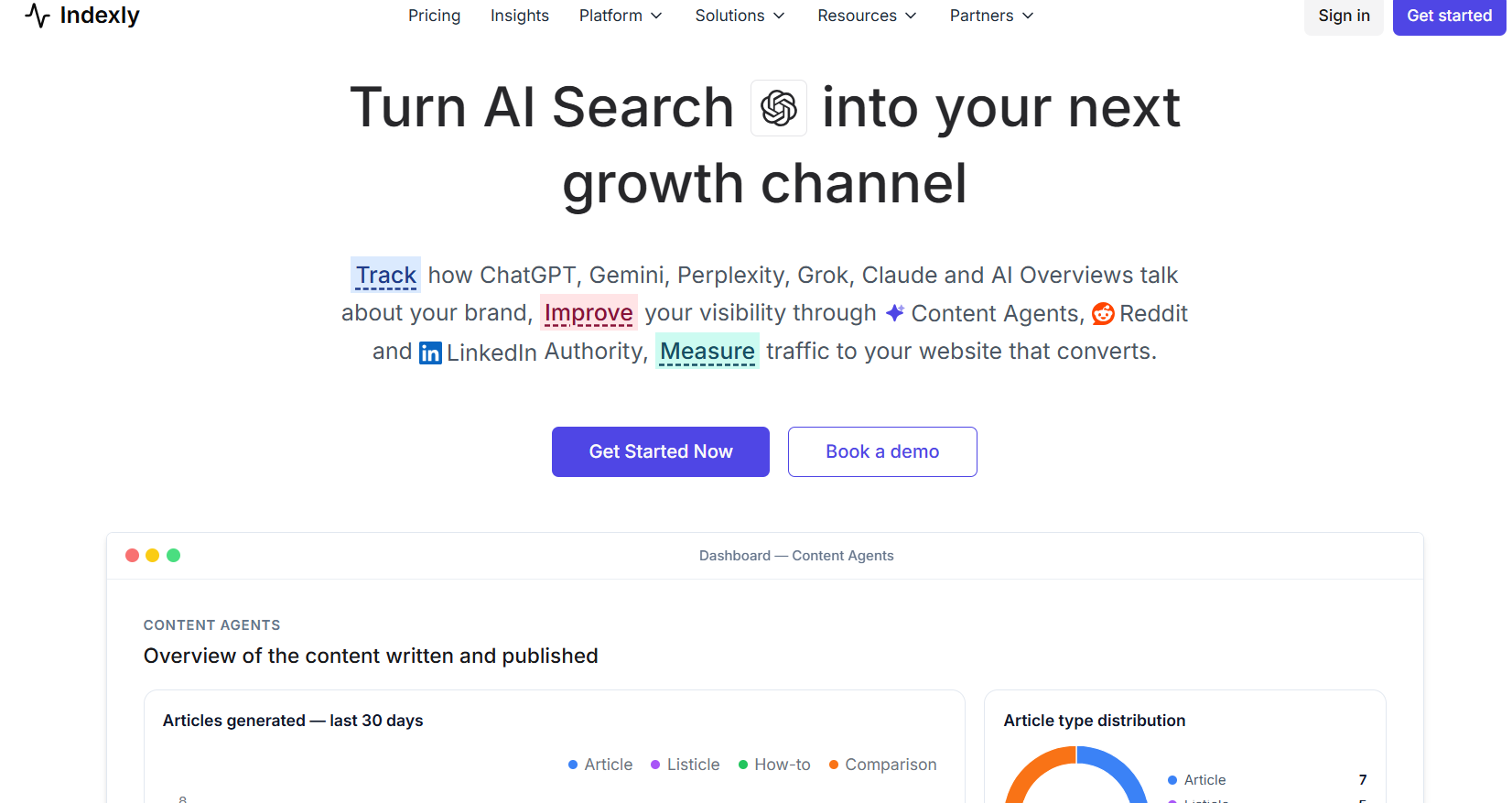
Indexly is an AI search visibility platform that helps brands monitor, analyze, and improve their presence across AI search engines including ChatGPT, Gemini, Claude, Perplexity, Grok, and Google AI Overviews.
It combines AI search analytics, citation tracking, prompt monitoring, traffic attribution, and GEO content optimization in a single platform for marketing teams, agencies, and enterprise brands.
Key Analytics Features
- Prompt Tracking and Research: Indexly lets you track specific prompts that matter most across all AI platforms, organise prompts by topics or campaigns using custom tags, and track prompt response evolution over time to identify patterns.
- Citation Gap Analysis: This feature surfaces the citation share your competition is capturing, highlighting the exact prompts where competitors appear but you do not — giving content teams a direct list of optimisation targets.
- Brand Sentiment Monitoring: Indexly analyses AI-generated answers for tone and accuracy, allowing you to see whether AI models describe your brand positively, negatively, or incorrectly, and get recommendations to influence those perceptions.
- AI Traffic Analytics: Tracks and attributes website traffic from AI search engines, Reddit, and LinkedIn, identifying the channels, prompts, and content that generate the most visits, conversions, and revenue.
Aspect | Detail |
|---|---|
Pros | Widest AI engine coverage including Grok; citation gap analysis; GEO content agents; AI traffic attribution; unified SEO + AI dashboard; strong agency features; accessible pricing |
Cons | Newer entrant vs. enterprise incumbents; some advanced enterprise compliance features still maturing |
Pricing | Starts at $99/month; scales with domains and seats; free AI visibility checker available |
Best For | Marketing teams, brand managers, AEO agencies, and growth leads that need analytics + content execution + attribution in one platform |
Overall Analytics Score | 9.4 / 10 |
"Indexly has completely changed how I track my visibility across AI search engines. The AI Search Visibility and Prompt Tracking features helped me finally understand how ChatGPT and other models perceive my pages." — Indexly customer review
Read: The 10 Best AI Search Visibility Tracking Platforms in 2026
Nightwatch
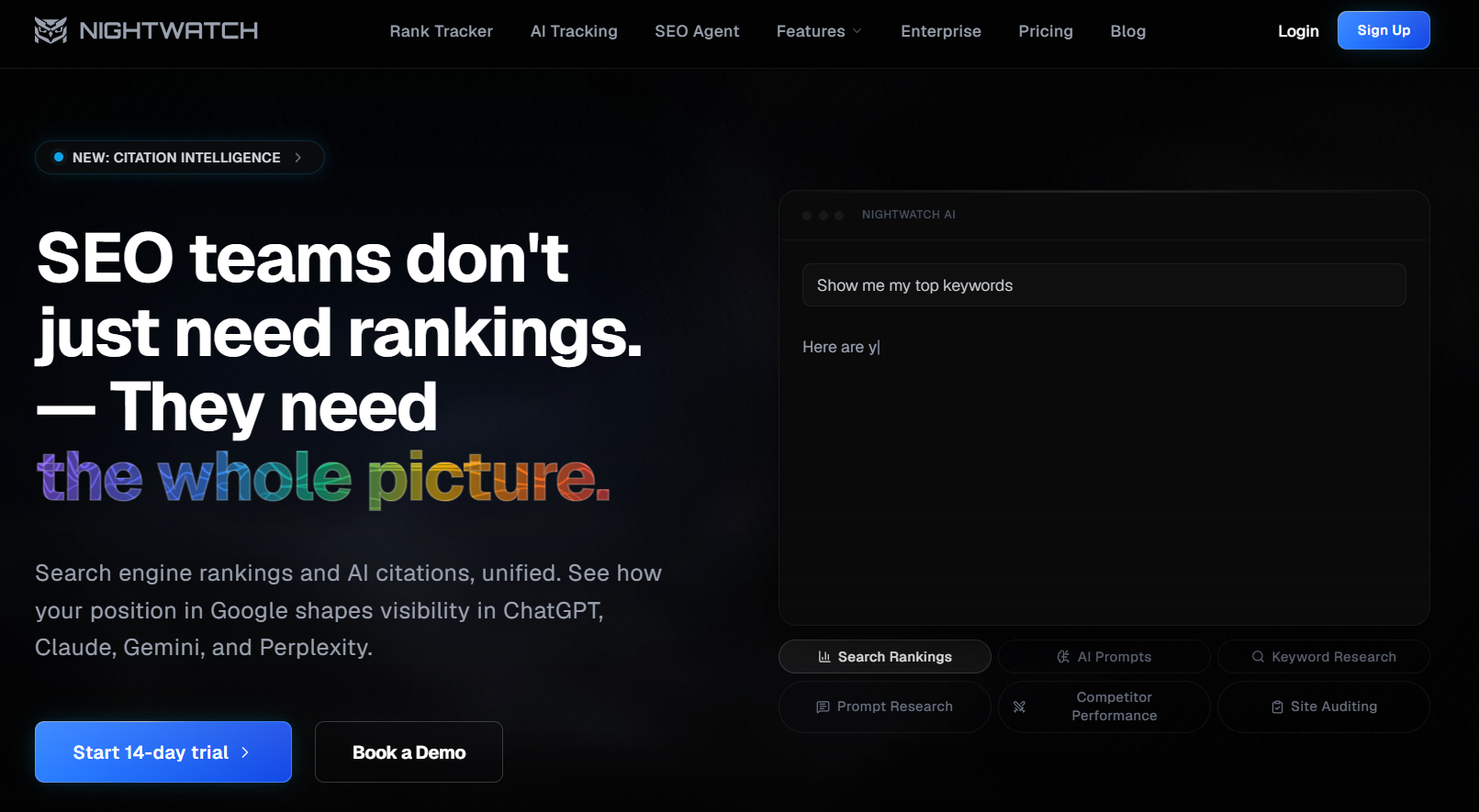
Nightwatch is a mature rank tracking platform that added LLM monitoring to its core product. It is the only platform that connects 13 years of ranking data with AI visibility across ChatGPT, Claude, Gemini, and Perplexity. It is an excellent fit for SEO teams that want traditional rank data and AI citation data side-by-side.
Key Analytics Features
- Localized AI Visibility Tracking: Measures AI visibility across multiple geographic locations to identify regional differences in search results.
- Combined SEO & AI Reporting: Consolidates traditional SEO rankings and AI visibility metrics into a single analytics dashboard.
- Citation Monitoring: Tracks changes in citations across monitored prompts to identify emerging trends and visibility fluctuations.
- White-Label Reporting: Enables agencies to create fully branded reports combining SEO and AI visibility insights for client reporting.
Aspect | Detail |
|---|---|
Pros | Unified rank + AI tracking; unlimited seats; white-label reporting; Citation Intelligence; Looker Studio integration; 14-day free trial |
Cons | AI visibility is an add-on to its core rank tracking product; AI features are priced separately ($99+/month add-on) |
Pricing | Plans start at $39/month (500 keywords) — AI tracking is a separate add-on |
Best For | SEO professionals and agencies that want rank tracking as the foundation with AI visibility as an extension |
Overall Analytics Score | 8.0 / 10 |
Peec AI
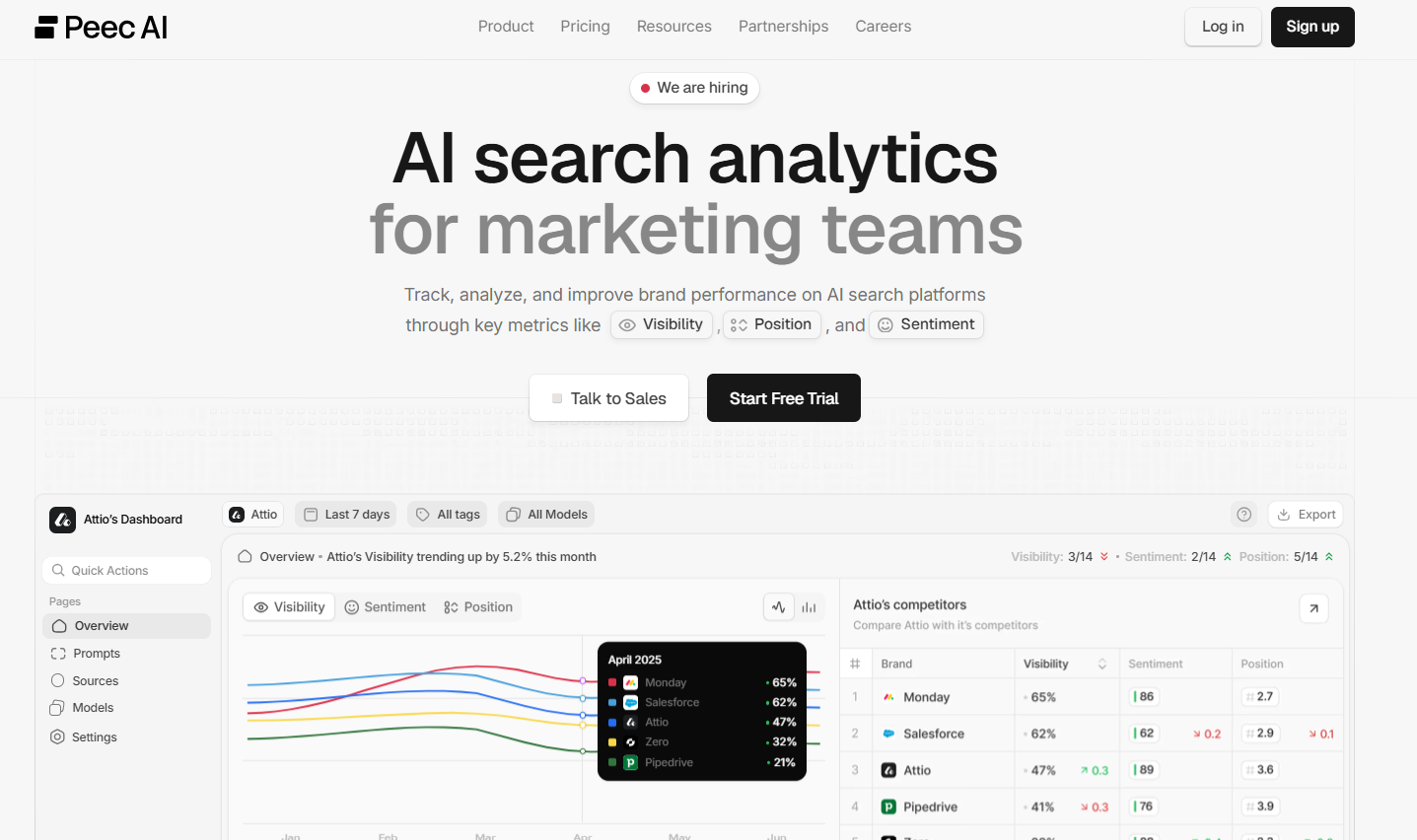
Peec AI is a focused AI visibility monitoring platform designed for fast time-to-value. It focuses on simplicity and accessibility, tracking brand mentions and prompt-level appearances across AI systems without extensive SEO analytics. It is particularly well-suited to agencies managing multiple clients who want monitoring speed over analytical depth.
Read: Peec AI Review: Features, Pricing, Pros, and Cons
Key Analytics Features
- Funnel & Persona Segmentation: Groups visibility data by audience type and buying stage to reveal how AI exposure changes across the customer journey.
- Brand vs. Source Citation Tracking: Separates explicit brand mentions from citations where AI models use your content without directly referencing your brand.
- Source URL Analytics: Shows which webpages contribute most frequently to AI-generated responses related to your business.
- Daily Prompt Monitoring: Refreshes tracked prompts every 24 hours, providing consistent visibility updates and trend analysis.
Aspect | Detail |
|---|---|
Pros | Fast setup; accessible pricing; strong prompt auto-generation; source-level citation tracking; good for agency multi-client use |
Cons | Limited analytics depth compared to enterprise options; narrower AI model coverage; lighter historical data and trend analysis |
Pricing | Starting around $85/month; scales by prompt volume and client accounts |
Best For | Agencies and smaller teams wanting fast, clean monitoring without complex infrastructure |
Overall Analytics Score | 7.5 / 10 |
Profound
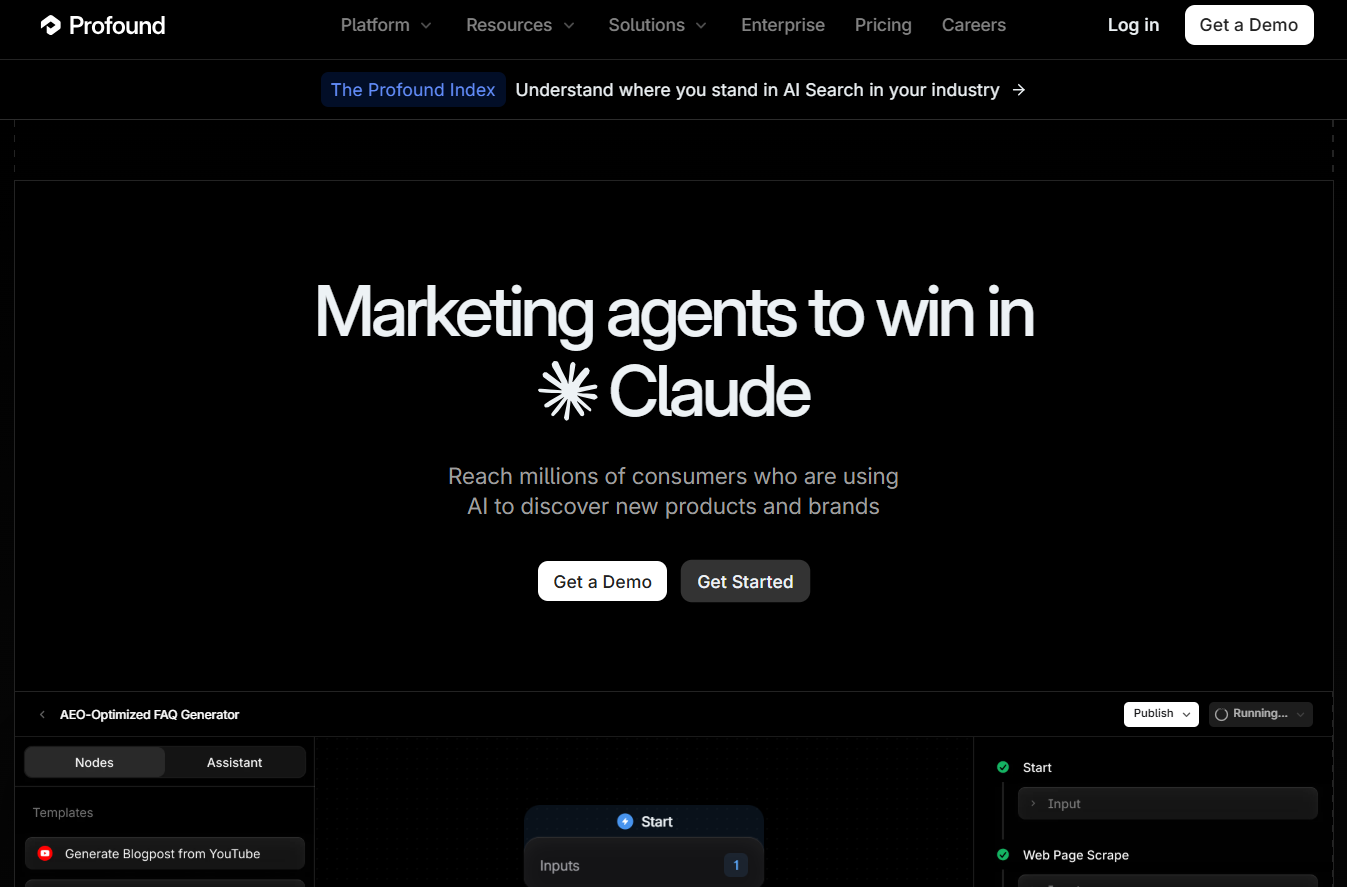
Profound is an enterprise-grade AI visibility platform purpose-built for large marketing organizations. It combines log-level AI crawler data, real-time visibility snapshots, and SOC 2 compliance, built for enterprise teams that need GA4 attribution, multilingual tracking, and deep technical control.
Read: Profound AI Review: Features, Pricing, Pros, and Cons
Key Analytics Features
- AI Share of Voice: Compares your brand's representation in AI-generated responses against competitors across supported platforms.
- Product & Brand Visibility Tracking: Monitors how AI engines reference both brands and individual products within generated answers.
- Sentiment Analysis: Evaluates the tone of AI responses to determine whether brand mentions are positive, neutral, or negative.
- Historical Response Reporting: Stores historical AI responses, making it easy to analyze shifts in citations, messaging, and visibility over time.
Aspect | Detail |
|---|---|
Pros | Enterprise-grade depth; panel-derived prompt volume; agent analytics; GA4 attribution; SOC 2 compliance; documented case studies (e.g., Ramp 7x AI visibility) |
Cons | Premium pricing typically requires a sales conversation; most advanced features behind custom enterprise plans; data-heavy interface requires onboarding |
Pricing | Starter $99/month (50 prompts, ChatGPT only); Growth $399/month (100 prompts, 3 platforms); Enterprise custom (10+ platforms, SOC 2) |
Best For | Enterprise brands requiring the deepest analytics, compliance-grade infrastructure, and dedicated support |
Overall Analytics Score | 8.8 / 10 |
Semrush AI Toolkit
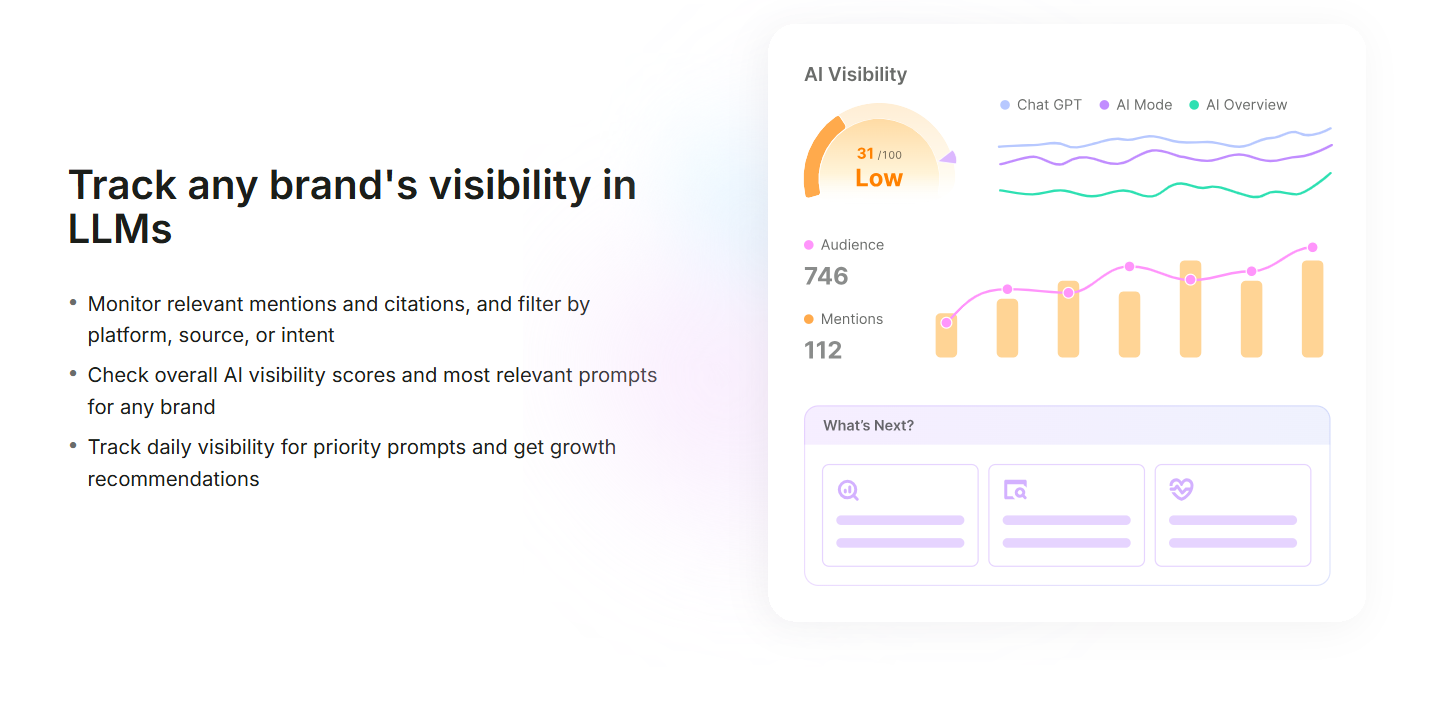
The Semrush AI Visibility Toolkit is an add-on to Semrush's existing platform, designed for teams already invested in its SEO ecosystem. The toolkit shows you how brands appear in AI-generated answers, helping you measure a new layer of visibility beyond traditional search.
Read: Semrush Review 2026: Features, Pros, and Cons
Key Analytics Features
- AI Visibility Score: Delivers a unified score that benchmarks your brand's presence across supported AI search platforms and measures visibility over time.
- Competitor Prompt Analysis: Uncovers prompts where competing brands appear in AI responses while your brand is missing, highlighting optimization opportunities.
- Citation & Mention Trends: Tracks fluctuations in citations, mentions, and referenced pages to measure changes in AI search performance.
- Model & Geographic Reporting: Breaks down visibility by AI platform and region, helping identify where your brand performs best.
Aspect | Detail |
|---|---|
Pros | Integrates with existing Semrush workflows; up to 50 competitor slots; strong Business Landscape reports; intuitive dashboard; client-ready reporting |
Cons | Concerns about data validity for smaller brands; reliance on simulated rather than real user queries; no free trial for the AI Toolkit standalone |
Pricing | $99/month per domain as an add-on; adding a user costs $45–$100/month plus an additional $99 if they need AI Visibility access |
Best For | Teams standardised on Semrush that need AI visibility layered into their existing SEO reporting stack |
Overall Analytics Score | 7.8 / 10 |
Read: Best AI Search Visibility Platforms For Brands 2026
Who Wins in Each Analytics Category?
Breaking the comparison down by individual analytics category gives marketing leads, brand managers, and AEO agencies a fast verdict for their specific use case. Each category below identifies the leading platform and the key reasons why.
Best Overall Analytics
Winner: Indexly. Tools like Indexly that blend traditional SEO metrics with AI search visibility are becoming essential. Indexly sets itself apart by offering a single platform that tracks both traditional SEO performance and AI search visibility in one dashboard. The combination of prompt tracking, citation gap analysis, sentiment monitoring, GEO Content Agents, and AI Traffic Analytics gives it the widest analytics scope.
Best Prompt Tracking
Winner: Indexly (closely followed by Profound). Indexly's prompt tracking supports custom creation, auto-generation, tagging by topic, and trend monitoring over time. This helps discover new opportunities and measure competitive positioning inside AI search. Profound's panel-derived prompt volume data adds a unique demand-sizing layer that is a strong differentiator for enterprise teams.
Best Citation Analytics
Winner: Indexly (citation gap analysis) / Profound (enterprise citation depth). Indexly delivers deep insights into citation sources and competitive positioning, with its citation gap analysis showing exactly which prompts send users to competitors instead of your brand. Profound provides enterprise-grade citation analytics with panel-derived data. Nightwatch's Citation Intelligence module is the strongest choice for teams that need citation data correlated to SEO rankings.
Best Competitor Analysis
Winner: Semrush AI Toolkit (volume of competitors) / Indexly (actionability). Semrush can track up to 50 competitors simultaneously, an advantage for large market-mapping exercises. However, Indexly's competitor data feeds directly into content recommendations, making its insights more immediately actionable for teams of any size.
Best Reporting Dashboard
Winner: Indexly. Indexly's unified dashboard aggregates data from all AI platforms into a single, comprehensive view. For agencies needing client-ready outputs, Nightwatch includes unlimited user seats and white-label reporting as standard, not as costly add-ons.
Best Historical Data
Winner: Nightwatch. Nightwatch retains full SERP archives for 3 years for historical analysis, and its Citation Intelligence tracks how citation patterns evolve over time alongside keyword ranking history. For teams building long-term AI visibility trend reports, Nightwatch's historical depth is unmatched in this comparison.
Best AI Model Coverage
Winner: Indexly. Indexly monitors brand visibility across all major AI platforms including ChatGPT, Claude, Gemini, Perplexity, Grok, and AI Overview from one dashboard. No other platform in this comparison explicitly includes Grok in its standard monitoring alongside the other five major engines.
Best Enterprise Analytics
Winner: Profound. Profound is purpose-built for measuring and improving brand visibility in AI-generated answers, giving teams a fuller view of where their company appears and what sources influence those answers. Profound's Agent Analytics gives full visibility into how AI crawlers access and interpret content, backed by SOC 2 Type II, GDPR, and CCPA compliance.
Best Value for Money
Winner: Indexly . At an entry point of $99 per month, teams get prompt tracking, citation gap analysis, AI traffic attribution, brand sentiment monitoring, and GEO Content Agents. This represents a breadth of analytics capability that other platforms charge two to four times more to approximate.
Key Takeaway: Indexly wins the most individual category verdicts — especially for teams that need analytics connected to content action and attribution. Profound is the enterprise specialist; Nightwatch excels for SEO-integrated AI citation data. For most teams evaluating these platforms, the choice comes down to whether you need breadth or specialization.
Conclusion
Choosing the right AI search visibility platform comes down to the depth of analytics your team needs and how you plan to act on those insights.
While Profound is well suited for enterprise organizations, Nightwatch excels for SEO-focused workflows, Semrush AI Toolkit integrates seamlessly with existing Semrush users, and Peec AI offers lightweight AI visibility monitoring.
For teams looking for an all-in-one platform that combines prompt tracking, citation gap analysis, sentiment monitoring, AI traffic attribution, and GEO content optimization, Indexly provides the most comprehensive solution.
If you're ready to measure and improve your brand's visibility across AI search, start with Indexly's free AI Search Visibility Checker to benchmark your presence before investing in a full AI visibility strategy.
FAQs
Which AI Search Visibility Platform has the Best Analytics?
Indexly offers the strongest overall analytics for most marketing teams, combining prompt tracking, citation gap analysis, sentiment monitoring, AI traffic attribution, and GEO content optimization in one platform. Profound is best for enterprise compliance and advanced analytics, while Nightwatch excels at connecting AI visibility with traditional SEO rankings.
Which GEO Platform has the Best Reporting?
Indexly provides the most comprehensive reporting by combining AI visibility, SEO metrics, and AI traffic attribution in one dashboard. Nightwatch is a strong choice for agencies needing white-label reports, while Semrush AI Toolkit integrates AI visibility reporting into its existing reporting ecosystem.
Which AI SEO Tool has the Best Dashboards?
Indexly offers the most complete dashboard, combining AI visibility, prompt tracking, traffic attribution, and SEO metrics across multiple AI platforms. Nightwatch links AI citations with keyword rankings, while Semrush AI Toolkit provides a familiar interface for teams already using the Semrush platform.
Which Platform Provides the Best AI Visibility Analytics?
Indexly delivers the most comprehensive AI visibility analytics, covering prompt tracking, citation monitoring, sentiment analysis, competitor benchmarking, and AI traffic attribution. Unlike monitoring-focused tools, it also connects insights with GEO content optimization and broader brand influence strategies.
Which AI Search Platform Tracks Citations Best?
Indexly stands out with citation gap analysis that identifies prompts where competitors are cited but your brand is missing. Nightwatch is ideal for SEO teams correlating citations with rankings, while Profound offers enterprise-grade citation analysis for large-scale content and visibility audits.
Which AI Search Tool has the Best Competitor Analysis?
Semrush AI Toolkit is strongest for large-scale competitor tracking, supporting up to 50 competitors. Indexly focuses on actionable citation gap analysis against direct competitors, while Nightwatch automatically discovers competitors and visualizes AI citation trends over time.
What is the Best Enterprise AI Search Analytics Platform?
Profound is the leading enterprise platform, offering compliance features, GA4 attribution, multilingual tracking, and advanced analytics. Indexly is a strong alternative for enterprises that also want GEO content optimization, AI traffic attribution, and broader marketing workflows at a more accessible price.
How Do I Compare AI Search Visibility Platforms?
Compare platforms based on AI model coverage, prompt tracking, citation monitoring, competitor analysis, reporting quality, historical data, and AI traffic attribution. Prioritize platforms with frequent data updates and actionable insights, and test your visibility with a free checker before committing to a paid plan.