
The growth of AI content creation has accelerated rapidly in recent years. The global generative AI market is projected to reach $91.57 billion by 2026, up from $63 billion in 2025. Adoption among marketers and businesses continues to rise as companies look for faster and more scalable ways to produce high-quality content.
Today, AI content writers are used to streamline content production, improve SEO performance, scale blog publishing, maintain brand voice consistency, and support GEO and AI search visibility strategies.
These tools are not designed to replace human creativity entirely. Instead, they function as intelligent writing assistants that help marketers, SEO teams, agencies, and businesses create optimized content more efficiently while allowing humans to focus on strategy, editing, expertise, and audience engagement.
As AI-powered search platforms like ChatGPT, Gemini, Perplexity, Grok, and Google AI Overviews continue changing how users discover information, AI content writers are becoming an important part of modern SEO, GEO, and content marketing workflows.
In this blog, we’ll discuss what AI content writers do, how AI article writing tools work, whether AI-generated content can rank on Google, whether Google penalizes AI-written content, how AI helps SEO content creation, and how to create SEO, GEO, and AEO-optimized content using Indexly AI Content Writer.
What does an AI Content Writer do?
An AI content writer is a software application that uses natural language processing (NLP) and machine learning algorithms to create written content that resembles human writing. These systems can understand context, maintain consistency, and generate coherent content for different formats and industries.
Core Functions of AI Content Writers
AI content writers perform several important functions that help streamline the content creation process:
- Content generation: Create written content from prompts or outlines, including blog posts, articles, product descriptions, and marketing copy.
- Research assistance: Summarize information, organize sources, and identify weak or unsupported claims to improve content accuracy and save time.
- Tone adaptation: Adjust writing style and tone to match different audiences, brands, or communication goals.
- SEO optimization: Incorporate relevant keywords and structure content to improve search engine visibility and online reach.
- Ideation support: Assist with brainstorming by generating topic ideas, outlines, and content suggestions, especially useful during writer’s block.
AI Content Generation Capabilities by Type
Content Type | AI Capability Level | Human Oversight Required | Typical Use Cases |
|---|---|---|---|
Short-form content | High | Low | Social media posts, email subjects |
Product descriptions | High | Medium | E-commerce, catalogs |
Blog posts | Medium | High | Content marketing, SEO |
Technical documentation | Medium | High | Manuals, guides, specifications |
Creative writing | Low | Very High | Storytelling, brand narratives |
Content Quality and Accuracy
While AI algorithms are constantly improving and the chances of errors or inaccuracies in generated content are extremely low, it is highly recommended to review and edit all content before publishing.
Ensuring accuracy through clear instructions, thorough content review, fact-checking, and incorporating human expertise when needed is a critical part of the workflow.
How does AI help with Content Writing?
AI helps content writing by delivering 62% faster content production and 3.8x higher output with assistance. 83% of marketers report increased productivity since adopting AI tools. The technology transforms traditional writing workflows by automating time-consuming tasks and providing intelligent support throughout the entire content creation process. What used to take a full day now takes a few hours, freeing writers to focus on strategy and original thinking.
Speed and Efficiency Improvements
AI writing tools can reduce time investment in long-form content, enabling content creators to publish blog posts more than 3x faster than traditional methods.
- First draft generation: AI creates workable drafts in seconds from detailed briefs, with writers who used to spend two hours on first drafts now spending 20 minutes.
- Outline creation: AI tools can create comprehensive outlines, summaries, and rough drafts in seconds, providing a solid structure for writers to build upon.
- Research aggregation: AI handles research aggregation, structural outlines, headline variations, metadata, and repurposing existing material into new formats.
- Content scaling: AI helps marketing teams create and test multiple content variations more efficiently, allowing them to improve messaging, optimize campaigns, and reach different audience segments with greater consistency.
Quality Enhancement Features
AI provides several quality improvement capabilities that enhance the final written product:
- Grammar and style checking: AI writing tools spot grammar problems, detect unclear sentences, suggest better phrasing, and analyze how sentences connect across paragraphs to improve flow and readability.
- Consistency maintenance: AI learns brand tone and helps writers stay consistent across all touchpoints, ensuring every piece sounds cohesive rather than like random templates.
- SEO optimization: AI generates SEO-optimized ideas, and the more information provided in prompts along with quality keyword research results in stronger headlines and titles.
Multilingual and Personalization Support
AI writing tools enable multi-language content creation at an unprecedented scale, making it possible for companies to create content in dozens of languages simultaneously. This capability opens up global markets that used to be too expensive or logistically difficult to reach.
Can Google Detect AI Generated Content in Search Results?
Google can identify patterns that are often linked to spammy or low-quality automated content. At the same time, Google’s ranking systems are primarily focused on evaluating whether content is helpful and valuable to users rather than simply detecting AI usage.
AI-generated content can still appear in search results if it demonstrates: originality, relevance, expertise, trustworthiness, and helpful information.
Does Google penalize AI Written Content in 2026?
Google does not automatically penalize AI-written content, but low-quality or unhelpful content may struggle to rank regardless of how it was created.
Content is more likely to underperform when it feels repetitive or generic, lacks original insights or expertise, contains inaccurate information, or is overly optimized for keywords without delivering real value to readers. Articles published without proper editing, fact-checking, or human review may also struggle to perform well in search results.
At the same time, AI-assisted content can rank effectively when combined with expert editing, accurate information, strong SEO practices, audience-focused writing, clear structure, and unique perspectives.
Search engines are increasingly prioritizing content quality and user experience over the specific tools used to create the content. AI works best as a support tool that helps improve content workflows rather than fully automating low-quality publishing at scale.
What is an AI Article Writing tool and how does it work
An AI article writing tool operates on advanced natural language processing models trained on massive datasets, using a transformer architecture to understand context, tone, and user intent rather than simply stitching together existing text.
These sophisticated platforms have evolved far beyond basic text generation to become comprehensive content creation systems that form the core of modern content strategies.
Technical Architecture and Functioning
When you input a prompt, an AI article writer doesn't search and copy existing content. Instead, it uses statistical patterns learned from billions of text examples to predict what words should come next in a sequence.
This prediction process happens thousands of times per second to build natural and contextually appropriate sentences, effectively generating original content based on its training.
The technical process involves several key components:
- Data input: The AI is fed a wide variety of texts and training data, helping it learn language intricacies including grammar, tone, and style.
- Algorithm training: Machine learning algorithms process this data to identify patterns and structures in human writing, building a complex neural network.
- Text generation: When tasked with writing, the AI uses its trained models to predict and generate text while adhering to specific requirements and context provided by users.
- Continuous learning: The AI improves its writing capabilities through continuous learning informed by user interactions and additional data, refining its output over time.
How to Create SEO and GEO-Optimized Content Using Indexly AI Content Writer
Step 1: Set Up Your Brand Voice in Indexly
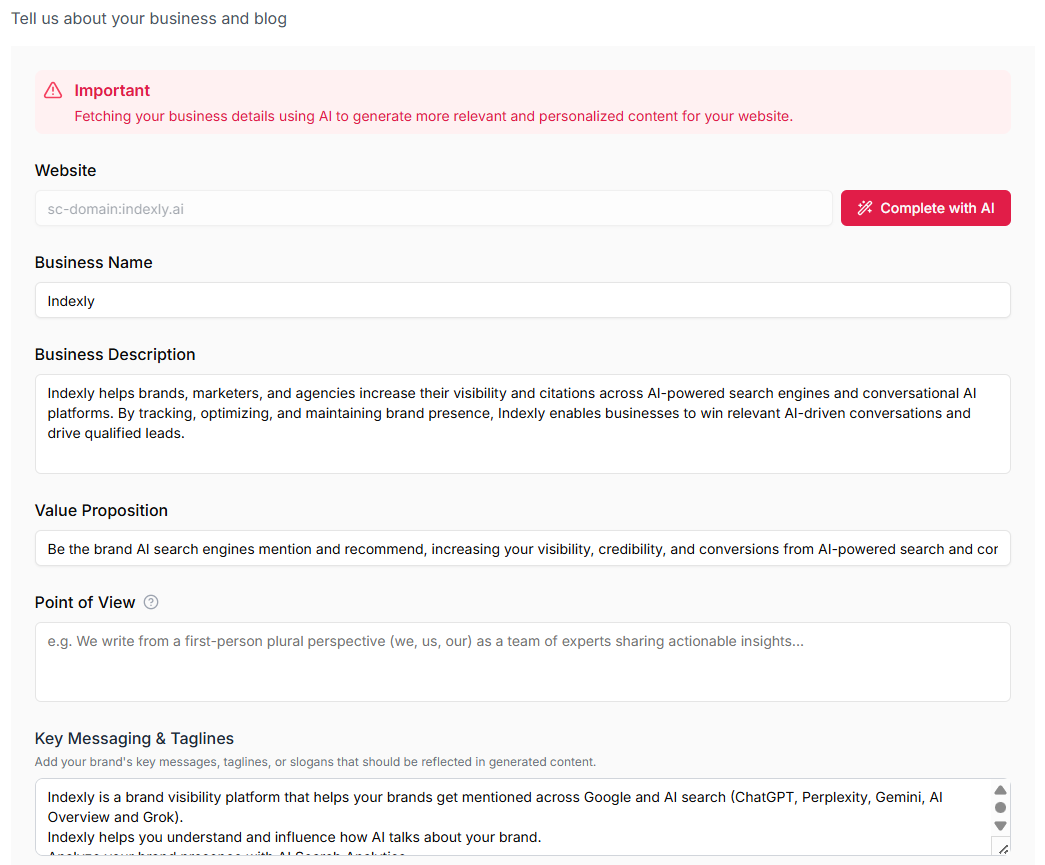
Inside Indexly’s Content Agents dashboard, start by configuring the Brand Hub. This helps the AI understand your business, messaging, target audience, and overall content strategy before generating articles.
Add details such as:
- business name
- website URL
- business description
- value proposition
- industries
- target audience
- blog sitemap URL
- key messaging and taglines
For example, Indexly positions itself as a platform that helps brands improve visibility across Google Search, ChatGPT, Perplexity, Gemini, AI Overviews, and other AI-powered search platforms. Defining this information allows the AI writer to generate more relevant and consistent content aligned with your SEO and GEO goals.
The Brand Hub helps maintain:
- consistent brand voice
- SEO relevance
- GEO optimization
- messaging alignment
- audience targeting
Step 2: Analyze Competitor Content Strategies
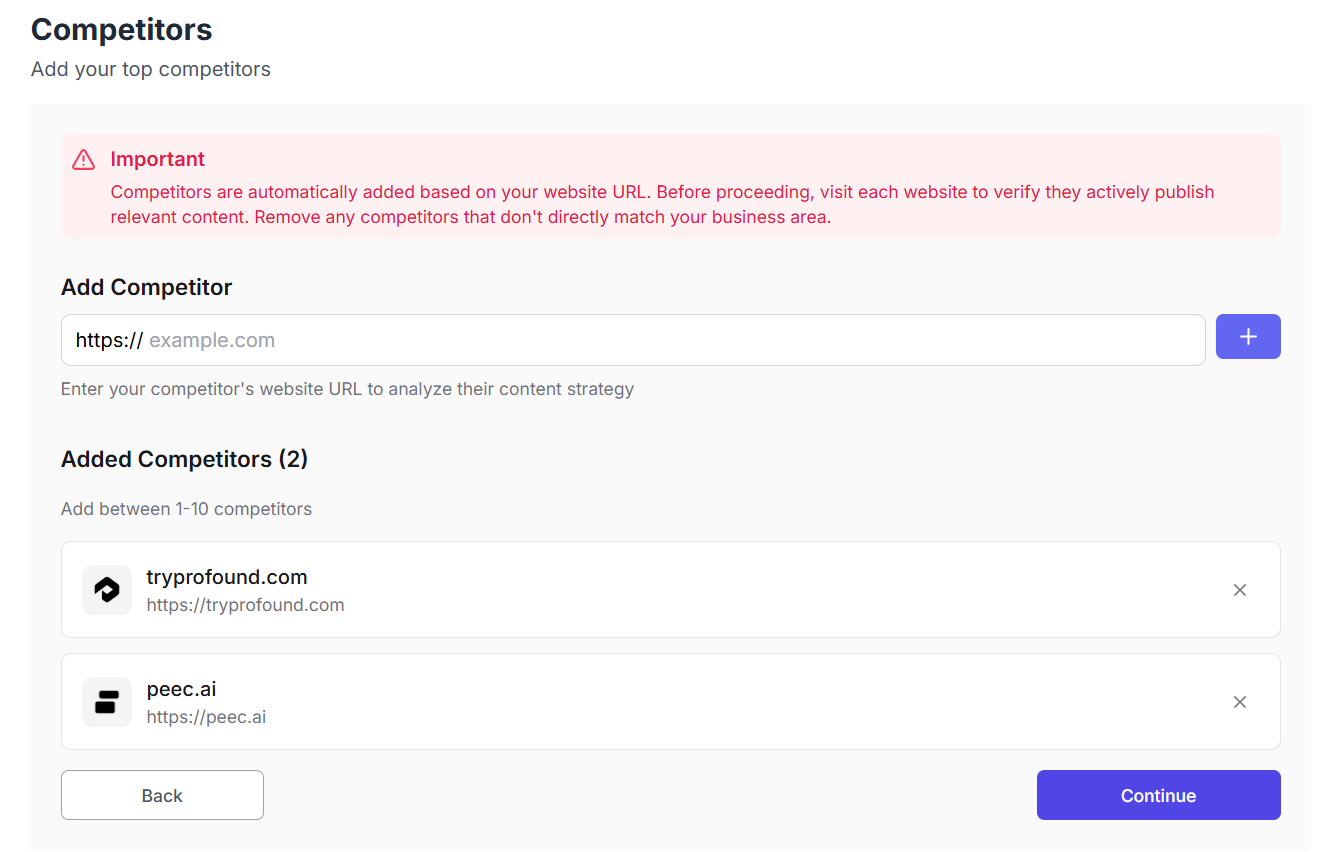
Indexly allows users to add competitors and their website URLs to analyze their content strategies and search visibility approach.
This helps teams understand:
- keyword targeting patterns
- topical coverage
- content structure
- GEO optimization opportunities
- AI search visibility trends
Competitor analysis helps improve article quality while identifying gaps in existing search content.
Step 3: Configure Content Generation Preferences

Before generating articles, configure your preferred:
- country
- language
- tone and style
- image style
- brand color
- publishing settings
Indexly supports multiple content image styles including:
- photography
- illustration
- infographic
- sketch
- claymation
You can also define: informative tone, professional writing style, awareness-focused content goals, and custom brand narrative instructions.
These settings help ensure all generated content stays aligned with your brand identity and audience expectations.
Generate Articles with Indexly AI Content Writer
After setup, go to the Overview section and click “Write New Content.”
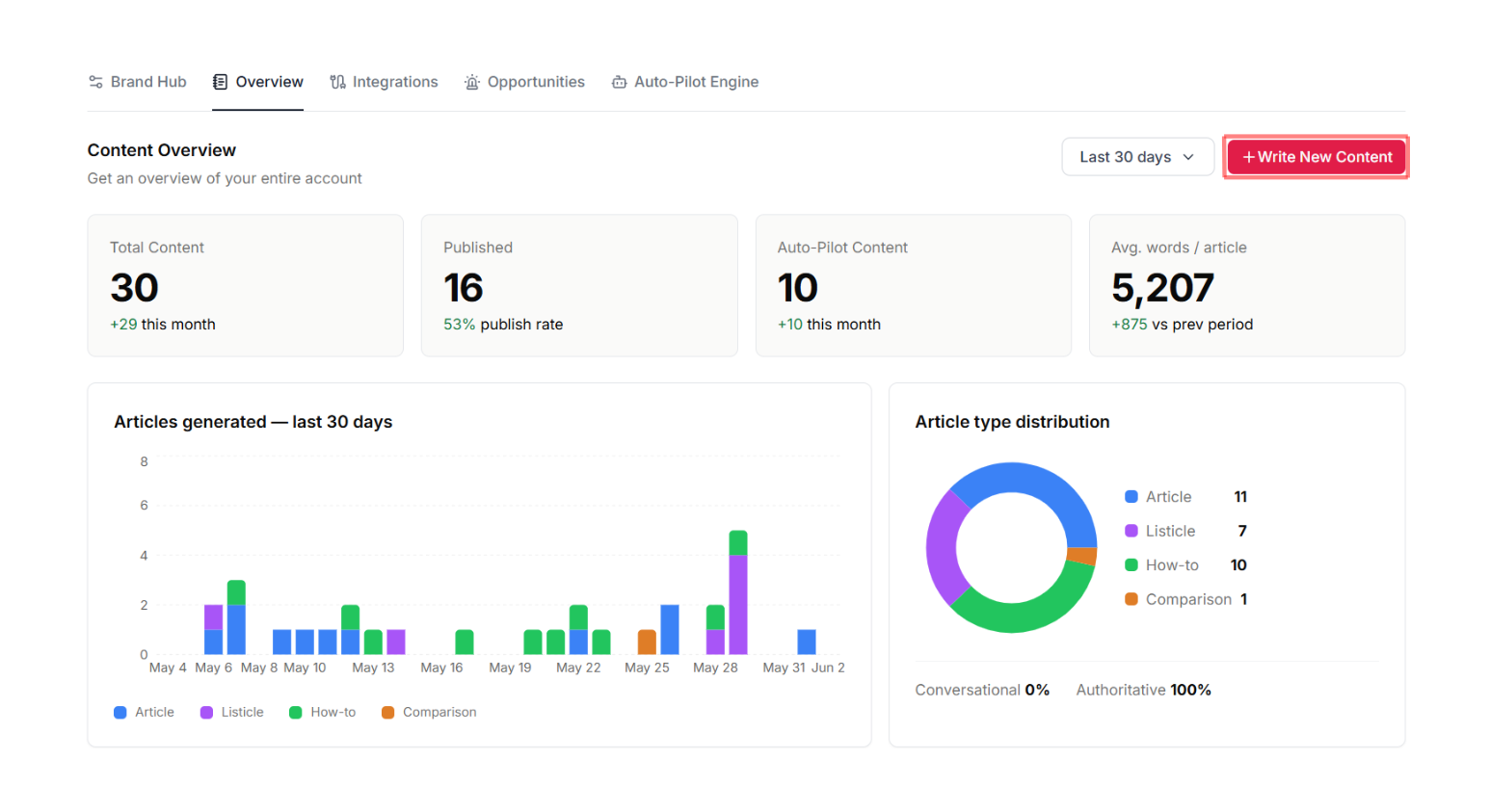
Indexly supports multiple article formats including: how-to articles, listicles, comparison articles, and blog posts.
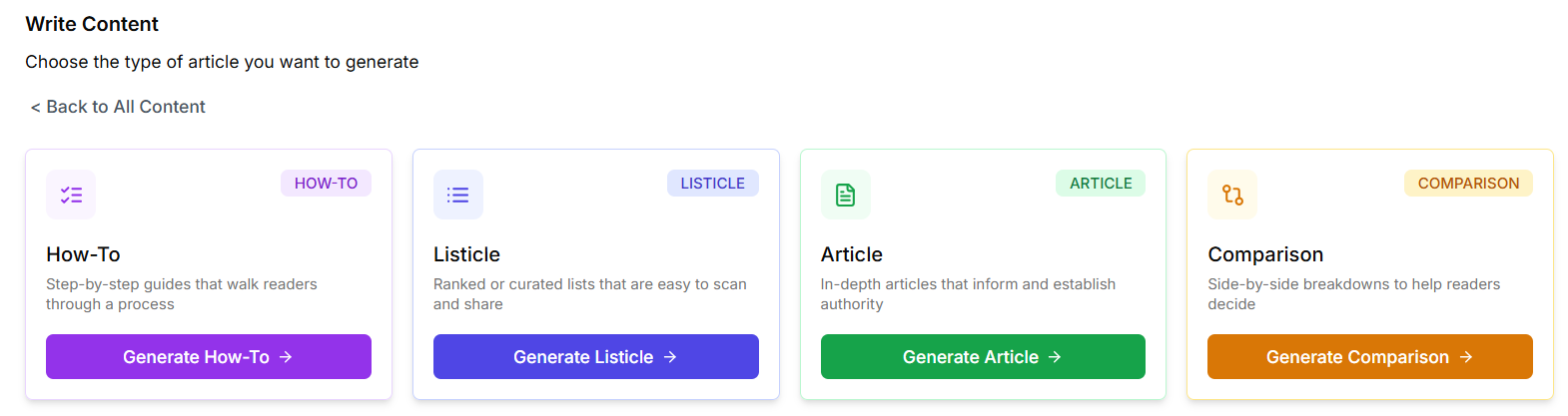
To generate content, enter:
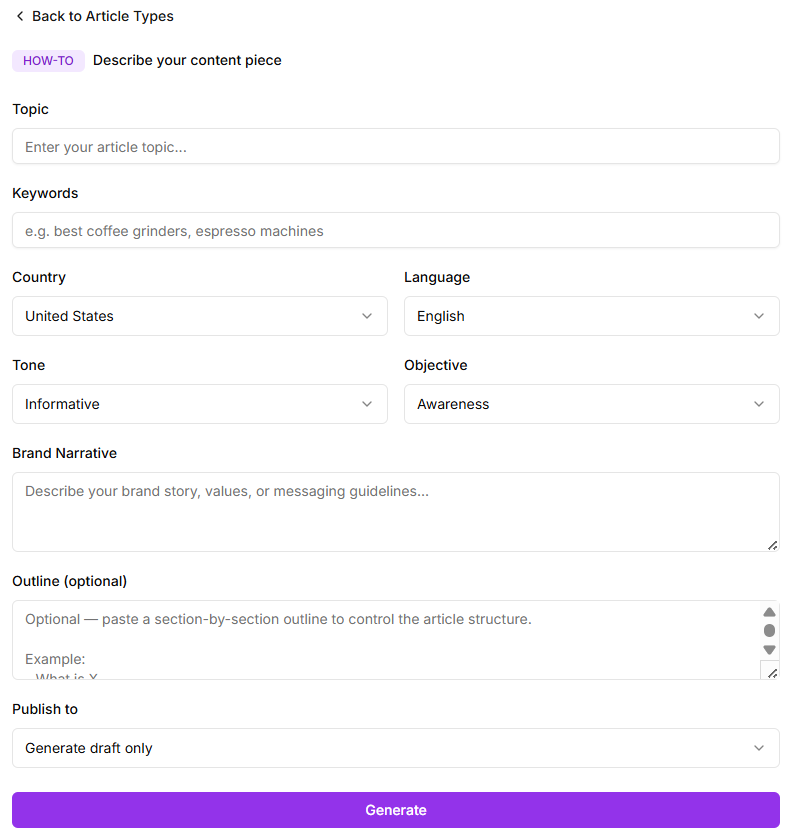
- article topic
- target keywords
- country
- language
- tone
- objective
- brand narrative
- optional article outline
The AI writer typically takes around 4–5 minutes to generate a complete article draft.
You can either generate a draft only or publish directly to your connected website automatically.
This workflow makes it easier for marketing teams to scale content production without slowing down editorial processes.
Can AI Content Writers Actually Produce SEO-Optimized Blog Posts?
Indexly AI Content Writer automatically generates structured content optimized for both traditional search engines and AI-powered search experiences.
Generated articles can include: SEO-friendly headings, internal and external links, keyword optimization, FAQs, metadata, slugs, entity-rich sections, tables, bullet points, embedded videos, and images.
The built-in editor also allows users to:
- modify H1, H2, and H3 headings
- add links and media
- adjust formatting
- insert lists and tables
- refine article structure before publishing
This gives teams flexibility while maintaining strong SEO and GEO optimization.
SEO and GEO Scoring in Indexly

After generating an article, Indexly provides detailed SEO and GEO scoring insights.
SEO metrics include:
- word count
- keyword density
- headings
- internal links
- external links
- optimization suggestions
GEO metrics include:
- entities covered
- questions answered
- external references
- bullets
- tables
- structured formatting
The platform also highlights quick wins and improvement opportunities before publishing, helping teams strengthen article quality and AI search visibility.
Automated Publishing Workflow
Indexly supports direct publishing integrations, allowing users to connect their CMS and streamline content operations.
Teams can:
- generate articles automatically
- review drafts
- optimize content
- publish directly to their website
This helps businesses scale SEO and GEO-focused content creation while maintaining consistency, structure, and brand voice across all published content.
Conclusion
AI content writers are helping businesses scale content production faster while improving SEO, GEO, and AI search visibility. However, strong content still requires human editing, accuracy, and audience-focused writing to perform well in search results.
With Indexly AI Content Writer, teams can generate SEO and GEO-optimized content faster using AI-powered writing, optimization scoring, competitor analysis, and automated publishing workflows.
Sign up for Indexly today and start creating content optimized for both Google Search and AI-powered search platforms.
FAQs
Who needs an AI Content Writer?
AI content writers are useful for marketers, SEO professionals, agencies, ecommerce brands, publishers, startups, and businesses that need to produce content regularly. They help simplify content workflows, improve publishing consistency, and reduce the time required to create articles, website copy, and marketing content.
Why would a content team need an AI Writer?
Content teams use AI writing tools to speed up tasks like research, outlining, drafting, optimization, and content planning. This allows writers and editors to spend more time on strategy, quality improvements, audience engagement, and refining the final content instead of handling repetitive manual work.
Why would I need an AI content Writer for my blog?
AI content writers help create articles more efficiently by assisting with outlines, SEO-friendly structures, headings, FAQs, metadata, and first drafts. This can help maintain a more consistent publishing schedule while reducing the workload involved in content creation.
Is Indexly good for AI Content Writing?
Indexly is built for brands, agencies, and SEO teams looking to create content optimized for SEO, GEO, and AI-powered search experiences. The platform combines AI content generation with brand voice customization, optimization scoring, competitor analysis, and publishing workflows to simplify large-scale content creation.
Is Indexly good for Automating Blog Content Creation?
Yes. Indexly helps automate multiple stages of the blogging process, including draft generation, optimization, formatting, editing, and publishing.
Is Indexly worth it for SEO teams?
Indexly can be helpful for SEO teams that want to scale content production while improving visibility across Google Search and AI-powered platforms. Features like GEO scoring, entity optimization, competitor analysis, and automated publishing workflows help streamline SEO and content operations.
Which AI tool creates content that actually ranks on Google (SEO, AEO, GEO)?
Ranking on Google depends more on content quality, relevance, structure, and user value than the AI tool itself. AI platforms perform best when combined with strong SEO strategies, human editing, accurate information, and audience-focused writing. Tools like Indexly support this process by helping optimize content for SEO, AEO, and GEO visibility.
What is an Automated Blog Post Generator and how does it work?
An automated blog post generator is an AI-powered system that creates article drafts based on prompts, keywords, outlines, or topic inputs. These tools use natural language processing and machine learning models to generate structured blog content that may include headings, FAQs, metadata, formatting, and SEO-focused elements.