
Last updated: Aug 2026 | Tested and reviewed by the Indexly editorial team | Tools evaluated: 7 AI share of voice platforms
Quick Verdict: Best Platforms to Measure AI Share of Voice at a Glance
The list below compares the best AI share of voice tracking tools for marketing teams, brand managers, and AEO agencies. If you're looking for the best platform to measure AI share of voice, this guide evaluates the leading solutions based on AI engine coverage, prompt tracking, citation analysis, AI traffic analytics, pricing, and overall value.
| Tool | Best Strength | Ideal Users | Free Trial | Overall Value |
|---|---|---|---|---|
| Indexly | End-to-end AI share of voice analytics | Marketing teams, brands, agencies | ✓ | Excellent |
| Cognizo | UI-based AI answer tracking | Mid-market & enterprise teams | ✗ | Very Good |
| Evertune | Enterprise AI benchmarking | Global enterprise brands | ✗ | Good |
| Peec AI | Multilingual AI monitoring | International B2B companies | ✗ | Good |
| Otterly AI | Affordable AI visibility tracking | SMBs & startups | ✓ | Good |
| Rankability | Content optimization workflows | Agencies & content marketers | ✗ | Good |
What Is AI Share of Voice Analytics?
AI share of voice analytics measures a brand’s visibility within AI-generated responses by comparing how often it appears against competitors for a specific set of prompts.
It helps businesses understand their presence across AI search platforms such as ChatGPT, Gemini, Claude, Perplexity, and Google AI Overviews by analyzing brand mentions, citations, response placement, and competitive visibility.
AI share of voice platforms evaluate factors such as:
- Brand presence: How frequently a brand is included in AI-generated answers.
- Response visibility: Where and how prominently a brand appears compared with other companies.
- Citation analysis: Which websites, pages, and content sources are referenced by AI models.
- Competitive insights: How a brand’s visibility compares with competitors within the same category.
- Prompt analysis: Which customer questions generate brand mentions and where visibility gaps exist.
For example, companies can monitor prompts such as:
- "best CRM software for startups"
- "best AI marketing tools"
- "HubSpot alternatives"
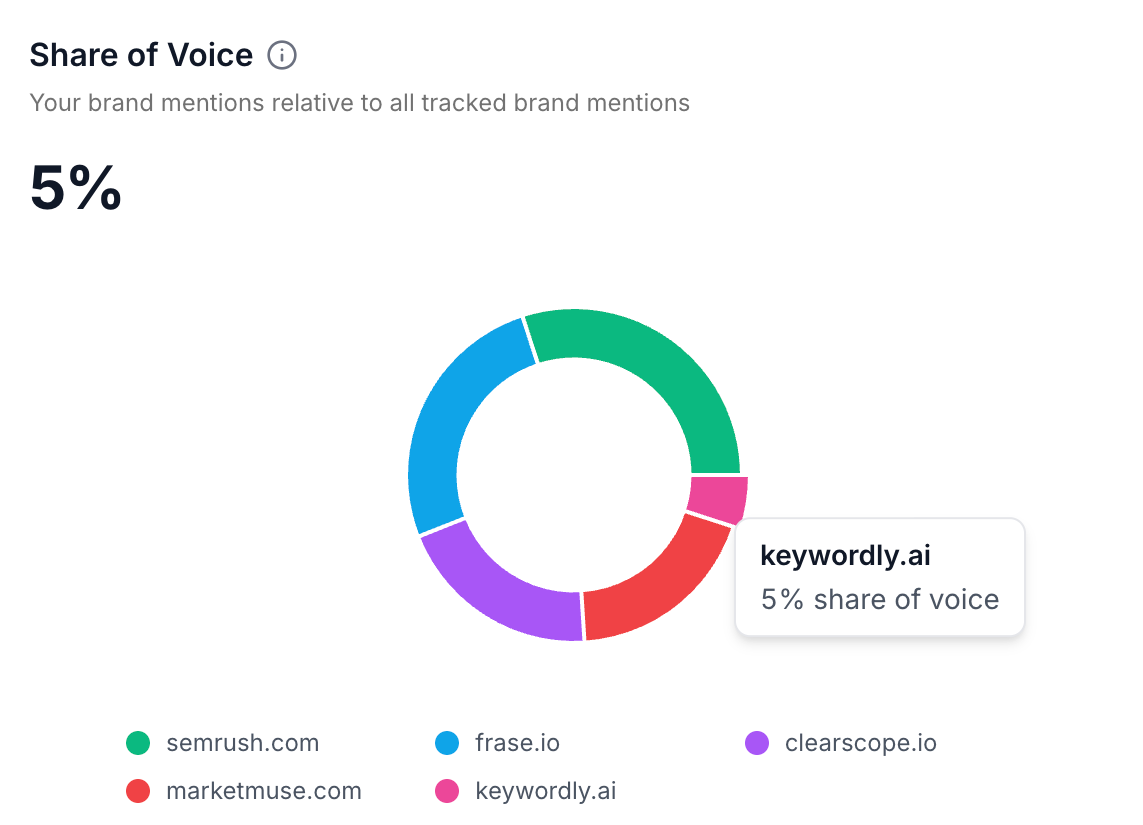
The platform analyzes AI responses to identify which brands are recommended, what sources influence those recommendations, and how competitors perform across similar queries.
By measuring brand visibility in AI search experiences, AI share of voice analytics helps marketing teams understand their position in the evolving AI discovery landscape and find opportunities to improve mentions, citations, and overall visibility.
Why You Need AI Share of Voice Tracking Tools in 2026
Brand discovery has fundamentally shifted. Buyers no longer stop at Google to research a purchase. They ask ChatGPT what to buy, read Google AI Overviews before scrolling, and compare options inside Perplexity and Copilot. That behavioral shift has created an urgent measurement gap for marketing teams. According to Gartner, traditional search engine volume will drop 25% by 2026 as search marketing loses share to AI chatbots and virtual agents.
AI share of voice tracking tools solve that gap. The process starts with a set of prompts that reflect what buyers actually ask in your category. A tool runs those prompts across AI platforms on a schedule, records every answer, and parses each one to track which brands appear, where they rank in the response, and which sources the model cited. Your share of voice is your brand's mention count as a percentage of all brand mentions across that prompt set. According to AthenaHQ's State of AI Search 2026 report, the average brand mention rate across AI answers sits at just 17.2%, with top-performing companies reaching dramatically higher rates. The gap between visible and invisible brands is wide—and the tools below help close it. Understanding where your brand stands in this landscape is the first step toward capturing more visibility. For supporting market data, see The Best AI Share of Voice Tools in 2026 - Slate.
How We Evaluated the Best Platforms to measure AI Share of Voice
Comparing AI share of voice tracking platforms requires a consistent evaluation framework that measures the capabilities most important for marketing teams, brand managers, AEO agencies, and growth teams.
The strongest AI share of voice platforms do more than track brand mentions. They help businesses understand how brands appear in AI-generated answers, which sources influence those responses, how competitors perform, and where opportunities exist to improve visibility.
Each platform in this comparison was evaluated across six core categories:
AI Engine Coverage
AI engine coverage measures how widely a platform tracks brand visibility across different AI search experiences.
Platforms were evaluated based on:
- Number of AI platforms supported: Coverage across ChatGPT, Gemini, Claude, Perplexity, Google AI Overviews, Grok, Copilot, and other AI engines.
- Multi-model visibility: Whether brands can compare performance across different AI systems, since each model may generate different answers.
- Coverage consistency: How reliably the platform tracks mentions and citations across supported AI platforms.
Broader AI engine coverage provides a more complete understanding of overall brand visibility in AI search.
Share of Voice Accuracy
Share of voice accuracy evaluates how reliably a platform measures brand presence within AI-generated responses.
Key factors considered:
- Tracking methodology: Whether platforms use UI-based monitoring, APIs, or other data collection methods.
- Response accuracy: How closely tracked responses match what users actually see.
- Sampling frequency: How often prompts are refreshed and analyzed.
- Measurement reliability: Whether share of voice calculations provide consistent competitive insights over time.
Accurate tracking ensures businesses can make decisions based on reliable AI visibility data.
Citation and Competitor Analysis
Citation and competitor analysis measures how effectively a platform explains why certain brands appear in AI responses.
Evaluation included:
- Citation tracking: Identifying the websites and pages AI models reference when generating answers.
- Citation gap analysis: Finding prompts where competitors receive citations but a brand does not.
- Competitor benchmarking: Comparing brand mentions, visibility scores, and citation performance against competitors.
- Source attribution: Understanding which content assets influence AI recommendations.
These insights help teams identify opportunities to improve content and increase AI visibility.
Content Action Layer
The content action layer evaluates whether platforms help teams move from insights to execution.
Platforms were assessed on:
- Optimization recommendations: Whether tools suggest ways to improve AI visibility.
- Content workflows: Support for creating or improving content based on AI visibility gaps.
- GEO capabilities: Features designed to optimize content for generative search experiences.
The best platforms connect analytics with actionable strategies rather than only reporting visibility metrics.
AI Traffic Attribution
AI traffic attribution measures whether platforms can connect AI visibility with measurable business outcomes.
Evaluation criteria included:
- AI referral tracking: Ability to identify website visits generated from AI platforms.
- Prompt-level attribution: Understanding which prompts or AI engines drive traffic.
- Business impact measurement: Connecting AI visibility improvements with engagement and conversions.
Traffic attribution helps teams understand the commercial value of appearing in AI-generated answers.
Pricing and Value
Pricing and value were evaluated based on the features provided at each pricing tier.
Factors considered:
- Feature availability: Which capabilities are included in entry-level plans.
- AI engine access: Number of AI platforms available at different pricing levels.
- Prompt limits: Restrictions on tracking volume and scalability.
- Overall value: Whether the platform’s analytics capabilities justify the investment.
This scoring framework shaped the final rankings and explains why platforms with deeper analytics, stronger AI coverage, and more actionable insights scored higher in the comparison.
5 AI Share of Voice Platforms with Best Analytics
Below are the top AI share of voice tracking tools that help businesses measure brand visibility, mentions, citations, and competitive presence across AI search engines.
1. Indexly — Best for End-to-End AI Search Visibility and GEO Content
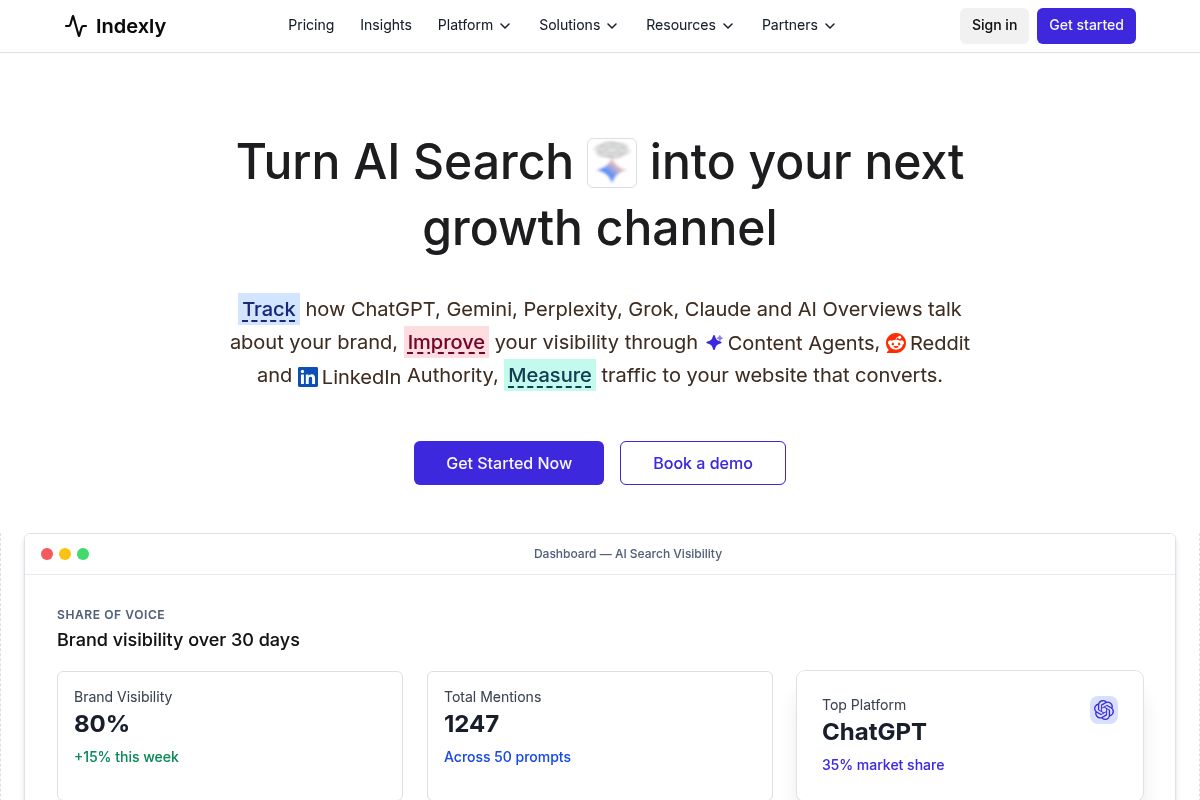
Indexly is an AI search visibility platform that helps brands monitor, analyze, and improve their presence across AI search engines including ChatGPT, Gemini, Claude, Perplexity, Grok, and Google AI Overviews.
It combines prompt tracking, citation gap analysis, AI sentiment monitoring, GEO-optimized content creation, AI traffic analytics, and brand signals from platforms like Reddit and LinkedIn to help marketing teams understand, optimize, and grow their AI search visibility.
Key Features
- Prompt Tracking and Research: Tracks important prompts across AI platforms, helps organize queries by campaigns, and monitors response changes to identify visibility trends.
- Citation Gap Analysis: Identifies prompts where competitors receive AI citations but your brand does not, helping teams find content optimization opportunities.
- Brand Sentiment Monitoring: Analyzes AI responses to understand how models describe your brand and detect positive, negative, or inaccurate mentions.
- AI Hallucination Detector: Finds incorrect or misleading AI-generated information about your brand and helps improve response accuracy.
- Query Fan-Out Analysis: Discovers related queries and user intent patterns to uncover new AI visibility opportunities.
- GEO-Optimized Content Agents: Helps create and optimize content designed to improve AI citations and brand mentions.
- AI Traffic Analytics: Tracks AI-driven traffic and connects visibility insights with sessions, conversions, and business impact.
- Brand Memory with Reddit and LinkedIn Signals: Uses external brand signals from Reddit, LinkedIn, and owned content to understand AI answer influence.
- White-Label Agency Mode: Enables agencies to manage clients with branded reporting, multi-client workflows, and scalable AI visibility services.
| Aspect | Detail |
|---|---|
| Pros | Prompt tracking, citation gap analysis, GEO content agents, AI traffic attribution, Reddit/LinkedIn signals, strong agency features, affordable pricing |
| Cons | Newer entrant compared with enterprise platforms; advanced compliance features require custom plans |
| Pricing | Starts at $99/month; scalable plans for teams and agencies |
| Best For | Marketing teams, brand managers, AEO agencies, and growth teams needing AI visibility analytics + optimization |
| Overall Analytics Score | 9.4 / 10 |
"Indexly has completely changed how I track my visibility across AI search engines. The AI Search Visibility and Prompt Tracking features helped me finally understand how ChatGPT and other models perceive my pages." — Indexly customer review
Read: The 10 Best AI Search Visibility Tracking Platforms in 2026
2. Cognizo — Best for UI-Scraped Answer Accuracy and ChatGPT Ads Integration
Cognizo is a GEO platform that helps brands measure AI share of voice by tracking how they appear across major AI search platforms. Its Answer Engine Insights module monitors brand visibility, sentiment, owned citations, and earned citations across ChatGPT, Google AI Overviews, Gemini, Perplexity, Microsoft Copilot, Claude, Grok, Meta AI, and DeepSeek.
Unlike platforms that rely only on API-based responses, Cognizo uses UI scraping to capture the actual AI-generated answers users see. This provides more accurate visibility data by reflecting real-world AI search experiences.
Key Features
- Answer Engine Insights: Tracks AI share of voice using UI-scraped responses, measuring brand mentions, citations, sentiment, and visibility across AI platforms.
- Prompt Volume Insights: Uses real-world search signals to identify high-value prompts and understand what users are asking across AI search.
- AI Content Studio: Generates content briefs, outlines, drafts, and FAQs based on AI visibility gaps and optimization opportunities.
- ChatGPT Ads Integration: Helps brands activate paid visibility within ChatGPT-powered experiences through targeted advertising capabilities.
- AI Traffic Analytics: Tracks AI-driven traffic performance to help teams measure the impact of AI visibility efforts.
- Technical AI Audits: Provides schema guidance and entity optimization recommendations to improve AI understanding of brand content.
- Unlimited Team Access: Supports unlimited users across plans, making it suitable for larger marketing teams and organizations.
| Aspect | Detail |
|---|---|
| Pros | UI-scraped AI answer tracking, broad AI engine coverage, prompt volume insights, ChatGPT Ads integration, unlimited seats |
| Cons | Higher entry pricing; limited content generation on lower plans |
| Pricing | Starts at $149/month; Growth plan with ChatGPT Ads integration at $499/month |
| Best For | Mid-market and enterprise teams needing accurate AI answer tracking, content workflows, and AI visibility insights |
| Overall Analytics Score | 8.9 / 10 |
3. Evertune — Best for Statistical Enterprise AI Brand Intelligence Across 11 Models
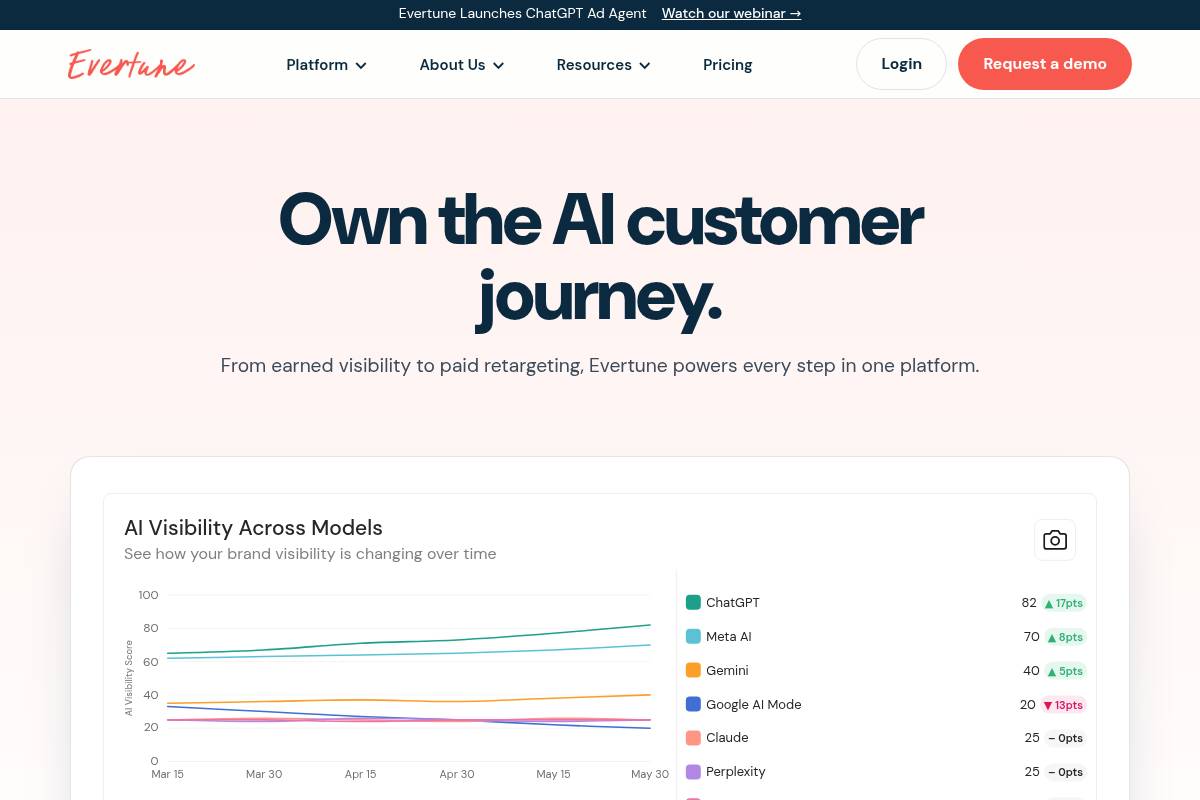
Evertune focuses on measuring AI brand visibility through large-scale statistical analysis rather than individual prompt checks. The platform runs thousands of AI queries across multiple models to create benchmark-level share of voice scores, helping enterprise brands understand how often they appear, how competitors compare, and how AI systems perceive their brand.
Key Features
- AI Brand Index: Measures brand share of voice across 11 AI models using large-scale prompt sampling.
- Source Intelligence: Identifies the websites and content sources influencing AI-generated brand mentions.
- AI Perception Monitoring: Tracks how AI models describe brands and detects inaccurate or misleading information.
- Shopping Intelligence: Monitors AI shopping recommendations and product comparison visibility.
- AI Retargeting: Helps brands activate advertising campaigns based on AI search visibility insights.
- Enterprise Analytics: Provides reporting designed for large brands and enterprise marketing teams.
| Aspect | Detail |
|---|---|
| Pros | Large-scale AI share of voice measurement, statistical benchmarking, AI perception monitoring, enterprise brand intelligence |
| Cons | Premium pricing; limited content optimization and SEO workflow capabilities |
| Pricing | Starts at approximately $3,000/month with enterprise plans |
| Best For | Enterprise brands requiring statistically reliable AI visibility benchmarks and competitive intelligence |
| Overall Analytics Score | 8.4 / 10 |
4. Peec AI — Best for Multi-Language B2B Share of Voice Tracking
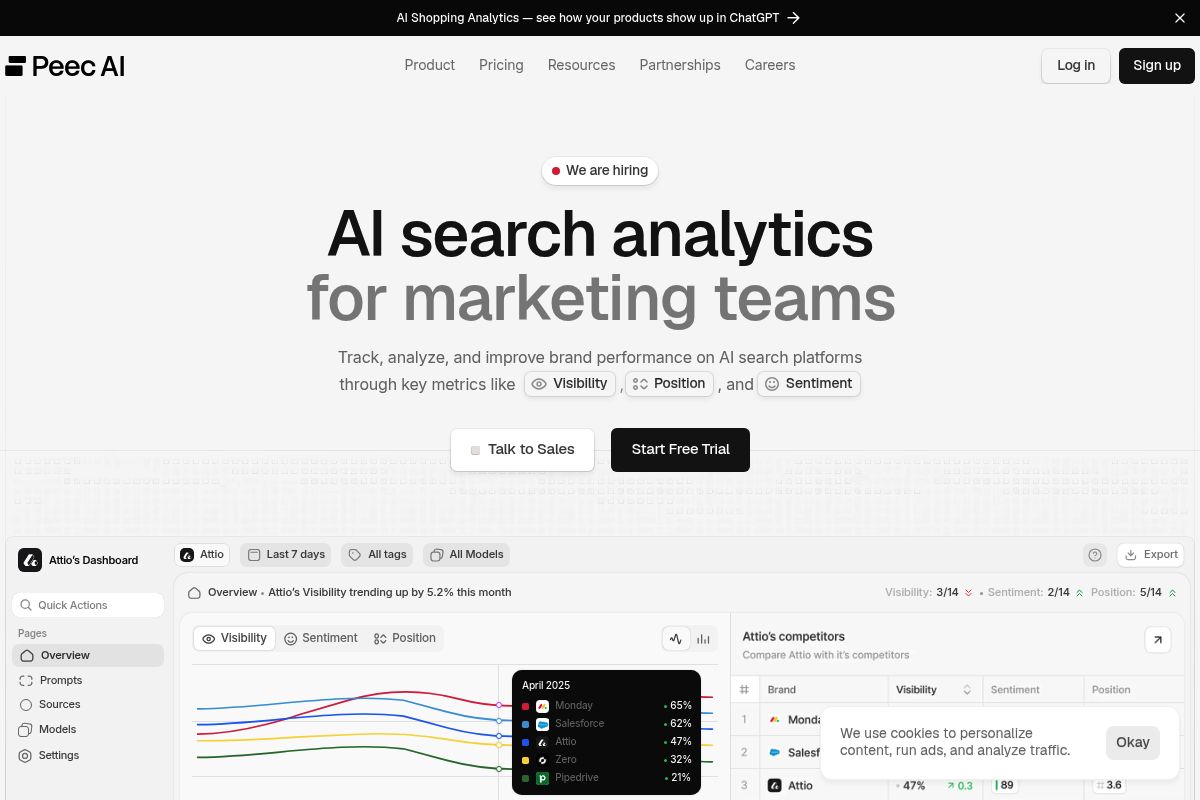
Peec AI calculates AI share of voice by monitoring brand mentions across tracked prompts and comparing visibility against competitors across regions and languages. Its focus is on helping global brands understand where they appear, which markets they dominate, and where competitors receive more AI visibility.
Read: Peec AI Review: Features, Pricing, Pros, and Cons
Key Features
- AI Share of Voice: Offers AI Mention Tracking, AI Visibility Score, and Prompt Visibility Monitoring, plus Citation Intelligence, Response Position Analysis, and Share of Voice with Competitive Benchmarking.
- 115+ Language Support: The broadest multi-language coverage of any tool in this list—essential for global and regional brand managers.
- UI Scraping Methodology: Queries AI platforms by simulating real browser sessions rather than calling APIs, capturing the same responses actual users see.
- Looker Studio and API Exports: Peec AI's main strengths include AI search metrics, prompt discovery, competitor benchmarking, citation source analysis, and reporting integrations such as CSV exports, Looker Studio, and API access.
- Unlimited Seats: All plans include unlimited users—no per-seat fees regardless of team size.
| Aspect | Detail |
|---|---|
| Pros | 115+ language support, regional AI share of voice tracking, competitor benchmarking, unlimited users, reporting integrations |
| Cons | No content creation workflows; focused mainly on analytics and measurement |
| Pricing | Starts at approximately $95/month for brands and $245/month for agencies |
| Best For | Global brands and B2B teams tracking AI visibility across multiple regions and languages |
| Overall Analytics Score | 7.9 / 10 |
5. Otterly AI — Best for Budget-Conscious Teams Entering AI Visibility Monitoring
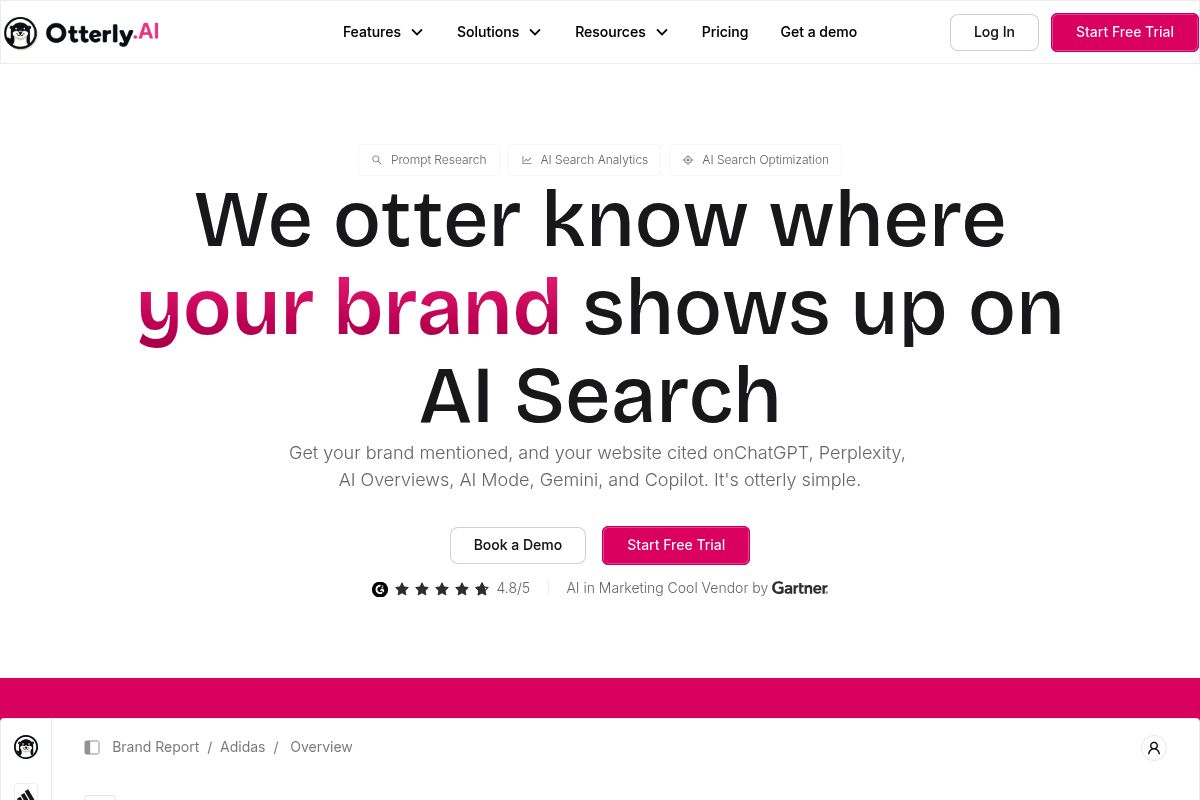
Otterly AI is a clean, self-serve AI search visibility tool built for marketers and agencies who want to start measuring mentions, citations, and GEO performance fast. It's not the deepest platform in the category, but it is one of the easiest to adopt.
Otterly reruns your prompts daily across ChatGPT, Perplexity, Google AI Overviews, and Microsoft Copilot, stores the history, and turns it into a brand visibility index plus citation and share-of-voice reports.
Key Features
- Daily Prompt Tracking: Runs tracked prompts daily across four core AI engines with historical trend data.
- Brand Visibility Index: Provides a clean headline metric that is easy to track and present to stakeholders.
- GEO URL Audits: The Lite plan includes 15 prompts, all four core engines, 1,000 GEO URL audits, multi-country tracking across 50+ markets, an AI keyword research tool, and unlimited team members.
- MCP Server and API Access: Otterly ships a live official MCP server, a public API, and a Claude Skill—a serious agent stack for a tool at this price point.
- 50+ Country Coverage: Multi-country tracking available on every plan including the $29/month Lite tier.
- Pricing: Lite is $29/month, Standard is $189/month, and Premium is $489/month, with annual discounts that bring effective prices to $25, $160, and $422/month respectively.
| Aspect | Detail |
|---|---|
| Pros | Affordable pricing, simple AI visibility tracking, daily prompt monitoring, GEO audits, beginner-friendly setup |
| Cons | Limited advanced analytics; lower plans have prompt restrictions |
| Pricing | Starts at $29/month with higher plans available |
| Best For | SMBs, startups, and marketers looking for an affordable entry point into AI share of voice tracking |
| Overall Analytics Score | 7.7 / 10 |
6. Rankability — Best for Agencies Consolidating Content Creation and AI Visibility
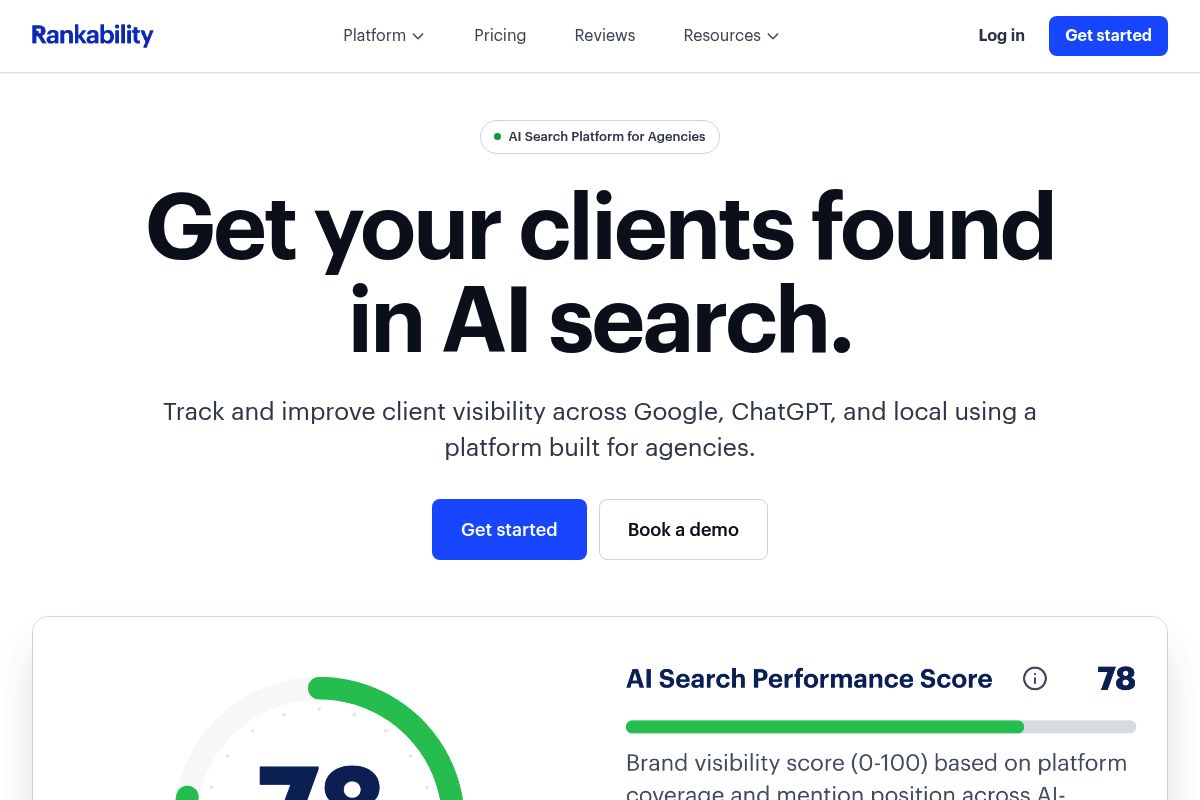
Rankability is an AI SEO platform that combines AI share of voice tracking with content optimization workflows. It measures brand visibility by monitoring AI mentions, citations, and competitor presence across AI-generated responses, then connects those insights with SEO research, content briefs, and optimization recommendations.
Unlike dedicated AI monitoring platforms, Rankability focuses on helping teams not only measure their AI visibility but also create and optimize content to improve future AI search performance.
Key Features
- AI Visibility Tracking: Offers AI Accessibility Audit, AI Mention Tracking, AI Visibility Score, and Citation Intelligence for monitoring visibility across AI platforms.
- GEO-Optimized Content Creation: Includes GEO Optimization, GEO-Optimized Content Creation, keyword research tools, SEO Audit, schema guidance, competitive benchmarking, reporting, and multi-brand management.
- Multi-Client Management: Multi-client management features and white-label capabilities make client reporting seamless for digital marketing agencies.
- Google Integrations: Connects natively to Google Analytics 360, Google Data Studio, and Google Search Console.
- AI-Powered Content Briefs: Automated brief generation that combines competitive data with AI visibility gaps to inform content strategy.
| Aspect | Detail |
|---|---|
| Pros | AI visibility tracking combined with SEO, content optimization, AI writing, briefs, and agency workflows |
| Cons | AI share of voice analytics are less advanced than dedicated AI visibility platforms |
| Pricing | Starts at $199/month |
| Best For | SEO agencies and content teams that want AI visibility insights integrated with content operations |
| Overall Analytics Score | 7.3 / 10 |
Who Wins in Each AI Share of Voice Category?
Not every AI share of voice platform excels in the same area. Some focus on enterprise reporting, while others prioritize AI traffic attribution, multilingual tracking, or content optimization. Breaking the comparison down by category makes it easier to choose the right platform for your specific goals.
Best Overall AI Share of Voice Platform
Winner: Indexly. Indexly provides the most complete AI share of voice solution by combining prompt tracking, citation gap analysis, AI traffic attribution, GEO content optimization, sentiment monitoring, and competitor analysis in a single platform. Rather than only measuring visibility, it helps teams understand why competitors are being recommended and what actions can improve AI search presence.
Best Prompt Tracking
Winner: Indexly. Prompt tracking is the foundation of AI share of voice analytics, and Indexly offers one of the most comprehensive implementations. Teams can organize prompts into campaigns, monitor visibility trends over time, compare results against competitors, and discover new prompt opportunities as AI-generated answers evolve.
Best Citation Analysis
Winner: Cognizo. Cognizo stands out by using UI-based answer capture to analyze the same AI responses users actually see. Its citation intelligence identifies which websites influence AI recommendations and helps brands understand where citation opportunities exist across multiple AI platforms.
Best Competitor Benchmarking
Winner: Indexly. Indexly makes competitor analysis highly actionable by comparing brand mentions, citation share, and visibility across tracked prompts while highlighting citation gaps where competitors are recommended instead of your brand. This helps marketing teams prioritize content improvements with the greatest potential impact.
Best AI Engine Coverage
Winner: Cognizo. Cognizo supports one of the broadest ranges of AI platforms, including ChatGPT, Gemini, Claude, Google AI Overviews, Perplexity, Microsoft Copilot, Grok, Meta AI, and DeepSeek. Its extensive coverage gives organizations a broader view of AI visibility across emerging answer engines.
Best GEO Content Optimization
Winner: Indexly. Unlike analytics-only platforms, Indexly connects AI share of voice insights directly to content execution. Its GEO Content Agents help teams create and optimize content designed to increase AI citations, improve brand mentions, and strengthen visibility across AI search engines.
Best AI Traffic Attribution
Winner: Indexly. Indexly goes beyond visibility metrics by showing how AI search translates into website traffic. Teams can measure AI referral sessions, identify which prompts generate visits, and connect AI visibility improvements to business outcomes.
Best Multilingual AI Share of Voice Tracking
Winner: Peec AI. Peec AI supports more than 115 languages, making it one of the strongest choices for international brands. Its regional tracking and multilingual benchmarking allow businesses to compare AI visibility across countries and markets from a single dashboard.
Best Enterprise Brand Intelligence
Winner: Evertune. Evertune specializes in large-scale statistical AI visibility measurement across multiple models. Its benchmarking methodology is designed for enterprises that need long-term market intelligence and reliable share of voice reporting rather than day-to-day optimization.
Best Budget-Friendly AI Share of Voice Tool
Winner: Otterly AI. Starting at just $29 per month, Otterly AI offers one of the lowest-cost entry points into AI share of voice monitoring. It includes prompt tracking, visibility reporting, and citation monitoring, making it well suited for startups and smaller marketing teams.
Best Agency Platform
Winner: Indexly. Indexly includes white-label reporting, multi-client management, branded dashboards, and scalable workflows, making it particularly attractive for agencies managing AI visibility across multiple client accounts.
Best Value for Money
Winner: Indexly. Indexly combines prompt tracking, citation gap analysis, GEO content creation, AI traffic analytics, competitor benchmarking, and agency features at a significantly lower price than many enterprise-focused alternatives. For teams seeking both analytics and optimization capabilities, it delivers one of the strongest feature-to-price ratios in this comparison.
Key Takeaway: Indexly wins the most AI share of voice categories by combining analytics, competitor insights, GEO content optimization, and AI traffic attribution in one platform. Cognizo excels in citation analysis, Peec AI leads multilingual tracking, Evertune stands out for enterprise analytics, and Otterly AI offers the best value for budget-conscious teams.
Read: Best AI Search Visibility Platforms For Brands 2026
Conclusion
Choosing the right AI share of voice tracking platform depends on your goals, budget, and the level of insights your team needs.
While Cognizo stands out for UI-based AI answer tracking, Evertune is ideal for enterprise brand intelligence, Peec AI excels in multilingual monitoring, and Otterly AI offers an affordable starting point for smaller teams.
For businesses looking for an all-in-one platform that combines AI share of voice tracking, prompt monitoring, citation gap analysis, AI traffic attribution, competitor analysis, and GEO content optimization, Indexly provides the most comprehensive solution.
If you're ready to measure and improve your brand's visibility across AI search, start with Indexly's free AI Search Visibility Checker to benchmark your presence before investing in a full AI visibility strategy.
Frequently Asked Questions
What is an AI share of voice tracking tool?
An AI share of voice tracking tool measures how often your brand appears in AI-generated responses across platforms like ChatGPT, Gemini, Claude, Perplexity, and Google AI Overviews. It tracks brand mentions, citations, prompt rankings, and competitor visibility to help improve your AI search presence.
Which is the best AI share of voice tracking tool?
The best tool depends on your needs. Indexly is a strong choice for marketing teams looking for AI visibility tracking, prompt monitoring, citation gap analysis, GEO content creation, and AI traffic analytics in a single platform. Enterprise teams may also consider Profound or Evertune, while Otterly AI is a good option for smaller budgets.
What features should an AI share of voice tool include?
Look for features such as AI prompt tracking, citation tracking, competitor benchmarking, brand sentiment analysis, AI traffic analytics, and support for major AI search engines like ChatGPT, Gemini, Claude, Perplexity, and Google AI Overviews.
How is AI share of voice different from traditional SEO?
Traditional SEO focuses on improving rankings in search engines like Google, while AI share of voice measures how often your brand is mentioned or cited in AI-generated answers. Both are important, but AI share of voice helps brands understand their visibility in AI search experiences.
Can AI share of voice tools improve my AI visibility?
Yes. Many platforms provide insights into citation gaps, competitor mentions, and prompt performance, helping teams identify opportunities to create content that is more likely to be referenced by AI models.
Which AI search engines do these tools support?
Most AI share of voice tools track leading AI search platforms, including ChatGPT, Gemini, Claude, Perplexity, Google AI Overviews, Microsoft Copilot, and, in some cases, Grok and DeepSeek.
Methodology: This review was compiled by the Indexly editorial team in July 2026. Tool features, pricing, and positioning were verified against official vendor websites, G2, Capterra, and independent third-party review sources. Pricing reflects published self-serve rates as of the publication date and may change; always verify current pricing on each vendor's official website before committing. Indexly is ranked #1 as the publisher's recommended top pick based on its unique combination of prompt tracking, citation gap analysis, GEO content agents, brand memory signals, and AI traffic attribution at an accessible price point for marketing teams and AEO agencies. Ratings are editorial assessments weighted across six criteria: AI engine coverage (25%), share of voice accuracy (20%), citation and competitor analysis (20%), content action layer (15%), traffic attribution (10%), and pricing and value (10%).