
Updated: June 2026 | Author: Indexly Editorial Team | Time Required: 3–5 hours per article | Difficulty: Beginner
What You'll Learn
This blog teaches you exactly how to optimize LinkedIn Pulse articles for AI engine citations. If you've been wondering how to get your LinkedIn content in front of AI systems like ChatGPT and Perplexity, you're in the right place.
“LinkedIn Pulse articles account for the majority of LinkedIn content citations in AI search and consistently receive the highest citation frequency compared to other content types.”
That's not an accident. It's structural. By following this seven-step framework, your marketing team, brand managers, or digital agency will be able to structure, write, and publish Pulse articles that ChatGPT, Perplexity, Gemini, Google AI Overviews, Microsoft Copilot, and Grok actively cite in their responses.
The Process at a Glance
| Step | Action | Time | Outcome |
|---|---|---|---|
| 1 | Choose a high-intent topic AI engines answer | 30–60 min | Topic mapped to real AI queries |
| 2 | Hit the 500–2,000-word citation sweet spot | 60–90 min | Article length optimized for AI retrieval |
| 3 | Build an H2/H3 heading hierarchy for extraction | 20–30 min | Semantic structure AI engines can chunk |
| 4 | Write answer-first sections in plain text | 60–90 min | Every section citable as a standalone answer |
| 5 | Embed entities, data points, and named frameworks | 20–30 min | AI knowledge graph recognizes your expertise |
| 6 | Add a Q&A section for direct query matching | 20–30 min | Article matches conversational AI queries |
| 7 | Publish, verify indexing, and track citations | 30–45 min | Citations monitored across all AI platforms |
Step 1: Choose a High-Intent Topic That AI Engines Are Already Answering
What You're Doing
Select a specific professional question that users already ask in ChatGPT, Perplexity, or Gemini, and that you can answer with experience and authority. Topic selection determines whether your content gets cited in AI search. If the topic is wrong, even strong writing won’t perform.
How to Do It
- Open ChatGPT, Perplexity, and Gemini. Enter a question your ideal audience would ask, such as:
- “How do B2B SaaS companies reduce churn in 2026?”
- “What is the best content strategy for AI-driven lead generation?”
- Review the answers and note which sources are cited. If LinkedIn Pulse articles appear, analyze their topics and structure. If not, you may have found a content gap.
- Validate search demand using Indexly to confirm real Google search volume. Aim for topics relevant in both AI and traditional search.
- Choose topics where you have first-hand experience, proprietary data, or a defined framework. Most AI citations come from original content, not reshared posts.
- Avoid broad thought-leadership topics like “the future of work.” Prioritize educational, how-to content.
Example: Topic Selection Decision Table
| Topic Idea | Format Type | AI Citation Potential | Verdict |
|---|---|---|---|
| "My thoughts on AI in 2026" | Opinion/thought leadership | Low | Avoid |
| "How to reduce B2B SaaS churn rate" | How-to guide | High | Publish |
| "What is account-based marketing" | Definition/explainer | High | Publish |
| "Top 7 CRM tools for mid-market sales" | Listicle/comparison | High | Publish |
| "Exciting news from our team" | Announcement | None | Avoid for AI |
Best Practices
- Publish articles on the exact topics for which you want your brand to be cited. Aim for answer completeness, not post frequency.
- Build a topic cluster: publish 3–5 related Pulse articles over a 4-to-6-week period to signal topical authority to AI retrieval systems.
- Name your frameworks explicitly. Entity resolution, the process an LLM uses to connect a specific label (like your framework's name) to a specific concept or brand, allows an LLM to connect a specific label to a specific person or brand — a named framework becomes a node in the model's knowledge graph.
What Done Looks Like
You have a precise, question-based topic aligned with your expertise, confirmed in multiple AI tools as a cited source, and supported by real search demand.
Read: how to get your LinkedIn content cited by ChatGPT and Perplexity
Step 2: Hit the 500–2,000-Word Citation Sweet Spot
What You're Doing
You're calibrating your Pulse article's word count to fall within the range that AI engines cite most frequently, balancing enough depth to answer a detailed professional query with enough focus to remain useful throughout. This sounds simple, but it's where many writers go wrong, they either publish thin 300-word pieces or rambling 4,000-word epics, neither of which performs well in AI search.
How to Do It
- Target a final word count of 800–1,500 words as your default range. Content between 500 and 2,000 words tends to perform best for AI citation because it is detailed enough to be useful while still easy to extract and reuse.
- Do not inflate word count. Every paragraph must add a distinct, usable insight or instruction.
- Start with a strong opening paragraph of 2–3 sentences that clearly states your main claim. AI systems often extract early sentences, so the introduction must stand alone as a complete answer.
- Use short paragraphs of 2–4 sentences. AI retrieval systems break content into chunks (often 300–500 words). If a paragraph contains multiple ideas, it reduces clarity and citation strength.
- For Microsoft Copilot specifically, prioritize long-form: Pulse articles make up 90.2% of Copilot's LinkedIn citations, making article length and structure especially critical for that platform.
What Done Looks Like
Your article is 800–1,500 words long, opens with a clear and complete claim in the first two sentences, uses short focused paragraphs, and each section answers a specific sub-question. Any single paragraph can stand alone and still make sense.
Step 3: Build an H2/H3 Heading Hierarchy for AI Extraction
What You're Doing
You’re structuring your LinkedIn Pulse article so AI systems can easily break it into meaningful sections. A clear H2/H3 hierarchy helps models identify, isolate, and cite specific parts of your content in response to precise queries.
How to Do It
- Use H2 headings to define the major themes of your article (e.g., "What Is Account-Based Marketing?", "How to Build an ABM Strategy in 2026"). Use H3 headings for sub-topics within each theme.
- Write every heading as a standalone knowledge claim or direct question. Every H2 and H3 should be writable as a standalone FAQ question or a direct declarative claim; if it cannot pass that test, rewrite it.
- Place a subheading every 200–300 words to avoid large blocks of text. This improves both readability and AI extractability.
- Follow each H2/H3 heading immediately with a direct answer of 40–60 words. Use H2/H3 headers for questions, followed by direct, 40–60-word summaries. Support that summary with bullet points or a short table below.
- Test your heading structure by reading only the headings in sequence. Ask: "Can someone understand what this article covers and what it claims, without reading the body?" If yes, your structure is AI-ready.
Example: Heading Structure Comparison
| Weak Heading (Low Citation Potential) | Strong Heading (High Citation Potential) |
|---|---|
| Introduction | What Is Account-Based Marketing and Why It Matters in 2026 |
| Some Background | How to Build an ABM Target Account List in 5 Steps |
| Things to Consider | What Metrics Measure ABM Campaign Success |
| Wrapping Up | How to Scale ABM Without Increasing Headcount |
Best Practices
- Use a clear heading hierarchy: H2 for themes, H3 for specifics, with sections of approximately 120–180 words for optimal extractability.
- Keep heading nesting to H2 and H3 only. Going deeper than H3 creates structural complexity that reduces AI chunking accuracy.
- Including data tables can increase citation rates by 2.5 times; add at least one comparison table per article where your topic permits it.
What Done Looks Like
Your article contains 4–7 H2 sections, each with 1–2 H3 sub-sections. Every heading works as a standalone question or claim. The heading outline alone tells the full story of the article, allowing someone to understand the entire piece without reading the body text.
Step 4: How to Optimize LinkedIn Pulse Articles with Answer-First, Plain-Text Sections
What You're Doing
You’re rewriting each section of your Pulse article so it begins with a direct answer to the implied question. This ensures AI systems can immediately extract and cite the core idea without needing context from surrounding text. AI models prioritize clarity and directness over narrative buildup or stylistic framing.
How to Do It
- Apply an answer-first structure to every section. Start with a clear 40–60 word answer in the first 1–2 sentences, then follow with supporting evidence, data, or context.
This structure improves extractability because AI systems can isolate the main claim instantly without scanning the full section.
Write using simple Subject–Predicate–Object (SPO) sentences:
- One idea per sentence
- One idea per paragraph
- Direct, unambiguous statements only
Always lead with the conclusion, then explain it.
- Avoid vague or filler phrasing such as “it is widely believed.” Replace it with specific, factual statements that can stand independently.
Example:
Instead of: “It is widely believed that ABM improves revenue.”
Use: “B2B companies using account-based marketing generate higher revenue because they concentrate resources on high-value accounts."
3.Avoid embedding key facts inside complex, multi-clause sentences. The paragraph that gets cited is the one that makes sense when read in isolation, with no surrounding context required.
4.Use plain text formatting only. LinkedIn Pulse does not require HTML, styling, or formatting tricks, clean structure performs better for AI extraction.
- Bold key entities and definitions, for example, the first instance of a named framework or a critical statistic. Bolding used excessively creates noise and can reduce performance by obscuring what matters.
Best Practices
- Prioritize practical, specific advice over abstract framing; first-hand experience and original analysis over synthesized summaries; embedded data, methodology, or specific examples; and clear arguments with stated positions over balanced both-sides framing.
- Avoid using pronouns like "it," "they," or "this" when the referent could be ambiguous. Repeat the entity name if needed. Reducing ambiguity improves AI extraction accuracy because LLMs understand meaning, not just exact-match keywords.
What Done Looks Like
Every section begins with a 40–60 word direct answer. Each paragraph contains only one idea. Every section can be understood independently without relying on earlier context. The article is structured so each block is directly extractable and citable by AI systems.
Step 5: Embed Entities, Data Points, and Named Frameworks
What You're Doing
You're making your expertise easier for AI systems to recognize and trust by explicitly naming people, companies, tools, frameworks, and statistics. Specific entities create stronger connections and make your content easier to cite.
How to Do It
- Give your methodology or process a clear name. Use a short 2–5-word label such as "Revenue Attribution Framework" or "Three-Stage Content Flywheel." Named frameworks create recognizable concepts that AI systems can associate with your brand.
- Spell out company names, platforms, and tools on first mention. For example, write "ChatGPT (OpenAI)," "Microsoft Copilot," and "Google AI Overviews." Define acronyms before using abbreviated versions.
- Include 2–3 statistics from named sources throughout the article. Specific numbers provide extractable facts and strengthen credibility.
- Reference related entities to establish semantic context. If your article is about AI search, mention ChatGPT, Perplexity, Gemini, and Google AI Overviews by name. Mentioning related entities establishes semantic context that AI engines use to map your content to specific queries.
- Attribute the article to a specific named individual with verifiable credentials. Named individuals are 87.8% of cited content URLs but account for 91.7% of citations, at 8.5 per URL compared to 5.5 for company pages and unattributed authors.
- Link to your website or other Pulse articles covering related topics. Cross-links reinforce relationships between entities and strengthen topical authority.
Best Practices
- Maintain consistent entity naming across all your Pulse articles. If a value proposition changes between the website, the LinkedIn page, and third-party reviews, model confidence drops, reducing citation likelihood.
- Include your own original data or survey results when possible. Even a small dataset (e.g., "of 50 clients surveyed...") constitutes a citable data point that AI engines cannot source elsewhere.
What Done Looks Like
Your article contains at least one named framework, includes multiple attributed statistics, uses full entity names throughout, and is published under a credentialed individual's profile.
Read: the top AI visibility platforms for LinkedIn citation tracking
Step 6: Add a Structured Q&A Section for Direct AI Query Matching
What You're Doing
You're adding a FAQ section at the end of your LinkedIn Pulse article that mirrors the questions users ask ChatGPT, Perplexity, and other AI tools. This section creates direct matches between user queries and your content, giving AI systems additional passages they can extract and cite. Even if the main article structure is imperfect, a well-written Q&A section can still provide highly citable answers.
How to Do It
- Go back to the AI tools you used during topic research and collect the exact questions users ask about your topic. Use those questions as your Q&A headings instead of rewriting them into formal or academic language.
- Format each question as a bold H3 heading or subheading, followed immediately by a plain-text answer of 40–80 words. Start with the answer, then add supporting context if necessary.
- Include four to six questions per article. FAQ sections align naturally with how people interact with AI assistants, making them one of the most reliable formats for citation.
- Make every answer completely self-contained. An AI system should understand the answer without needing to read previous sections. Follow the "atomic chunk" principle: one question, one answer, one idea.
- Avoid copying paragraphs directly from the article body. Rewrite the answer in slightly different language. Multiple versions of the same idea give AI systems additional extractable passages.
Example: Q&A Block for a LinkedIn Pulse Article on ABM
| Question | Answer Format | Word Count Target |
|---|---|---|
| What is account-based marketing (ABM)? | Definition + one-sentence context | 40–60 words |
| How does ABM differ from inbound marketing? | Direct comparison, SPO sentences | 50–70 words |
| What is the average ROI of ABM campaigns? | Statistic + attributed source | 40–50 words |
| How do I build an ABM target account list? | 3-step numbered list | 60–80 words |
Best Practices
- Use the exact natural-language phrasing people use in AI tools. Questions beginning with "how," "what," "why," and "which" tend to match conversational searches more closely.
- Treat each Q&A pair like a mini-article with a complete, quotable answer.
- Keep answers concise, clear, and independently understandable.
What Done Looks Like
Your article ends with a dedicated FAQ section containing four to six questions. Each question uses natural conversational language, and each answer is a self-contained 40–80-word paragraph that makes sense without requiring additional context. The section reads like a conversation between a user and an AI assistant.
Read: why Wikidata matters for AI citations
Step 7: Publish, Verify, and Track AI Citations with Indexly
What You're Doing
You're publishing your optimized LinkedIn Pulse article, verifying that AI platforms can access it, and monitoring citation performance over time. The goal is not just to publish content, but to understand which topics and formats earn citations so you can refine your strategy based on data.
How to Do It
- Publish your Pulse article as a public post from a personal LinkedIn profile. Company page articles earn fewer citations.
- Within 24 hours of publishing, test your article manually. Open ChatGPT, Perplexity, and Gemini and ask the exact question your article answers. Note whether your article appears as a citation.
- Share the article as a LinkedIn post from the same profile to generate the initial engagement signals (clicks, dwell time) that may influence freshness scores in AI retrieval systems. Push notifications and email distribution generate immediate engagement signals that may influence freshness signals to AI retrieval systems.
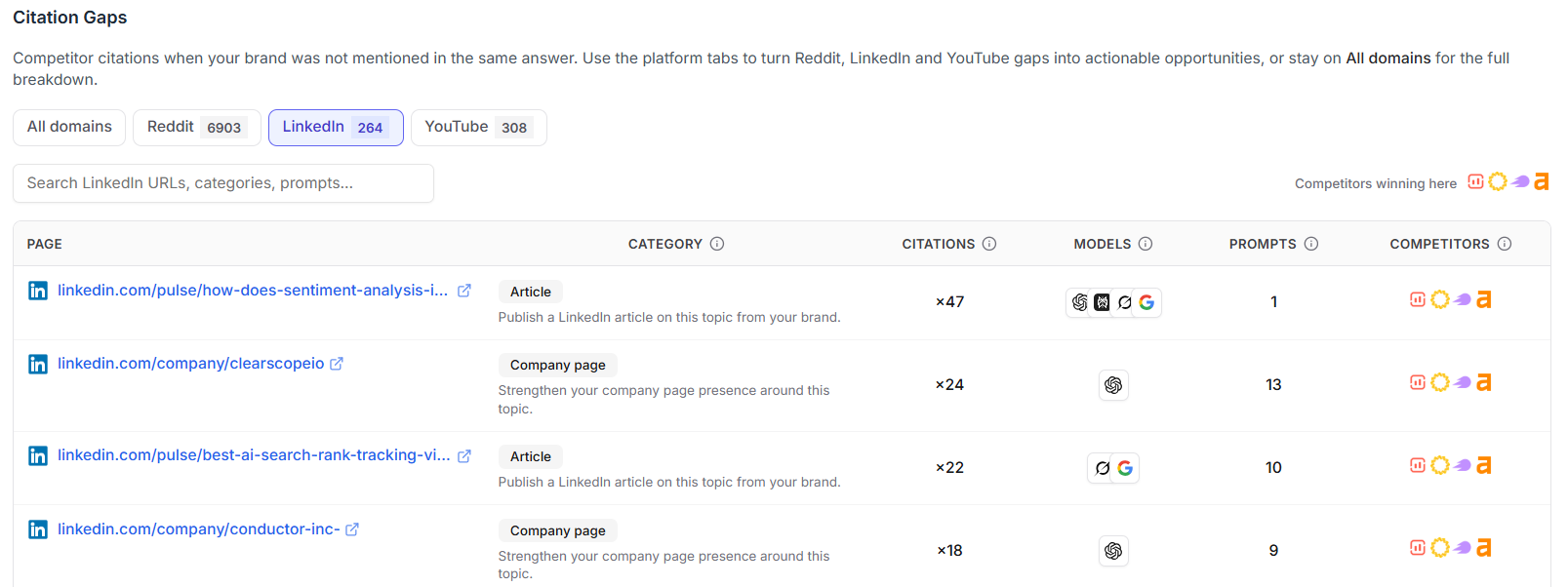
- Set up citation tracking using Indexly, a brand visibility platform that helps your brand get mentioned across Google and AI search.
- Update each Pulse article every 3–4 months with fresh data, new statistics, or updated examples. Answer engines weight recently published content for queries about current topics — date-stamped, current content signals to AI tools that the information is likely accurate.
What Done Looks Like
Your article is live on LinkedIn Pulse under a named individual's profile, you have confirmed it is being indexed by running manual tests across at least two AI engines, citation tracking is active through Indexly, and you have a calendar reminder to update the article within 90 days.
Conclusion
LinkedIn Pulse articles get cited by AI systems when they are structured like reference documents rather than opinion pieces. Clear topic selection, consistent heading hierarchy, answer-first writing, and explicit use of entities all improve how easily AI systems can extract and reuse your content.
When combined with a 500–2,000 word format, a strong Q&A section, and ongoing citation tracking through tools like Indexly, your articles become discoverable across ChatGPT, Perplexity, Gemini, and other AI search engines. The real advantage comes from consistency; repeating this structure across multiple articles builds lasting topical authority and improves long-term citation performance.
FAQ
How do you optimize LinkedIn Pulse articles for AI engine citations?
Optimize LinkedIn Pulse articles by selecting high-intent topics, writing 500–2,000 words, using clear H2/H3 headings, and starting each section with a 40–60-word direct answer. Add named entities, data points, and a Q&A section. Publish from a personal profile and maintain consistent, structured content for better AI extraction and citation.
Why do LinkedIn Pulse articles get more AI citations than LinkedIn posts?
Pulse articles get more AI citations because they are long-form, structured, and easier for AI systems to extract. They contain headings, deeper explanations, and standalone sections, making them more suitable as reference material compared to short-form posts that lack structure and completeness.
What is the ideal word count for a LinkedIn Pulse article to get cited by AI?
The ideal word count is 500–2,000 words, with 800–1,500 words performing best. This range provides enough depth to fully answer professional queries while remaining structured and easy to extract. Very short content lacks authority, while overly long content reduces clarity if not well organized.
How long does it take to start getting AI citations from LinkedIn Pulse articles?
Most optimized articles begin receiving AI citations within 2–4 weeks. Consistent citation patterns typically develop over 4–6 weeks with regular publishing. Speed depends on structure, topic relevance, indexing, and how often AI systems encounter similar queries.
What tools can I use to track which LinkedIn Pulse articles are getting AI citations?
Indexly helps track AI citations across ChatGPT, LinkedIn, Perplexity, Gemini, and Google AI Overviews by providing visibility analytics and monitoring brand mentions. Manual testing in AI tools using target questions can also confirm whether your article is being cited.
Which AI platforms are most likely to cite LinkedIn Pulse articles?
Google AI Overviews and Microsoft Copilot cite LinkedIn Pulse most frequently due to their preference for structured, long-form content. ChatGPT and Perplexity also cite LinkedIn articles depending on query type. Well-structured, answer-first content improves performance across all major AI platforms.