
Search is no longer just about retrieving information; it’s starting to decide how information is explained. With Google AI Mode, users don’t just get a list of links anymore. They get a single response. For many websites, this changes a fundamental assumption: visibility is no longer guaranteed by ranking alone.
What makes this shift harder to grasp is that it’s happening quietly in the background. Most brands are aware that AI is involved in search now, but few understand how deeply it changes what gets shown, what gets ignored, and why certain content is chosen over others.
This raises a more practical concern: if search is now AI-driven, what does “optimised content” actually mean today? And how do you stay visible in a system that doesn’t just list pages, but generates answers?
In this blog, we’ll discuss how Google AI Mode actually works, the core systems behind it, how it differs from traditional SEO, and how it continuously updates and learns.
What Is Google AI Mode?
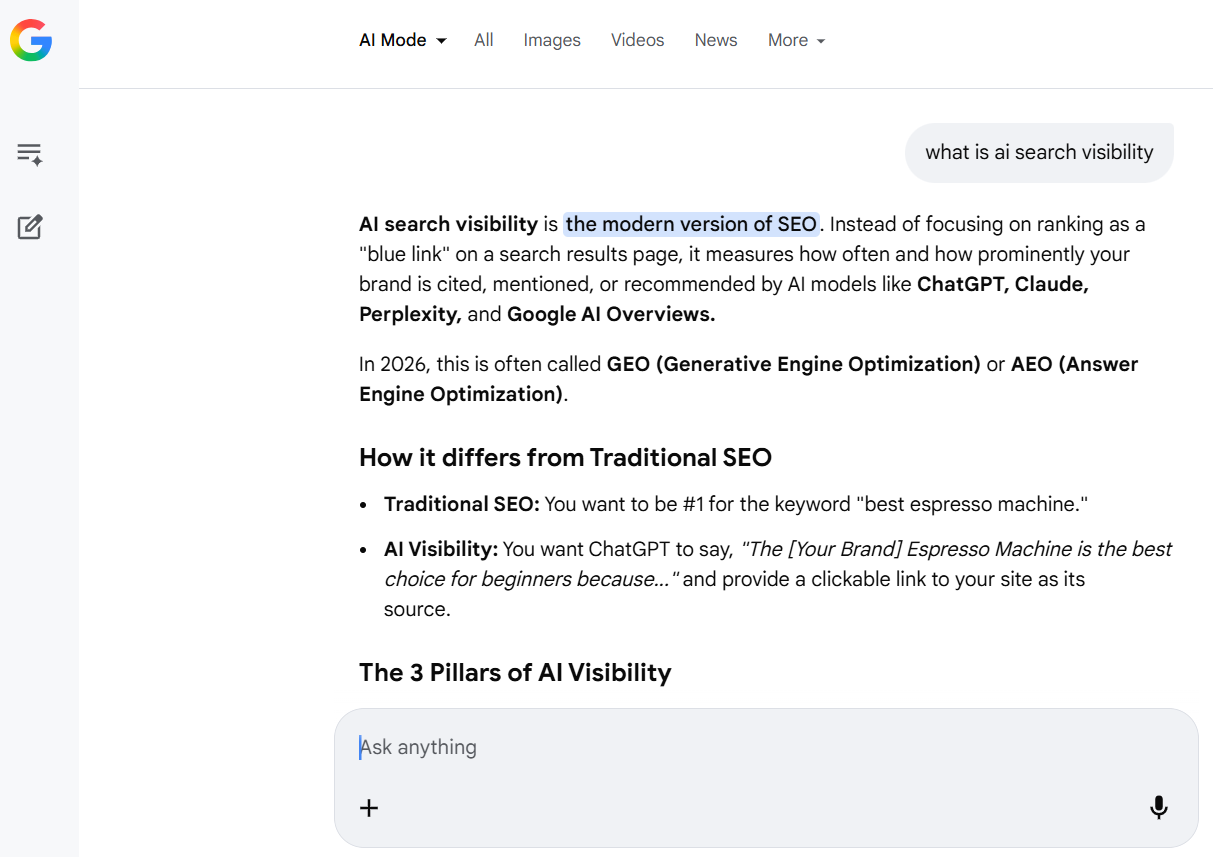
Google AI Mode is an AI-powered, conversational search feature within Google Search that uses a customised Gemini model to deliver direct, synthesised answers instead of traditional ranked web links. It gathers and processes information from multiple sources, including the live web, structured datasets, and the Knowledge Graph, to generate responses that align closely with user intent.
Unlike conventional search results pages, Google AI Mode is built to understand complex queries and provide structured, context-rich explanations. It also enables follow-up interactions, allowing users to continue refining their questions within the same conversational flow.
Google AI Mode vs AI Overviews
Read: Google AI Overviews Optimization Tools Guide 2026
Google AI Mode: 5-Step Working Process
Step 1: Intent understanding
Google AI Mode begins by analysing the user’s query to understand intent rather than just matching keywords. It interprets what the user is trying to achieve and evaluates the context and complexity of the question.
Based on this understanding, it determines whether the query is simple or requires deeper reasoning. If the request is multi-layered or exploratory in nature, the system activates its full AI-driven search process.
Step 2: Query fan out
After identifying intent, Google uses query fan out to expand the original query into multiple related sub-queries. Each of these sub-queries focuses on a different aspect of the topic, such as explanations, comparisons, related concepts, or supporting details.
This approach allows Google AI Mode to cover the subject more comprehensively instead of relying on a single search path, making it more effective than traditional search.
Step 3: Parallel information retrieval
Once sub-queries are generated, they are processed simultaneously across various data sources. This parallel retrieval system helps Google gather information quickly from multiple directions at once. It also enables the combination of factual data, context, and real-time information into a more complete understanding of the topic.
Step 4: AI synthesis
After gathering relevant passages, Google AI Mode uses advanced AI models to combine and organise the information into a single, coherent response. It removes repetition, aligns related ideas, and structures the output in a logical format.
Step 5: Conversational delivery
Finally, the response is presented in a conversational interface within Google Search. It typically includes supporting links, references, and additional context for deeper exploration. Users can also continue the interaction by asking follow-up questions, allowing the search experience to evolve naturally. This turns search into an ongoing dialogue rather than a one-time query-response interaction.
Core Technologies Behind Google AI Mode
Three interlocking systems give AI Mode its power.
Gemini 2.5 — the reasoning engine
Since May 2025, AI Mode and AI Overviews in the US have run on a custom version of Gemini 2.5, Google's most capable model. Gemini provides the reasoning layer: understanding nuanced intent, generating sub-queries, weighing evidence, and writing the synthesised response.
The Knowledge Graph — structured entity intelligence
The Knowledge Graph is Google's database of billions of entities — people, places, products, organisations, concepts — and the relationships between them. When AI Mode identifies entities in your query, it cross-references them against the Knowledge Graph to enrich responses with factual, structured data.
For SEO, this means that being a well-defined entity in the Knowledge Graph substantially improves your chances of appearing in AI-generated answers. Schema markup accelerates this process by making entity relationships machine-readable.
Retrieval-Augmented Generation (RAG)
AI Mode does not rely solely on Gemini's training data. It uses RAG — a framework where the model retrieves relevant documents from the live web at inference time, then grounds its response in those passages. This is what separates Google AI Mode from a standalone large language model: every answer is anchored to verifiable, real-time sources, reducing hallucinations and making citation accuracy possible.
How Google AI Mode Learns and Improves Over Time
Google AI mode has a "feedback loop" — features that prove valuable in AI Mode are eventually graduated into the core Search experience for all users. Several mechanisms drive this continuous improvement.
First, user interaction signals from AI Mode sessions inform future model fine-tuning. Queries that produce high engagement, follow-up questions, or click-throughs to sources signal that the response quality is high.
Second, Google Bots — specifically Google's AI-oriented crawlers — continuously re-index the web with an eye toward passage-level relevance rather than just page-level authority. Fresh, well-structured content that has been recently crawled is more likely to be retrieved and cited.
Third, real-time data integrations (sports scores, financial data, product pricing) are refreshed continuously. For queries touching these domains, the system blends live data with synthesised knowledge — making recency a genuine ranking signal, not just a tiebreaker.
How to write content for Google AI Mode?
As Google AI Mode uses query fan-out to break a single search into multiple sub-queries, content must be structured clearly for easy retrieval and section-level extraction. Here's how to do it:
Structure content as independent sections
Google AI Mode does not process an article as a whole. It identifies and pulls specific passages that best match parts of a query. This makes it important for each section to stand on its own and deliver complete meaning without relying heavily on surrounding text. The most effective approach is to present the key point immediately, especially in the opening sentence of each section.
Apply schema markup for better understanding
Schema markup helps AI systems interpret page content more accurately. Using structured data such as Article, FAQPage, HowTo, Organisation, and Breadcrumb in JSON-LD format improves how search systems read and categorise content. Proper schema implementation increases the chances of content being selected for AI-generated responses by improving machine readability and structure.
Focus on topical depth over keywords
Modern AI search systems prioritise topic coverage rather than simple keyword optimisation. Building topical authority requires interconnected content that fully explores a topic, similar to a structured knowledge system like the Knowledge Graph.
Build authority through Digital PR
AI systems tend to trust external validation more than standalone brand content. Mentions in credible publications, industry reports, research studies, or sources like Wikipedia improve the likelihood of being included in AI-generated answers. Digital PR therefore plays an important role in improving AI SEO performance by strengthening credibility and trust signals.
Quick optimisation tip
Adding FAQPage schema to high-traffic pages can significantly improve visibility in AI-driven search. Updating content regularly and showing a clear “last updated” date also helps improve freshness signals, which are increasingly important in AI search systems.
Make your site AI-crawler friendly
To appear in AI-powered search results, content must be accessible to both traditional and AI crawlers. Ensuring that Google bots are not blocked in robots.txt is essential for indexing. A growing best practice is adding an llms.txt file, which helps AI systems better understand site structure in a way similar to how sitemap.xml supports traditional search engines.
How Google AI Mode Differs from Traditional Search
How Indexly Helps Improve Visibility in Google AI Mode

Indexly improves visibility in Google AI Mode by tracking AI citations across AI answer engines, showing exactly where your content is being referenced and how often it appears compared to competitors. This helps identify real citation gaps and winning pages inside AI-generated responses.
It provides prompt opportunities, which surface the exact questions and user intents people are asking across AI search environments. This allows teams to create content based on real query demand, improving alignment with query fan-out behaviour and increasing chances of inclusion in AI answers.
Alongside this, Indexly runs AI readiness analysis, including schema markup checks, llms.txt support, and crawl accessibility for Google bots and AI crawlers, ensuring content can be properly understood and retrieved at the passage level.
It further supports a content engine that gives SEO/GEO optimised content and social presence layer, aligning content distribution across search and platforms like Reddit and LinkedIn, where engagement signals influence how AI systems interpret authority.
Conclusion
Visibility now depends on being included in the response. This change pushes SEO toward generative engine optimisation (GEO), where structured, entity-rich, and well-organised content is more likely to be cited.
Indexly helps brands stay visible by tracking AI citations, finding prompt opportunities, and optimising content for AI search systems. Stay ahead in AI search with Indexly — built for visibility in Google AI Mode and beyond.
FAQs
What is Google AI Mode?
Google AI Mode is a conversational search interface within Google Search, powered by a custom version of Gemini 2.5. Unlike standard results, it generates synthesised, cited answers by running parallel sub-queries (query fan-out) across the live web, the Knowledge Graph, and specialised databases — then weaving the results into a coherent response.
How is Google AI Mode different from AI Overviews?
AI Overviews are brief AI-generated summaries that appear at the top of standard Google search results for a wide range of queries. Google AI Mode is a dedicated, fully conversational interface designed for complex, multi-step research — with deeper reasoning, follow-up dialogue, and more extensive query fan-out. AI Overviews are the ambient AI layer; AI Mode is the deep AI experience.
Does traditional SEO still matter with Google AI Mode?
Yes, significantly. Strong organic rankings correlate directly with AI citation rates — 52% of sources appearing in AI Overviews rank in the top 10 organic results. Google still drives vastly more traffic than standalone AI tools. The right approach is to build on solid SEO fundamentals while layering GEO practices on top for AI search visibility.
How does schema markup help with Google AI Mode visibility?
Schema markup (implemented as JSON-LD using Schema.org vocabulary) makes your content's structure and meaning machine-readable. AI Mode parses structured data to understand entities, relationships, and content types before deciding what to cite. Research shows content with proper schema markup achieves 30–40% higher visibility in AI-generated answers.
How can I measure my brand's visibility in Google AI Mode?
Google Search Console does not currently separate AI Mode traffic from traditional organic traffic, creating a visibility gap. Purpose-built AI SEO tools — such as Indexly — track how often your brand is cited in AI Mode and AI Overviews responses, measure share of voice against competitors, and surface which pages are being pulled into AI-generated answers.