Digital Agencies - How to Create Client Reports for AI Visibility
Create clear AI visibility reports for digital agencies using Indexly with unified dashboards, audits, and insights.


Client reporting for digital agencies is the moment where marketing work turns into clear proof of impact that every client can actually understand. It connects every campaign activity with real business outcomes, helping clients see not just what was done, but what it achieved.
Clients today expect more than just results; they expect clarity, transparency, and meaningful insights. They want to see how marketing efforts translate into outcomes like leads, revenue growth, brand visibility, and presence in AI-driven search results.
As Peter Drucker famously said, “What gets measured gets managed.” In the same way, strong reporting transforms complex marketing data into clear, actionable insights that help clients understand progress while enabling agencies to build trust and long-term relationships.
In this blog, we will explore how agencies can make client reporting even more powerful, structured, and interesting by using modern strategies and AI-driven approaches.

Accelerate your agency growth with AI-powered SEO & search visibility services. Get a multi-client dashboard, co-branded materials, dedicated support, tiered pricing, and directory exposure to attract more clients.
Why Digital Agencies Must Create Client Reports
Client reporting is one of the most important yet often underestimated parts of running a successful digital agency. It is more than a monthly task, it is the foundation of trust, communication, and long-term client growth.
In today’s data-driven marketing world, where clients expect full transparency and real-time insights, reporting has become a critical business function rather than just an operational activity.
- Enhances client retention by making outcomes easier to understand and reducing uncertainty.
- Builds trust and clarity by transparently showing completed work and achieved results.
- Showcases actual performance growth such as traffic increases, leads, conversions, and AI visibility improvement plans.
- Reveals performance gaps and opportunities like content weaknesses, missing keywords, and competitor strengths.
- Supports data-backed decision-making instead of relying on assumptions or guesswork.
- Strengthens client relationships and overall agency growth by consistently proving value over time.
67% of customer churn can be reduced when companies resolve issues during the first interaction and effectively manage customer expectations.
Step-by-Step: How to Create Client Reports for AI Visibility for Digital Agencies
Step 1: Define AI Visibility Outcomes That Actually Matter to the Client
Start by clearly defining what success looks like in AI-driven discovery. Instead of vague reporting goals, agencies should map visibility to real outcomes like brand discovery inside AI answers, category positioning, and influence on purchase decisions.
Each client will have a different priority—some care about being mentioned more often, others care about being recommended over competitors. This distinction shapes how every AI visibility metric is interpreted later in the report.
Without this alignment during onboarding, reporting becomes disconnected from business reality. The goal is to ensure every metric ties back to something the client can actually act on or measure in revenue terms.
Step 2: Map the AI Ecosystems Where Visibility Actually Happens
AI visibility does not exist in one place—it is distributed across multiple answer engines. Agencies need to actively track how brands appear across ChatGPT, Perplexity, Gemini, and Google AI Overviews.
Each platform behaves differently. Some prioritize citations, others rely on reasoning patterns or conversational context. Treating them the same leads to misleading reporting.
A complete tracking setup reveals where a brand is strong, where competitors dominate, and where Share of Answer gaps are silently costing visibility.
Step 3: Build Intent-Based Prompt Libraries That Mirror Real Users
Instead of random keyword sets, agencies should design prompts based on real decision-making behavior. These include buyer intent questions, comparison searches, and problem-solving queries.
The objective is to replicate how users naturally interact with AI tools, not how SEO tools structure keywords. This makes AI visibility metrics far more realistic and actionable.
When structured properly, these prompts become a diagnostic layer that reveals how AI systems interpret authority, trust, and relevance across different query types.
43% of consumers use AI daily, and 75% use new search tools more now than a year ago, showing how quickly search behavior is shifting toward AI-driven discovery.
Step 4: Use Indexly for Automated Reporting and White-Label Dashboards
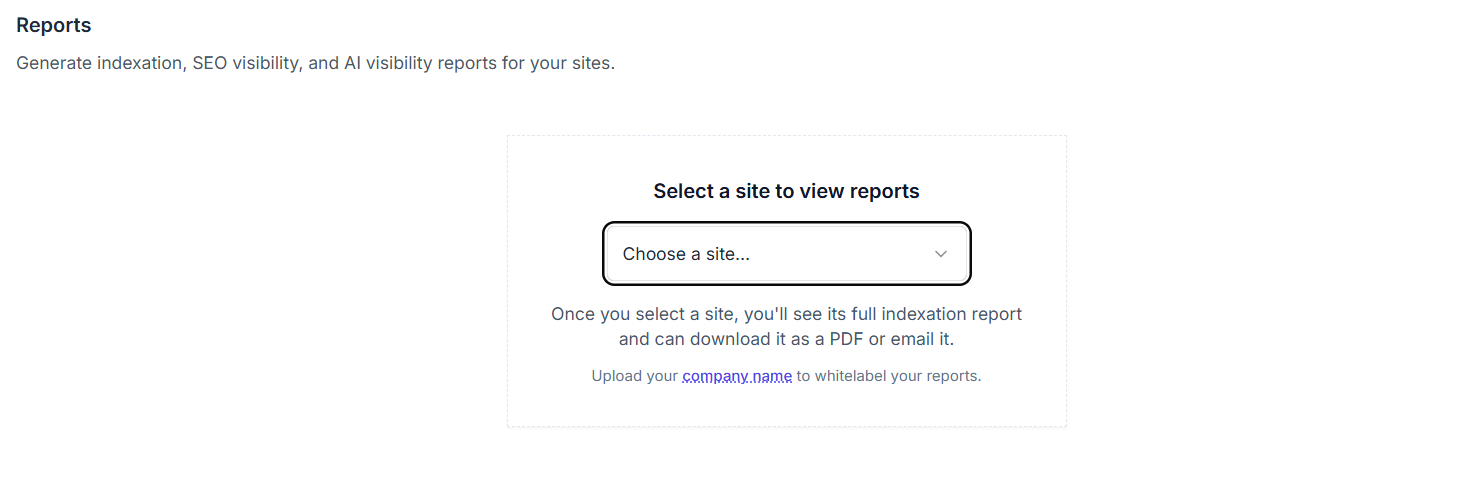
Modern digital agencies cannot rely on manual reporting if they want to scale efficiently. This is where automation becomes essential for consistency and speed.
Indexly automated reporting and white-label reporting is highly valuable for agencies, not only to keep clients consistently updated but also to significantly reduce manual reporting workload.
It allows agencies to generate professional, branded dashboards that combine AI visibility, SEO performance, and client metrics in one place. This improves accuracy, saves time, and ensures every client receives clear, structured, and timely insights without extra effort from the agency team.
Step 5: Analyze Visibility Through Mentions, Citations, and Sentiment Depth
Raw visibility data is not enough. Agencies must break it down into meaningful signals like how often a brand is mentioned, whether it is cited, and how it is described.
Sentiment plays a critical role here. AI systems often influence perception subtly, so understanding whether the tone is positive, neutral, or negative is essential.
When combined, these signals reveal how strongly a brand is positioned inside AI-generated ecosystems and how competitors are shaping the narrative.
Step 6: Consolidate Everything into a Decision-Focused Reporting Layer
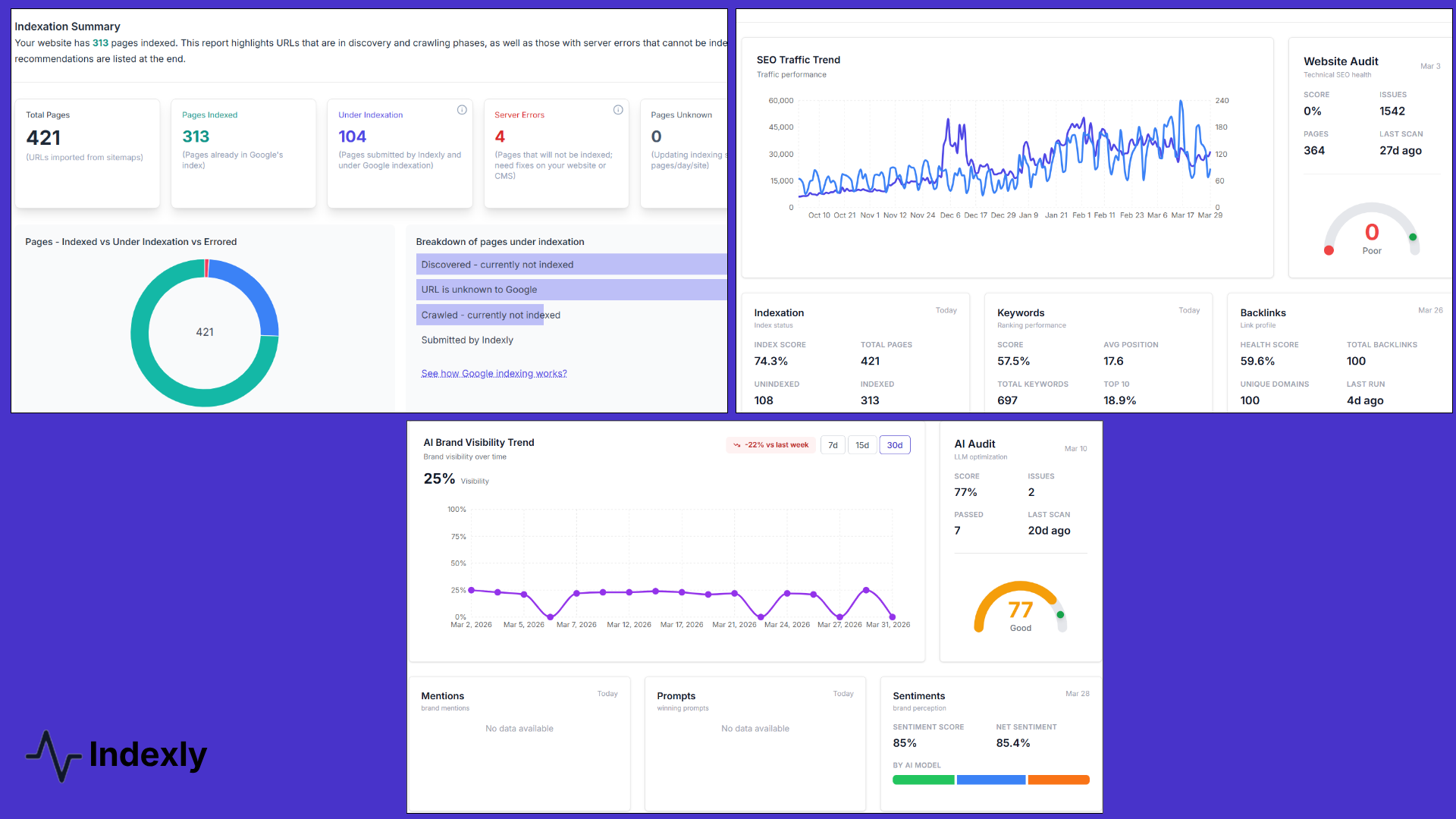
Instead of scattered reports, agencies should build a single structured view that combines AI visibility, SEO performance, and business metrics.
This reporting layer should answer one question clearly: What changed, why did it change, and what should we do next?
With platforms like Indexly, agencies can automate this structure into client-ready dashboards and white-label reports, ensuring consistency across accounts without manual effort.
Step 7: Connect AI Visibility Directly to Revenue Impact
The final step is where most reporting fails—linking visibility to business outcomes. AI presence alone means little unless it influences demand, searches, or conversions.
Even when AI tools don’t generate direct traffic, they shape decision-making before users reach a website. This makes visibility a top-of-funnel influence channel.
Strong agencies connect AI visibility improvements to lead generation trends, branded search growth, and conversion lift, proving that visibility is not just awareness—it is revenue influence.
Common Mistakes to Avoid
Here are a few common mistakes agencies should avoid when building AI visibility reports. These issues often reduce accuracy, weaken insights, and lead to incomplete understanding of how brands appear in AI-driven search systems.
Relying Only on SEO Metrics Instead of AI Signals
A common mistake agencies make is depending too much on traditional SEO data like rankings, backlinks, and traffic. While these are still useful, they don’t show how a brand actually appears inside AI-generated responses.
AI visibility works on different signals such as mentions, citations, Share of Answer, and sentiment. Ignoring these leads to incomplete reporting and a weak understanding of how AI systems evaluate brand authority.
Tracking Only a Single AI Platform
Another frequent error is analyzing just one AI tool, usually ChatGPT. This gives a limited and often misleading picture of overall visibility.
Different AI platforms like Perplexity, Gemini, and Google AI Overviews behave differently and generate varied responses. If agencies don’t track all of them, they miss important gaps where competitors may be performing better.
Using Poorly Designed Prompt Sets
Many agencies rely on generic or keyword-based prompts that don’t reflect real user intent. This reduces the accuracy of AI visibility insights.
Effective reporting requires intent-driven prompts that mimic how users actually ask questions in AI systems. Without this, the data becomes artificial and fails to represent real-world search behavior.
Not Automating the Reporting Workflow
Manual tracking of AI responses is inefficient and hard to scale, especially when managing multiple clients. It also increases inconsistency and reporting errors.
Without automation, most time is spent collecting data instead of analyzing it. Tools like Indexly help solve this by streamlining reporting and centralizing AI visibility data into structured dashboards.
Ignoring Competitor and Share of Answer Analysis
Some agencies only focus on client performance and skip competitor benchmarking. This creates an incomplete view of market positioning.
Share of Answer analysis is crucial because it shows how often competitors appear in AI-generated responses compared to the client. Without this, agencies cannot identify real opportunities or competitive gaps.
Treating AI Visibility as a Separate Channel
Another mistake is isolating AI visibility from SEO and overall marketing performance. This disconnect weakens the quality of insights.
AI visibility is closely tied to content authority, SEO strength, and brand perception. When it is treated separately, the reporting fails to show its true impact on growth.
Not Providing Clear Action Steps
Many reports stop at presenting data without explaining what should be done next. This reduces their practical value.
Strong reporting should always include clear recommendations such as improving content structure, enhancing authority signals, or fixing topical gaps. Without this, reports remain informational rather than strategic.
Not Linking Visibility to Business Results
A major mistake is failing to connect AI visibility with real outcomes like leads, conversions, or revenue. This makes it difficult for clients to understand its importance.
AI visibility often influences users before they even reach a website. If this impact is not tied to measurable business metrics, the true value of reporting is lost.
Future of Client Reporting in Digital Agencies
Client reporting is evolving into a more automated, real-time, and insight-driven process. Instead of static monthly documents, agencies are moving toward live dashboards that continuously track SEO performance, AI visibility, and overall business outcomes.
The emphasis is also shifting away from traditional metrics like rankings and traffic toward AI-based indicators such as mentions, citations, sentiment, and Share of Answer. This reflects how audiences now discover and evaluate brands through AI-powered platforms.
In this changing environment, automation tools like Indexly are becoming increasingly important. They help agencies scale reporting through white-label dashboards and automated insights, improving efficiency, consistency, and accuracy while reducing manual effort.
Conclusion
Client reporting is no longer just an operational task—it has become a key strategic function that drives trust, retention, and measurable business impact.
As AI-driven search continues to grow, agencies must adopt reporting systems that connect visibility, performance, and revenue into a clear and meaningful story.
To stay competitive, agencies should use platforms like Indexly, which provide automated reporting and white-label solutions to streamline workflows and deliver high-quality client insights at scale.
👉 Start using Indexly to automate reporting.
FAQs
1. What is AI visibility reporting for digital agencies?
AI visibility reporting helps digital agencies track how a brand appears in AI-generated answers across platforms like ChatGPT and Google AI Overviews. It includes AI visibility metrics such as mentions, citations, and brand sentiment tracking, going beyond traditional reports. Platforms like Indexly simplify this by consolidating all data into a unified dashboard. This helps agencies clearly measure and communicate brand visibility in AI-driven content engines.
2. What metrics should agencies include in AI visibility reports?
Agencies should focus on AI visibility metrics like mentions, citations, Share of Answer, and brand sentiment tracking. These provide deeper insights than traditional reports alone. Indexly automatically tracks these metrics and highlights gaps through its reporting system. This ensures agencies can connect visibility performance with real business impact.
3. How does Indexly improve AI visibility reporting for agencies?
Indexly improves reporting by automating AI visibility tracking, monitoring, and insights through a single unified dashboard. It generates white label reports, making it easy for agencies to present data professionally to clients. With features like technical audit and a built-in content engine, agencies can also act on insights instantly. This leads to better client satisfaction and scalable client success.
4. Why is automation important in AI visibility reporting?
Automation helps digital agencies scale reporting efficiently without manual errors or delays. Indexly provides end to end support, from the client onboarding process to ongoing reporting and optimization. Its automated workflows reduce time spent on data collection and improve accuracy. This allows agencies to focus more on strategy and lead generation.
5. How can Indexly help agencies connect AI visibility to business results?
Indexly helps agencies link AI visibility to outcomes like lead generation, conversions, and brand growth. By combining visibility data with performance insights, it shows how AI presence influences user decisions. Its reporting makes it easier to demonstrate ROI to clients. This strengthens trust and drives long-term client success.


