AirOps Review 2026: Features, Pros, and Cons
An Airops review covering features, pros, cons, and real reviews to help understand its content and AI Visibility capabilities.

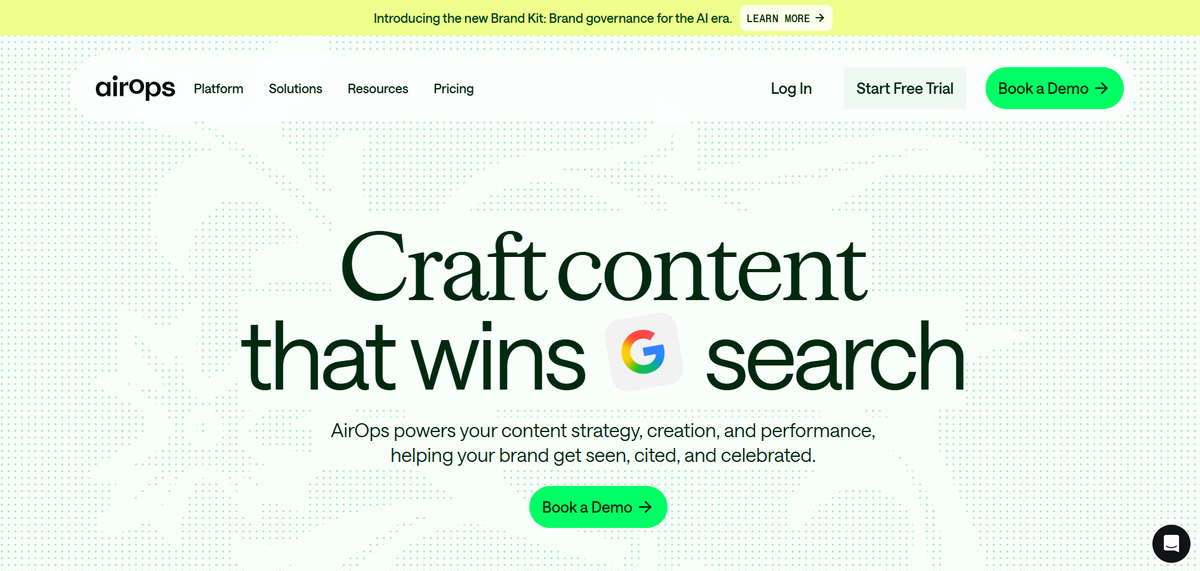
Looking for an AirOps review? Most teams today aren’t lacking tools; they’re overwhelmed by them. One for SEO, another for content creation, another for analytics, and now an entirely new category for AI search visibility. Every platform promises to “scale content” or “automate workflows,” but that’s no longer the real problem.
AirOps is one of the more prominent platforms trying to solve this. It positions itself as a content operations system, combining workflows, automation, SEO, and AI-driven execution into a single platform. Companies like Webflow, Ramp, and Carta use it, which signals real adoption. But here’s what most reviews don’t fully address: is AirOps helping you win visibility or just helping you produce more? If your goal is to get cited and surfaced in tools like ChatGPT and Perplexity, that distinction matters.
This review doesn't just list features; it evaluates where AirOps actually delivers, where it becomes complex or resource-heavy, and how effective it is for AI search visibility.
By the end, you’ll have a clear answer: do you need a full content operations platform, or a focused approach that helps you win in AI-driven search faster?
"My agency became x3 times more efficient, and clients' results because x2 times better!"- Romana K.Founder @SaaStorm
What Is AirOps?
AirOps is an AI-driven content operations platform that helps brands improve visibility, earn citations, and rank across traditional and AI-powered search. It combines content creation, SEO, strategy, and AI search visibility into one unified workflow system.
The platform is structured around three core components:
- Insights — analysing visibility and competitive positioning
- Actions — building and executing AI-powered workflows
- Context — ensuring outputs align with brand voice and internal knowledge
Together, these ensure teams don’t just produce content, but create work that is strategic, performance-driven, and scalable.
Who Is AirOps For?
AirOps is built for teams with an established content strategy that want to scale, rather than those still developing foundational processes. It suits SEO teams managing large content libraries, content-led growth teams moving quickly on opportunities, agencies handling multiple clients, and enterprise marketing teams needing structured workflows and brand consistency.
For individual creators or small teams without defined workflows, it may feel complex. AirOps delivers the most value when properly implemented and can underdeliver if rushed.
AirOps Features: A Detailed Breakdown
1. Insights: Understand Before You Execute
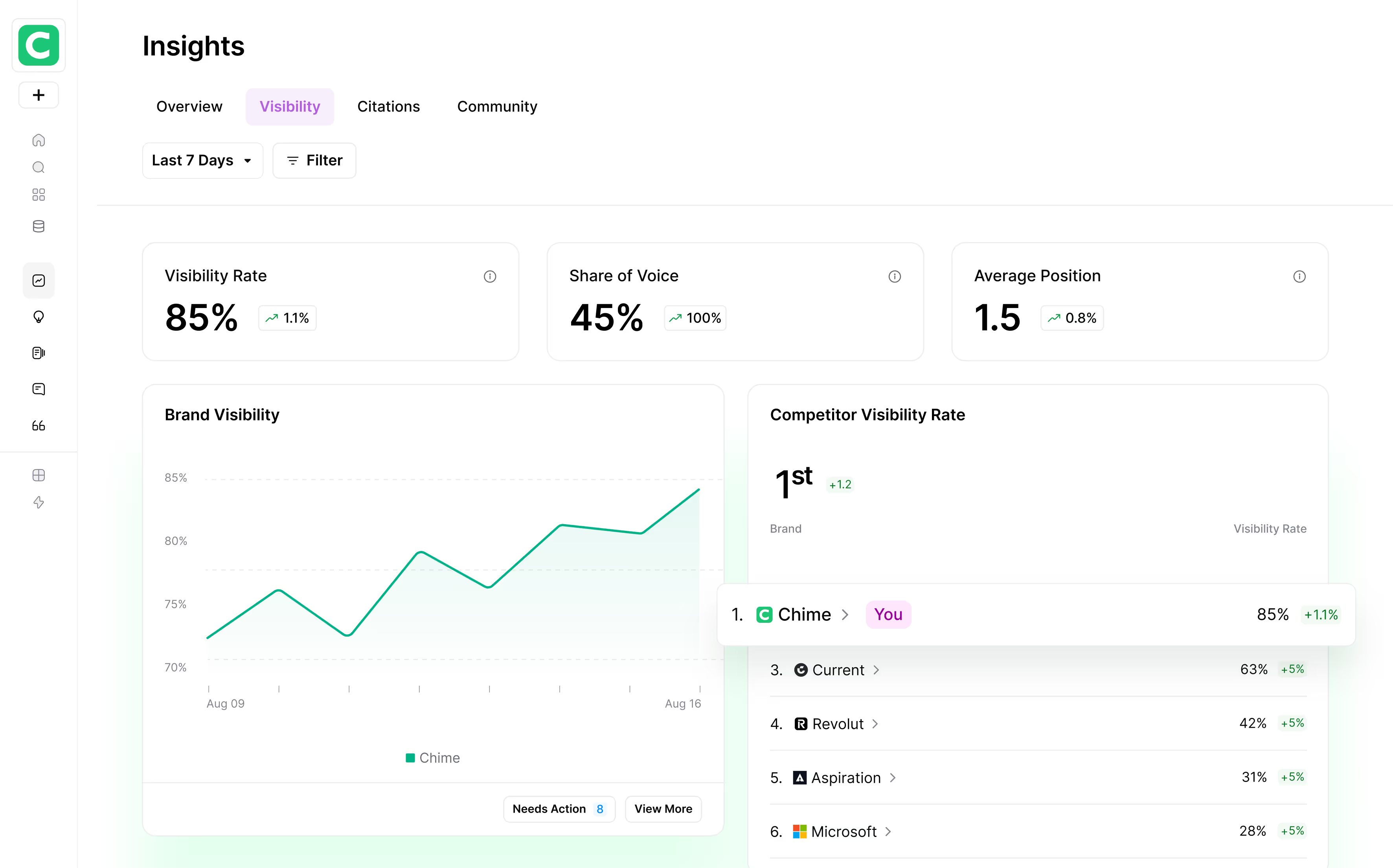
The Insights module acts as the analytical core of AirOps, combining AI search and traditional search data into a single interface. It helps teams identify performance trends, gaps, and opportunities.
2. Actions: From Insight to Execution
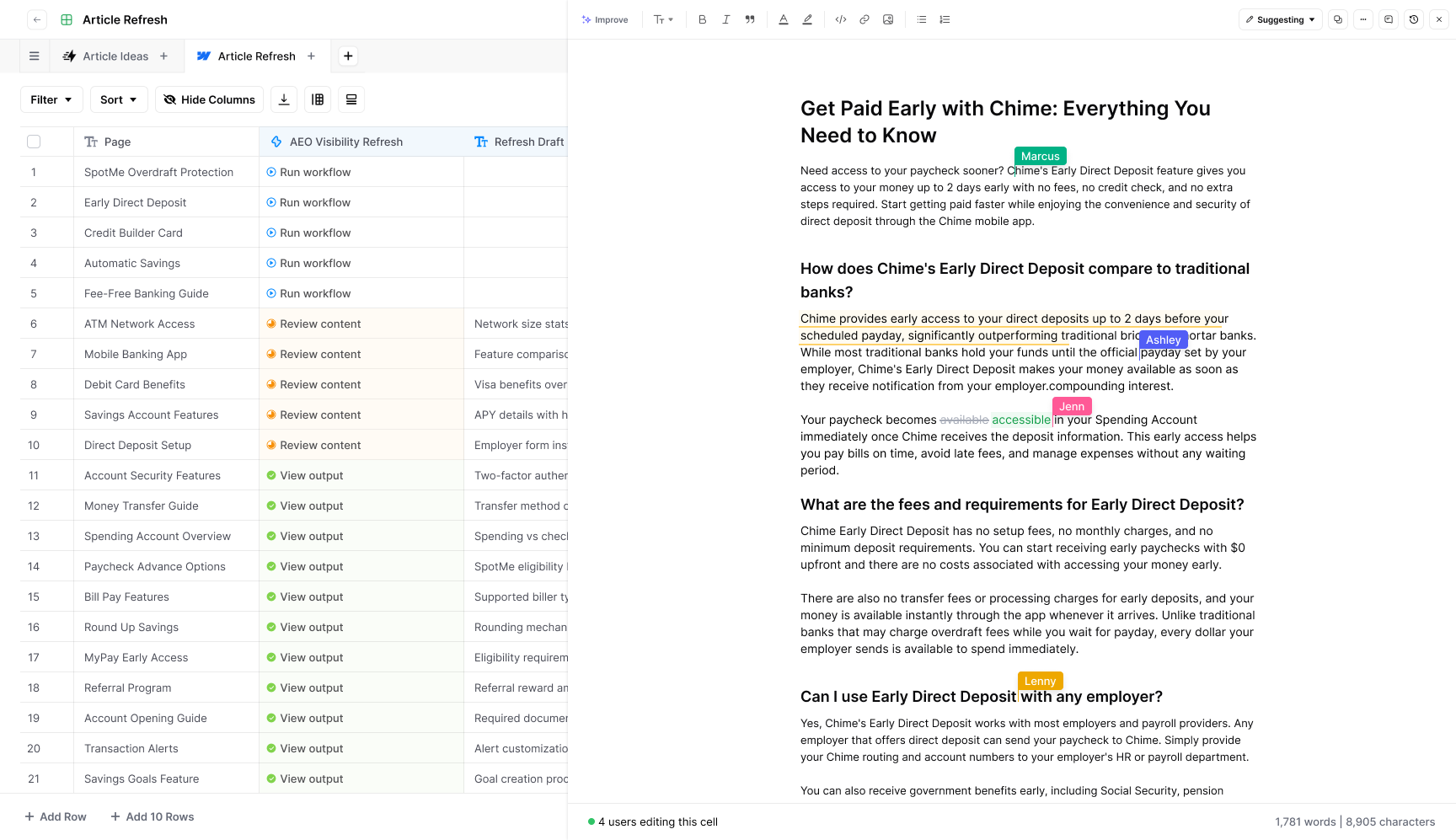
The Actions module is where strategy turns into output, positioning AirOps as more than just an analytics tool.
3. Context: Ensuring Brand Consistency
This is where AirOps differentiates itself from standard AI writing tools.
Read: Peec AI Review
Pros of AirOps
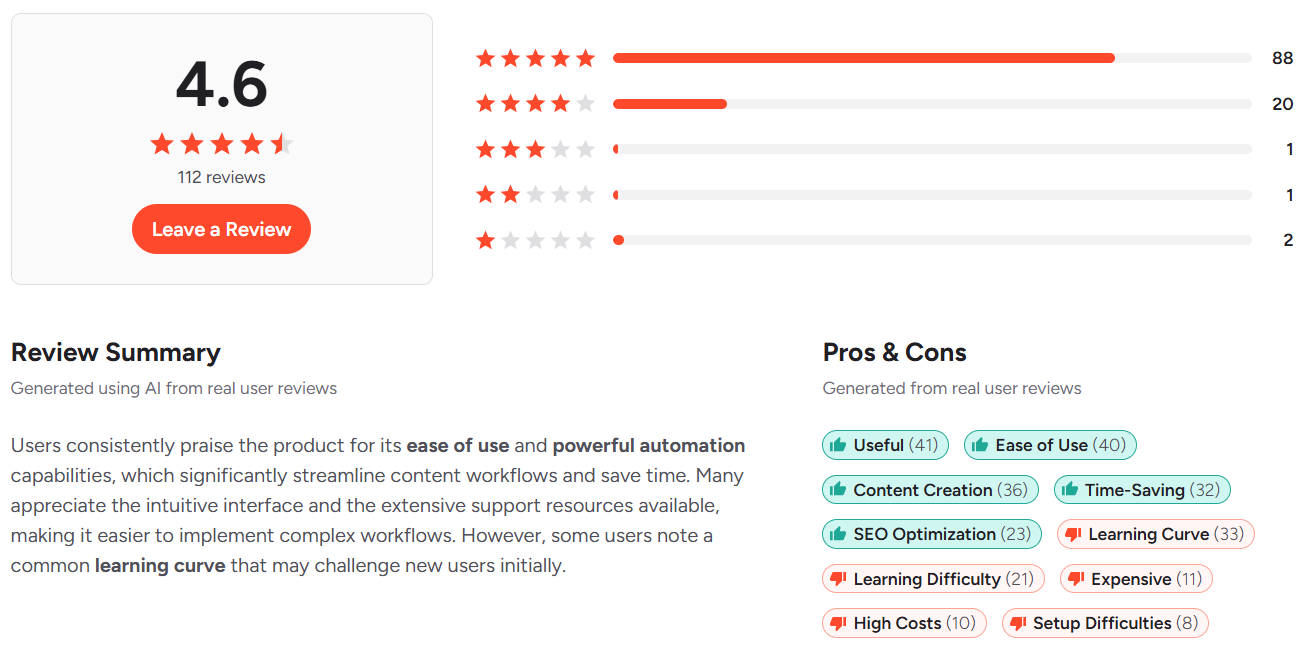
- Workflow automation efficiency: Connects research, writing, and publishing into structured workflows.
- Scalable content operations: Helps teams produce large volumes of content without increasing workload.
- All-in-one system: Combines SEO, content planning, and execution in one platform.
- AI search visibility focus: Tracks citations and visibility across AI-powered search systems.
- Flexible no-code setup: Allows teams to build and adapt workflows without coding.
"AirOps Supercharges Content Creation with Impressive Quality and Efficiency"- Adina T. Head of Content
Check out Airops G2 Reviews
Cons of AirOps
- Steep learning curve: Requires time to understand workflow setup and system structure.
- Complex onboarding: Setup is not instant and needs configuration before use.
- High cost for small teams: Pricing may not suit early-stage or small-scale users.
- Usage-based limitations: Credit system can make scaling costs less predictable.
- Ongoing maintenance required: Workflows need updates as content systems evolve.
"Took an entire day just to configure a 3-step workflow. Getting help was frustratingly difficult."- Loh Y. Martech Manager
However, these drawbacks don’t fully define its overall effectiveness. Let’s look at whether it is worth having in your stack.
Is AirOps Worth It?
AirOps is best understood as a content operations infrastructure rather than a simple SEO tool. It performs well for teams that already have a structured content process in place and are looking to scale production efficiently. It is especially useful when workflows need to be centralized and when the goal is to optimize content for both traditional SEO and emerging AI-driven search visibility.
However, AirOps is less effective for users looking for quick wins or a lightweight tool. It requires setup and configuration before delivering value, which can make it less suitable for those who want immediate results or minimal complexity.
Conclusion
AirOps is a comprehensive content operations platform that brings together SEO, content creation, automation, and AI search visibility into a single system. Its strength lies in its ability to connect insights with execution—allowing teams to not only understand performance gaps but also act on them at scale through structured workflows. For organisations with established strategies and the resources to invest in setup, it can significantly improve efficiency, consistency, and output.
At the same time, that depth comes with trade-offs. The platform requires time to learn, effort to configure, and budget to sustain. It is not designed for quick wins or plug-and-play usage. Teams that approach it without a clear process or without committing to proper implementation may struggle to see immediate value.
If your goal is to boost AI search visibility without dealing with complex setups, heavy workflows, or uncertain costs, Indexly is designed with that focus in mind. It delivers clear, actionable insights around citations, content gaps, and opportunities—helping you act faster and achieve results sooner. Try Indexly to see how a streamlined approach to AI visibility can drive real impact.
Frequently Asked Questions
What is AirOps used for?
AirOps is an AI-powered content operations platform used for content strategy, automated content creation, content optimisation, content refresh, AI search visibility tracking, citation monitoring, and workflow automation. It's designed for content and SEO teams looking to scale production and improve brand visibility across both traditional and AI search.
How much does AirOps pricing cost?
AirOps offers a free Solo plan with 1,000 tasks per month. Paid Scale and Enterprise plans — where AI search visibility features are fully unlocked — require contacting sales for pricing. Paid plans are generally positioned for established teams rather than individual users or small businesses.
What is citation tracking in AirOps?
Citation tracking in AirOps monitors which URLs are being cited by AI search engines in response to the prompts you're tracking. It shows citation rate, citation share, and whether your brand is referenced in cited content. It also surfaces pages where competitors are cited but your brand isn't — creating a direct list of outreach and content creation priorities.
Does AirOps have a steep learning curve?
Yes. G2 users consistently report a significant initial learning curve, with many teams describing a two-to-three week period before feeling productive. AirOps offers strong customer support and structured onboarding to help bridge that gap, but the platform is not plug-and-play. Setup investment is required to get full value.