Understanding AirOps Pricing: A Complete Overview
AirOps pricing explained: plans, task-based costs, overages, and how to estimate total cost for SEO and AI workflows.

Here’s the honest POV most AirOps pricing breakdowns miss: the platform is powerful enough to replace multiple SEO and AI content tools, but its pricing model is not immediately intuitive. If you are evaluating AirOps pricing for SEO workflows, content automation, or AI visibility tracking, the real challenge is not what the tool does; it is understanding how much it will actually cost at scale.
AirOps pricing is not a simple subscription model. It is a hybrid system combining plan-based access with task usage billing, meaning your final AirOps cost depends heavily on how many workflows you run inside your workspace. For teams scaling content operations, this makes AirOps both flexible and potentially unpredictable.
This guide breaks down AirOps pricing plans, task usage, overage charges, and whether the platform is worth it based on real-world usage patterns.
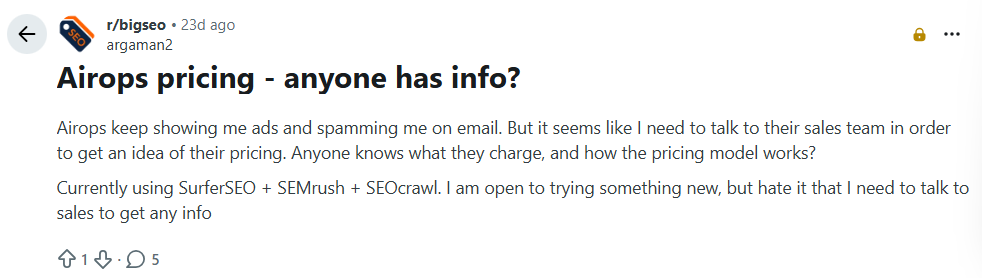
People are also asking about AirOps pricing on Reddit, which is why we’ve created this blog to provide clear and accurate information.
How AirOps Pricing Works
AirOps pricing is built on a usage-based system centred around workspace tasks. A workspace task is a unit of execution inside AirOps that is consumed whenever a workflow runs an AI step, processes data, or generates output. This means that every automated action inside your workflow contributes directly to your AirOps cost.
Unlike traditional SaaS tools, AirOps pricing does not rely solely on fixed monthly limits. Instead, it uses a hybrid model where users pay for a base plan and then incur additional costs depending on task usage. This makes AirOps cost dynamic and closely tied to actual platform activity.
If users exceed their monthly task allowance, overage charges apply for additional workspace tasks. This is why monitoring task usage is essential for controlling overall AirOps pricing effectively. AirOps provides internal tracking tools inside its dashboard so users can monitor consumption in real time.
AirOps also offers a free trial, allowing users to test workflows and understand task consumption before committing to a paid plan.
Check out: Airops Review
AirOps Pricing Plans
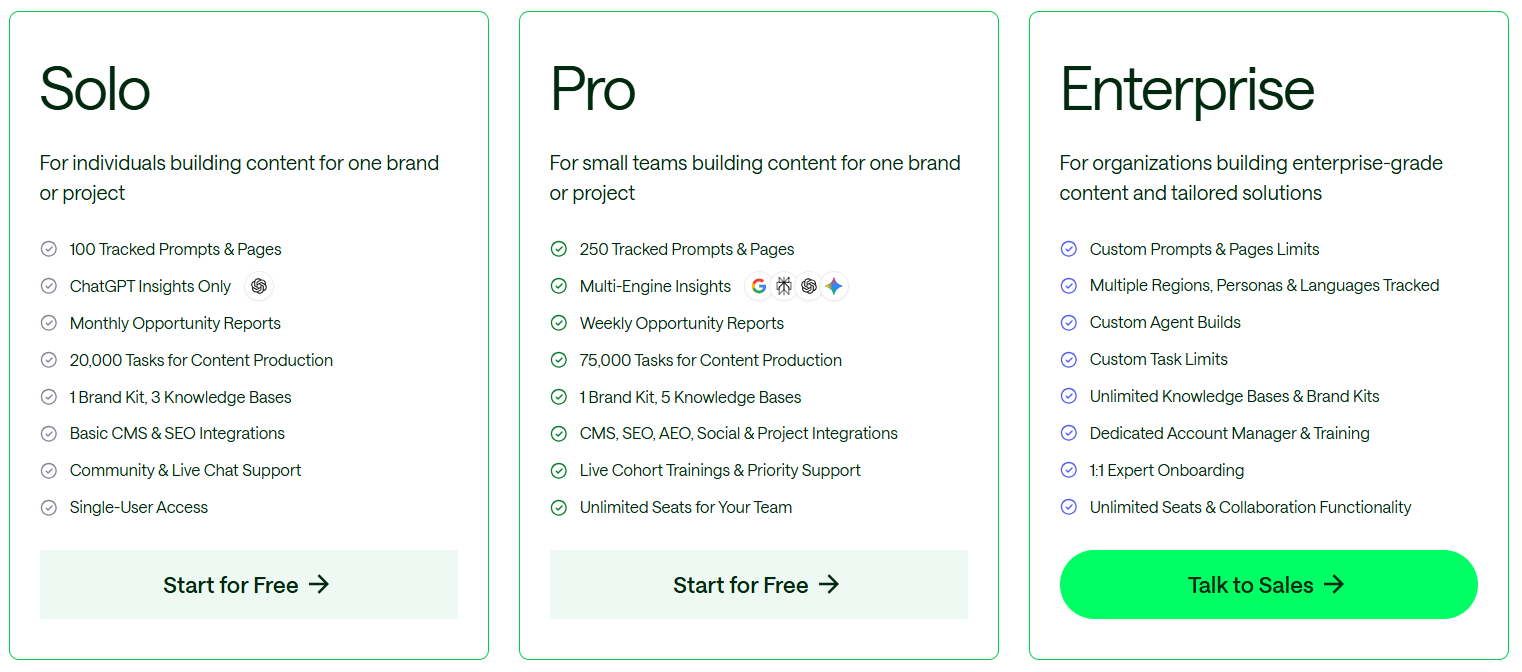
AirOps pricing plans are structured into three main tiers: Solo, Pro, and Enterprise, available for large organisations. Each tier is designed for different levels of workflow complexity and task usage.
Pricing estimates are based on multiple third-party reviews and user reports, as AirOps does not publicly disclose fixed plan costs.
Solo Plan
The AirOps Solo Plan is the first paid tier in AirOps pricing plans and is designed for individuals managing content for a single brand or project. It increases task capacity significantly and introduces structured tracking for content performance.
It includes 100 tracked prompts and pages, monthly opportunity reports, and 20,000 workspace tasks for content production. Users also get one Brand Kit, three Knowledge Bases, and integrations with tools like Moz, and DataforSEO.
However, the Solo Plan only supports ChatGPT insights, meaning it does not track visibility across Google AI, Perplexity, or Gemini. This limitation can create gaps in modern answer engine optimisation strategies. As a result, AirOps cost in this tier may increase indirectly if users need additional tools to compensate for missing AI visibility coverage.
Pro Plan
The Pro Plan is the recommended tier in AirOps pricing plans and is designed for teams scaling content operations across multiple channels. It significantly expands both task usage capacity and AI search visibility coverage.
It includes 250 tracked prompts and pages, along with multi-engine insights across ChatGPT, Google AI, Perplexity, and Google AI Studio. Reporting is upgraded from monthly to weekly, making it more effective for continuous optimisation workflows.
This plan provides 75,000 workspace tasks for content production, one Brand Kit, and five Knowledge Bases. It also has a full integration suite, including CMS tools, SEO platforms like Semrush and Ahrefs, AEO tools, social platforms, and project management tools like Asana and Airtable. Unlimited team seats and priority support are included.
A key factor in AirOps pricing comparison is that major SEO tools like Semrush and Ahrefs are only included in Pro and above, which significantly impacts overall AirOps cost for teams already paying for these tools separately.
Enterprise Plan
The Enterprise Plan represents the highest tier in AirOps pricing and is designed for large organisations requiring scalable, global content infrastructure. Unlike other AirOps pricing plans, Enterprise cost is not publicly listed and is determined through direct consultation with the AirOps sales team.
This plan includes custom task usage limits, advanced multi-region and multi-language tracking, persona-based configurations, and custom AI agent development. It also supports unlimited Knowledge Bases, unlimited Brand Kits, and fully tailored workflow systems.
Enterprise customers receive dedicated account management, 1:1 onboarding, and unlimited collaboration seats. This makes it suitable for organisations running large-scale AI-driven content systems where AirOps cost depends entirely on operational scale and complexity.
In every plan, you can analyse or incorporate signals from platforms like YouTube and Reddit.
Pros of AirOps Pricing
One of the biggest advantages of AirOps pricing is its flexibility, as users can start with a free tier and scale based on actual task usage rather than fixed feature bundles. This makes it easier to align AirOps cost with real operational needs.
Another strength is the depth of integrations and AI model access available even in lower tiers. The ability to connect CMS platforms, SEO tools, and multiple AI systems allows users to build scalable workflows without immediately moving to higher-cost plans.
Finally, AirOps pricing plans support progressive scaling, meaning teams can start small and upgrade as task usage increases, which is beneficial for growing content operations.
Cons of AirOps Pricing
A major drawback of AirOps pricing is the complexity of task-based billing and is not transparent. Since AirOps cost depends heavily on workspace tasks, it can become difficult to predict monthly spending accurately without monitoring usage closely.
"The downside is the pricing model. If you’re not careful about monitoring team usage, it’s easy to burn through your task budget faster than expected."-Lesley M. Director of Organic Growth
Another limitation is the restriction of AI visibility tracking in lower tiers. For example, Solo users only get ChatGPT insights, which limits coverage across modern AI search engines and can weaken answer engine optimization strategies.
Additionally, overage charges may apply if task usage exceeds plan limits, making cost estimation more important for scaling teams.
Check out Airops Alternatives
Is AirOps Pricing Worth It?
AirOps pricing is worth it if you are running structured SEO systems, AI-driven content pipelines, or automated workflow operations at scale. In such cases, the platform can replace multiple tools and reduce manual workload significantly, making AirOps cost justifiable.
For solo users or light content creators, the value depends on workflow frequency. If task usage remains low, the Solo plan can be cost-effective. However, as automation increases, AirOps pricing becomes more dynamic due to rising workspace task consumption.
For teams, the Pro plan is usually the most balanced option because it offers higher task limits, better integrations, and more predictable scaling for workflows.
Conclusion
AirOps pricing is fundamentally a hybrid model that combines subscription tiers with task-based usage billing. This means that AirOps cost is directly influenced by how workflows are built and how many workspace tasks are consumed.
The AirOps Solo plan is best for individuals starting out, while the AirOps Pro plan is designed for teams scaling SEO and AI content operations. Enterprise pricing is custom and depends on organisational requirements.
Ultimately, managing AirOps pricing effectively requires understanding task usage patterns and monitoring workflows closely. When optimised correctly, AirOps delivers strong value for AI-driven content systems, but without control, overage charges can increase costs quickly.
FAQs
What is AirOps pricing based on?
AirOps pricing is based on subscription tiers combined with task usage limits. AirOps cost increases as workspace tasks and workflow automation scale.
Does AirOps have a free plan?
Yes, AirOps offers a Free / Insights Plan with limited task usage and basic features, suitable for testing and evaluation.
What is included in the AirOps Solo Plan?
The Solo Plan includes 20,000 workspace tasks, 100 tracked prompts, SEO integrations, and ChatGPT-only insights.
Why is the Pro Plan recommended in AirOps pricing plans?
The Pro Plan is recommended because it includes multi-engine AI visibility, higher task limits, and advanced SEO integrations like Semrush and Ahrefs.
Does AirOps pricing include overage charges?
Yes, in some cases overage charges apply when workspace task usage exceeds plan limits, especially in high-volume workflows.
How do I estimate AirOps cost?
AirOps cost depends on task usage, integrations, and plan tier. Monitoring workspace tasks is the best way to estimate monthly cost.