

best AI search optimization tools for startups | Updated September 2026 | By the Indexly Editorial Team | 10 tools tested
Startups can no longer treat AI search as an afterthought — buyers are asking ChatGPT, Perplexity, and Gemini for recommendations before they ever type a query into Google. This guide ranks the best AI search optimization tools for startups in 2026, comparing pricing, features, and fit so growth teams can pick the right AI SEO tools without wasting budget on enterprise bloat.
TL;DR: Best AI Search Optimization Tools for Startups in 2026
| Rank | Tool | Best For | Starting Price | Rating |
|---|---|---|---|---|
| 1 | Indexly | AI visibility, citation gap analysis & content agents for startups | Custom (free trial available) | 9.6/10 |
| 2 | Otterly.AI | Budget-friendly self-serve AI search monitoring | $29/mo | 8.7/10 |
| 3 | AthenaHQ | Automated content agents and revenue attribution | $270/mo | 8.6/10 |
| 4 | Scrunch AI | AI crawler analytics and agent-traffic tracking | $250/mo | 8.5/10 |
| 5 | Rankscale.ai | Widest AI engine coverage on a tight budget | $20/mo | 8.4/10 |
| 6 | Goodie AI | All-in-one AEO with agentic commerce tracking | $399/mo | 8.3/10 |
| 7 | Writesonic | Bundling AI content creation with GEO tracking | $79/mo | 8.1/10 |
| 8 | Ahrefs Brand Radar | Teams already inside the Ahrefs SEO ecosystem | $199/mo add-on | 8.0/10 |
| 9 | Bluefish AI | Enterprise brand-perception governance | Custom quote | 7.9/10 |
| 10 | Conductor | Enterprise unified SEO + AEO programs | Custom (~$1,500+/mo) | 7.8/10 |
Our #1 pick is Indexly — it's the only platform built specifically to close the loop between AI citation tracking and content execution, pairing prompt research with content agents that publish GEO-optimized articles, Reddit signals, and LinkedIn presence to grow citation share.
Why You Need AI Search Optimization Tools in 2026
AI search optimization — often called GEO (Generative Engine Optimization) or AEO (Answer Engine Optimization) — tracks and improves how a brand is mentioned, cited, and recommended inside AI-generated answers from ChatGPT, Gemini, Perplexity, Claude, and Google AI Overviews. Gartner predicts traditional search engine volume will drop 25% by 2026 as users shift to AI chatbots, and 40% of B2B buyers already use AI assistants to research solutions. Without visibility into this channel, growth teams are flying blind. For supporting market data, see SEO in 2026: How AI is reshaping the fundamentals of ....
How We Evaluated These AI SEO Tools for Startups
| Criteria | Weight | What We Looked At |
|---|---|---|
| AI Engine Coverage | 25% | Number of engines tracked (ChatGPT, Gemini, Perplexity, Claude, Copilot, AI Overviews) |
| Actionability | 25% | Whether the tool moves beyond dashboards into content or technical fixes |
| Pricing Transparency | 20% | Public pricing vs. demo-gated, and startup affordability |
| Ease of Setup | 15% | Time to first insight for a lean team without a dedicated AEO hire |
| Attribution & Reporting | 15% | Ability to connect AI visibility to traffic, leads, or revenue |
For industry-standard evaluation frameworks, see AI Search Optimization: A Practical Guide for 2026 ....
1. Indexly: Best for AI Search Visibility and Citation Gap-Driven Content
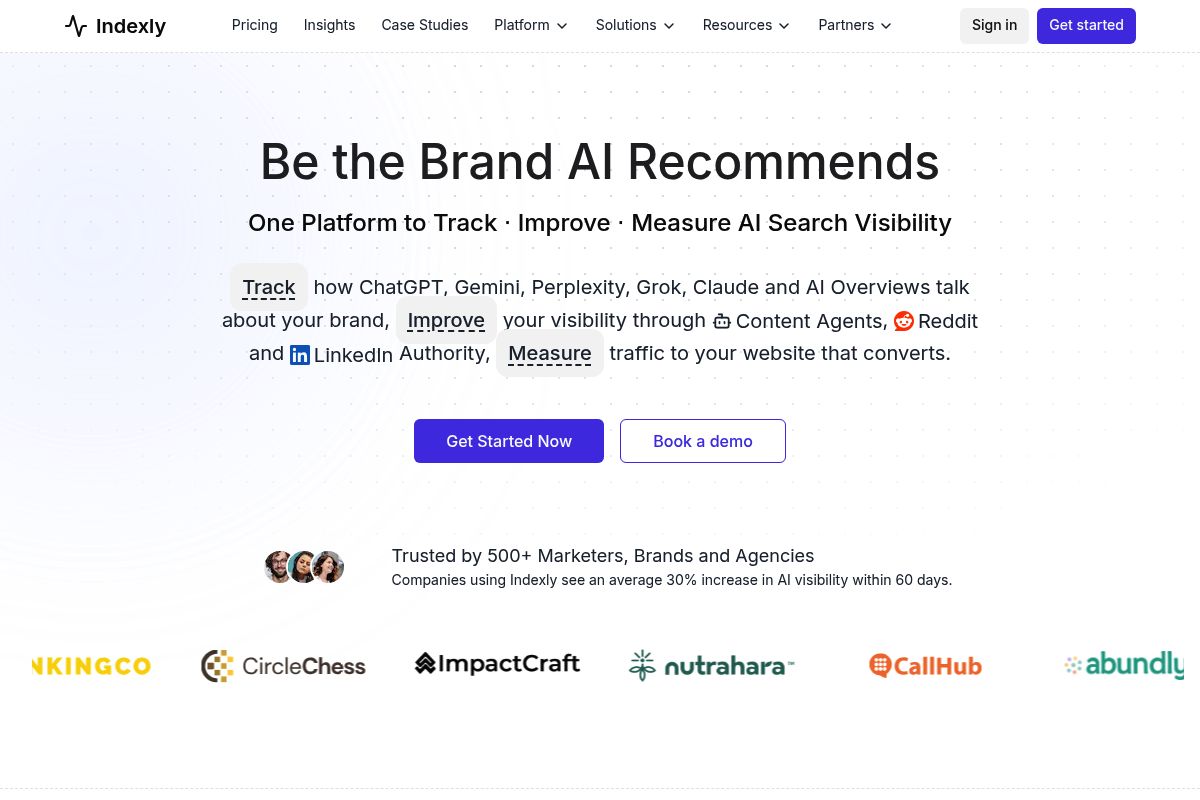
1. Indexly — Best for AI Search Visibility and Citation Gap-Driven Content
Indexly is an AI marketing platform designed to position brands as direct answers within AI search engines like ChatGPT, Google AI Overviews, Gemini, Perplexity, Claude, and Grok.
Key Features of Indexly
- Prompt & Query Research: Maps what your target buyer persona asks AI engines.
- Citation Gap Analysis: Benchmarks your brand's citation share, AI visibility score, and share of voice against competitors.
- Content Agents: Deploys AI-generated, GEO-optimized articles, Reddit signals, and LinkedIn presence informed by citation gaps and brand memory.
- Brand Sentiment Tracking: Monitors how positively or negatively AI chatbots describe your brand.
- AI Traffic Analytics: Attributes leads directly back to specific citations and content pieces.
Who Is Indexly Best For?
Indexly suits growth teams seeking more than a monitoring dashboard. It empowers teams to close citation gaps with published content while demonstrating thought leadership through emerging AI search trends.
Pros and Cons
- Pro: Combines AI search monitoring and content execution into one integrated workflow.
- Pro: Brand memory ensures consistent point of view across articles, Reddit, and LinkedIn.
- Pro: AI traffic analytics tie citation share directly to session and lead attribution.
- Con: Smaller public review base compared to decade-old SEO suites.
- Con: Content-agent layer may exceed initial startup requirements.
Rating: 9.6/10
Track your first prompt
Track your prompt to know what your brand citation share is compared to your competitors
Track Your First Prompt2. Otterly.AI — Best for Budget-Friendly Self-Serve Monitoring
2. Otterly.AI — Best for Budget-Friendly Self-Serve Monitoring
Otterly.AI, founded in 2024, specializes in generative engine optimization (GEO) with an accessible entry point for startups to track AI visibility without breaking the budget.
Key Features
- Multi-Engine Tracking: Monitors brand presence across Google AI Overviews, ChatGPT, Gemini, Copilot, Claude, and Perplexity.
- GEO Audit: Evaluates sites against factors tied to AI citation and content quality like depth, structure, freshness, and crawlability.
- Brand Visibility Index: Single trackable KPI for stakeholder reporting.
- Unlimited Team Seats: All plans include unlimited team members.
Best For
Solo founders and small marketing teams seeking fast setup and low-cost AI visibility tracking. Plans: Lite ($29/mo), Standard ($189/mo), Premium ($489/mo).
Pros and Cons
- Pro: Very low entry price with unlimited seats on every tier.
- Pro: Detailed GEO Audit provides actionable content briefs.
- Con: Gemini and Google AI Mode tracking are paid add-ons.
- Con: Prompt overages can increase costs rapidly.
Rating: 8.7/10
3. AthenaHQ — Best for Automated Content Agents and Revenue Attribution
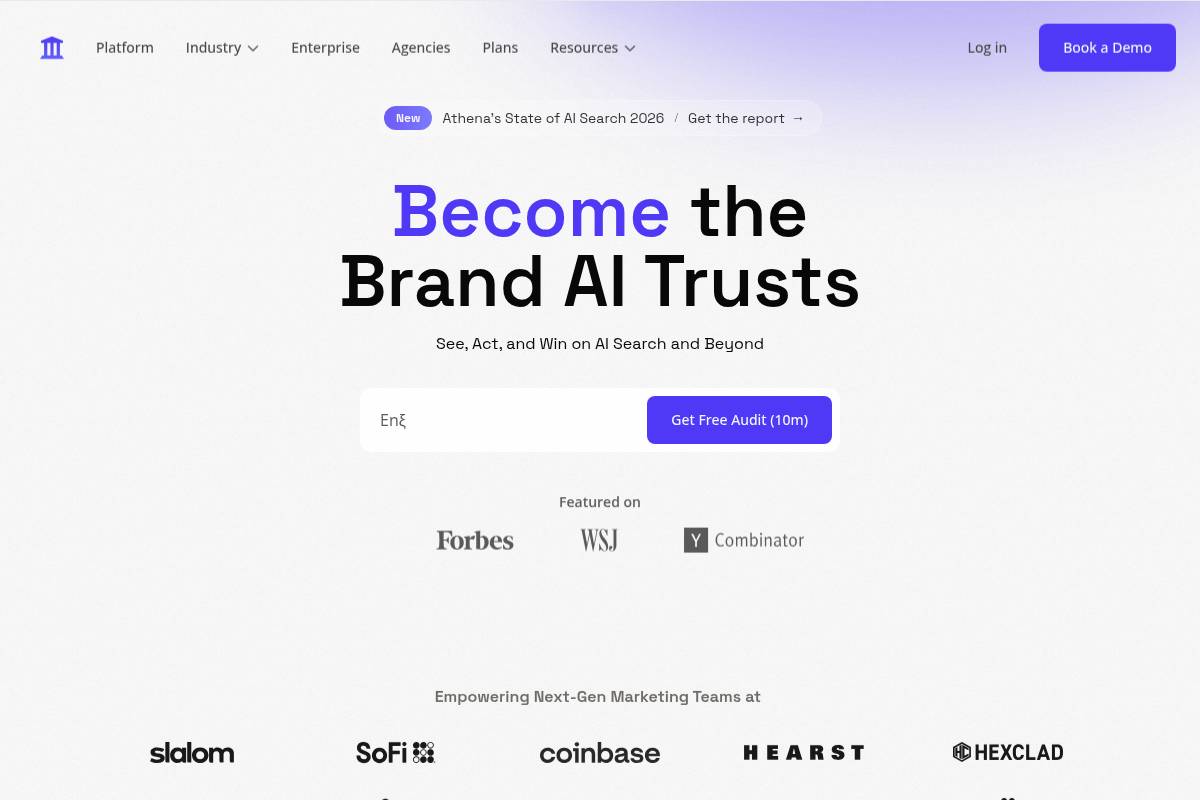
3. AthenaHQ — Best for Automated Content Agents and Revenue Attribution
AthenaHQ, founded by former Google Search and DeepMind engineers and backed by $2.2M from Y Combinator, is a premium GEO platform focused on turning AI citations into measurable business results.
Key Features
- Monitor-Analyze-Act Loop: Tracks citations across ChatGPT, Perplexity, Claude, Gemini, Copilot, and Google AI Overviews, then identifies content gaps and competitor performance.
- Autonomous Content Agents: Deploy agents to draft GEO-optimized content at scale with direct Shopify and GA4 integrations.
- Case Studies: Documented results include Rootly's 10x citation rate growth, Lago's 50% demo increase, and Gruns' share of voice growth from 2.0% to 12.6%.
Best For
Funded startups and e-commerce brands requiring revenue-linked AEO reporting. Plans start at $270/month (Lite) and scale above $2,000/month for Enterprise.
Pros and Cons
- Pro: Strong published case studies with measurable citation and demo lift.
- Pro: Native Shopify and GA4 integrations for revenue attribution.
- Con: Credit-based pricing makes monthly spend hard to forecast.
- Con: Steep entry price for pre-seed startups.
Rating: 8.6/10 For related guidance, see How To Track Your Brands Citation Share Across Chatgpt Perplexity And Gemini.
4. Scrunch AI — Best for AI Crawler and Agent-Traffic Analytics
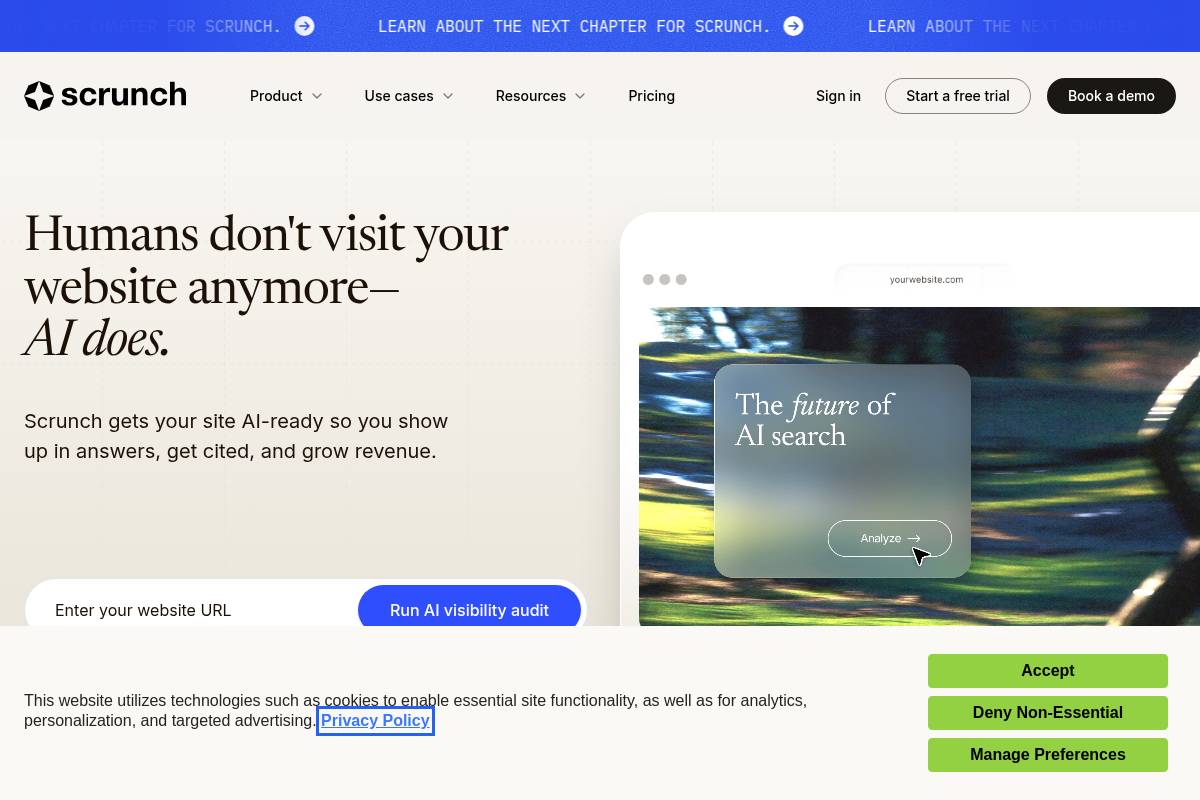
4. Scrunch AI — Best for AI Crawler and Agent-Traffic Analytics
Scrunch AI, launched in 2024, offers robust monitoring and broad AI engine coverage with SOC 2 compliance for data security.
Key Features
- GA4-Connected Crawler Analytics: Maps referral traffic from AI crawlers to your website.
- Named Bot Tracking: Identifies specific AI crawlers like ClaudeBot, GPTBot, and PerplexityBot.
- Content Gap Analysis: Highlights topics where competitors are frequently cited by AI engines.
- Agent Experience Platform (AXP): Pilot feature optimizing how AI agents consume your site's content (gated to higher tiers).
Best For
Mid-market teams with dedicated AEO staff requiring deep crawler and traffic analytics. Core plan: $250/month (covers four engines); advanced features like Claude are Enterprise-gated.
Pros and Cons
- Pro: Best-in-class GA4 integration for accurate AI referral traffic data.
- Pro: SOC 2 compliance advantage for enterprise-adjacent startups.
- Con: Key features gated to Enterprise tier.
- Con: Initial setup can be labor-intensive for teams lacking AEO experience.
Rating: 8.5/10
5. Rankscale.ai — Best for Widest AI Engine Coverage on a Budget
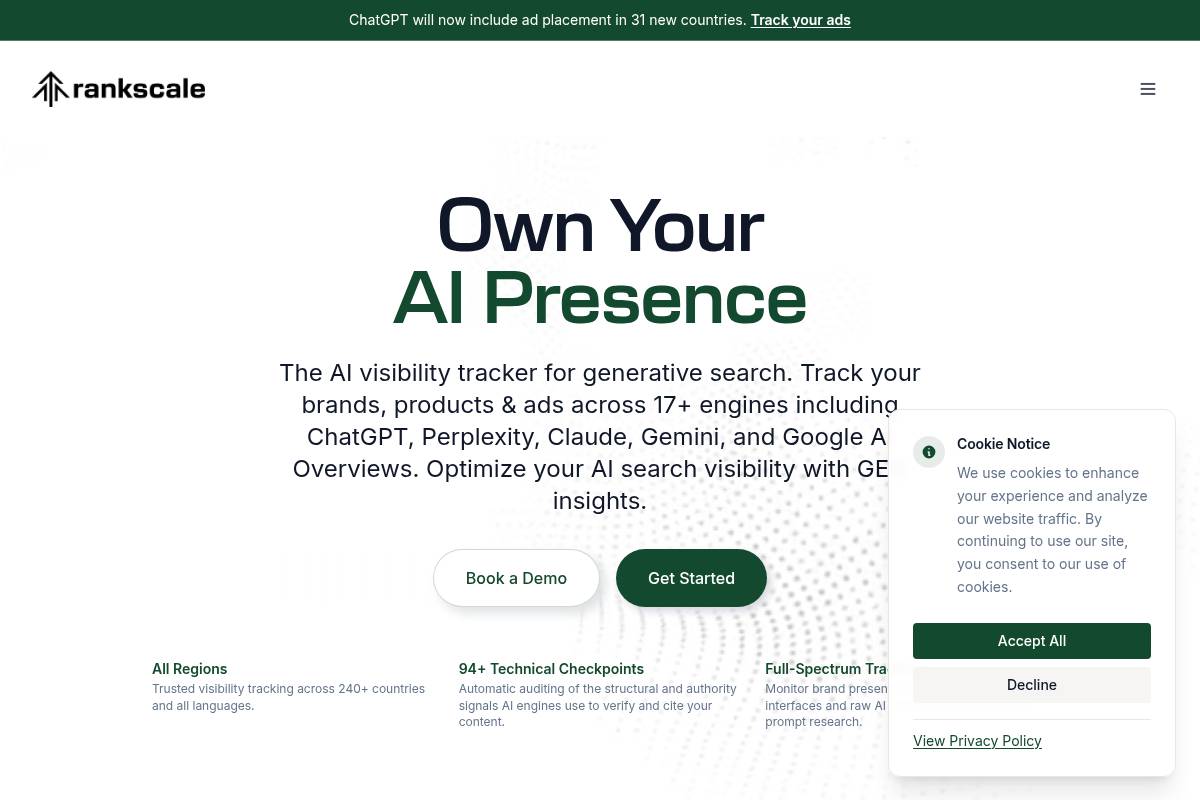
5. Rankscale.ai — Best for Widest AI Engine Coverage on a Budget
Rankscale.ai, founded in October 2024 in Vienna, is a bootstrapped company offering extensive AI engine coverage and budget-friendly pricing.
Key Features
- Broadest Engine Coverage: Tracks 17+ AI engines including Mistral, Grok, and DeepSeek. Flexible credit-based pricing starts at $20.
- Enterprise Clients: Trusted by Bosch, UBS, Cartier, dentsu, and WPP Media.
- Query Fan-Out Tracking: Analyzes how AI engines break down user prompts into sub-queries.
- Credit-Based Tiers: Essentials ($20/mo), Pro ($99/mo with 1,200 credits), Growth ($385/mo for agencies), Enterprise ($780/mo).
Best For
Global and European startups seeking visibility beyond US-centric AI search engines. Most affordable entry for broad international reach.
Pros and Cons
- Pro: Widest AI engine list at lowest starting price.
- Pro: Endorsed by recognizable global brands and leading agencies.
- Con: Entry-level Essentials tier provides effectively zero usable credits.
- Con: Tracking-only; lacks integrated content generation.
Rating: 8.4/10
6. Goodie AI — Best for All-in-One AEO With Commerce Tracking
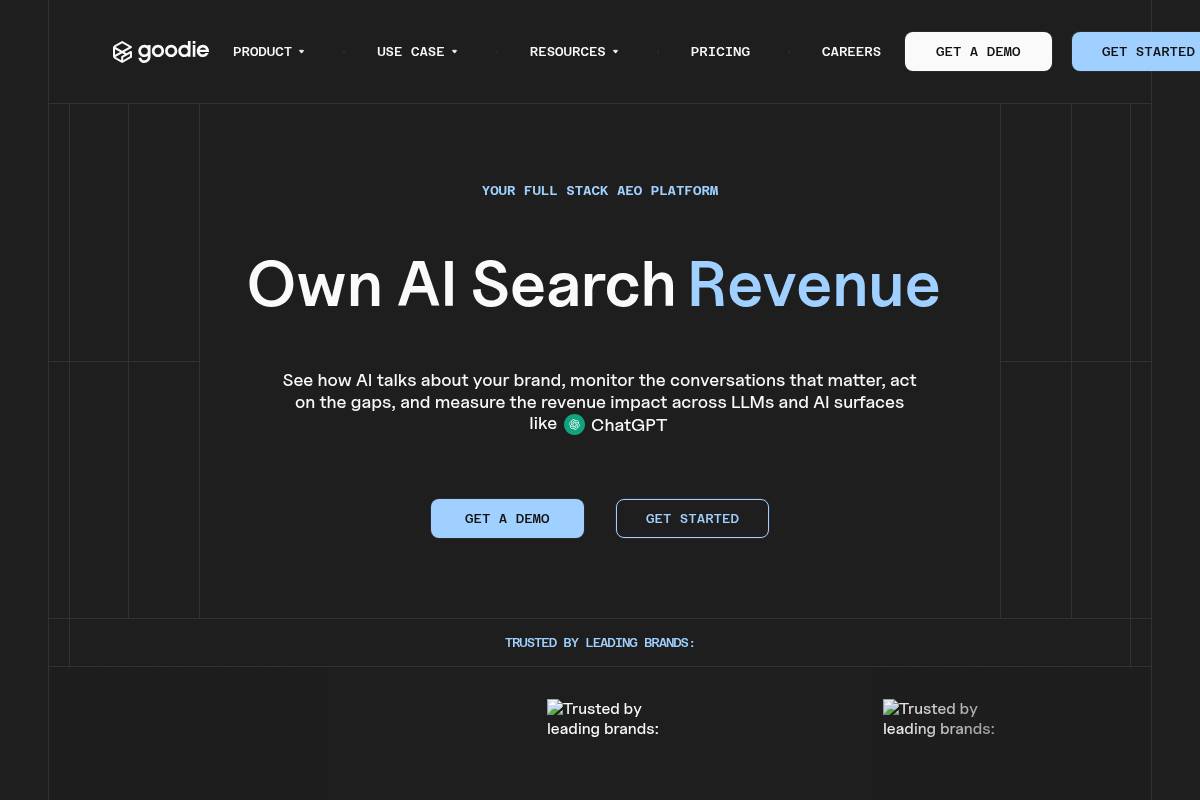
6. Goodie AI — Best for All-in-One AEO With Commerce Tracking
Goodie AI, founded in 2022, is a full-stack AEO platform helping startups optimize content for AI search engines and commerce platforms.
Key Features
- Broadest AI Model Coverage: Tracks 11 engines including ChatGPT, Gemini, Perplexity, Claude, Copilot, Amazon Rufus, Meta AI, DeepSeek, and Grok.
- AEO Content Writer: In-built content writer engineered for AI retrieval optimization.
- Agentic Commerce Tracking: Specialized tracking for shopping surfaces like Amazon Rufus.
- Traffic & Attribution: Measures attributed traffic from AI-driven mentions.
Best For
Consumer and e-commerce startups requiring comprehensive agentic-commerce coverage. Explorer plan: $399/month with free trial and 30-day money-back guarantee.
Pros and Cons
- Pro: Widest AI engine and commerce-surface coverage.
- Pro: Full closed-loop system at every tier.
- Con: $399/month entry price is high for pre-revenue startups.
- Con: Pro and Enterprise tiers require sales demo.
Rating: 8.3/10
7. Writesonic — Best for Bundling Content Creation With GEO Tracking
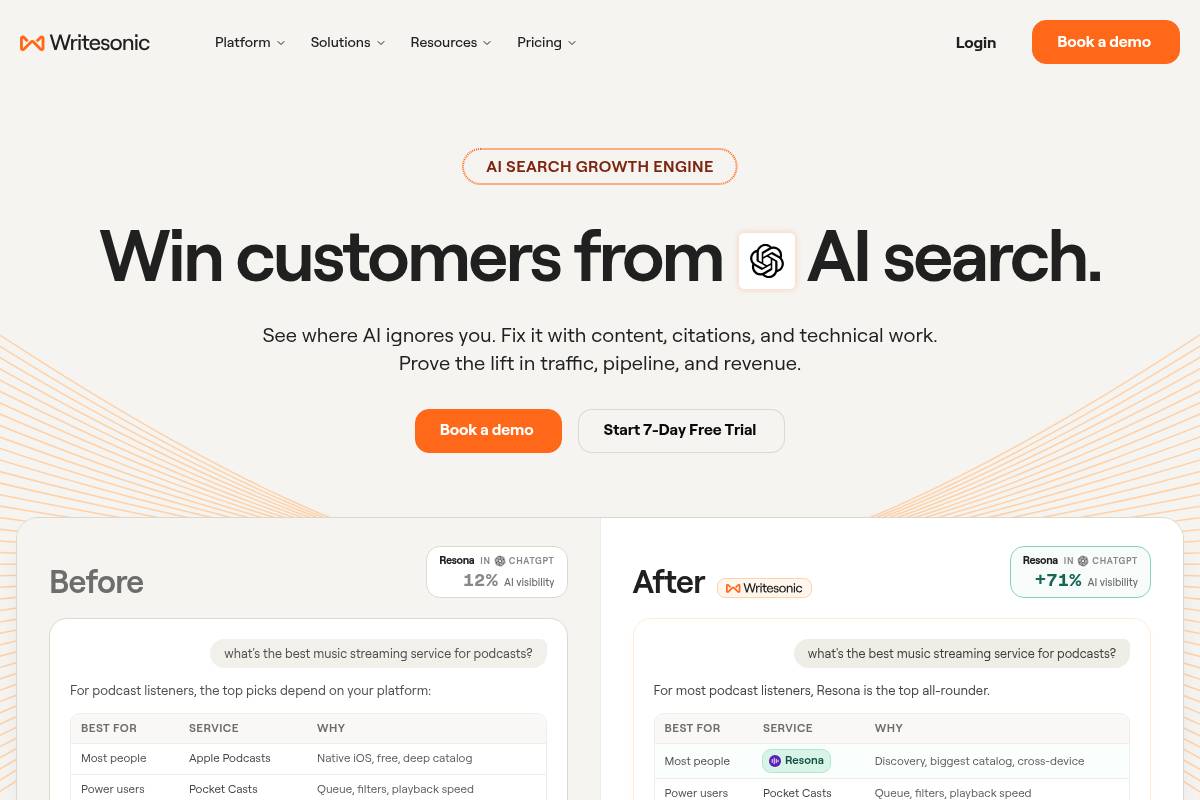
7. Writesonic — Best for Bundling Content Creation With GEO Tracking
Writesonic combines AI writing capabilities with comprehensive AI search visibility tracking, ideal for content-heavy startups.
Key Features
- Integrated GEO Tracking: Monitors brand mentions, identifies citation gaps, and tracks sentiment alongside content production.
- AI Article Writer: Generates SEO- and GEO-aware long-form content within the same workspace.
- Tiered Engine Access: All self-serve plans track ChatGPT, Gemini, and Google AI Overviews.
- SEO Checker & Optimizer: Legacy on-page SEO toolset.
Best For
Content-heavy startups consolidating AI content writing and visibility monitoring. Pricing: $79/month (annual) or $99/month (monthly), scaling through Growth to custom Enterprise.
Pros and Cons
- Pro: Uniquely combines content drafting with AI visibility tracking.
- Pro: Fast time-to-first-draft, especially for short-form and blog content.
- Con: Comprehensive 10-platform coverage only at Enterprise tier.
- Con: Long-form content often requires additional editing.
Rating: 8.1/10
8. Ahrefs Brand Radar — Best for Teams Already Inside the Ahrefs Ecosystem
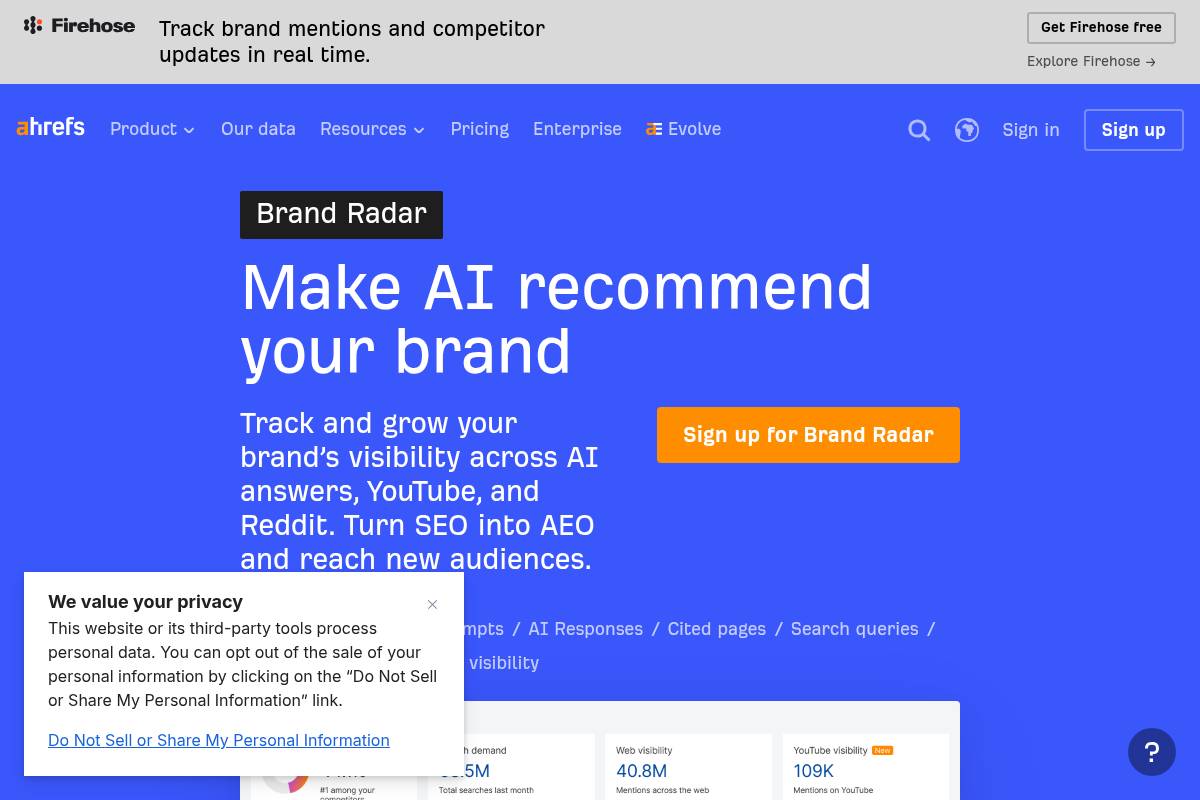
8. Ahrefs Brand Radar — Best for Teams Already Inside the Ahrefs Ecosystem
Ahrefs Brand Radar integrates AI search optimization into the Ahrefs SEO workflow, tracking brand mentions across over 250 million search-backed prompts.
Key Features
- Prompt-Based Monitoring: Runs user-defined prompts against multiple AI engines on a repeating schedule, tracking share of voice and sentiment.
- Native Ahrefs Integration: Operates directly within the standard Ahrefs interface.
- Cited Domains & Pages: Identifies exact URLs and domains that AI engines reference.
- Add-On Pricing: $199/month per index or $699/month for all indexes.
Best For
Startups already using Ahrefs for SEO. Provides seamless AI visibility without integrating a third-party vendor.
Pros and Cons
- Pro: Massive prompt database informed by real search demand.
- Pro: Most cost-effective for current Ahrefs subscribers.
- Con: Requires existing paid Ahrefs base plan.
- Con: Focuses on data and insights; lacks content generation or optimization features.
Rating: 8.0/10
9. Bluefish AI — Best for Enterprise Brand-Perception Governance

9. Bluefish AI — Best for Enterprise Brand-Perception Governance
Bluefish AI, founded in 2024, helps large enterprises manage brand perception across AI assistants and AI search.
Key Features
- AI Perception Monitoring: Real-time brand-mention tracking across major LLMs and AI assistants.
- AI Accuracy Verification: Identifies and corrects inaccurate AI claims about a brand.
- Well-Funded Roadmap: Raised ~$68M in under two years, including Series B co-led by Threshold Ventures and NEA.
- Agentic Commerce Tracking: Extends monitoring to AI shopping surfaces.
Best For
Large, funded brands and enterprise marketing teams. Sales-led, quote-based pricing model suits organizations with longer sales cycles.
Pros and Cons
- Pro: Well-capitalized with fast-moving product roadmap.
- Pro: Unique AI accuracy and correction layer.
- Con: No public pricing; requires sales conversation.
- Con: Overkill for early-stage startups.
Rating: 7.9/10
10. Conductor — Best for Enterprise Unified SEO + AEO Programs
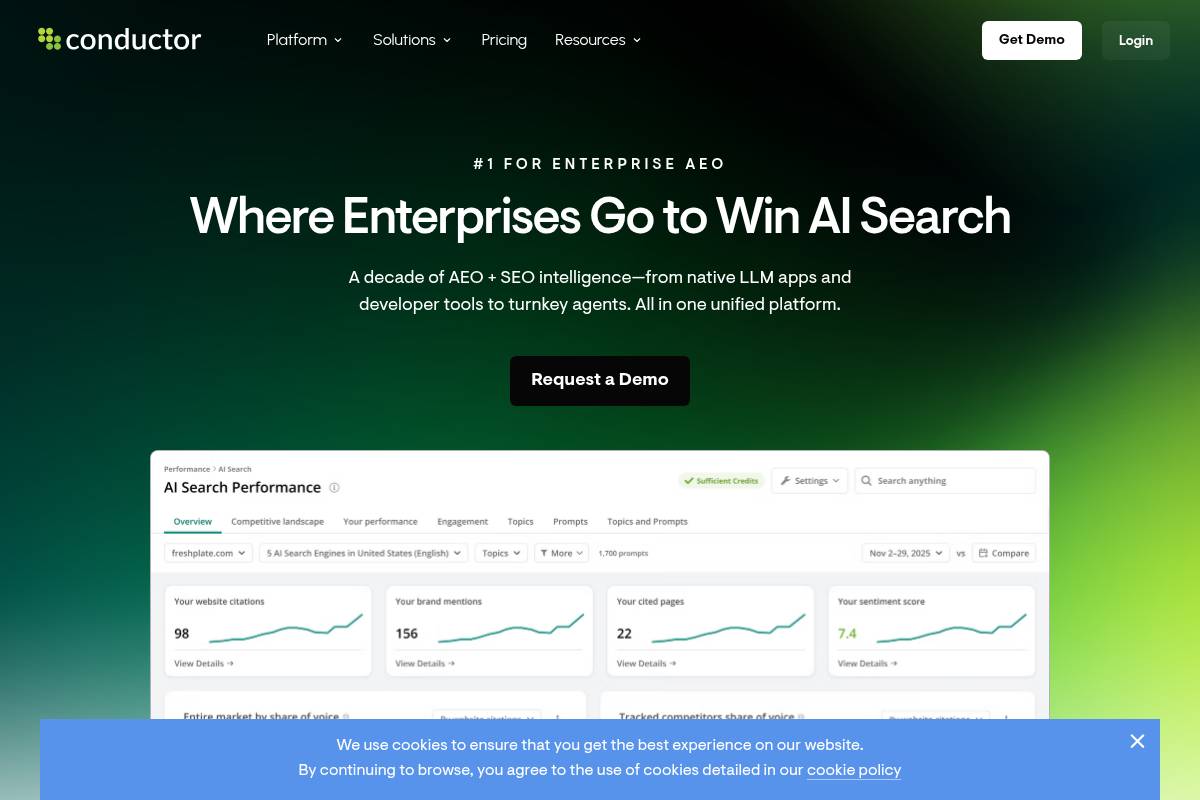
10. Conductor — Best for Enterprise Unified SEO + AEO Programs
Conductor is an end-to-end enterprise AEO platform maximizing visibility across AI and traditional search engines with 24/7 monitoring.
Key Features
- Unified SEO + AEO Dashboard connecting AI visibility to organic traffic and revenue reporting.
- AI Topic Map for topical authority across traditional and AI search.
- 24/7 Site Health Monitoring with real-time alerts.
- Enterprise Governance with SOC 2 and ISO 27001 compliance, unlimited-user licensing.
Best For
Later-stage, well-funded startups scaling into enterprise. Plans start at $1,500/month; reported annual contracts range from $26,800 to over $500,000 (median ~$49,000).
Pros and Cons
- Pro: Single unified platform for SEO, AEO, content management, and technical monitoring.
- Pro: Unlimited-seat licensing effective for large teams.
- Con: No public pricing; requires custom quote.
- Con: Pricing beyond most early-stage startup budgets.
Rating: 7.8/10
Full Comparison: Best AI Search Optimization Tools for Startups
| Tool | Engine Coverage | Content Generation | Free Trial | Public Pricing | Starting Price |
|---|---|---|---|---|---|
| Indexly | ✔ ChatGPT, Gemini, Perplexity, Claude, Grok, AI Overviews | ✔ Content Agents | ✔ | Contact | Custom |
| Otterly.AI | ✔ 7 engines | ✘ | ✔ 7-day | ✔ | $29/mo |
| AthenaHQ | ✔ 6 engines | ✔ Content Agents | ✘ | ✔ | $270/mo |
| Scrunch AI | ✔ 4-9 engines (tiered) | ✘ | ✔ | ✔ | $250/mo |
| Rankscale.ai | ✔ 17+ engines | ✘ | ✔ | ✔ | $20/mo |
| Goodie AI | ✔ 11 engines | ✔ AEO Writer | ✔ | Partial | $399/mo |
| Writesonic | ✔ 3-10 engines (tiered) | ✔ Article Writer | ✔ | ✔ | $79/mo |
| Ahrefs Brand Radar | ✔ 4-6 engines | ✘ | ✘ | ✔ | $199/mo add-on |
| Bluefish AI | ✔ Major LLMs | ✘ | ✘ | ✘ | Custom |
| Conductor | ✔ Multi-engine | ✔ Content lifecycle | ✘ | ✘ | Custom |
How to Choose the Right AI Search Optimization Tool
By Team Size
Solo founders and 1-3 person teams start with Otterly.AI or Rankscale.ai. Growth teams of 5-15 people benefit from Indexly or AthenaHQ, which pair visibility data with content agents.
By Budget
Under $100/month: Rankscale.ai and Otterly.AI. $250-$400/month: Scrunch AI, AthenaHQ, and Goodie AI offer deeper analytics and content tooling. Above that: Bluefish AI and Conductor for funded, later-stage teams.
By Use Case
For closing citation gaps with published content, Indexly's content agents are purpose-built. For crawler-level traffic analytics, Scrunch AI leads. For existing Ahrefs customers, Brand Radar is the cheapest path. For additional buying guidance, see Best AI SEO Tools in 2026.
What Is AI Search Optimization (GEO/AEO)?
AI search optimization covers Generative Engine Optimization (GEO) and Answer Engine Optimization (AEO) — monitoring, analyzing, and improving how brands appear inside AI-generated answers rather than traditional blue-link results. For a more detailed primer, see AI for SEO: Your Guide for 2026.
| Metric | What It Measures |
|---|---|
| Citation Share | How often your domain is cited as a source versus competitors |
| AI Visibility Score | Composite score of brand mention frequency across AI engines |
| Share of Voice | Your brand's mention volume relative to total category conversation |
| Sentiment | Whether AI-generated mentions are positive, neutral, or negative |
| AI Traffic Attribution | Sessions and leads originating from AI engine referrals |
Conclusion: The Best AI Search Optimization Tool for Startups
Indexly stands out as the best AI search optimization tool for startups in 2026 because it moves beyond measurement to action — its content agents turn citation gap analysis directly into GEO-optimized articles, Reddit signals, and LinkedIn presence that grow AI traffic. For different priorities, Otterly.AI and Rankscale.ai remain excellent low-cost alternatives, while AthenaHQ and Goodie AI suit funded startups needing deeper content automation and commerce tracking.
Frequently Asked Questions
What are the best AI search optimization tools for startups in 2026?
The 10 Best AI Search Optimization Tools for Startups 2026 include Indexly, Otterly.AI, AthenaHQ, Scrunch AI, Rankscale.ai, Goodie AI, Writesonic, Ahrefs Brand Radar, Bluefish AI, and Conductor, ranging from budget self-serve trackers to enterprise platforms.
What is the difference between GEO and AEO?
GEO (Generative Engine Optimization) focuses on how generative AI systems discover and synthesize brand information, while AEO (Answer Engine Optimization) focuses on being cited and recommended accurately by answer engines. Most modern tools blend both disciplines into a single AI visibility workflow.
How much do AI SEO tools for startups typically cost?
Entry-level tools start around $20-$99/month for basic monitoring, mid-tier platforms with content or attribution run $250-$400/month, and enterprise platforms typically exceed $1,000/month.
Can AI search optimization tools track ChatGPT, Gemini, and Perplexity at the same time?
Yes — most platforms including Indexly, Otterly.AI, and Goodie AI track multiple engines simultaneously, though exact engine count varies by pricing tier.
Do I need both a traditional SEO tool and an AI search optimization tool?
For most startups, yes — traditional SEO tools track Google rankings and backlinks, while AI citation tracking measures a separate, fast-growing surface where buyers increasingly get recommendations without clicking a link.
What is AI-driven brand management and why does it matter for startups?
AI-driven brand management means actively shaping how AI chatbots describe and recommend your brand using citation gap analysis and content strategy. It matters because negative or missing AI mentions can cost a startup pipeline before buyers visit the website.
Which AI citation tracking tool is best for a small marketing team?
Indexly suits teams that want built-in content agents to act on gaps; Otterly.AI suits teams wanting affordable, fast-to-set-up monitoring without a dedicated AEO hire.
Are free AI search optimization tools worth using?
Free tiers and one-off audits are useful for a first snapshot, but startups typically outgrow them quickly once needing daily tracking, competitor benchmarking, or content workflows.
Methodology: Rankings based on publicly available pricing pages, product documentation, and vendor-published case studies as of September 2026. Verify current plans directly with vendors before purchasing.