
Last updated: July 2, 2026 | Author: Madhu |
If you're asking why your LinkedIn content is not being cited by AI search engines, the answer comes down to one of seven structural problems: formatting that AI cannot parse, posting too infrequently, content lacking specificity and named entities, or misaligned profile strategy.
LinkedIn is now the second most-cited domain across ChatGPT, Google AI Mode, and Perplexity, trailing only Reddit, yet most brands earn zero citations because they optimize for human virality rather than machine retrievability.
In this blog, we’ll discuss why LinkedIn content fails to get cited by AI search engines in 2026, the key structural mistakes behind low visibility, and the exact strategies you can use to improve AI retrieval, entity recognition, and citation rates.
"AI search doesn't just cite LinkedIn — it echoes it." The platform's content is increasingly reinterpreted into AI-generated answers, with semantic similarity scores of 0.57–0.60 between AI responses and their LinkedIn sources. Your strongest positioning claim has a real probability of appearing inside a buyer's research session — the only question is whether your company name travels with it.
Why AI Search Engines Cite LinkedIn Content and What Qualifies
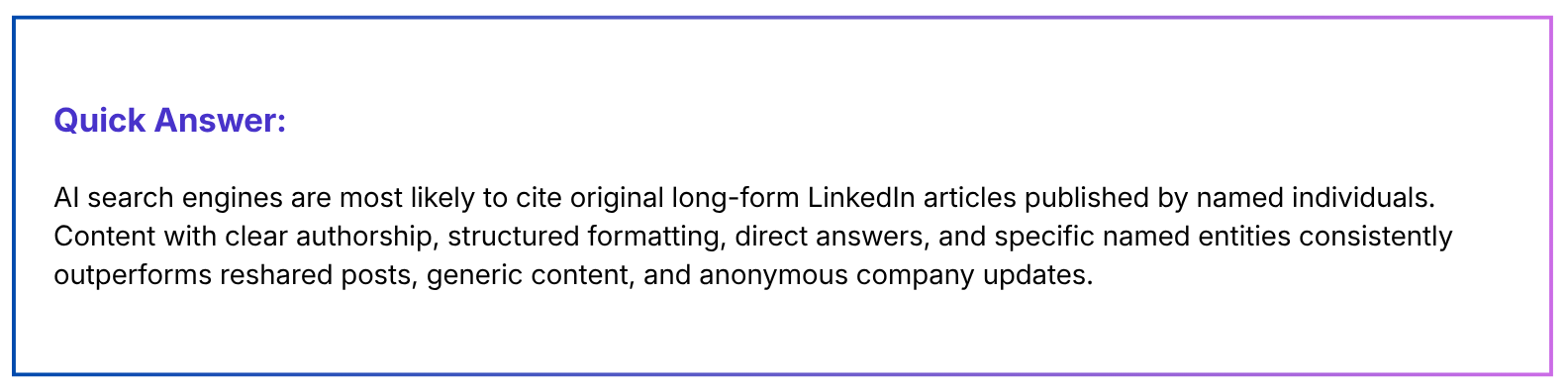
AI search engines cite LinkedIn because its public content aligns with the retrieval signals used by large language models (LLMs) such as ChatGPT, Google AI Mode, Perplexity, Microsoft Copilot, and Gemini.
Public URLs, identifiable authors, professional credentials, structured headings, topical relevance, and clear named entities make LinkedIn content easier to retrieve, verify, and cite in AI-generated answers.
Retrieval-augmented generation (RAG) systems evaluate individual content passages. They prioritize content that delivers direct answers, demonstrates subject-matter expertise, includes verifiable evidence, and uses clear named entities such as people, companies, products, and technologies.
Which LinkedIn Content Gets Cited by AI Search Engines?
- Long-form articles (LinkedIn Pulse): Pulse articles account for 63% of content URLs and take 72.2% of content citations, averaging 8.5 citations per URL, outperforming feed posts.
- Original posts only: Approximately 95% of cited posts are original.
- Mid-length feed posts: Posts in the 50-to-299 word range account for the largest share of post-level citations.
- Article word count: Articles of 500–2,000 words are cited the most.
- Named-individual content: Named individuals are 87.8% of cited content URLs but 91.7% of citations, at 8.5 per URL against 5.5 for company pages.
The Platform-by-Platform Citation Split
Data from a Semrush analysis covering 325,000 unique prompts in early 2026 confirms consistent citation splits across platforms.
| AI Engine | LinkedIn Citation Rate | Prefers Company Page or Individual? | Primary Signal |
|---|---|---|---|
| ChatGPT Search | 14.3% of responses | Individual creators (59%) | Content substance, named entities |
| Google AI Mode | 13.5% of responses | Individual creators (59%) | E-E-A-T signals, structured content |
| Perplexity | 5.3% of responses | Company Pages (59%) | Freshness, real-time indexing |
| Microsoft Copilot | High pulse-article share | Pulse articles (90.2%) | Long-form structure, LinkedIn affinity |
For more, see How To Write Linkedin Posts That Get Cited By Ai Search Engines.
11 Common Reasons your LinkedIn Content isn't cited by AI Search Engines
Most LinkedIn content earns zero AI citations because of specific, diagnosable formatting and structural errors that make content invisible to AI retrieval systems.
The following eleven factors account for the overwhelming majority of citation failures.
1. Unicode Formatting
Unicode text-formatting characters can reduce AI citation rates because they make content more difficult for AI retrieval systems to process accurately. ChatGPT and other AI search engines perform best with standard, machine-readable text.
- Impact: Unicode formatting is associated with a 58% lower AI citation rate.
- Recommendation: Remove Unicode formatting from LinkedIn posts, profile headlines, About sections, and other public content. Use plain text or LinkedIn's native formatting instead.
2. Using the Link-in-Comments Strategy
Keeping links in the comments instead of the post body can reduce AI citation eligibility because important context is separated from the primary content.
- Impact: Posts using a link-in-comments strategy experience a 31% lower citation rate.
- Recommendation: If your goal is AI citations, include important links within the post body whenever appropriate.
3. Resharing Instead of Publishing Original Content
AI search engines strongly favor original content over reshared posts.
- Impact: Approximately 95% of cited LinkedIn posts are original, while reshared posts account for only 5% of AI citations.
- Recommendation: Publish original insights instead of relying on reshares.
4. Posting Too Infrequently
Publishing infrequently reduces the number of opportunities AI search engines have to retrieve and cite your content.
- Impact: 75% of cited authors published five or more times within a four-week period.
- Recommendation: Maintain a consistent publishing schedule with original LinkedIn content.
5. Missing Named Entities
Named entities help AI retrieval systems understand exactly what your content discusses. Posts that mention specific companies, tools, products, technologies, and people are easier to retrieve than generic advice.
- Impact: Posts containing specific technical details and named entities are 77% more likely to be cited by ChatGPT.
- Recommendation: Mention relevant companies, tools, products, technologies, datasets, and industry experts where appropriate.
6. Writing About Topics That Are Too General
Broad commentary provides weaker retrieval signals than content focused on a specific question or topic.
- Impact: Topic specificity correlates with an 18% increase in AI citations and a 13% increase in human engagement.
- Recommendation: Write focused content that answers one clear question rather than covering broad themes.
7. Ignoring the Opening Line
The opening line is often the first passage retrieved by AI search engines. If it does not provide a direct, standalone answer, AI systems frequently move to another source.
- Recommendation: Begin every LinkedIn post with a concise answer, insight, or key takeaway before expanding on the topic.
"After controlling for content dimensions, post age, and prompt difficulty, a post's reaction count has near-zero predictive power over whether ChatGPT cites it." — Scrunch analysis of 12,000 LinkedIn posts, 2026
8.Not leading with a direct answer
Your post starts with context, storytelling, or background instead of stating the core insight upfront. This forces AI systems and readers to scan deeper to find meaning.
- Impact: AI systems like ChatGPT and Perplexity may fail to extract the primary insight, reducing citation likelihood and weakening retrieval priority.
- Recommendation: Always start with a “Question: Answer” format. Place the conclusion or key insight in the first 1–2 lines before any explanation.
See How To Get Your Linkedin Content Cited By Chatgpt And Perplexity In 2026.
9.Not signaling freshness explicitly
Your content does not include clear time references, making it difficult for AI systems to understand whether the information is current or outdated.
- Impact: Reduces ranking in time-sensitive queries because generative systems prioritize recent and clearly dated content.
- Recommendation:
Include explicit temporal markers like “Q2 2026 data”, “July 2026 findings”, or “2026 benchmark update” whenever relevant.
10.Ignoring platform-specific citation behavior
You assume all AI systems retrieve and cite content the same way, without adapting structure for different engines.
- Impact:
Misalignment reduces visibility: - ChatGPT and Google AI Mode prefer individual authors (~59%)
- Perplexity prefers company pages (~59%)
Relevant systems: ChatGPT, Google AI Mode, and Perplexity
- Recommendation: Use individual profiles for expertise-driven content and company pages for product or brand-level content to match platform behavior.
11.Lack of cross-platform consistency
Your expertise, identity, or messaging changes across platforms, preventing AI systems from forming a stable association with your authority.
- Impact: Weakens entity recognition and reduces long-term citation strength across generative engines.
- Recommendation:
Maintain consistent identity signals (name, role, expertise themes) across LinkedIn, blogs, podcasts, and external publications.
How AI Engines Actually Retrieve and Score LinkedIn Content
Generative AI systems retrieve content in modular "chunks," not entire pages. Each section should begin with a direct answer to the implied question.
How Each Major AI Engine Finds Your Content
| Signal Type | ChatGPT Search | Perplexity | Google AI Mode | Why It Matters for LinkedIn |
|---|---|---|---|---|
| Crawl backend | Bing index (OAI-SearchBot) | Proprietary real-time index | Google's organic index | LinkedIn articles indexed in all three; posts vary |
| Freshness weighting | Moderate | High (3.3x fresher than Google) | Moderate-high | Date-stamp posts; post regularly |
| Authority signal | Entity mentions + brand co-occurrence | Domain trust + recency | E-E-A-T, existing rankings | Named authorship with credentials outperforms anonymous content |
| Content preference | Listicle structure, direct answers | Short fact-dense paragraphs | Structured headings, Q&A format | Format for extraction, not scrolling |
What Signals Increase LinkedIn AI Citations?
| Retrieval Signal | Why It Matters | Best Practice |
|---|---|---|
| Named Entities | AI retrieval systems identify relationships between people, companies, products, tools, and technologies. LinkedIn content with clear named entities is easier to understand, retrieve, and cite than generic content. | Mention relevant companies, products, tools, technologies, and people naturally throughout your content. |
| Freshness Signals | Date-stamped and regularly updated content signals to AI search engines that the information is current and reliable. | Publish consistently, update existing articles, and include dates when discussing time-sensitive topics. |
| Cross-Platform Corroboration | Brands consistently mentioned across LinkedIn, company websites, industry publications, podcasts, and other trusted sources build stronger entity authority, increasing AI confidence in citations. | Reinforce your expertise by publishing and earning mentions across multiple authoritative platforms, not just LinkedIn. |
The "Ghost Citation" Problem: When AI Uses Your Content But Names a Competitor
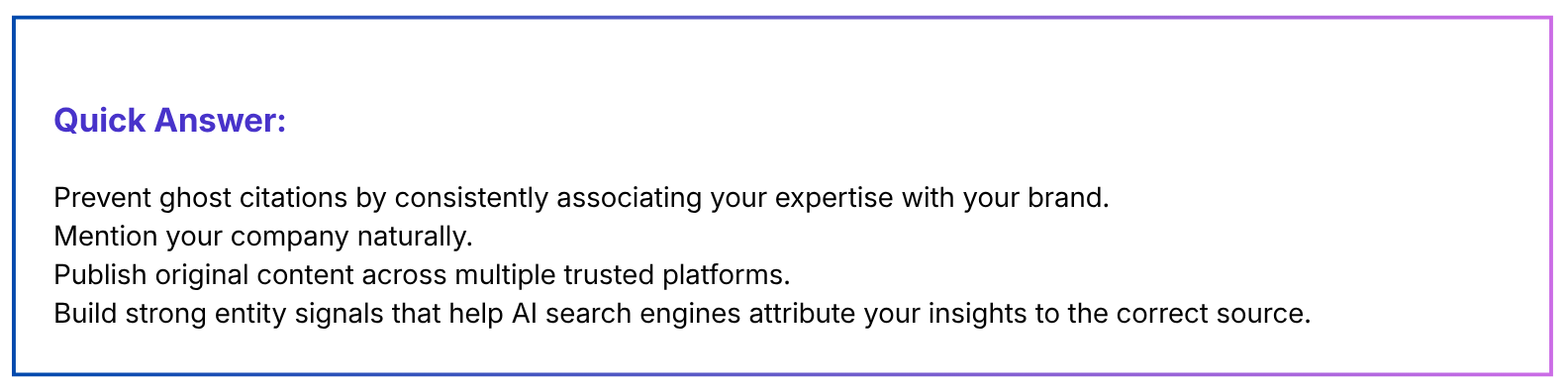
A ghost citation occurs when an AI engine uses your content but never mentions your brand.
Why Ghost Citations Happen
1. Your Brand Isn't Mentioned
AI search engines retrieve knowledge based on entities and relationships.
If your LinkedIn posts demonstrate expertise without mentioning your company name, products, services, or category, AI systems may associate that knowledge with competitors that have stronger web-wide entity signals.
Recommendation: Mention your brand name, products, services, and industry category naturally throughout your LinkedIn content.
2. Weak Off-Platform Entity Signals
AI search engines evaluate authority across the web, not just on LinkedIn. An Ahrefs analysis of 75,000 brands found that brand web mentions correlate 0.664 with AI citation rates, compared with 0.218 for backlinks.
Consistent entity mentions across trusted websites strengthen brand recognition and improve attribution.
Recommendation: Build authority through your website, industry publications, podcasts, case studies, news coverage, and other trusted sources—not LinkedIn alone.
3. Publishing on Only One Platform
When your expertise exists only on LinkedIn, AI search engines have limited opportunities to validate and reinforce your authority.
Publishing related content across multiple trusted domains creates stronger corroborating signals that improve confidence in your brand.
Recommendation: Repurpose LinkedIn insights into blog posts, research reports, newsletters, webinars, guest articles, and other authoritative content.
How Can You Identify Ghost Citations?
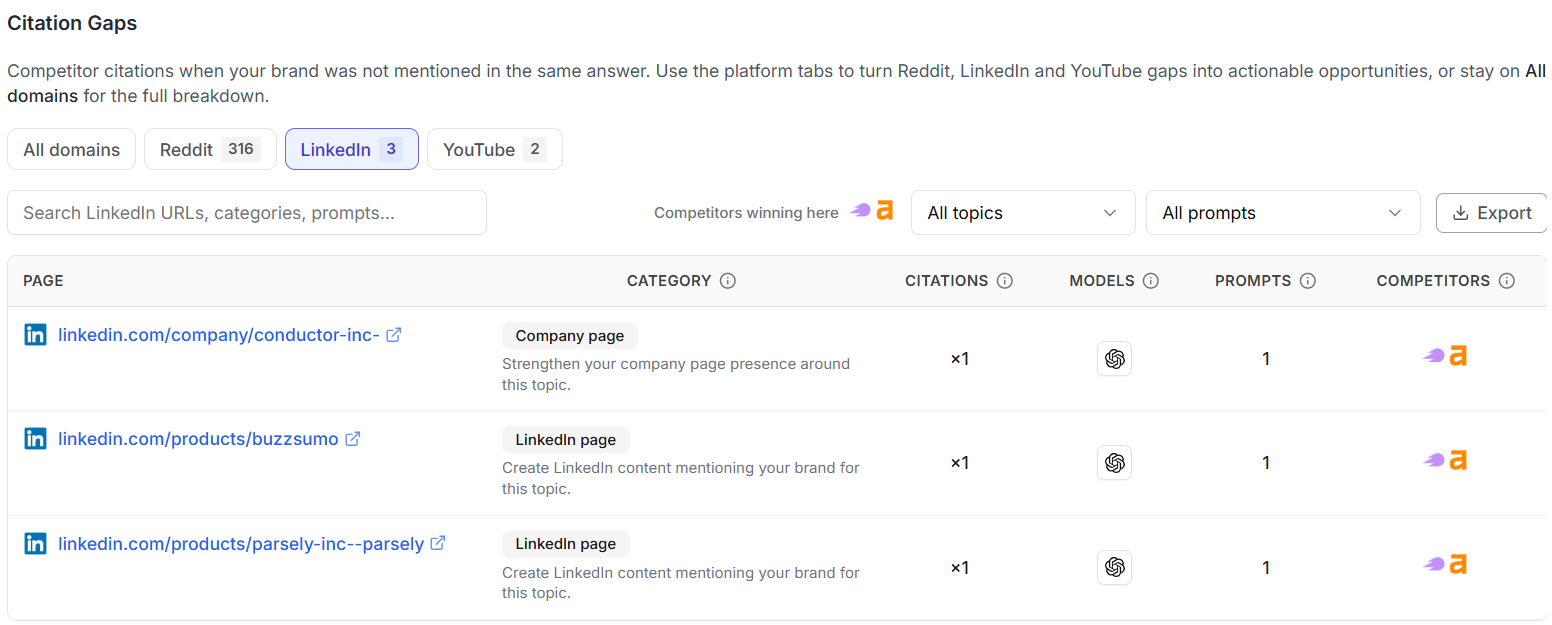
Run your target customer prompts across ChatGPT Search, Google AI Mode, Perplexity, and Microsoft Copilot. Compare which brands are mentioned, which sources are cited, and whether your company receives attribution.
AI visibility platforms such as Indexly can monitor prompt-level citations, brand mentions, citation gaps, and competitor visibility over time.
Measuring and Attributing Your LinkedIn AI Citation Performance
LinkedIn AI citation visibility is measurable. Combining four signals provides the clearest picture: AI visibility, brand sentiment, referral traffic from AI tools, and lifts in branded traffic. Most US marketing teams track none of these in 2026.
Building a Measurement Framework
- Prompt tracking: Identify the 10-15 queries your buyers most commonly run in ChatGPT, Perplexity, and Google AI Mode. Run these manually weekly or use automated monitoring.
- Citation gap analysis: Only 11% domain overlap exists between ChatGPT and Perplexity. Track citation share per platform separately.
- AI referral traffic in GA4: When users click citations, GA4 records referral traffic from chatgpt.com, perplexity.ai, and gemini.google.com. Segment these as a baseline.
- Brand mention vs. content citation ratio: Track whether your brand appears in AI responses that cite your content. A large gap is the ghost citation signal.
Indexly tracks brand presence and sentiment with prompt tracking and citation gap analysis across ChatGPT, AI Overviews, Gemini, Perplexity, and Grok. Its AI traffic analytics connects citations to actual sessions from AI engines. Adding AI referral traffic tracking in GA4 takes 10 minutes and should be standard for content marketing programs in 2026.
Key Takeaway: Measurement separates a citation strategy from a publishing habit. Set up AI referral traffic tracking in GA4 this week, then add prompt-level citation tracking.
See Best Ai Citation Tracking Tools For Linkedin Visibility In 2026.
Conclusion
AI search engines like ChatGPT, Perplexity, and Google AI Mode don’t cite LinkedIn content based on engagement; they cite it based on structure, clarity, named entities, and retrieval signals.
Most content fails because it isn’t designed for machine extraction. Once you fix formatting, add clear entities, improve structure, and build cross-platform authority, LinkedIn becomes a strong AI citation source.
The shift is simple: write for retrieval, not just reach.
Use Indexly to track how your LinkedIn content performs across AI engines. Monitor prompt-level visibility, citation gaps, and AI referral traffic to see what’s actually getting picked up.
FAQs
Why is my LinkedIn content not being cited by AI search engines in 2026?
LinkedIn content typically fails to earn AI citations because of seven common structural issues: Unicode formatting, links in comments, reshared content, infrequent publishing, missing named entities, weak opening lines that don't provide direct answers, and limited off-platform brand authority. Fixing these issues makes content easier for AI search engines to retrieve, understand, and cite.
Does LinkedIn engagement affect whether AI engines cite my content?
No. A Scrunch analysis found reaction count has near-zero predictive power over ChatGPT citations. A post with 100 reactions is cited at essentially the same rate as one with 10,000. AI engines select on content substance and structure, not social proof.
Do LinkedIn articles get cited more than feed posts?
Yes. Pulse articles account for 63% of content URLs but take 72.2% of citations, averaging 8.5 citations per URL against 5.9 for posts. One well-structured article generates significantly more AI citation activity than multiple short posts.
Should I publish from my personal profile or company page for AI citations?
Perplexity cites Company Pages most (59%); ChatGPT and Google cite individuals (59%). Publish from personal profiles for ChatGPT and Google; Company Pages for Perplexity.
What is a ghost citation, and how do I know if it is happening?
A ghost citation occurs when AI uses your content but does not mention your brand — meaning a competitor's name may appear as the recommendation. Detect ghost citations by running key buyer prompts in AI engines and checking whether your brand appears in responses citing your content. Indexly tracks this gap systematically.
How often should I post on LinkedIn to improve AI citation rates?
75% of cited authors posted 5 or more times in any four-week period. Aim for 2-3 times per week, or at least weekly, to establish strong publishing presence.
How do I track whether my LinkedIn content is generating AI citations and traffic?
Start with Google Analytics 4. AI referral traffic appears as sessions from chatgpt.com, perplexity.ai, and gemini.google.com. For full attribution including impressions and prompt-level tracking, use dedicated platforms. Indexly provides AI traffic analytics alongside prompt tracking and citation gap analysis.
Does the type of LinkedIn content affect which AI platforms cite me?
Yes. Microsoft Copilot is pulse-heavy, with long-form articles at 90.2% of LinkedIn citations. Only 11% of domains are cited by both ChatGPT and Perplexity. Diversify across personal profiles and Company Pages to build presence across all major AI engines.
Methodology: This article synthesizes data from multiple third-party studies published between November 2025 and June 2026, including Semrush's analysis of 325,000 prompts and 89,000 LinkedIn URLs (March 2026), OtterlyAI's analysis of 1.31 million LinkedIn AI citations across six platforms (January-June 2026), Scrunch's analysis of 12,000 LinkedIn posts and ChatGPT citation behavior, Seer Interactive's analysis of 541,213 LLM responses across 20 brands and 6 AI platforms (March 2026), and Profound's longitudinal tracking of 1.4 million citations across six AI models (November 2025-February 2026). Statistics reflect findings as of study publication dates and may shift as AI engine retrieval behavior evolves.