
Last updated: June 2026 | Author: Editorial Team | Tools tested: 10 AI visibility and LinkedIn citation tracking platforms across ChatGPT, Perplexity, Google AI Overviews, Gemini, and Grok
TL;DR — Top AI Visibility Platforms Compared at a Glance
The market for AI visibility platforms has rapidly expanded in 2026, as brands race to understand and influence how they appear across AI-powered search engines.
Traditional analytics can no longer capture the full picture of discovery and engagement in this new environment. Instead, marketing success is increasingly measured through LLM referral traffic, citation frequency, and brand mention volume within AI-generated responses.
LinkedIn has highlighted this broader shift toward AI-native visibility metrics, signaling a new standard for performance tracking in marketing. The 10 platforms below represent a definitive field guide for marketing teams, brand managers, and agencies looking to stay visible and competitive in the AI citation economy.
| Rank | Tool | Best For | Starting Price | Rating |
|---|---|---|---|---|
| 1 | Indexly | AI-driven lead generation and full-stack brand visibility | $49/month | 9.5/10 |
| 2 | Profound | Fortune 500 enterprise AI visibility and GEO | $499/month | 8.8/10 |
| 3 | Otterly AI | Agency GEO monitoring and prompt research | $29/month | 8.5/10 |
| 4 | Semrush AI Visibility Toolkit | Teams needing SEO + AI visibility in one platform | $99/month add-on | 8.3/10 |
| 5 | SE Ranking AI Tracker | Budget agencies wanting all-in-one SEO and AI | $103/month (Core) | 7.9/10 |
| 6 | Meltwater GenAI Lens | PR and comms teams with enterprise media needs | Custom (enterprise) | 7.7/10 |
| 7 | LLM Pulse | Mid-market teams needing transparent, self-serve tracking | €49/month | 7.8/10 |
| 8 | BrightEdge | Large enterprises with deep content intelligence needs | Custom (enterprise) | 7.5/10 |
| 9 | Peec AI | International and multilingual brand visibility | €89/month | 7.4/10 |
| 10 | AirOps | Content workflow automation paired with AI visibility | Free tier available | 7.2/10 |
How We Evaluated These Top AI Visibility Platforms Compared
Our editorial team evaluated each platform across five core criteria, weighting them by their practical impact on marketing team outcomes in 2026.
| Evaluation Criteria | Weight | What We Measured |
|---|---|---|
| AI Platform Coverage | 25% | Number of LLMs tracked (ChatGPT, Gemini, Perplexity, Grok, Claude, Copilot) |
| Citation and Mention Tracking Depth | 25% | Granularity of brand mention, citation, and sentiment analytics |
| Optimization Features | 20% | Content agents, GEO recommendations, Reddit signals, content audits |
| Pricing and Accessibility | 15% | Transparent pricing, free trials, agency scalability |
| Ease of Use and Reporting | 15% | Dashboard UX, white-label capabilities, team collaboration features |
With this framework in place, we can now dive into the individual platforms and see how each one stacks up against these criteria.
1. Indexly — Best for AI-Driven Lead Generation and Full-Stack Brand Visibility
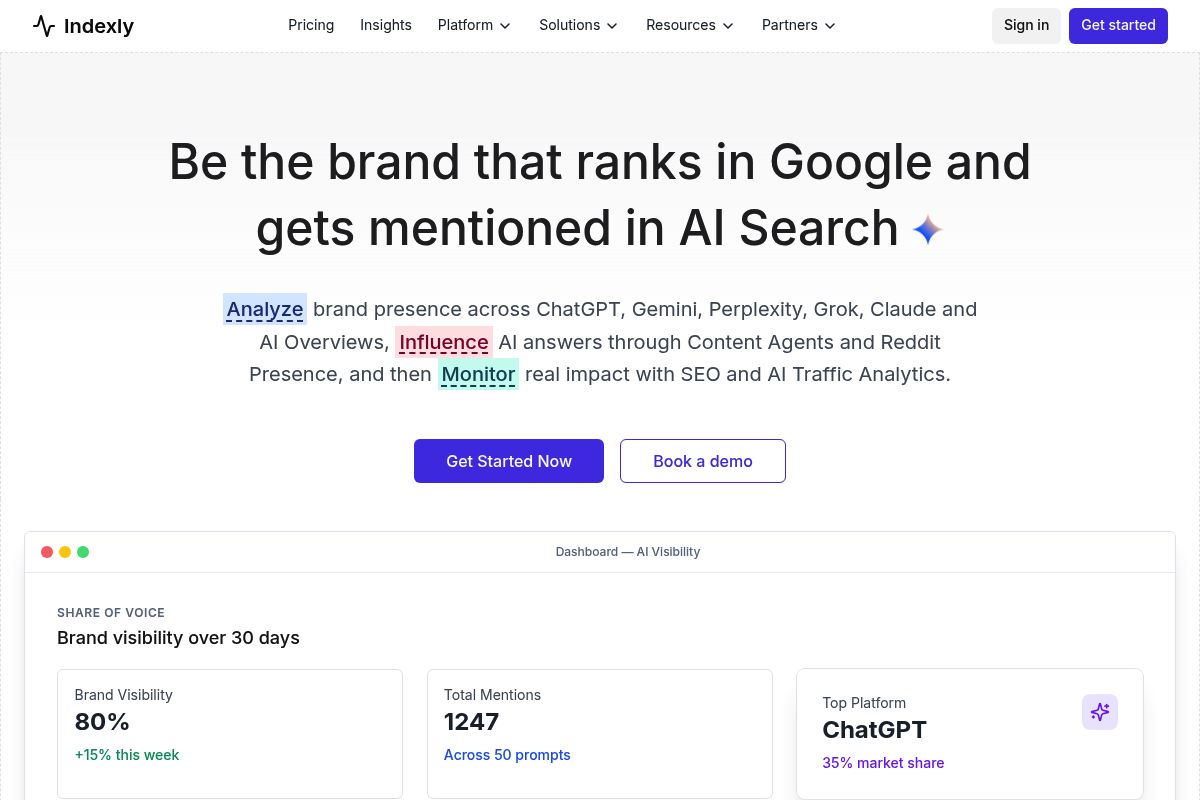
Indexly is an AI search visibility and brand management platform designed to help brands get mentioned and accurately represented across AI search engines like ChatGPT, Perplexity, and Gemini.
It provides a full suite of tools for monitoring brand presence in AI-generated answers, influencing the narrative through proprietary features, and tracking AI-driven lead generation. This focus on active influence and conversion tracking makes it stand out when evaluating platforms for business impact.
The platform moves beyond passive monitoring by enabling users to actively shape their brand's story in the AI ecosystem. Users can analyze their presence with AI Search Analytics, influence AI models through tools like Content Agents and Reddit Signals, and monitor outcomes with advanced analytics. This approach helps brands demonstrate thought leadership by publishing insights and data-driven recommendations that AI models are more likely to cite.
Key Features
- Multi-Platform AI Monitoring: Tracks your brand's visibility inside leading AI models like ChatGPT (OpenAI), Perplexity, Gemini (Google), Grok (xAI), and Claude (Anthropic). It monitors prompt-level mentions and brand sentiment, analyzes AI citations, and provides insights into why your content does or does not appear in AI-generated answers.
- AI Search Analytics: AI visibility, sentiment analysis, indexing status, technical audits, and keyword and backlink intelligence are consolidated into one unified dashboard for a complete overview of your brand's digital presence.
- Content Agents and Reddit Signals: Content Agents are purpose-built tools for content optimization, while Reddit Signals is a feature for community signal building. Together, they help brands move from passive monitoring to active optimization, directly influencing how AI models learn about and reference a brand.
- White-Label Agency Platform: Offers a complete white-label solution designed for digital agencies, featuring multi-client management and custom branding. This allows agencies to provide AI visibility services under their own brand, complete with agency-specific pricing and comprehensive training.
- Lead Generation Tracking: Provides specialized tracking for AI-driven conversions, identifying qualified leads that originate from AI search engine recommendations. This feature is crucial for connecting visibility efforts directly to revenue and proving ROI.
- Sub-Brand Management: Allows users to set up and monitor multiple sub-brands within a single account, ensuring each product line or division gets its own dedicated visibility tracking and reporting. Agency accounts include this capability by default for managing different clients.
- Pricing: Plans begin at a highly accessible $49/month, with scalable agency plans and custom enterprise tiers available. These options include white-label features and enterprise-grade security to accommodate organizations of all sizes.
Best For
Indexly is ideal for marketing teams, brand managers, and digital agencies that need to actively win AI-driven conversations, not just passively monitor them. Its toolset is built for users who want to influence how AI models perceive and discuss their brand, making it a proactive solution among AI citation tracking tools.
The platform is particularly well-suited for organizations focused on AI-driven lead generation. With comprehensive tracking capabilities at an accessible price point, it helps teams convert AI-generated visibility into measurable business outcomes, delivering enterprise-grade features at a cost accessible to growing brands.
Pros and Cons
- Pro: Offers an excellent value proposition, with a starting price of $49/month that is highly competitive when compared to other, more expensive AI search engine tools.
- Pro: A true full-stack platform, combining tracking, influence tools, and analytics in one unified dashboard, eliminating the need for multiple disparate tools.
- Pro: Includes robust white-label agency capabilities with multi-brand management and branded reporting, making it an ideal solution for client-facing agencies.
- Pro: Uniquely helps brands get recommended by AI search engines while building long-term authority, moving beyond simple mention monitoring to active narrative shaping.
- Con: As a newer platform in the AI-powered marketing space, some enterprise integrations are still maturing compared to legacy SEO platforms like Semrush or BrightEdge.
- Con: The comprehensive breadth of features may require an initial onboarding period for teams accustomed to single-purpose monitoring tools.
Rating: 9.5/10
Key Takeaway: Indexly distinguishes itself by combining comprehensive monitoring with active influence capabilities, such as Content Agents and Reddit Signals, positioning it as a full-stack solution for brands aiming to control their narrative in AI search and drive measurable leads. When comparing enterprise-level options, Profound takes a different approach entirely.
2. Profound — Best for Fortune 500 Enterprise AI Visibility
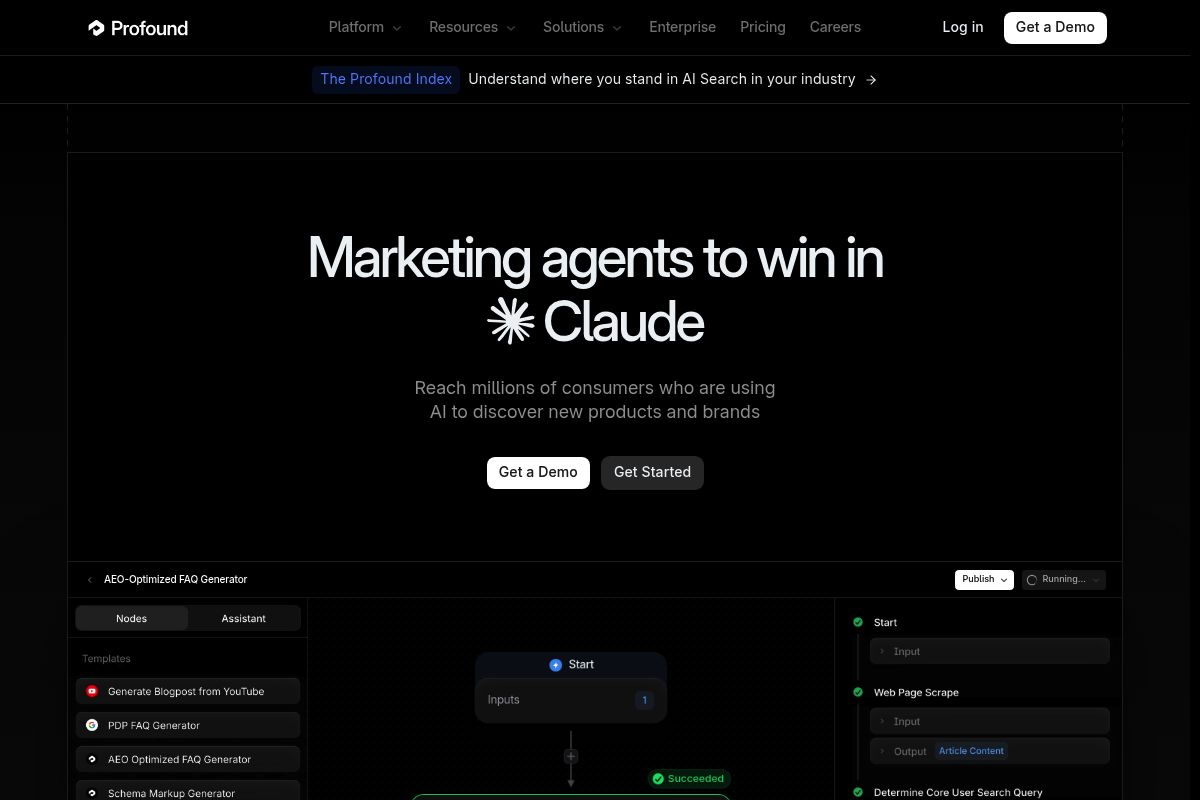
Profound is an enterprise-grade generative AI marketing intelligence platform built for large organizations that require deep, compliance-ready AI visibility at scale. A generative AI marketing intelligence platform is a system that tracks how brands appear in answers from models like ChatGPT, Perplexity, and Gemini, providing tools to optimize that presence. Profound delivers this by monitoring major AI engines and offering a workflow product called Agents to generate and publish AEO content.
Backed by a $96M Series C funding round in February 2026 at a $1B valuation, Profound has established a strong enterprise client base. The platform is trusted by leading companies such as Ramp, DocuSign, Figma, Target, Walmart, MongoDB, and Charlotte Tilbury for their AI-powered marketing platform needs.
Key Features
- Prompt Volumes Panel Data: The platform processes 5M+ citations daily, tracks 4M+ crawler visits, and handles 1M+ prompts to give enterprise brands the intelligence needed to win in the zero-click world.
- Multi-Platform Coverage: Tracks brand visibility across ChatGPT, Perplexity, Gemini, Copilot, Google AI Overviews, and more. Profound tracks real user prompts, not synthetic queries, giving its visibility data a grounding in actual search behavior.
- Competitive Benchmarking: Identifies which domains AI platforms trust most in your category, showing which third-party publications are powering competitor mentions so you can focus earned media efforts.
- Enterprise Security: SOC 2 Type II compliance ensures it meets Fortune 500 security requirements.
- AI Content Agents: One-click AI content creation, real-time optimization, and customizable dashboards are included.
- Pricing: Lite at $499/mo (ChatGPT only, 50 prompts, 1 seat), Growth at $399/mo (ChatGPT + Perplexity + Google AI Overviews, 100 prompts, 3 seats), and Enterprise at $2,000-$5,000+/mo. All plans require a sales conversation — no self-serve checkout.
Best For
Profound is best for Fortune 100 companies and large enterprise marketing teams. The platform monitors user-facing interfaces across more than ten AI engines to deliver detailed analytics on brand representation, sentiment trends, and competitive positioning. The minimum $499/month entry point and sales-led procurement model make it unsuitable for SMBs or agencies without dedicated enterprise AEO retainers.
Pros and Cons
- Pro: Some enterprise clients have reported up to 700% increases in AI referrals, with six-figure revenue generated directly from AI recommendations.
- Pro: Deepest platform coverage and Prompt Volumes panel data in the enterprise segment.
- Pro: SOC 2 Type II and HIPAA compliance for regulated industries.
- Con: No free trial, no free tier, and no self-serve signup — every plan including Lite is sales-led, and time to first usable data is typically 1-3 weeks.
- Con: Does not support multi-account management; you get one workspace per account — a hard limit for agencies running multiple client brands.
Rating: 8.8/10
Key Takeaway: Profound is a premium, security-focused AI visibility tool tailored for the Fortune 500, offering unparalleled data depth and platform coverage. However, its high cost, sales-gated access, and lack of multi-account support make it a non-starter for smaller businesses and most agencies. For teams looking for a more accessible entry point with agency capabilities, Otterly AI offers a compelling alternative.
3. Otterly AI — Best for Agency GEO Monitoring and Prompt Research
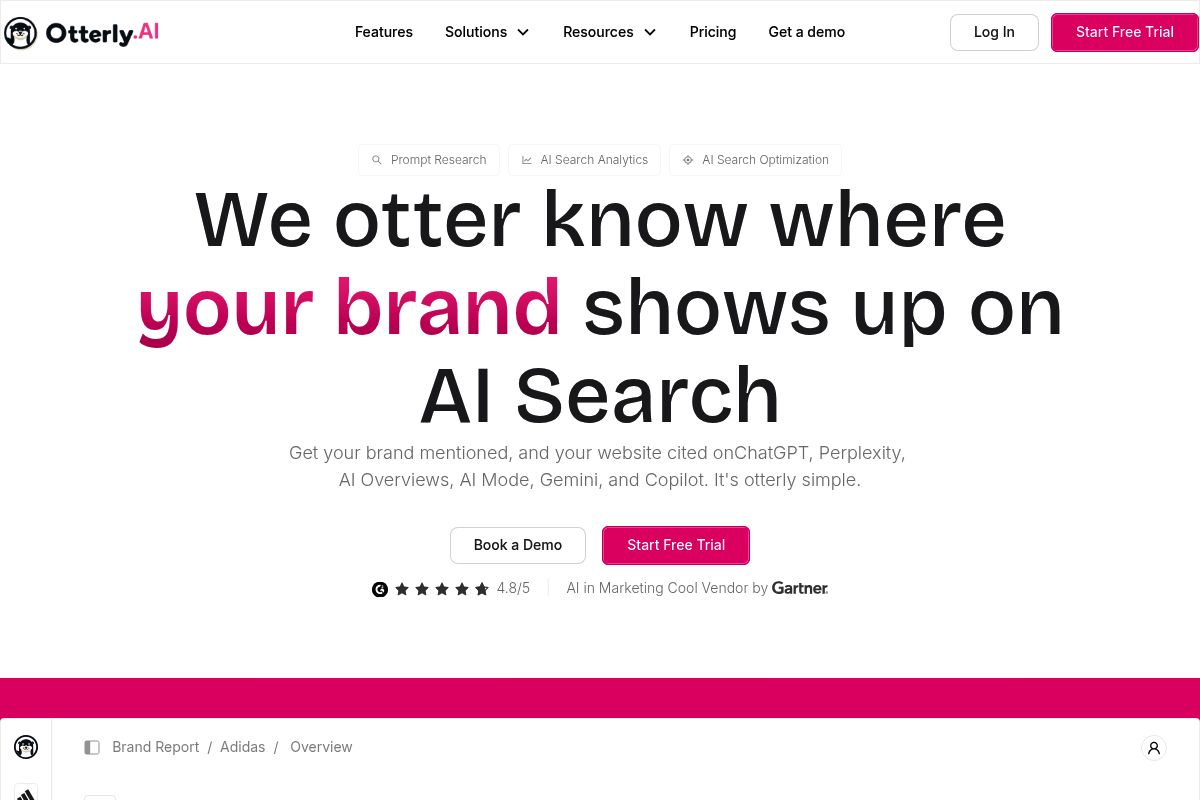
Otterly AI is a purpose-built AI search visibility and GEO monitoring platform designed for marketers and agencies. It specializes in measuring brand citations, tracking user prompts, and conducting content audits across major answer engines like ChatGPT and Google AI Overviews.
When evaluating AI visibility platforms, Otterly positions itself as a comprehensive solution for marketers. The platform centers its features on prompt research, brand visibility, citations, GEO audits, and reporting across ChatGPT, Google AI Overviews, Perplexity, Google AI Mode, Gemini, and Microsoft Copilot. Otterly AI holds a 4.8 out of 5 rating on G2 and was recognized by Gartner as a Cool Vendor in 2025 for AI in Marketing.
Key Features
- Six-Engine Coverage: Tracks six current AI search engines: Google AI Overviews, ChatGPT, Perplexity, Google AI Mode, Gemini, and Microsoft Copilot.
- Brand Visibility Index: The Brand Visibility Index is a proprietary KPI that aggregates multiple data points into a single score showing how visible a brand is across ChatGPT and AI search over time, making it easy to track progress and report to stakeholders.
- GEO Audit with SWOT: A GEO Audit is a content audit that identifies why AI engines are skipping your pages, with crawlability checks, content scoring, and briefs for improving specific pages.
- AI Prompt Research: Discovers which prompts your target audience is asking in AI search based on your keywords, brand name, or URL.
- Agency Partner Program: Agency Partners get unlimited workspace management, pitch workspaces for prospects, custom reports via Google Looker Studio with agency branding, co-marketing opportunities, and simplified billing.
- Pricing: Offers multiple tiers, including Lite at $29/month (15 prompts), Standard at $189/month (100 prompts), and Premium at $489/month (400 prompts), with a free trial available for all plans.
Best For
Otterly AI was purpose-built for agencies managing multiple client brands in the evolving AI search landscape. It provides the essential infrastructure to launch and scale GEO services profitably, featuring an unlimited seats model and white-label reporting options.
The platform is especially well-suited for agencies ranging from solo practitioners to teams handling 10–20 client accounts. It offers a self-serve, affordable entry point with a genuine 14-day free trial, making it accessible for growing businesses.
Pros and Cons
- Pro: Lowest entry price in the category at $29/month with unlimited team members on all plans.
- Pro: Helped users better understand actual competitors in AI search results, providing valuable insights into share of voice, competitor positioning, and how brands are surfaced in AI-generated answers.
- Pro: 14-day free trial with no credit card required; recognized by Gartner as a Cool Vendor.
- Con: Does not track Claude, Grok, DeepSeek, Meta AI, or Mistral; Gemini and AI Mode require paid add-ons.
- Con: Offers limited actionable optimization recommendations and shallow historical data on lower tiers.
Rating: 8.5/10
Key Takeaway: Otterly AI is an excellent choice for marketing agencies seeking an affordable, scalable platform for GEO monitoring and prompt research, particularly due to its agency-specific features like unlimited seats and white-label reporting. If you're already invested in the Semrush ecosystem, however, their AI Visibility Toolkit offers a different integration advantage worth considering.
4. Semrush AI Visibility Toolkit — Best for Teams Needing SEO and AI Visibility Together
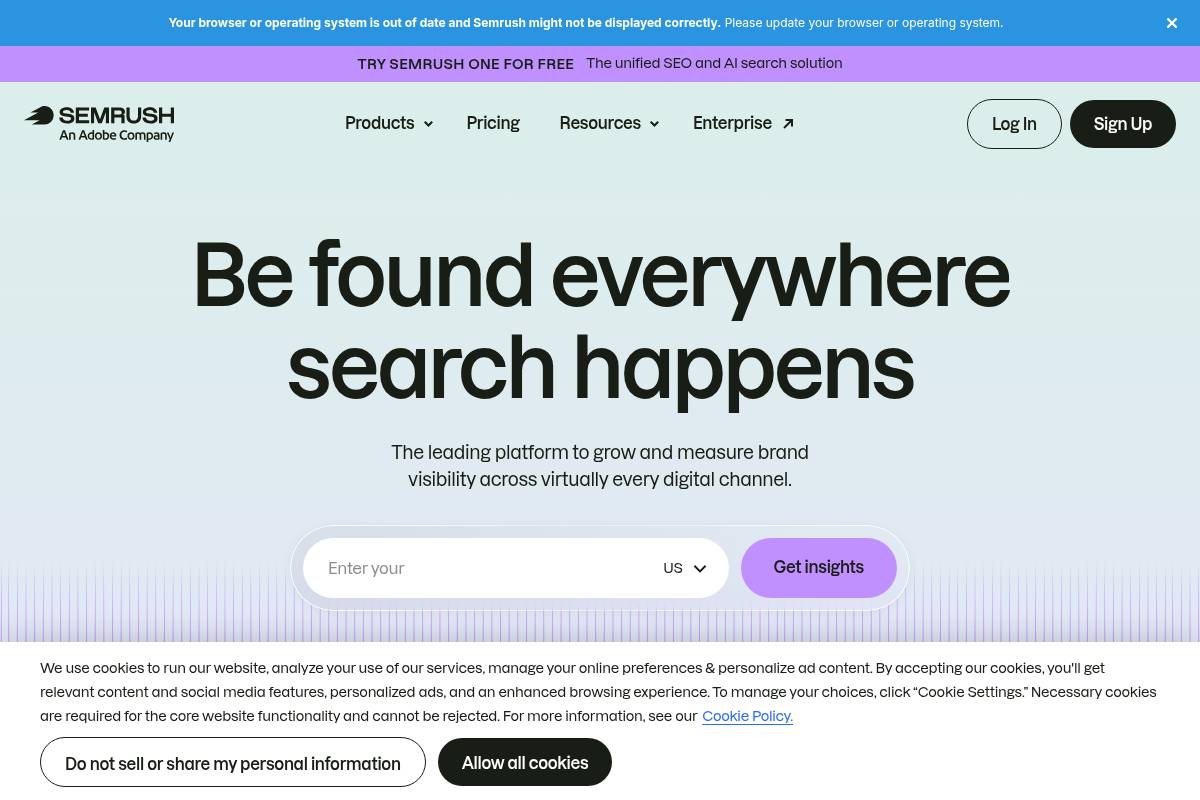
The Semrush AI Visibility Toolkit stands out as a comprehensive module designed for teams needing to manage both traditional SEO and AI-powered search visibility from one place. It serves as a complete search operating system by tracking brand mentions and citations across major AI engines, offering a unified solution for modern search marketing.
Launched in October 2025 and now bundled within Semrush One, the toolkit specifically monitors brand presence in ChatGPT, Google AI Overviews, Perplexity, and Gemini. Its core functionality includes Prompt Monitoring, an AI Visibility Score, and detailed tracking of Mentions, Cited Pages, and Citations to measure performance.
Key Features
- AI Visibility Score: The AI Visibility Score is a proprietary metric (0-100) that quantifies a brand's presence in AI-generated answers. This score is calculated using data from a massive 239M+ prompt database that is refreshed daily, powering features like Visibility Overview, Prompt Research, and Competitor Research.
- Brand Performance Reports: These reports allow you to benchmark your brand's AI visibility and mentions against competitors. You can also analyze brand perception and sentiment, and discover relevant prompts and topics to target for new visibility opportunities.
- AI Search Site Audit: This feature uses established site audit logic to identify technical blockers on your website that could reduce access for AI crawlers or otherwise weaken your content's discoverability in AI search models.
- Semrush One Integration: Semrush One is a bundled offering that combines the classic SEO toolkit with the AI Visibility Toolkit. This integration allows you to track your brand's presence on ChatGPT, Gemini, and Perplexity from a single, unified platform.
- Pricing: The standalone AI Visibility Toolkit is priced at $99 per month per domain with no free trial available. The broader Semrush One bundle starts at $199/month with a 7-day trial. The cost structure is a per-user, per-domain pricing model, meaning three team members needing access would cost $297/month, not a flat rate.
Best For
The platform is built for SMBs, agencies, and mid-market companies seeking practical, scalable insights to improve their presence in AI-driven search. It is particularly effective for existing Semrush users who already rely on the platform for keyword research, backlinks, and competitive analysis. For these teams, the AI layer slots naturally into an existing workflow without the complexity of adding a second vendor—a key consideration for efficiency-focused teams.
Pros and Cons
- Pro: The platform is highly valuable for users who need a single platform for traditional SEO and AI search. The AI Visibility Toolkit is a legitimate, robust tool with large-scale data and a logical workflow that connects prompt discovery, competitor benchmarking, and site auditing.
- Pro: Subscribers gain access to Semrush's massive 26.8B keyword database and the company's broader suite of established digital marketing tools, creating significant added value.
- Pro: Adobe's $1.9 billion acquisition of Semrush in April 2026 provides long-term product investment signals, suggesting continued development and financial stability for the platform.
- Con: The solution is less compelling if you only need AI visibility monitoring, as the comprehensive product breadth and associated pricing stack are bigger than necessary for a single-purpose user.
- Con: The per-user, per-domain pricing model can become expensive quickly for multi-brand agencies or companies with large marketing teams that require individual access.
Key Takeaway: Semrush offers a powerful, integrated solution for businesses already invested in its ecosystem, combining extensive SEO tools with robust AI visibility tracking. While the all-in-one approach is a major strength, the per-user, per-domain pricing model can become a significant expense for agencies or companies managing multiple brands, making it less ideal for those solely focused on AI citation monitoring.
Rating: 8.3/10
For teams seeking a more budget-friendly all-in-one approach, SE Ranking offers a compelling alternative with different pricing dynamics.
5. SE Ranking AI Visibility Tracker — Best for Budget-Conscious Agencies Wanting All-in-One SEO and AI
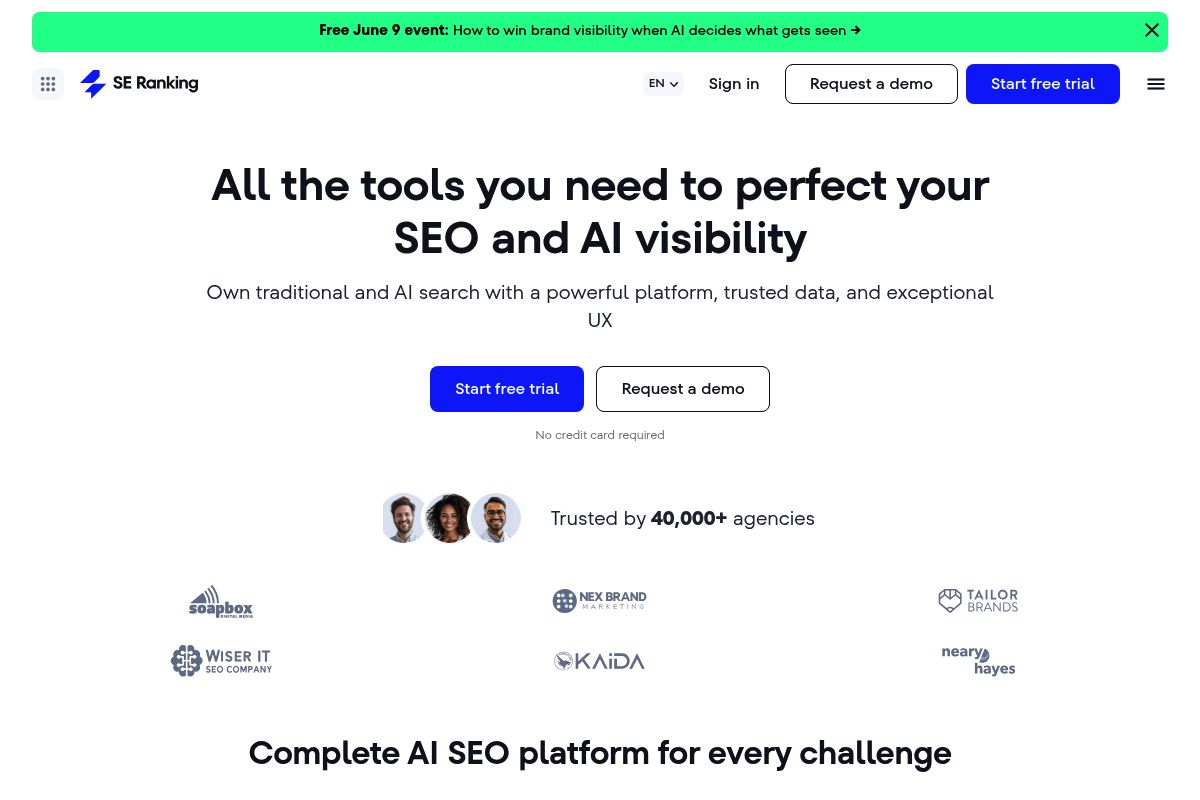
SE Ranking stands out as an all-in-one, cloud-based SEO platform offering a budget-conscious solution for AI visibility tracking. It is designed as the value leader for agencies and small-to-medium businesses (SMBs) seeking to integrate AI monitoring with a comprehensive suite of traditional SEO tools.
The platform's capabilities are extensive, featuring comprehensive rank tracking across 188 countries, a keyword database of 5.4–7 billion terms, and over 115 technical SEO checks. Its AI search visibility tracking covers 6 major platforms including ChatGPT, Google AI Overviews, Perplexity, and Gemini, providing a wide net for monitoring brand citations.
Key Features
- Three-Part AI Visibility Suite: The AI tracker is a feature that monitors Google AI Overviews, AI Mode, and LLM presence across ChatGPT, Perplexity, and Gemini. It offers presence and ranking tracking, source analysis, historical data with cached SERP copies, and LLM visibility research that measures share of voice, which is a metric quantifying a brand's visibility against its competitors.
- "No Cited" Competitor Gap Feature: The "No cited" feature, which identifies opportunities where competitors are mentioned in AI results but your brand is not, has been described by users as "gold for content ideas." This tool is crucial for strategic content planning and closing visibility gaps.
- API and MCP Integration: Users can pull AI mention, link, and competitor visibility data directly into their own tools via an API. It also allows for live queries inside Claude or other AI assistants via MCP (Multi-modal Content Platform), which are systems that can process and integrate various types of data inputs.
- Local AI Visibility: SE Ranking receives particular commendation for its local search tracking abilities, a critical feature for businesses with physical locations. The platform excels at tracking visibility by specific ZIP codes and cities, providing granular data for local SEO campaigns.
- Pricing: Core plans start from approximately $103/month and Growth plans from around $223/month, with the AI Search and Agency Pack available as add-ons. To achieve meaningful coverage, the AI Search add-on is necessary, bringing the total cost to a range of $150 to $240+ per month.
Best For
Agencies managing diverse client portfolios benefit from the comprehensive toolset, integrated white-label reporting, and affordable pricing model. For teams already embedded in the SE Ranking ecosystem, it is the ideal pick for layering AI visibility tracking onto existing SEO workflows without migrating platforms.
Pros and Cons
- Pro: The 14-day free trial, which does not require a credit card, and flexible pricing tiers make the platform highly accessible for businesses of all sizes.
- Pro: An all-in-one workflow combines a rank tracker, site audit, on-page checker, backlink analysis, keyword research, content editor, and AI reporting. This integration reduces tool sprawl and streamlines marketing operations.
- Pro: The platform includes strong white-label and agency reporting capabilities, complete with a Looker Studio integration for creating custom, client-facing dashboards.
- Con: The companion SE Visible platform refreshes its data weekly. At a cost of $189/month for this component, the weekly refresh is a significant limitation compared to daily-refresh competitors.
- Con: AI tracking functionality is split across the main SE Ranking platform and the separate SE Visible platform. This approach creates product fragmentation and decision complexity for buyers trying to select the right package.
Rating: 7.9/10
Key Takeaway: SE Ranking offers a compelling, cost-effective, all-in-one solution for agencies needing to integrate AI visibility tracking with traditional SEO workflows, though users should be aware of the fragmented product experience and weekly data refresh limitations of its companion platform. For PR and communications teams with broader media intelligence needs, Meltwater takes a different approach entirely.
6. Meltwater GenAI Lens — Best for PR and Communications Teams with Enterprise Media Needs
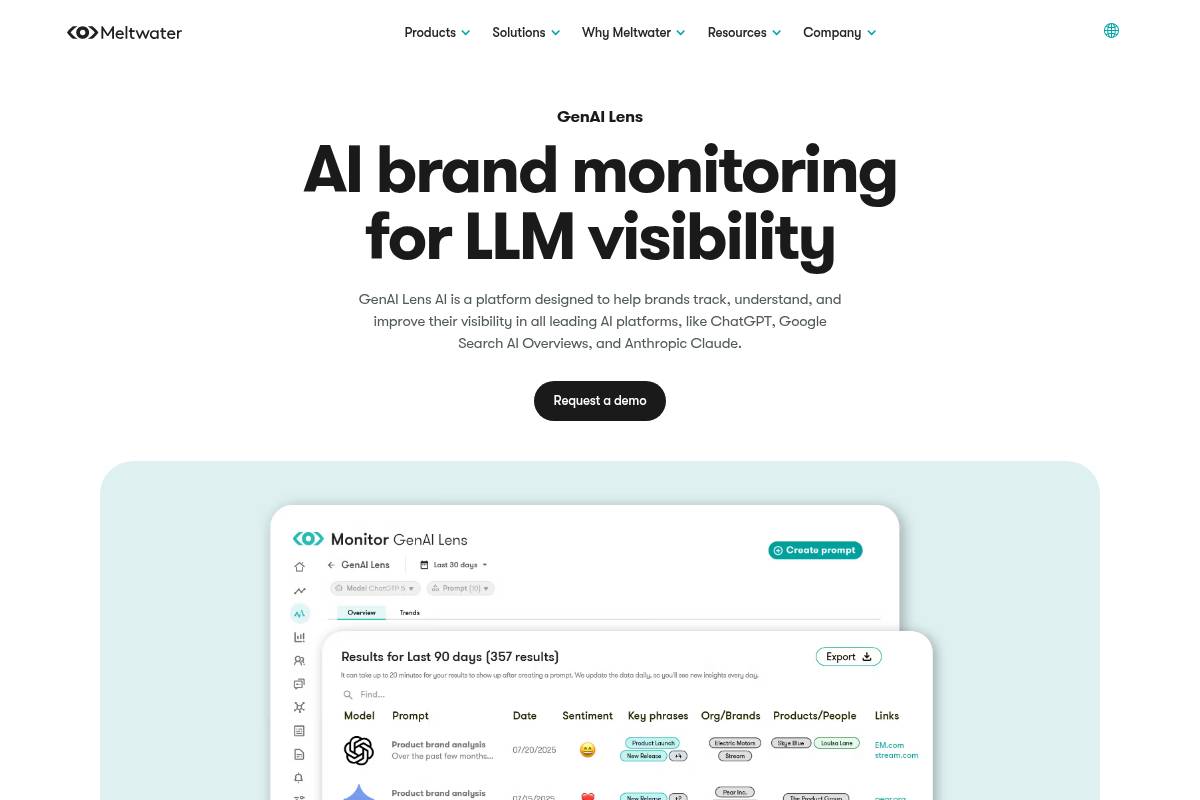
Meltwater GenAI Lens is an enterprise AI visibility module integrated into Meltwater's established media intelligence platform. It is specifically designed for PR, communications, and marketing teams who need to monitor brand mentions across both traditional media and AI-generated answers from leading large language models (LLMs).
The platform provides comprehensive visibility into how brands and competitors are portrayed by major AI Assistants like ChatGPT, Claude, Gemini, and Perplexity. This allows teams to track their narrative in the emerging landscape of generative AI, making it a key consideration for enterprise needs.
Key Features
- Multi-LLM Brand Monitoring: GenAI Lens tracks how large language models (LLMs)—which are complex AI systems trained on vast amounts of text data to understand and generate human-like language—describe your brand. It monitors models including ChatGPT, Gemini, Claude, Perplexity, Google AI Overviews, Google AI Mode, DeepSeek, Llama, and Grok to see how they represent your products and competitors when users ask them questions.
- Hallucination Detection: Hallucination detection is the process of identifying and flagging factually incorrect or nonsensical information generated by an AI. GenAI Lens validates the accuracy of every LLM output against trusted source datasets, detecting hallucinations, bias, and inconsistencies through its LLM monitoring capabilities.
- Competitive Share of Voice: AI share of voice is a metric that measures a brand's visibility within AI-generated responses compared to its competitors. The platform allows you to benchmark your AI share of voice, compare performance side-by-side, and track how AI recommendations evolve over time with prompt-based benchmarking.
- Source Transparency: The tool provides real-time brand and competitor mentions and offers source transparency for LLM outputs. This feature closes a critical gap in modern brand management by showing where the AI is getting its information, allowing teams to trace the origins of brand narratives.
- Integrated Media Intelligence: A key benefit is that AI insights sit alongside traditional news and social media monitoring within a single interface. This unified view helps teams think holistically about brand visibility across all critical channels, from a news article to a ChatGPT response.
- Pricing: Meltwater does not publish pricing publicly, as GenAI Lens is offered as an add-on to a broader Meltwater package, with availability varying by subscription tier. Pricing for a foundational single-user subscription starts around $7,000/year, while typical enterprise contracts range from $15,000 to $20,000 per year.
Best For
Meltwater is the ideal choice for enterprise public relations teams, global marketing departments, and large agencies that require a comprehensive, all-in-one platform. It combines media monitoring, social listening, and journalist outreach with AI visibility, making it particularly strong for brands managing complex, multi-market campaigns. While a specialized tool might offer deeper AI-specific analytics, Meltwater excels for teams already invested in its media intelligence suite who will find GenAI Lens to be a natural and powerful extension.
Pros and Cons
- Pro: Meltwater's platform analyzes approximately 1 billion pieces of content daily across its base of 27,000 global customers and 50 offices, providing unmatched media data breadth for enterprise brands.
- Pro: It is the only platform in our comparison with explicit hallucination detection and accuracy validation built directly into the product, addressing a major concern with AI-generated content.
- Pro: The platform's greatest strength is its ability to integrate AI visibility with social listening, PR measurement, and a journalist database, creating a single source of truth for communications teams.
- Con: Compared to purpose-built platforms, its AI visibility tracking is functionally shallow. It shows monitoring data but lacks advanced features like content gap analysis, AI crawler logs, traffic attribution, or integrated content generation tools.
- Con: Accessing GenAI Lens can be difficult and costly if you are not an existing Meltwater customer. The bundled package includes far more than most teams strictly need for AI visibility alone, making it a significant investment.
Key Takeaway: Meltwater GenAI Lens is best suited for large enterprises already using or needing a full media intelligence suite, offering the unique advantage of integrated AI monitoring with hallucination detection, rather than serving as a standalone, specialized AI visibility tool.
Rating: 7.7/10
For mid-market teams seeking transparency and control without enterprise complexity, LLM Pulse offers a compelling self-serve alternative.
7. LLM Pulse — Best for Mid-Market Teams Needing Transparent, Self-Serve AI Tracking
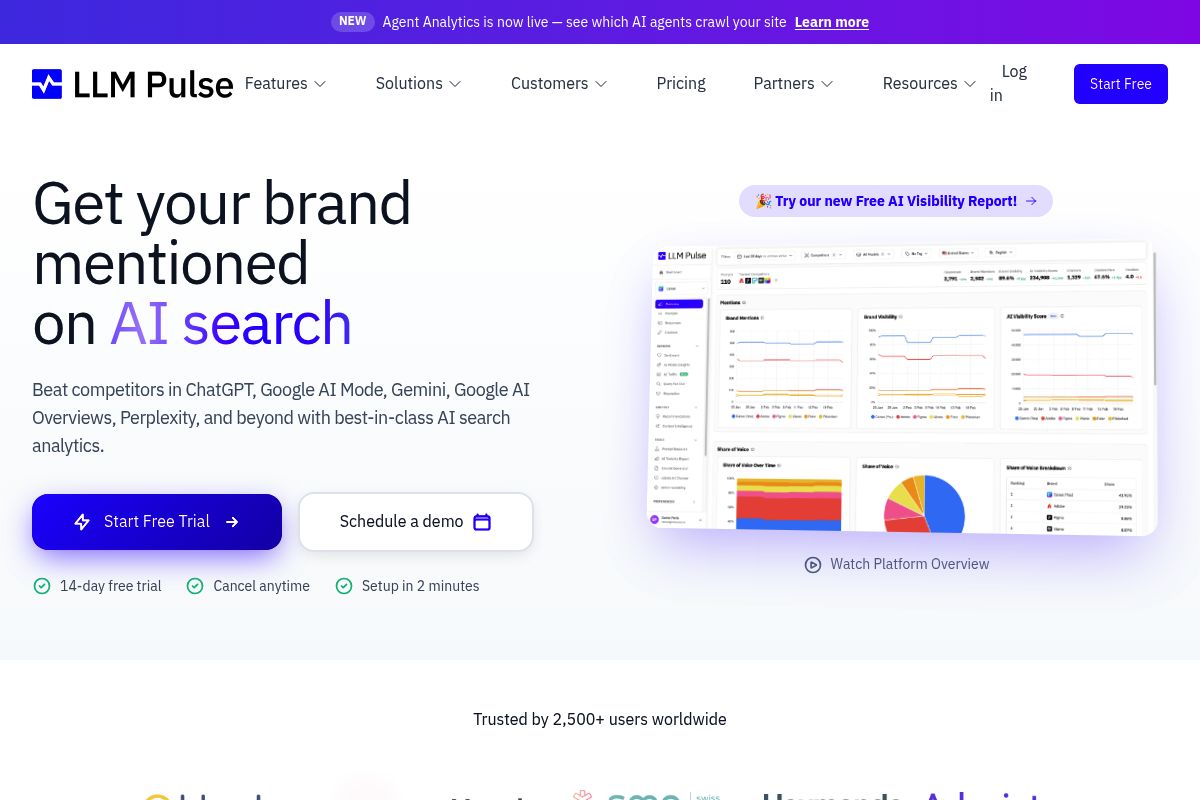
LLM Pulse emerges as a bootstrapped, all-in-one AI search visibility and reputation platform. It is an advanced AI Engine Optimization (AEO) platform—the practice of optimizing content to appear favorably in AI-generated answers—purpose-built to help brands monitor, analyze, and influence how they are represented across major LLMs.
Key Features
- Core AI Platform Tracking: Beat competitors in ChatGPT, Google AI Mode, Gemini, Google AI Overviews, and Perplexity with best-in-class AI search analytics — monitoring what AI models say about your brand across all core platforms.
- Visibility Score and Share of Voice: Measure your visibility score, citation rate, sentiment, and share of voice — then benchmark against competitors to understand your market position.
- Citation Analysis: Visibility scores measure brand presence across AI models, while citation analysis examines how AI systems source and reference brand information, providing crucial data for optimization.
- AI-Powered Recommendations: Get AI-powered recommendations to improve how you appear in LLM responses, effectively closing the optimization loop with actionable insights.
- Looker Studio Integration: A native Looker Studio connector is available for building custom dashboards and integrating AI visibility data with your broader business intelligence.
- Pricing: Starter at €49/month (1 team member, 1 project, 40 AI responses per week per model, 40 tracked prompts), Growth at €99/month, and Scale at €299/month. All plans include a 14-day free trial and unlimited seats.
Best For
LLM Pulse is strongest for agencies, small teams, and practical operators who want transparent pricing and a broad toolkit without the friction often associated with enterprise software procurement. The platform delivers a comprehensive suite of tools designed for hands-on users who need to track and improve AI visibility efficiently.
It is particularly well-suited to European teams and USD-budget startups who appreciate the self-serve model and transparent EUR-denominated pricing, which includes a 14-day free trial accessible without a mandatory sales call.
Pros and Cons
- Pro: The platform is unusually transparent compared to sales-led AI visibility products, featuring clear public pricing, a genuine free trial, and unlimited seats on all tiers.
- Pro: Because the company is bootstrapped, its pricing reflects actual value delivered, not investor return expectations, which can lead to more sustainable and fair costs for customers.
- Pro: It combines mention tracking, citation monitoring, sentiment analysis, share of voice, and competitive benchmarking into a single, cohesive dashboard for streamlined analysis.
- Con: As of 2026, LLM Pulse works as a standalone platform and does not integrate natively with your CRM, marketing automation, or BI tools through pre-built connectors, requiring manual data transfer for deeper integration.
- Con: Deeper model coverage (including Grok, Meta AI, Claude, DeepSeek, and Copilot) requires the Enterprise tier, limiting the scope for users on lower-priced plans.
Key Takeaway: LLM Pulse is the ideal choice for mid-market teams and agencies that prioritize transparent, self-serve access to comprehensive AI visibility and citation tracking tools without the complexities of enterprise sales cycles.
Rating: 7.8/10
For large enterprises with deeper content intelligence requirements, BrightEdge offers a more comprehensive solution built on years of SEO platform maturity.
8. BrightEdge — Best for Large Enterprises with Deep Content Intelligence Needs
BrightEdge is an enterprise-grade SEO and content intelligence platform designed for large organizations seeking to manage their brand presence in AI-generated answers. Trusted by Fortune 1000 companies like L'Oréal and Microsoft, the platform merges deep SEO analytics with new AI visibility tracking to provide a unified view of both traditional and AI-powered organic search performance.
Key Features
- AI Search Tracking: This feature is a monitoring system that tracks brand presence across Google AI Overviews, ChatGPT, and other major AI surfaces. It provides key metrics such as brand mention frequency, citation tracking, and competitive share of voice in AI-generated responses.
- Content Intelligence: BrightEdge offers industry-leading content performance analytics that identify which specific content assets are driving organic and AI visibility. The system includes AI-powered recommendations for content optimization to improve performance.
- DataCube Technology: DataCube is BrightEdge's proprietary dataset that analyzes billions of pieces of content. This technology delivers predictive insights on which topics and formats are most likely to be cited by generative AI platforms.
- Cross-Channel Reporting: The platform is recognized for its comprehensive reporting capabilities, which integrate data across multiple channels. BrightEdge receives strong reviews from digital marketing leaders at brands like L'Oréal and Microsoft, with platforms like G2 and Gartner Peer Insights consistently rating it highly for reporting accuracy and enterprise-grade support.
- Workflow Automation: The platform includes automated content brief generation and competitive intelligence workflows. These tools integrate directly with enterprise CMS platforms including Adobe Experience Manager and Salesforce Marketing Cloud to streamline marketing operations.
- Pricing: BrightEdge offers custom enterprise pricing only and requires direct sales engagement for a quote. According to third-party estimates, annual contracts typically range between $24,000 and $120,000 depending on the scope of services.
Best For
BrightEdge is ideal for large enterprise marketing teams at Fortune 500 companies that require a single, unified platform for both traditional SEO and emerging AI visibility. Its feature set is built for organizations needing deep content intelligence, predictive analytics, and dedicated customer success manager support.
While large agencies and multinational corporations sometimes cite the platform's steep learning curve and high price as potential drawbacks, positive feedback overwhelmingly notes that its depth of data and workflow automation drive measurable ranking and content performance improvements at scale. This makes it a powerful, albeit resource-intensive, solution for complex marketing ecosystems.
Pros and Cons
- Pro: Provides best-in-class content intelligence and predictive analytics specifically tailored for the complex needs of enterprise marketing teams.
- Pro: Offers deep, native integrations with essential enterprise software like Adobe Experience Manager and Salesforce Marketing Cloud, streamlining workflows.
- Pro: Has a long, proven track record working with Fortune 500 brands, backed by a dedicated customer success team for robust support.
- Con: The custom enterprise pricing model and lack of a self-serve option make it unsuitable for SMBs, growing agencies, or teams with limited procurement cycles.
- Con: Its AI visibility features are still maturing compared to newer, purpose-built platforms, as the core product DNA remains in traditional SEO.
Rating: 7.5/10
Key Takeaway: BrightEdge is a premium, enterprise-first platform that excels in providing deep data and workflow automation for large-scale SEO and AI visibility, but its cost and complexity make it less suitable for smaller businesses. For international brands needing multilingual coverage, Peec AI offers a specialized alternative.
9. Peec AI — Best for International and Multilingual Brand Visibility
Peec AI is a specialized AI search analytics platform designed for marketing teams to monitor brand visibility in AI-generated search results across numerous languages and international markets. Based in Berlin, this tool is purpose-built for global brand monitoring and competitive analysis within generative AI environments like ChatGPT and Perplexity.
With a notable $29M in funding, Peec AI's most significant differentiator is its support for over 115 languages, a capability that far surpasses the language coverage offered by most of its competitors in the market.
Key Features
- 115+ Language Support: The platform provides best-in-class support for over 115 languages, making it an essential tool for global brands. This feature includes daily prompt refreshes as a standard on all plans and offers agency pitch workspaces for creating customized, branded reports for prospective clients.
- Answer Engine Insights: Peec AI quantifies brand presence in AI answers by meticulously tracking mentions, share of voice, and comparative rankings across different brands and AI engines. It also helps estimate AI search demand by uncovering the specific questions users are asking generative AI platforms.
- Browser Simulation Technology: Peec AI utilizes advanced browser simulation technology, which is a method of replicating real user interactions within a web browser to capture AI responses with greater fidelity. This approach ensures the data more closely mirrors the actual AI search user experience, leading to higher accuracy in visibility tracking.
- API-First Design: The platform is built with an API-first design, enabling deep data analytics through features like CSV exports and comprehensive API integrations. This facilitates custom analysis, integration with other business intelligence tools, and efficient data warehousing.
- Notable Client Results: The platform has demonstrated tangible results for its clients, with notable examples including Wix, which reportedly achieved a 5x growth in LLM traffic by leveraging Peec AI's insights and analytics.
- Pricing: Subscription plans begin at €89 per month, which includes daily tracking across multiple AI platforms. Custom agency and enterprise plans are also available upon request to accommodate larger-scale needs.
Best For
Peec AI is the definitive choice for international brands that require daily AI visibility tracking across a wide array of languages and markets. Its extensive language support is a primary differentiator when evaluating platforms for multinational reach. Global e-commerce and SaaS companies aiming to monitor AI-driven product recommendations across Europe, Asia-Pacific, and North America will find its unmatched multilingual coverage indispensable for their marketing intelligence efforts.
Pros and Cons
- Pro: Its unrivaled support for over 115 languages makes it the only practical option for global brands that need to track AI visibility comprehensively across multiple international regions.
- Pro: A key competitive advantage is the inclusion of daily prompt refreshes on all subscription plans, offering more timely data than many competitors that operate on a weekly refresh cycle at similar price points.
- Pro: The use of browser simulation technology results in more accurate and realistic AI response data, providing a clearer picture of what actual users see.
- Con: For domestically-focused American brands, Peec AI has less brand recognition in the US market compared to established incumbents like Semrush or Profound.
- Con: The platform's features for content optimization and strategic improvement are less developed than those found in full-stack platforms, making it more of a specialized monitoring tool.
Key Takeaway: Peec AI is the leading specialized tool for multilingual and multinational AI visibility monitoring, offering unparalleled language support and daily data refreshes that are critical for global brands, though it is less suited for users needing deep content optimization features.
Rating: 7.4/10
For teams looking to automate the entire workflow from visibility insights to content production, AirOps bridges the gap between monitoring and execution.
10. AirOps — Best for Content Workflow Automation Paired with AI Citation Tracking
AirOps is an AI search and content workflow platform specifically designed to connect AI visibility tracking with content production. It enables marketing teams to build automated workflows for content refreshes, SEO programs, and scalable content operations, moving beyond simple AI mention monitoring to facilitate active content creation and optimization.
Key Features
- AI Search and Content Workflows: Build automated pipelines that monitor AI visibility, identify content gaps, create optimized content, and publish directly to your CMS, effectively closing the loop between insight and action.
- Citation Tracking Integration: AirOps is one of the few AI citation tracking tools that bridges content workflow automation with citation tracking and offers a free tier to get started.
- Agentic Content Operations: Unlike pure monitoring tools, AirOps automates the content production workflow that improves AI citation rates. This includes Agentic Content Operations, which are automated systems that can independently execute complex content tasks like content refreshes, structured data implementation, and authority-building content programs.
- Integrations: Native integrations with GA4, Google Search Console, HubSpot, Salesforce, and major CMS platforms provide end-to-end workflow connectivity from analytics to publication.
- Prompt Intelligence: The platform's Prompt Intelligence, a feature that analyzes user queries to AI engines, identifies the questions your audience asks and then automates content creation targeting those exact queries.
- Pricing: A free tier is available for users to explore the platform; paid plans start based on workflow volume and content output, so it is best to check the AirOps website for current tier pricing.
Best For
Ideal for content-driven growth teams and marketing operations professionals who need to automate the full cycle from AI visibility insight to content production and publication. It is best suited for teams running high-volume content programs where manual execution of AI optimization recommendations is a bottleneck—particularly B2B SaaS and enterprise content teams managing 50+ pieces of content per month.
Pros and Cons
- Pro: Its unique position bridging AI visibility monitoring and automated content production in a single platform means it is the only tool in this comparison that closes the full optimization loop.
- Pro: The free tier available makes it highly accessible for teams wanting to test AI-driven content workflows before committing to a paid plan.
- Pro: Deep CRM and marketing automation integrations provide revenue attribution data that standalone visibility and AI citation tracking tools often lack.
- Con: It is not a pure-play AI visibility monitoring platform. Teams that primarily need citation tracking dashboards will find the workflow focus adds complexity they may not need.
- Con: Requires more technical setup and onboarding compared to simpler monitoring-focused tools like Otterly AI or LLM Pulse, which are designed for immediate use.
Key Takeaway: AirOps stands out because it integrates AI citation tracking directly into automated content production workflows, making it ideal for teams focused on execution rather than just monitoring.
Rating: 7.2/10
Full Comparison Table — Top AI Visibility Platforms Compared Side by Side
| Tool | AI Platforms Tracked | LinkedIn Citation Tracking | Content Optimization | White-Label | Free Trial | Starting Price |
|---|---|---|---|---|---|---|
| Indexly | ChatGPT, Gemini, Perplexity, Grok, Claude, AI Overview | ✓ | ✓ (Content Agents + Reddit Signals) | ✓ | ✓ | $49/mo |
| Profound | ChatGPT, Perplexity, Gemini, Copilot, AI Overviews, 10+ on Enterprise | ✓ | ✓ (Agents feature) | ✗ | ✗ | $499/mo |
| Otterly AI | ChatGPT, Perplexity, Google AIOs, AI Mode, Gemini, Copilot | ✓ | ✓ (GEO Audit) | ✓ | ✓ | $29/mo |
| Semrush AI Toolkit | ChatGPT, Google AIOs, AI Mode, Perplexity, Gemini | ✓ | ✓ (Site Audit) | ✗ | ✓ (via Semrush One) | $99/mo add-on |
| SE Ranking | ChatGPT, Google AIOs, AI Mode, Perplexity, Gemini | ✓ | ✓ (Content Editor) | ✓ | ✓ | $103/mo |
| Meltwater GenAI Lens | ChatGPT, Claude, Gemini, Perplexity, Grok, DeepSeek | ✓ | ✗ | ✗ | ✗ | Custom |
| LLM Pulse | ChatGPT, Gemini, Perplexity, Google AI Mode, AI Overviews | ✓ | ✓ (Recommendations) | ✓ (Enterprise) | ✓ |