
If you’ve been using PromptWatch, you already know it’s pretty useful for tracking where your brand shows up in AI answers—like when someone asks ChatGPT or Gemini for recommendations. It gives you a solid view of visibility, mentions, and how you compare to competitors.
But after a while, many teams run into the same issue. You can see the data, but actually improving your presence—getting more citations, ranking higher, or influencing how AI talks about your brand—isn’t always easy.
That’s usually when people start exploring other options. Maybe you need broader coverage, more actionable insights, or tools that go beyond tracking and actually help with optimisation.
In this blog, we’ll break down the best PromptWatch alternatives so you can find a platform that not only shows what’s happening—but helps you improve it.
Why Look for Promptwatch Alternatives?
PromptWatch helps teams monitor how brands appear in AI-generated answers, but many outgrow its tracking-first approach as AI search evolves.
One key limitation is prompt discovery depth. While it surfaces prompts that mention your brand, it often leans on predictable queries, making it harder to uncover high-impact or long-tail opportunities across tools like ChatGPT, Perplexity, or Gemini.
It’s also less suited for full optimisation workflows. The platform focuses on tracking outputs rather than enabling deeper execution—like content gap analysis, scalable SEO/GEO content creation, or systematic improvements to increase AI visibility.
Competitive insights can feel limited as well. You can see where your brand appears, but not always why competitors are prioritised or how their content earns more citations, which makes it harder to act on the data.
Cost is another factor. As tracking scales across prompts, variations, and datasets, pricing can become less flexible for growing teams.
Finally, the AI search space itself is still maturing. Without standardised metrics or clear frameworks, teams may find it difficult to translate visibility data into consistent optimisation strategies.
Read: Promptwatch Review 2026: Features, Pros, and Cons
All tools below track brand visibility across AI answer engines like ChatGPT, Gemini, and Perplexity. The key difference is in depth—some focus on analytics, while others support optimisation, content workflows, or execution.
Promptwatch Alternatives
1.Indexly — AI Visibility Platform for Execution-Focused Teams
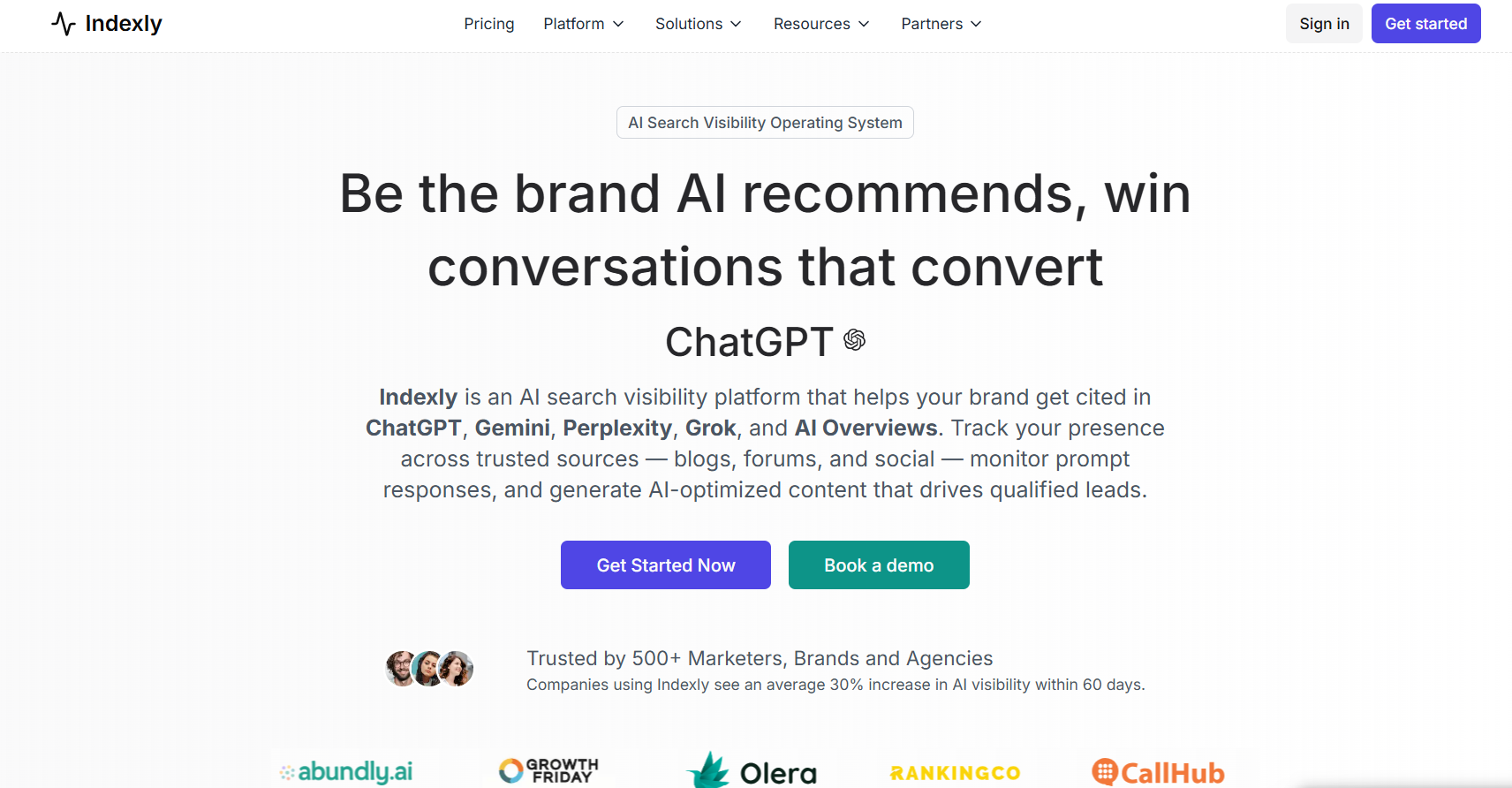
Built for teams that want to move from insight to execution, Indexly is an AI visibility platform designed to help marketing teams, brands, and agencies not just track but actively improve how they appear across AI answer engines.
Indexly connects visibility insights directly to execution. It combines AI visibility tracking, AI analytics, citation tracking, competitor analysis, prompt opportunity discovery, content optimisation, and generative engine optimisation (GEO) into a single unified workflow.
Key Features
| Feature | Description |
|---|---|
| AI Visibility Tracking | Monitors brand mentions across ChatGPT, Claude, Gemini, and Perplexity |
| AI Analytics | Provides insights into AI visibility performance and trends |
| Citation Tracking | Identifies where and how often a brand is cited in AI-generated answers |
| Competitor Analysis | Benchmarks AI visibility and share-of-voice against competitors |
| Prompt Opportunity Discovery | Finds high-intent prompts that improve AI search visibility |
| Content Optimisation | Recommends improvements to strengthen brand presence in AI answers |
| Content Gap Analysis | Detects missing topics and optimisation opportunities |
| AI Crawler Insights | Understands how AI systems discover and interpret content |
| SEO + GEO Integration | Aligns traditional SEO with generative engine optimisation (GEO) |
| Brand Mentions Monitoring | Tracks frequency and context of brand appearances in AI outputs |
| LinkedIn Content Engine (Upcoming) | Generates and optimises LinkedIn content using visibility insights |
| YouTube Content Engine (Upcoming) | Suggests and creates video topics based on AI and search demand |
| PR & Outreach Module (Upcoming) | Identifies media and outreach opportunities to improve brand authority |
Pros
Indexly brings multiple capabilities into a single execution-focused platform, helping teams turn AI search insights into real growth actions. It also reduces tool overload by combining AI analytics with SEO and GEO workflows.
Cons
As a newer platform, some advanced features are still evolving. It may require onboarding for teams new to GEO and AI-driven optimisation.
2. Rankscale — AI Visibility & Generative Search Analytics Platform
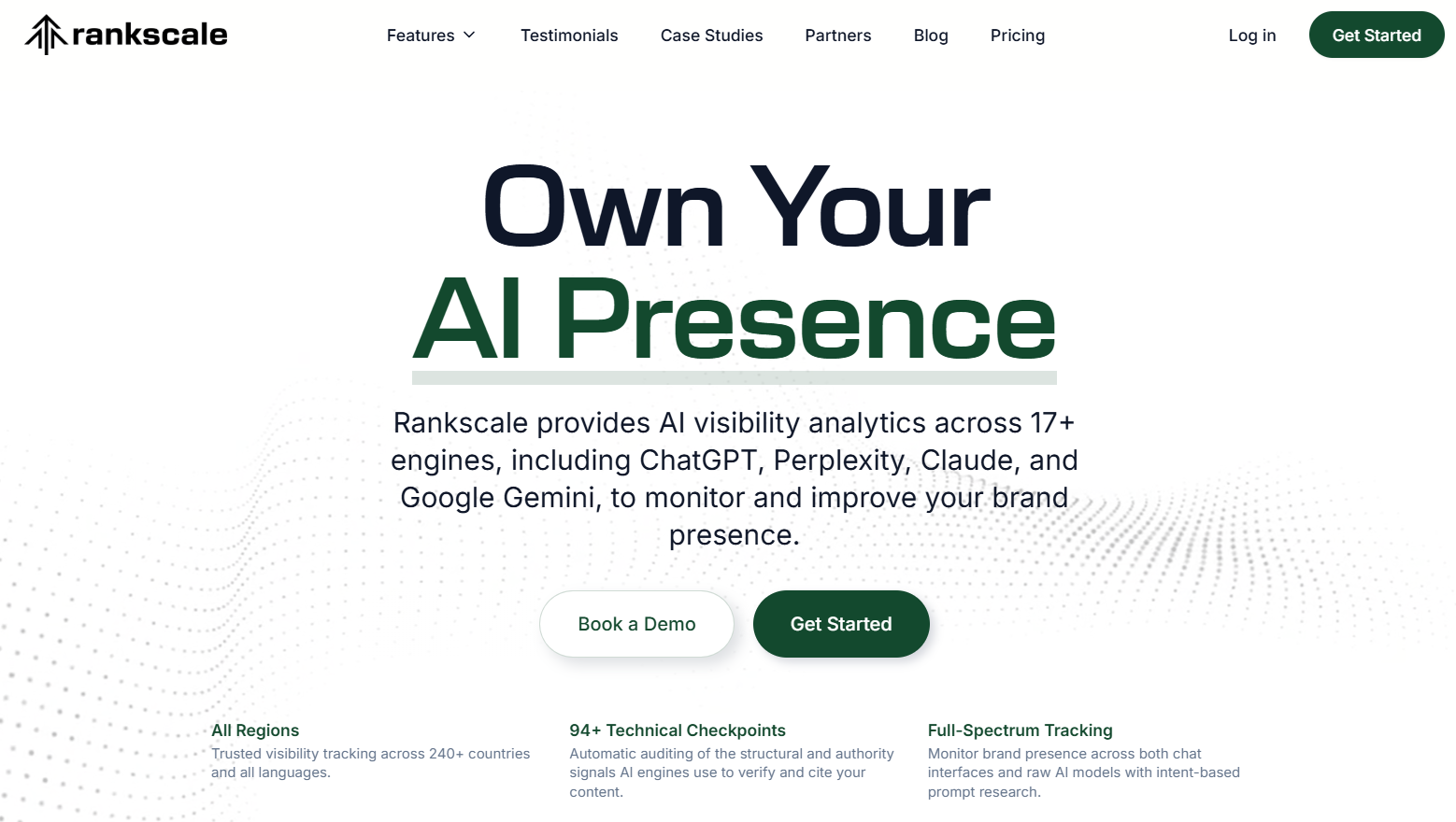
Rankscale is a performance analytics platform that focuses on rankings, citations, and visibility trends across AI-driven search and shopping queries. It is built for marketing teams, agencies, and brands aiming to track and improve how they appear across AI answer engines and generative search platforms. It also helps teams understand brand presence across both informational and commercial AI-driven queries.
Key Features
| Feature | Description |
|---|---|
| AI Rank Tracker | Tracks how your brand ranks in AI-generated answers across platforms |
| Page Audit | Analyzes pages to identify improvements for better AI and search visibility |
| Citation Analysis | Shows which sources AI models use and how your brand is cited |
| Sentiment Analysis | Evaluates how AI describes your brand (positive, neutral, negative) |
| Prompt Research | Identifies prompts that trigger brand mentions in AI responses |
| Shopping Analysis | Tracks visibility in AI-driven product and shopping-related queries |
| Brand Visibility Dashboard | Provides a central view of brand presence across AI platforms |
| Competitor Analysis | Compares your AI visibility and performance against competitors |
Pros
Strong coverage across rankings, citation analysis, sentiment insights, and shopping visibility. The dashboard provides a clear view of performance trends over time.
Cons
Primarily focused on analytics rather than execution, so teams will need additional tools for optimisation and content workflows.
3. Otterly AI — Lightweight AI Visibility Monitoring Platform
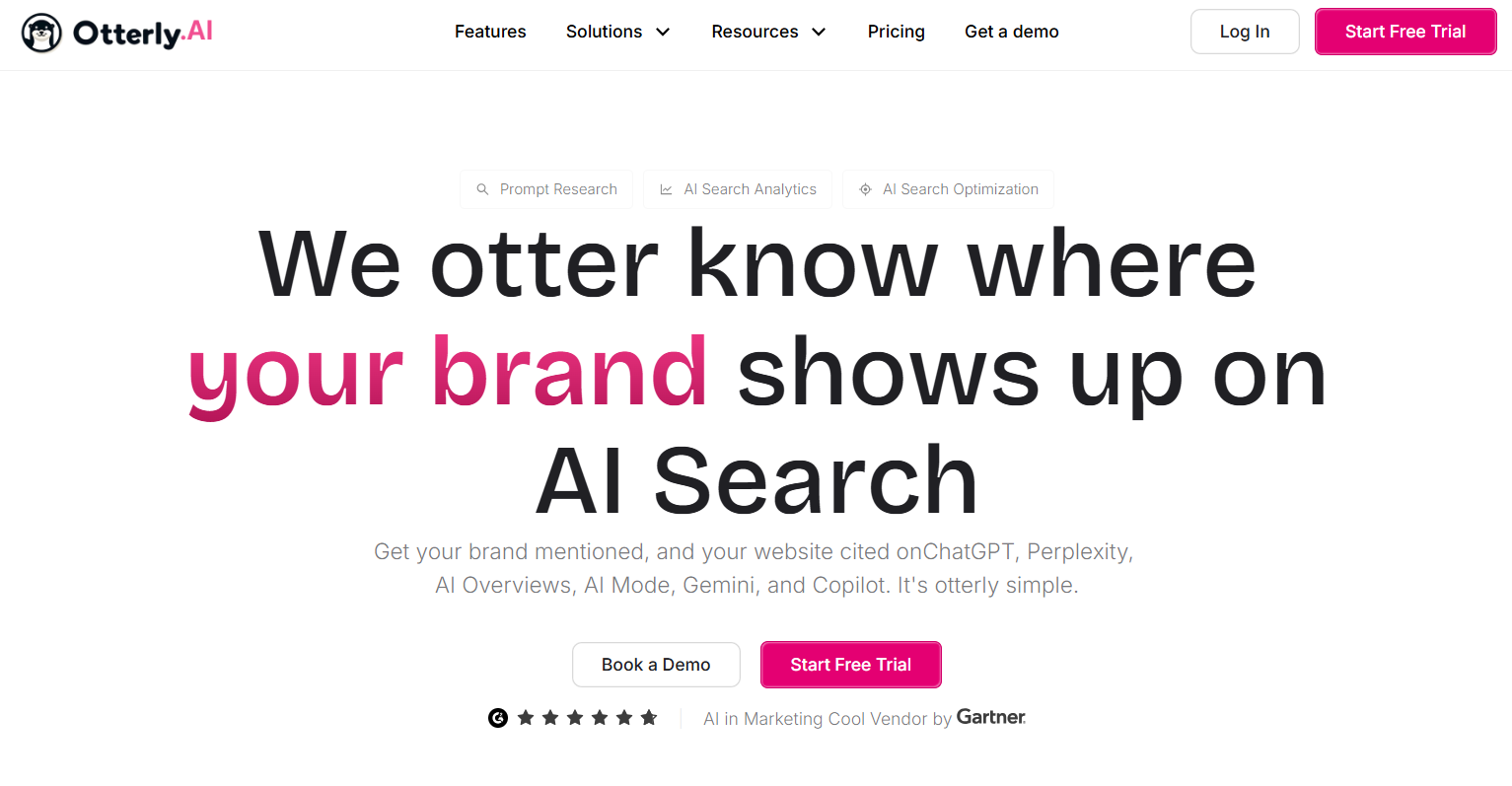
Otterly AI is built for startups, small teams, and marketers who need a simple way to track brand mentions and AI visibility across tools like ChatGPT, Perplexity, and Copilot. It focuses on lightweight monitoring of AI-generated responses, citations, and basic prompt tracking, making it easy to understand how often a brand appears in AI search outputs without complex setup or workflows.
Key Features
| Feature | Description |
|---|---|
| AI Prompt Discovery | Finds relevant prompts and queries users ask across AI platforms |
| Prompt Monitoring | Tracks AI-generated responses across tools like ChatGPT and Google AI Overviews |
| Brand Reporting | Provides insights into brand mentions, visibility, and citation sources |
| Ranking & Analytics | Monitors website rankings and tracks cited URLs across AI systems over time |
| Visibility Score | Measures overall brand presence across AI platforms and tracks performance trends |
| Sentiment Tracking | Analyzes how AI systems portray your brand (positive, neutral, or negative) |
| GEO Audit | Evaluates content using Generative Engine Optimization insights and recommendations |
| Citation Gap Analysis | Identifies missing citation opportunities and content gaps |
| Workspace Management | Allows teams to manage multiple brands or projects in one place |
| Data Export & Reports | Enables exporting of visibility, prompt, and citation data for reporting |
| Dashboard Integration | Connects data with tools like Looker Studio for custom reporting |
| Cross-Platform Tracking | Monitors brand visibility across multiple AI tools and search systems |
Pros
Easy to use, fast to set up, and suitable for basic AI visibility tracking and reporting.
Cons
Limited execution and optimisation features. Users also report data delays, increasing costs with scale, and a somewhat cluttered dashboard.
4. Goodie AI — AI Brand Sentiment, Commerce & Visibility Platform
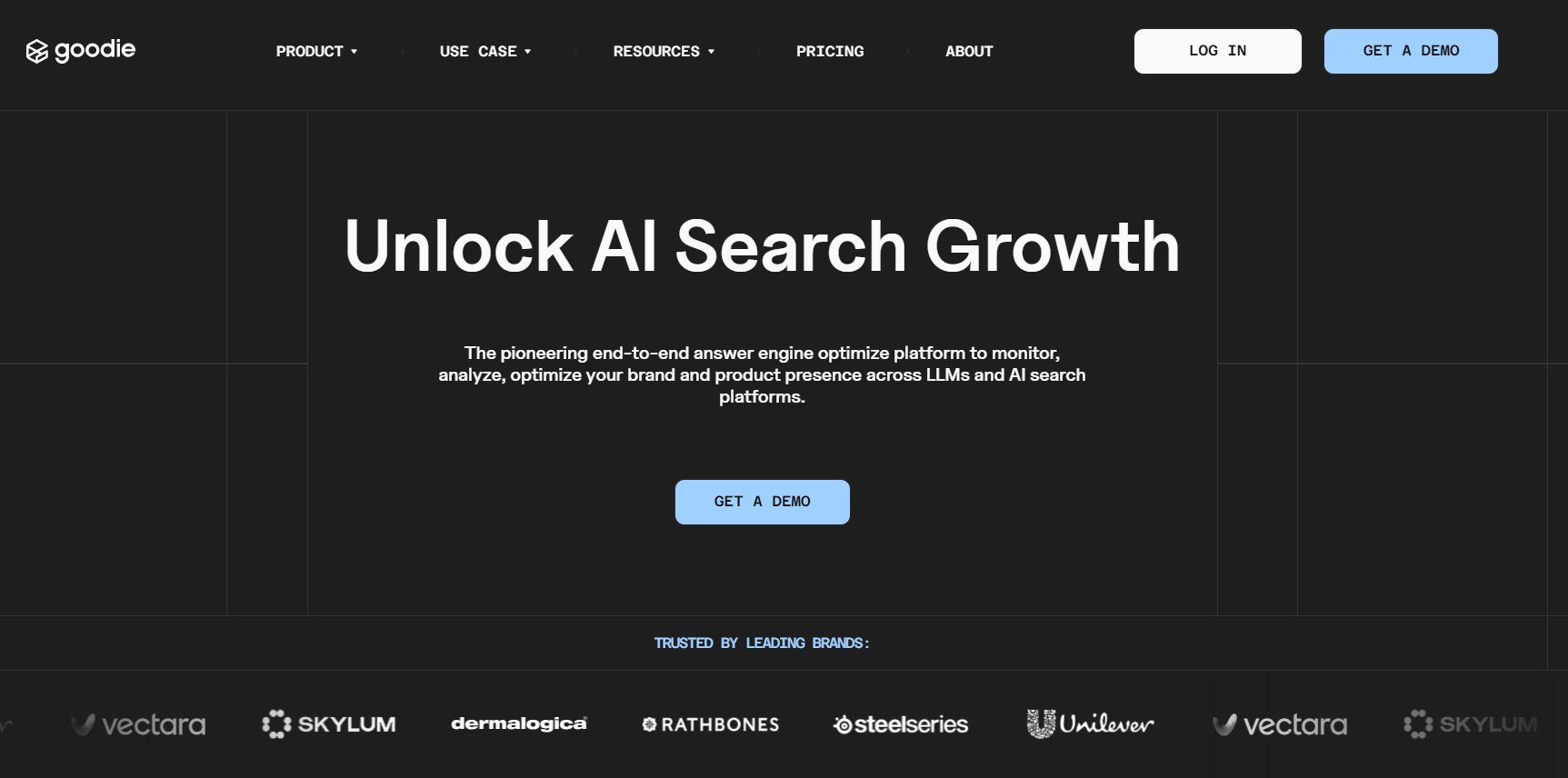
Goodie AI is an answer engine optimisation platform designed for teams that want deep visibility into how AI systems describe their brand. It focuses on AI visibility monitoring, sentiment analysis, prompt research, and AI-driven commerce insights.
The platform also combines AI crawler intelligence, visibility optimisation actions, and attribution tracking, allowing teams to identify gaps in how AI models interpret their content and take structured steps to improve brand presence.
Key Features
| Feature | Description |
|---|---|
| Prompt Research | Identifies real user prompts that customers ask AI systems |
| Agentic Commerce Suite | Provides visibility into AI-driven product discovery and shopping behaviour |
| Visibility Monitoring | Tracks how AI models describe and position a brand |
| AI Crawlers & Agents Insights | Shows how AI systems interact with and interpret website content |
| Optimization Actions | Recommends prioritized steps to close AI visibility gaps |
| Analytics & Attribution | Connects AI visibility performance to business outcomes and revenue |
| AEO Writer | Generates AI-optimized content aligned with brand voice and AI search needs |
Pros
Covers major AI platforms and provides actionable recommendations through its Optimize Agent. Also offers strong support for enterprise teams.
Cons
Still depends on traditional SEO tools for a complete strategy. Analytics may feel less granular, and pricing requires contacting the team.
5. Knowatoa — AI Search Visibility & Optimisation Platform
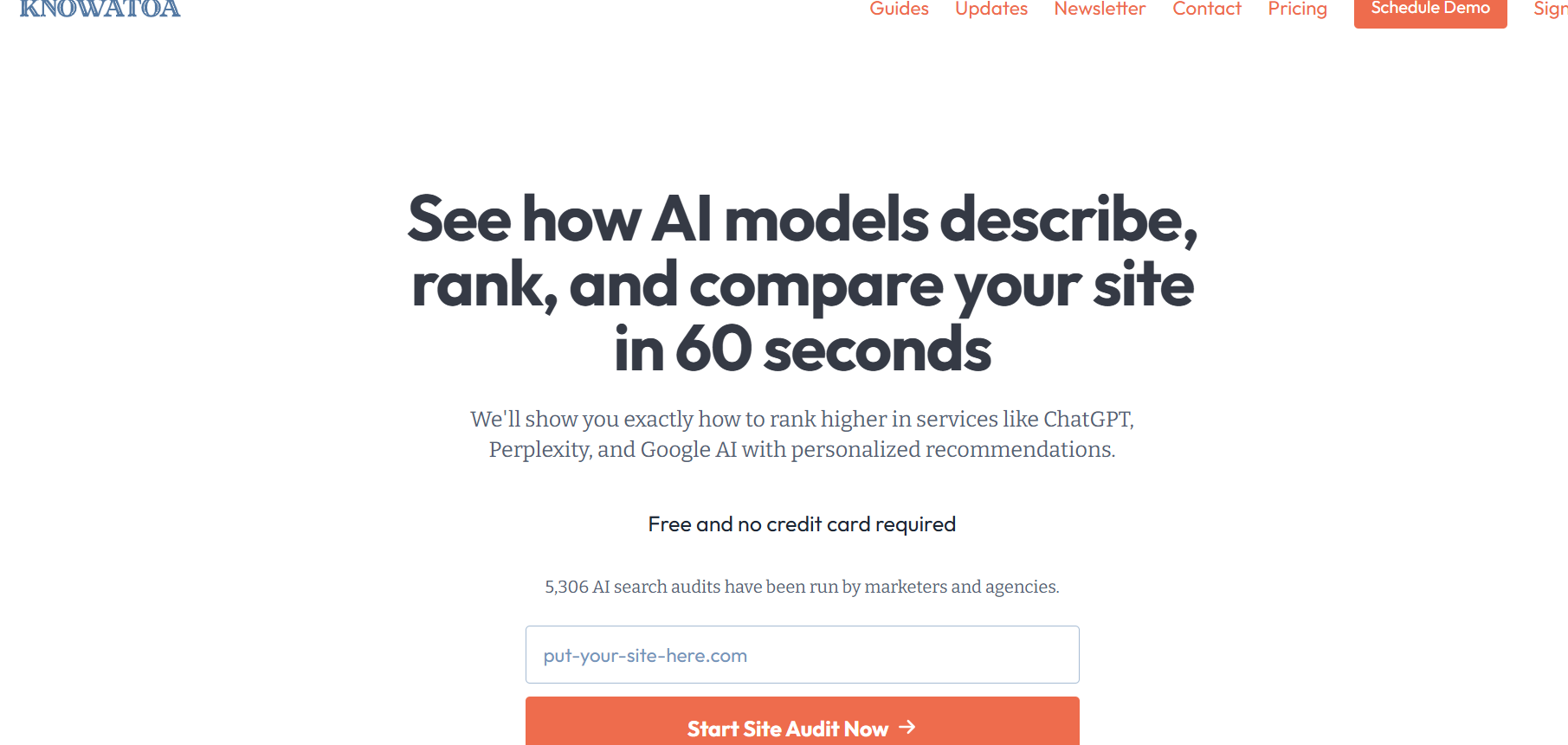
Knowatoa is built for marketing teams, agencies, and brands that want to understand and improve how they appear across AI answer engines. The platform is designed to run AI visibility audits and continuous monitoring, giving teams insight into how AI models interpret their brand, which competitors are being recommended instead, and where content gaps exist.
Key Features
| Feature | Description |
|---|---|
| AI Search Monitoring | Tracks brand visibility across ChatGPT, Claude, Gemini, Perplexity, Google AI Overviews, Google AI Mode, and Meta AI |
| AI Visibility Audits | Runs structured audits to evaluate how AI models describe a brand |
| Citation Tracking | Identifies sources AI systems use when generating responses |
| Sentiment Tracking | Analyzes whether AI mentions are positive, neutral, or negative |
| Competitor Analysis | Compares brand visibility and rankings against competitors |
| Feature Mentions | Shows which product features AI highlights or ignores |
| AI Ranking Position | Identifies where a brand appears in AI-generated recommendations |
| Keyword & Question Discovery | Finds prompts and queries that trigger AI responses |
| Historical Tracking | Tracks changes in AI visibility over time |
| Cross-Model Comparison | Compares performance across multiple AI systems |
| Recommendations Engine | Provides actionable insights to improve AI visibility |
| Location Targeting | Tracks visibility across regions and markets |
| API Access | Enables integration with external tools and dashboards |
| Data Export | Allows export of AI visibility reports for analysis |
Pros
Strong audit capabilities, historical tracking, and actionable recommendations for improving visibility over time.
Cons
Focused more on insights than execution, so additional tools may be needed for content production and scaling workflows.
6. Scrunch AI — AI Visibility & Agent Experience Platform
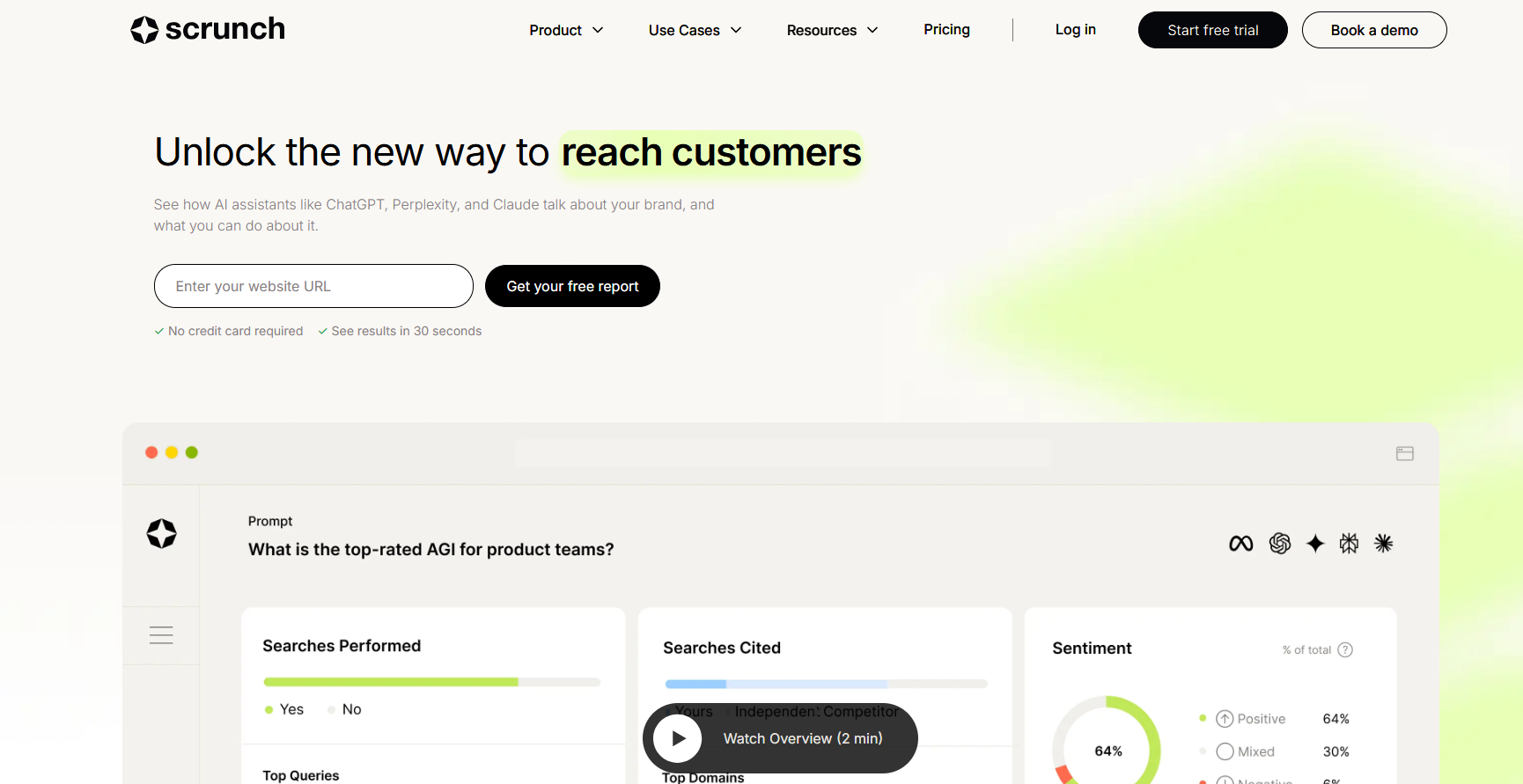
Scrunch AI is designed for teams that want to track and improve how their brand shows up across AI answer engines such as ChatGPT, Claude, Gemini, and Perplexity. It focuses on AI visibility tracking, prompt-level analysis, citation insights, sentiment evaluation, and AI crawler behaviour, helping teams understand how their brand is surfaced and interpreted in generative AI responses.
Key Features
| Feature | Description |
|---|---|
| AI Visibility Monitoring | Tracks brand presence across ChatGPT, Claude, Gemini, and Perplexity |
| Prompt Analysis | Identifies prompts that generate brand mentions in AI responses |
| Citation Insights | Shows which sources AI models rely on for answers |
| Brand Mention Tracking | Measures how often and in what context a brand appears |
| Sentiment Evaluation | Assesses tone used by AI when describing a brand |
| Competitor Benchmarking | Compares AI visibility against competitors |
| AI Traffic Insights | Studies how AI agents interact with website content |
| Agent Experience Platform (AXP) | Improves site accessibility for AI systems |
| Content Gap Analysis | Highlights missing topics affecting AI visibility |
Pros
Scrunch AI provides strong AI visibility monitoring, prompt insights, citation analysis, and AI crawler intelligence, helping teams understand how their brand is represented across generative AI systems.
Cons
More analysis-focused than execution-focused, requiring additional tools for optimisation and content workflows.
Read: Scrunch AI Review: Features, Pricing, Pros, and Cons
7. AIClicks AI — AI Search Tracking & Growth Platform
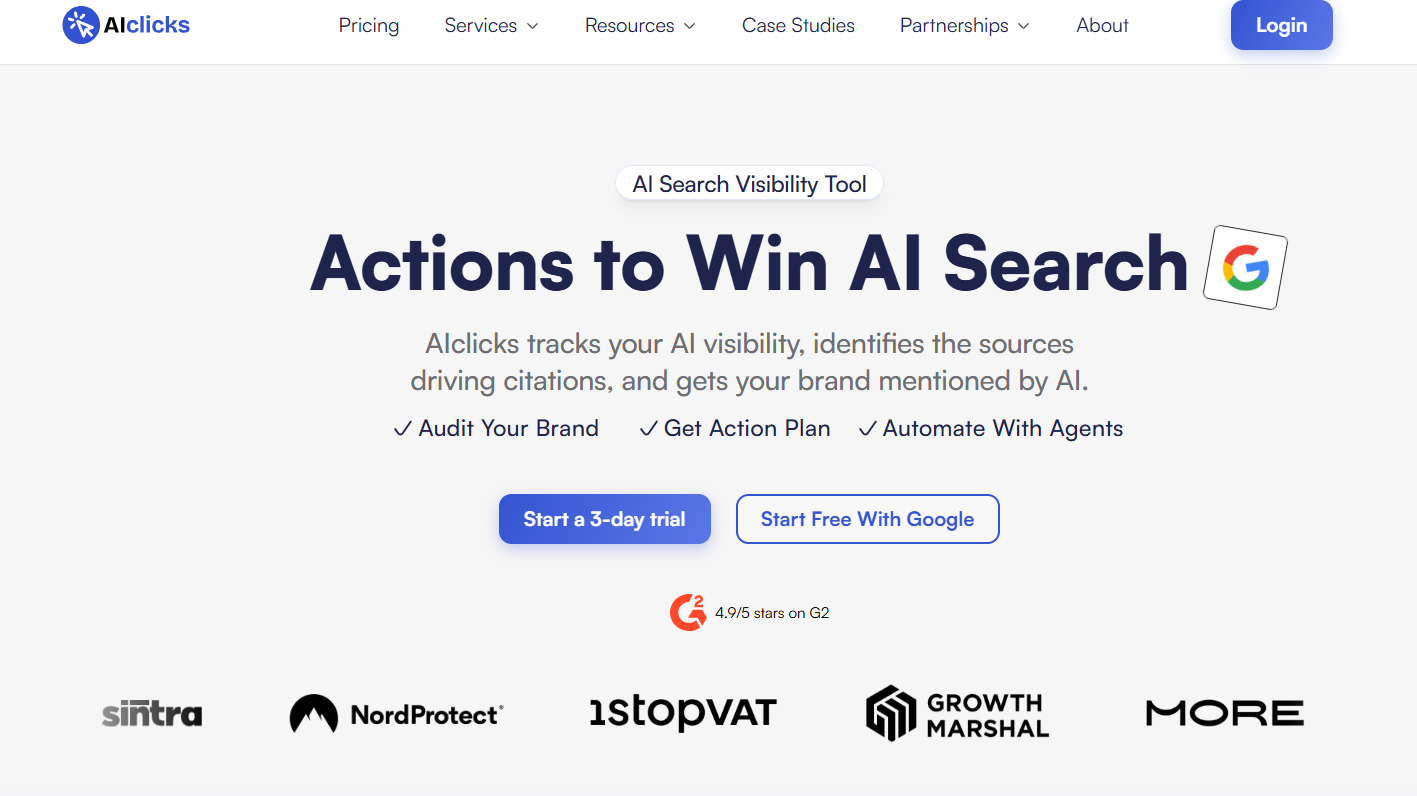
AIClicks AI is designed for teams that want to monitor and improve their visibility across AI systems. It focuses on AI visibility tracking, model-specific monitoring, SEO enhancement, and growth services.
The platform is split into two parts: self-serve tracking tools and managed growth services. This setup allows users to either independently track their brand performance across AI models or use done-for-you services such as SEO optimisation and community-driven growth strategies to improve visibility.
Key Features
| Feature | Description |
|---|---|
| ChatGPT Tracking | Monitors brand visibility within ChatGPT responses |
| Perplexity Tracking | Tracks how a brand appears in Perplexity AI |
| Claude Tracking | Measures visibility across Claude AI outputs |
| Gemini Tracking | Tracks brand presence in Google Gemini |
| AI Overviews Tracking | Monitors visibility in Google AI Overviews |
| AI SEO Optimization | Improves visibility across AI-driven search systems |
| Reddit Growth | Supports brand growth through Reddit engagement strategies |
| SEO Optimization | Enhances traditional search engine performance |
| Multi-Model Tracking | Provides visibility across multiple AI platforms |
Pros
Blends analytics with execution support, covering multiple AI models along with SEO and community-driven growth strategies.
Cons
The mix of tools and services may feel less streamlined for users who prefer a single unified platform.
8. Rank Prompt — AI SERP & Prompt Visibility Tracker
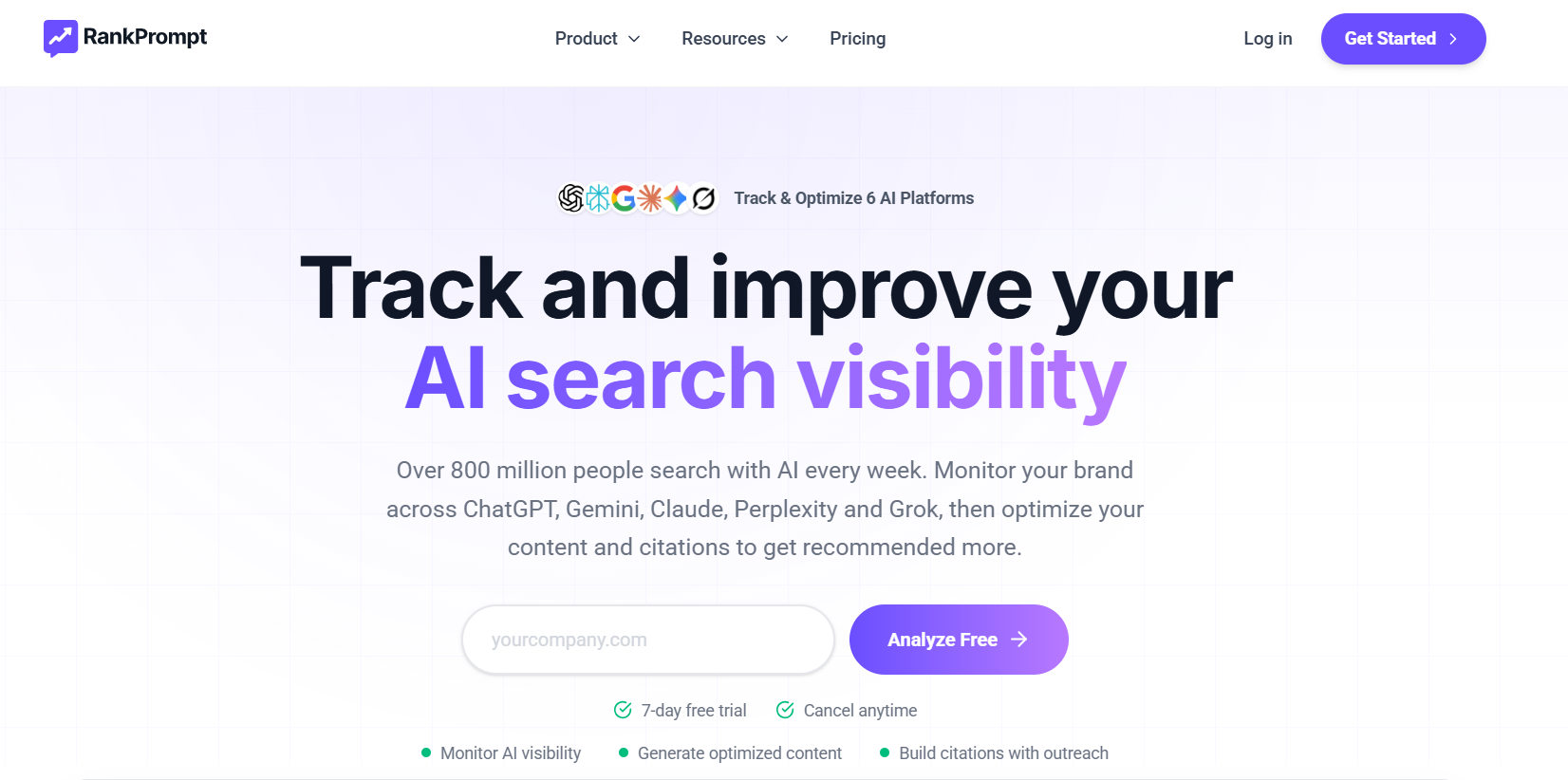
Rank Prompt is built to help users monitor how brands show up inside AI-generated search results and conversational responses across platforms like ChatGPT, Gemini, and Perplexity.
The tool is mainly used for basic AI visibility tracking and prompt testing, offering a simplified way to understand how prompts affect brand mentions and positioning in AI responses.
Key Features
| Feature | Description |
|---|---|
| AI Visibility (Brand Mentions) | Tracks where and how often your brand appears in AI-generated answers |
| Citations Tracking | Shows which sources AI models use in responses |
| Brand Audit (AI Perception) | Reveals how AI systems interpret and describe your brand |
| Analytics (GA4 Integration) | Connects AI visibility data with traffic and performance insights |
| Content Studio | Generates AI-optimized content designed to rank in AI search |
| SEO Audit (Technical + Core Web Vitals) | Analyzes and improves website performance for search and AI systems |
| Outreach (Backlinks & Prospecting) | Helps build backlinks and improve domain authority |
| Schedule (Automated Monitoring) | Automates tracking and monitoring processes |
| Tasks (AI SEO Task Management) | Organizes and prioritizes SEO and optimization tasks |
| Agent Mode (AI SEO Assistant) | Provides continuous AI-driven support for SEO and visibility |
| Integrations (GA4, GSC, WordPress) | Connects with external tools for seamless data and workflow integration |
Pros
Straightforward and useful for basic tracking and early-stage AI SEO experimentation.
Cons
Limited depth in analytics and optimisation, making it more suitable for beginners.
9. Omnia AI — Enterprise AI Visibility Intelligence Platform
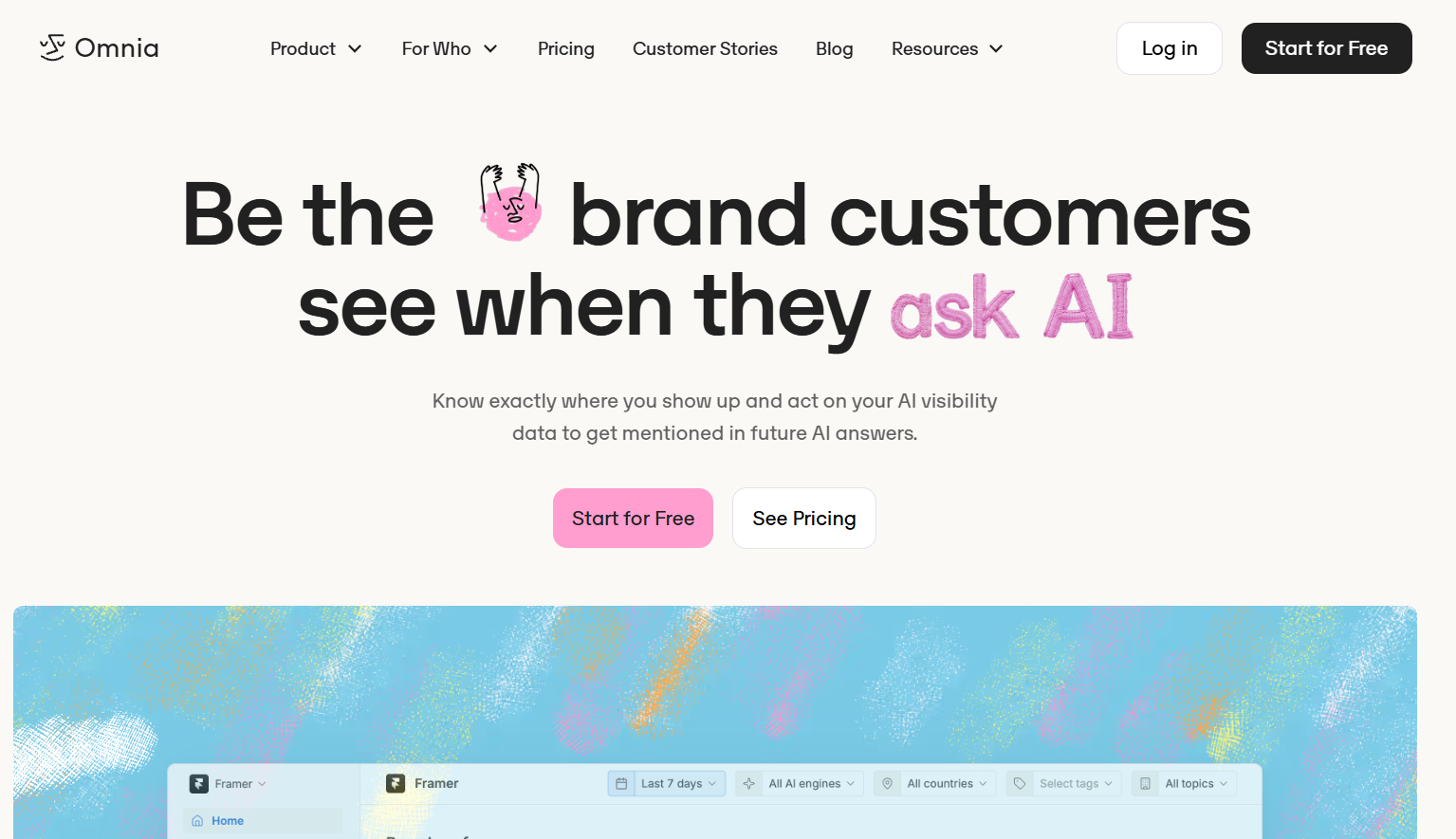
Omnia AI is designed for large organizations and enterprise teams that need advanced AI visibility tracking, competitor benchmarking, and prompt-level analytics. It focuses on monitoring brand performance across multiple AI systems, analyzing search behavior, and delivering structured visibility insights at scale.
The platform is built for multi-brand management and strategic reporting, making it ideal for companies operating across different markets and requiring centralized AI visibility dashboards.
Key Features
| Feature | Description |
|---|---|
| Enterprise AI Visibility Tracking | Monitors large-scale brand presence across AI platforms |
| Competitor Benchmarking | Compares performance across multiple brands |
| Prompt Intelligence | Analyzes high-impact AI prompts |
| Multi-Brand Dashboards | Centralized reporting across brands |
| AI Performance Analytics | Tracks visibility trends over time |
Pros
Omnia AI is strong for enterprise-level reporting, structured analytics, and large-scale competitor benchmarking across AI systems.
Cons
It is less suitable for small teams and focuses more on analytics than hands-on optimization or execution workflows.
10. GrowbyData AI — Competitive AI Visibility Intelligence Platform
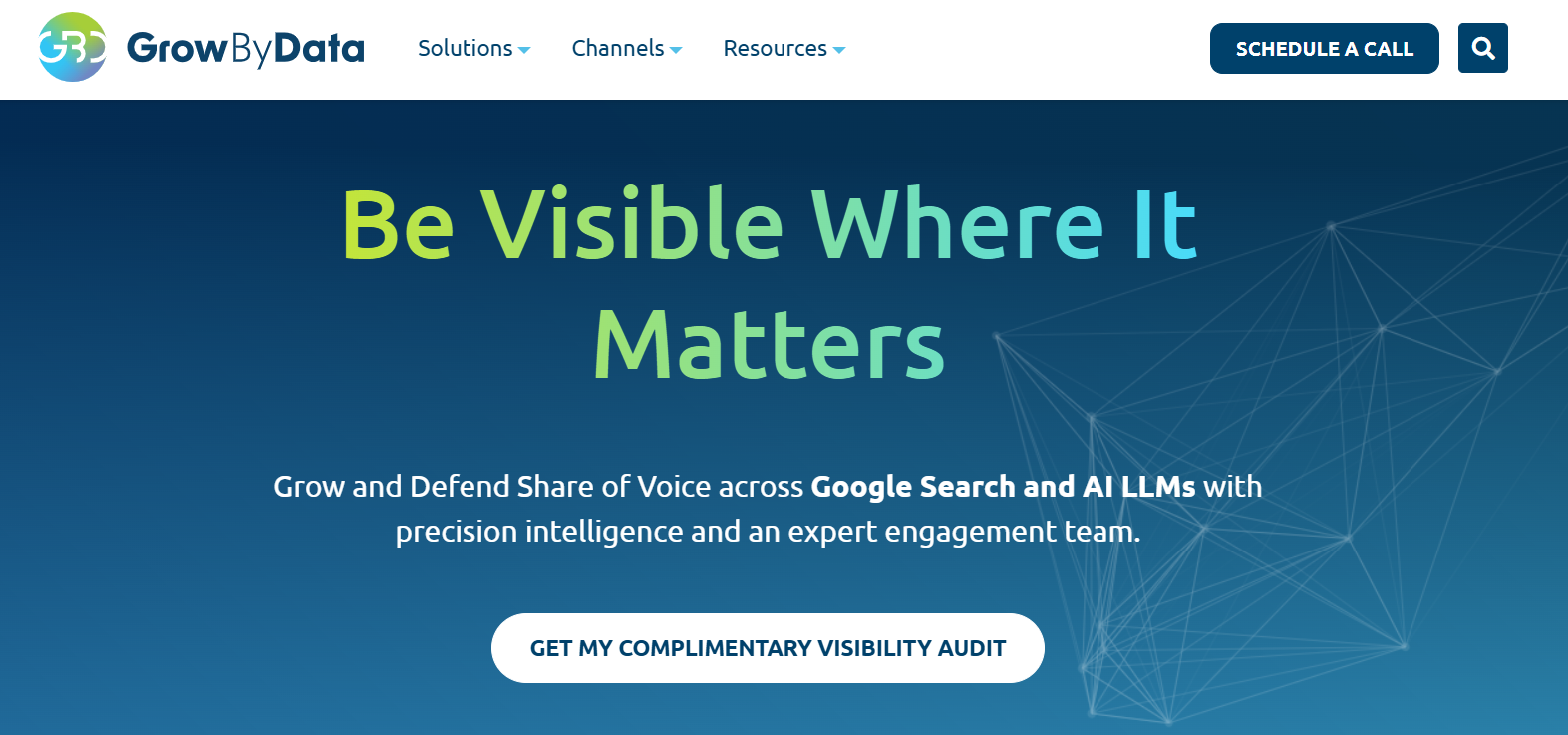
GrowbyData AI focuses on competitive intelligence within AI-driven search environments, helping brands understand how they compare against competitors in AI-generated responses. It emphasises market positioning, visibility, share tracking, and competitor insights.
The platform is especially useful for identifying which brands dominate AI recommendations and analysing why they appear more prominently.
Key Features
| Feature | Description |
|---|---|
| Competitive AI Tracking | Compares brand visibility with competitors |
| Share-of-Voice Analysis | Measures distribution of visibility across AI outputs |
| AI Ranking Insights | Shows positioning in AI-generated responses |
| Competitor Benchmarking | Evaluates performance against rivals |
| Market Positioning Analysis | Identifies gaps in AI search visibility |
Pros
Excellent for share-of-voice analysis and identifying why competitors dominate AI visibility.
Cons
Limited optimisation features, making it more insight-driven than execution-focused.
Conclusion
If you want both insights and execution, Indexly is the strongest choice, followed by AIClicks AI for a mix of tracking and growth services. For analytics and competitive tracking, tools like Rankscale, Knowatoa, and Scrunch AI work best, while Otterly AI or Rank Prompt are good for simple monitoring. GrowbyData AI stands out for competitive intelligence. For enterprise-scale needs, Omnia AI is the most suitable option.
FAQs
1. Which AI visibility tool helps improve rankings, not just track them?
Tools like Indexly and Goodie AI go beyond tracking by offering content optimisation, prompt insights, and execution features that help improve brand visibility in AI-generated answers.
2. How can I check if my brand appears in ChatGPT or Gemini answers?
You can use AI visibility tools like Rankscale, Knowatoa, or AIClicks AI to track brand mentions, rankings, and citations across platforms such as ChatGPT, Gemini, and Perplexity.
3. Why do competitors show up in AI answers instead of my brand?
Competitors often appear due to stronger content structure, better citations, and higher authority signals. Tools like GrowbyData AI and Scrunch AI help identify these gaps and improve positioning.
4. Are there tools that both track and improve AI visibility?
Yes, platforms like Indexly and Goodie AI combine tracking with optimisation features, helping teams not only monitor but also improve their presence in AI search results.
5. What is the easiest AI visibility tool for beginners?
Otterly AI and Rank Prompt are simple and beginner-friendly tools that provide basic AI visibility tracking without complex setup or advanced analytics.