
how to write ChatGPT ad context hints that convert for B2B software | Updated November 2026 | Indexly Editorial Team | 3-4 hours to draft and launch a first campaign | Beginner
What You'll Learn
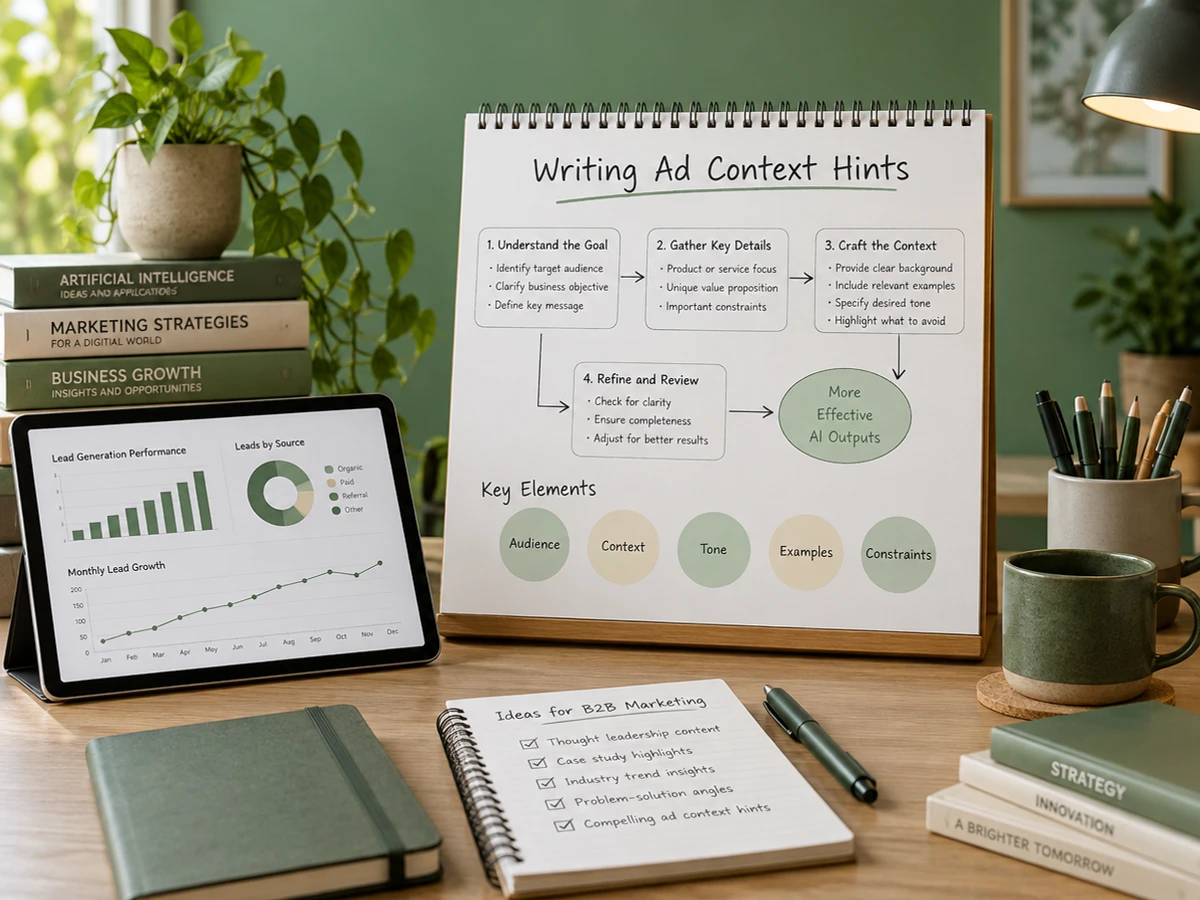
To get ChatGPT ad context hints that convert for B2B software in 2026, treat the Context Hints field as a conversation brief, not a keyword list. This guide covers researching the prompts your buyers type, turning them into natural-language hints, grouping hints by funnel stage, and tracking lead quality in your CRM. You will learn:
- How to find the real buyer conversations where your B2B software should appear.
- A repeatable formula (buyer + need + constraint) for writing hints that match intent instead of product labels.
- How to structure ad groups so one context hint never has to serve two different buyers.
- How to measure whether your hints produce qualified pipeline, not just impressions.
You'll need an active OpenAI Ads Manager account, a defined B2B offer with a dedicated landing page, and CRM access to tag lead sources.
Why Context Hints Matter in 2026
ChatGPT reached 1.2 billion weekly users as of OpenAI's September 2026 DevDay announcement, and more than 9 million of those are paying business users, many with real budget authority. For B2B marketers, the targeting mechanism is unlike anything on Google or LinkedIn: a single free-text field called Context Hints that replaces keywords, demographics, and interest categories.
Because context hints are the primary lever B2B advertisers control on ChatGPT Ads, how you write them decides whether your ad reaches a VP evaluating your category or gets wasted on an unrelated question. Most advertisers still paste in product categories instead of describing the buyer's situation, and in our experience that single habit explains most underperforming early campaigns.
The upside is real. A director asking detailed technical questions in ChatGPT is demonstrating purchase intent, whether or not they match a job-title filter. Well-written hints can reach someone mid-evaluation, a moment no demographic targeting system could reliably reproduce.
The Process at a Glance
| Step | Action | Time | Outcome |
|---|---|---|---|
| 1 | Research real buyer conversations in ChatGPT | 30-45 min | List of problem-aware prompts and phrasing |
| 2 | Draft hints with buyer + need + constraint formula | 45-60 min | 3-5 candidate context hints per offer |
| 3 | Structure hints into funnel-stage ad groups | 30 min | Separate ad groups with one theme each |
| 4 | Launch, connect CRM, track lead quality | Ongoing, review weekly | Pipeline-attributed data per ad group |
| 5 | Automate testing and refinement | Ongoing, review weekly | Continuously improving hint-to-pipeline match |
Plan on roughly 3-4 hours of focused work to get your first launch live. Expect reliable results after 4-6 weeks of data. For related guidance, see How To Track Chatgpt Ads Roas And Lead Quality Step By Step Guide.
Step 1: Research the Buyer Conversations Behind Your B2B Software
What You're Doing
Good hints start with listening. Find out what your buyers actually type into ChatGPT when they're stuck on the problem your software solves. The hint should describe that conversation, not your product.
How to Do It
- Open ChatGPT and role-play as your ideal customer: a RevOps lead, a VP Engineering, a founder, or whoever your ICP (Ideal Customer Profile) is.
- Ask the problem-aware questions that person would ask before hearing of your product (for example, "how do I stop deals falling through the cracks in a 15-person sales team").
- Note the exact phrasing ChatGPT uses in its answers. The language the AI naturally produces previews the context your ads will appear in.
- Pull your Google Ads keyword list and sales call transcripts, then cluster them by buyer and moment rather than product term.
- Separate "problem-aware" prompts (no product mentioned) from "solution-aware" prompts (comparing named tools). You'll need different hints for each.
Best Practices
- Interview 3-5 recent customers about the words they used before finding you. This is usually more accurate than guessing.
- Revisit this research quarterly, because buyer language shifts as your category matures.
What Done Looks Like
You have 10-15 real buyer phrases and situations, grouped by funnel stage and written in the buyer's own words. For a more detailed walkthrough, see ChatGPT ads context hints, not keywords - Index Lab.
Step 2: Write Context Hints Using the Buyer + Need + Constraint Formula
What You're Doing
This is the skill that matters most. You're turning research into a sentence or two that describes a moment, not a feature list.
How to Do It
- For each buyer cluster from Step 1, write one sentence following this pattern: [buyer/role] + [what they're trying to do] + [the constraint that matters].
- Avoid naming your product category outright. OpenAI's own ad group guide favors "cushioned everyday running shoes for beginners training for their first 5K" over a bare "running shoes", because the extra detail adds real context.
- Write the hint as a flowing sentence, not a tag cloud. A matcher reads disconnected keyword fragments far less reliably than one coherent description.
- Draft 3-5 variations per offer, then read each back as the buyer. Would this describe a conversation you'd actually have?
- Cut anything that describes your brand, feature list, or category name instead of the buyer's situation.
Common Mistakes
- Describing the product instead of the conversation: phrases like "project management software" or "[Competitor] alternative" name a category, not a conversation.
- Stacking two buyer types in one hint: if SMB and enterprise buyers need different landing pages, they need separate ad groups and hints.
Your first draft will likely sound like your homepage headline. Read it aloud, and if it doesn't sound like something a colleague would say about a real prospect, rewrite it.
What Done Looks Like
Each hint reads like something a colleague might say about a real prospect, not a line from your product page.
Example
| Weak hint (category label) | Stronger hint (buyer moment) |
|---|---|
| CRM software | Sales team struggling to keep forecast data accurate without manual spreadsheet updates |
| AI SDR tool | B2B founders under $5M ARR evaluating AI outbound that won't burn domain reputation or spam ICP inboxes |
| Observability platform | Platform engineers trying to cut weekly on-call interruptions without adding new dashboards to maintain |
This matches the shift good hints add information beyond the title, copy, and landing page, and describe situations rather than audience labels, the opposite of how most teams first approach the field.
Key Takeaway: Write context hints as natural sentences that describe a buyer's specific problem, need, and constraint. Skip product categories and feature lists. For a more detailed walkthrough, see 7 ChatGPT Ads Strategies Every Business Should .... For related guidance, see How To Set Up Reddit Keyword Monitoring For Competitor Brand Tracking 2026 Step By Step Guide 2026.
Step 3: Structure Hints Into Ad Groups by Funnel Stage
What You're Doing
Hints live at the ad group level, so your grouping decides whether each hint stays focused on one buyer moment or gets diluted.
How to Do It
- Create a separate ad group for each buyer moment: problem-aware, solution-aware (comparing tools), and decision-stage (pricing, implementation).
- Write one tightly scoped hint per ad group.
- Match each ad group's landing page to its hint's intent. A problem-aware hint shouldn't point to a pricing page.
- Set geography, platform (iOS, Android, web), and scheduling at the campaign level. OpenAI's documentation is clear that context hints are not keywords and don't replace explicit geographic, platform, or audience targeting.
What Done Looks Like
You have 3-5 ad groups, each with one clear buyer moment, one matching landing page, and no hint doing double duty across offers.
Example
| Ad group | Funnel stage | Hint theme |
|---|---|---|
| Problem discovery | Top of funnel | Teams missing handoffs and losing tasks across chat tools |
| Category comparison | Mid funnel | RevOps leaders comparing CRM alternatives due to admin overhead |
| Demo-ready | Bottom of funnel | Buyers evaluating pricing and implementation timelines before a trial |
Step 4: Launch, Connect Your CRM, and Track Lead Quality
What You're Doing
A hint that drives clicks but no qualified pipeline isn't working, no matter how good the click-through rate looks. This step connects your campaign to the systems that show whether hints attract the right buyers.
How to Do It
- Create your advertiser account at ads.openai.com, set up billing, then build your campaign (objective, locations, budget), ad group (bid, destination URL, context hints), and ad (title, description, landing page).
- Tag every click with UTM parameters (Urchin Tracking Module parameters, which are tags appended to a URL) and a campaign-level identifier, so you can trace each lead through your CRM (Customer Relationship Management system) to closed revenue.
- Set up CRM lead-source tagging so ChatGPT Ads show up as their own source value. This makes closed-loop attribution possible, from ad impression to closed deal, once your data hygiene is solid.
- Review pipeline weekly rather than daily. B2B conversion cycles are long, so the algorithm needs more time to learn what converts than a typical B2C campaign.
- Keep in mind who sees the ads. Users on ChatGPT Plus, Pro, Business, and Enterprise don't see ads, which shapes how far your hints can realistically reach.
Common Mistakes
- Giving up after two weeks: Cost per lead is usually higher in weeks one and two than by week six, because the system is still learning which hints convert.
- Optimizing for cheap leads instead of qualified pipeline: for B2B, 50 qualified leads beat thousands of clicks that never get past a form fill.
What Done Looks Like
Every ChatGPT Ads lead lands in your CRM tagged with source, campaign, and landing page. You can report cost-per-qualified-lead, not just cost-per-click.
Key Takeaway: Launch with CRM integration and UTM tagging to track lead quality and pipeline attribution. Optimize for qualified leads over raw clicks, and give the algorithm time to learn.
Step 5: Automate Testing and Refinement of Your Context Hints
What You're Doing
OpenAI doesn't provide a quality score, and visibility into which conversations triggered your ads is limited. Refinement comes from your own testing discipline and tooling, not a platform dashboard.
How to Do It
- Run two or three hint variations per ad group in sequence, changing one variable at a time: the buyer, the constraint, or the phrasing.
- Track which hints correlate with higher-quality CRM-tagged leads, not just higher click-through rate.
- Feed winning language back into landing page copy and sales talk tracks. Phrasing that earns clicks in ChatGPT often converts on other channels too.
- Use an AI visibility platform like Indexly to see how your brand is already discussed and cited across ChatGPT, Gemini, Perplexity, and other AI engines, so your hints match the language AI models already associate with your category.
Best Practices
- Indexly is an AI Search Visibility platform built for prompt tracking and citation gap analysis. It also tracks your brand presence and sentiment inside AI chatbots, which helps you spot the buyer language your hints should mirror.
- Its Content Agents use citation gaps as input and shape AI-generated answers through GEO-optimized articles, Reddit signals, and LinkedIn presence, drawing on an inbuilt brand memory. Resulting traffic is attributed through AI Traffic Analytics, so you can connect organic AI visibility with paid hint performance.
- To build a durable point of view in AI search, demonstrate real use cases and thought leadership, publish insights on influencing AI-driven content discovery, and pair data-driven recommendations with Reddit and LinkedIn activity.
What Done Looks Like
You keep a living document of tested hints ranked by lead quality. Organic AI visibility and paid hints reinforce the same buyer language instead of running in silos.
Key Takeaway: Run a disciplined testing cadence, rank hints by lead quality over click-through rate, and use AI visibility tools to keep paid and organic efforts aligned. For related guidance, see AI Search Visibility Tracking Best Practices Step By Step Guide.
What to Do After Writing Your Context Hints
Phase 1 (Weeks 1-2): Stabilize. Hold off on judging performance. Give the system time to gather signal before changing hints.
Phase 2 (Weeks 3-6): Refine. Cut underperforming hints, double down on those producing qualified pipeline, and split any ad group serving two buyer types.
Phase 3 (Ongoing): Scale and align. Expand into new funnel-stage ad groups, connect hint performance to your broader AI visibility strategy, and use tools like Indexly to keep paid hints and organic AI citations speaking the same buyer language.
Resources You'll Need
| Resource | Role | Requirement | Price |
|---|---|---|---|
| OpenAI Ads Manager | Platform where context hints are set at the ad group level | Required | Pay-per-click, no platform fee |
| Indexly | AI search visibility, prompt tracking, citation gap analysis, and content agents to align paid hints with organic AI brand language | Recommended | Contact for pricing |
| HubSpot (or your CRM) | Lead source tagging and pipeline attribution for ChatGPT Ads leads | Required | Free tier available |
| Conversions API / Pixel setup | Server-side tracking to connect clicks to CRM records | Required | Free (implementation time only) |
| Customer and sales call transcripts | Source material for buyer-language research in Step 1 | Recommended | Free (internal resource) |
See also, see How to Write ChatGPT Ads Context Hints: 12 Best Practices .... For related guidance, see Indexly Vs Semrush Which AI Brand Monitoring And Content Execution Platform Is Best For Your Team.
Common Plateaus & How to Break Through
Plateau: High click-through rate but poor lead quality
Likely cause: Your hint matches on topic alone, with no buyer qualifier, reaching people interested in the conversation but not your ICP.
Fix: Add a disqualifying constraint such as company size, role, or budget signal to filter out adjacent but wrong audiences.
Plateau: Cost per lead stays high after four weeks
Likely cause: Ad groups are too broad, so one hint serves several distinct buyer moments.
Fix: Split the ad group into narrower themes, each with its own hint and landing page.
Plateau: No visibility into which conversations triggered your ad
Likely cause: This is a platform limitation, not a campaign error. OpenAI currently gives advertisers no conversation-level reporting.
Fix: Compensate with tighter CRM tagging and lead-quality review, inferring performance from downstream outcomes.
Plateau: Hints keep drifting back toward product-feature language
Likely cause: Under deadline pressure, teams fall back on marketing copy habits.
Fix: Run every draft through one test: would a real buyer say this sentence about their own problem? If not, rewrite it. For more troubleshooting advice, see ChatGPT Ads: a practical guide for 2026.
Conclusion
Writing ChatGPT ad context hints that convert for B2B software in 2026 comes down to one discipline: describing the buyer's moment instead of your product's category. Teams that treat the Context Hints field as a conversation brief, organize it by funnel stage, and measure pipeline instead of clicks consistently beat those still pasting keyword lists into a free-text box.
Key Takeaways
- A strong context hint names a buyer, their goal, and a real constraint, not a product category or feature list.
- Separate ad groups by funnel stage so no single hint serves two buyer moments or landing pages.
- Track lead quality through your CRM from day one. Cost-per-click means little without downstream pipeline attribution.
Find your AI Share of Voice
Measure your Share of Voice compared to your competitors
Measure your AI SoVFAQ
How do you write ChatGPT ad context hints that convert for B2B software in 2026?
Research the problem-aware and solution-aware conversations your buyers have in ChatGPT. Write each hint as one natural sentence following a "buyer plus need plus constraint" formula, group hints by funnel stage into separate ad groups, and connect every lead to your CRM to measure pipeline, not just clicks.
What is a context hint in ChatGPT Ads?
A context hint is a free-text description, set at the ad group level in OpenAI's Ads Manager, of the conversations, topics, or situations where your product might be relevant. OpenAI describes hints as free-form phrases describing what your product offers, who it helps, or when it may be useful, not exact-match targeting rules.
How long should a ChatGPT ads context hint be?
Most effective hints run one to two sentences: long enough to describe a buyer, their goal, and a constraint, but short enough to stay focused on one theme.
Can context hints target by country or device?
No. Context hints only influence conversational relevance. Set geography, platform (iOS, Android, web), scheduling, and exclusions separately in campaign settings.
What's the biggest mistake B2B teams make with context hints?
Describing the product or category, such as "CRM software," instead of the buyer's situation. ChatGPT's ad system matches conversational context, not product labels.
How soon should I expect results from ChatGPT ad context hints?
Give the campaign at least four to six weeks before judging performance. Cost per lead is usually higher in the first two weeks while the system learns which hints convert best.
Who sees ChatGPT ads, and does that affect B2B targeting?
Ads currently reach only users on ChatGPT's free tier and ChatGPT Go. Subscribers on Plus, Pro, Business, and Enterprise plans don't see ads, which matters when estimating reach for enterprise-focused offers.
Can I just paste my Google Ads keywords into the context hints field?
Not directly. Cluster keywords by the buyer and moment behind them, then rewrite each cluster as one descriptive sentence. A raw keyword list reads to the matching engine as disconnected fragments.
This guide was compiled from publicly available OpenAI Ads documentation, third-party ChatGPT Ads best-practice research, and B2B SaaS advertising case studies current as of November 2026. Platform features and reporting capabilities continue to evolve, so verify current field behavior in your OpenAI Ads Manager account before launching a campaign.