
Last updated: June 2026 | Author: Indexly Marketing Intelligence Team | Time Required: 2–3 hours for initial setup; ongoing 2-3 hours per month | Difficulty: Beginner
What You'll Learn
If you want to track LinkedIn AI Citation Rate for your brand in 2026, this guide is for you. LinkedIn is now a major surface for AI-driven discovery. Between Jan–Feb 2026, SEMrush analyzed 325,000 prompts and found 89,000 LinkedIn URLs cited in AI responses, making LinkedIn the second-most cited domain across major AI platforms, behind Reddit. Yet most marketing teams still don’t measure whether their own brand is being cited.
This blog explains five steps: setting up prompt tracking, monitoring citation share, interpreting results, and linking citation performance to lead generation. You’ll learn how often AI tools like ChatGPT, Perplexity, and Gemini surface your LinkedIn content during buyer research.
You will:
- Build a prompt library based on real buyer queries
- Set up an automated citation dashboard (e.g., Indexly)
- Separate brand mentions from true citations
- Identify gaps, competitors, and ghost citations
- Connect citations to leads and pipeline using LLM referral tracking
Prerequisites: A LinkedIn page or profile, access to a citation tracking tool, and basic knowledge of your audience and competitors.
Why Tracking LinkedIn AI Citation Rate Matters in 2026
According to Seer Interactive’s analysis on LLM “ghost citations” and AI visibility patterns, when a brand is mentioned in an AI response, its content citation rate is significantly higher (53.1%) compared to when the brand is absent (10.6%)
This gap shows how often AI systems use your content as supporting evidence without attributing it to your brand, a phenomenon Seer defines as “ghost citations,” where your insights influence answers but competitors receive the credit.
In large-scale LLM response analysis (541,213 responses across multiple brands), Seer found that this attribution gap strongly impacts whether users associate expertise with your brand or a competitor, even when your content is the underlying source of information
This matters because AI search traffic converts significantly better than traditional organic traffic, making LinkedIn AI citation tracking essential for understanding real brand influence inside AI-generated answers rather than just website analytics.
For marketing teams, brand managers, and digital agencies focused on AI-driven lead generation, LinkedIn AI brand monitoring is no longer optional. Industry analysis shows that AI search visitors convert 4.4 times better than traditional organic traffic, meaning being mentioned in AI responses means reaching high-intent, ready-to-act users. For supporting data, see LinkedIn's AI search impact, by the numbers.
The Process at a Glance
| Step | Action | Time | Outcome |
|---|---|---|---|
| 1 | Build your LinkedIn prompt library | 45–60 min | Structured query set mirrors buyer intent |
| 2 | Set up Indexly citation tracking dashboard | 30–45 min | Automated citation monitoring is live |
| 3 | Establish your citation rate baseline | 15–20 min | Benchmark data documented by platform |
| 4 | Interpret citation share vs. competitor brands | 30 min/month | Competitive gap analysis completed |
| 5 | Connect citation data to lead generation outcomes | 1–2 hours/month | Citation-to-pipeline attribution established |
Total time to full setup: Approximately 2–3 hours for initial configuration; monthly reporting cadence of 2–3 hours thereafter.
Step 1: Build Your LinkedIn Prompt Library
What You're Doing
You are creating a structured set of queries called a prompt library that reflects how buyers use AI tools to research your category, competitors, and problems. This prompt library becomes the baseline for measuring AI visibility. Without it, you cannot reliably track whether your brand is being surfaced in AI answers.
How to Do It
- Identify your buyer's research questions. List 10–20 real questions buyers ask at each funnel stage:
- Category discovery (e.g., “best B2B demand gen tools”)
- Comparison (e.g., “how does X compare to Y”)
- Validation (e.g., “is X reliable for enterprise teams”)
- Add branded prompt variants. Seer Interactive's UX research found that up to 44% of AI prompts include brand names, so include prompts where your brand name appears explicitly. These are the prompts that matter most for purchase-stage research.
- Segment prompts by intent tier. Group your prompts into three buckets: Awareness (category-level), Consideration (comparison and feature queries), and Decision (branded and validation queries). This segmentation helps you spot which stages of the buyer journey you're strongest in.
- Add platform tags. Note which AI platforms you intend to monitor for each prompt at minimum: ChatGPT, Perplexity, and Google AI Mode, as these are the platforms where, according to SEMrush data, LinkedIn content is cited most heavily, with ChatGPT citing LinkedIn in 14.3% of responses and Google AI Mode in 13.5%.
- Aim for 25–50 prompts to start. This is enough to establish a statistically meaningful baseline without overwhelming your tracking capacity. Too few prompts and your numbers bounce around week to week. Too many and you lose focus on what actually matters to your business.
Example: Prompt Library Structure
| Prompt | Intent Tier | Branded? | Target Platforms |
|---|---|---|---|
| "Best B2B demand gen tools 2026" | Awareness | No | ChatGPT, Perplexity, Gemini |
| "How does [Your Brand] compare to [Competitor]?" | Consideration | Yes | ChatGPT, Google AI Mode |
| "Is [Your Brand] reliable for enterprise teams?" | Decision | Yes | ChatGPT, Perplexity |
| "LinkedIn AI citation tracking tools 2026" | Awareness | No | All platforms |
Best Practices
- Choose topics based on real AI queries, not internal brainstorming
- Focus on answer completeness over content volume
- Build clusters of 3–5 related topics over 4–6 weeks to establish authority signals
- Ensure every topic can realistically be answered with depth, steps, or frameworks
- Use clear named frameworks when possible, AI systems associate named methods more strongly with retrieval patterns
What Done Looks Like
You have a documented spreadsheet or prompt set within your tracking tool containing 25–50 queries, with each prompt tagged by intent tier, brand status, and target AI platform, ready for automated monitoring.
Explore: Top-ai-visibility-platforms-compared-for-linkedin-citation-tracking-2026,
Step 2: Set Up Your Indexly Citation Tracking Dashboard
What You're Doing
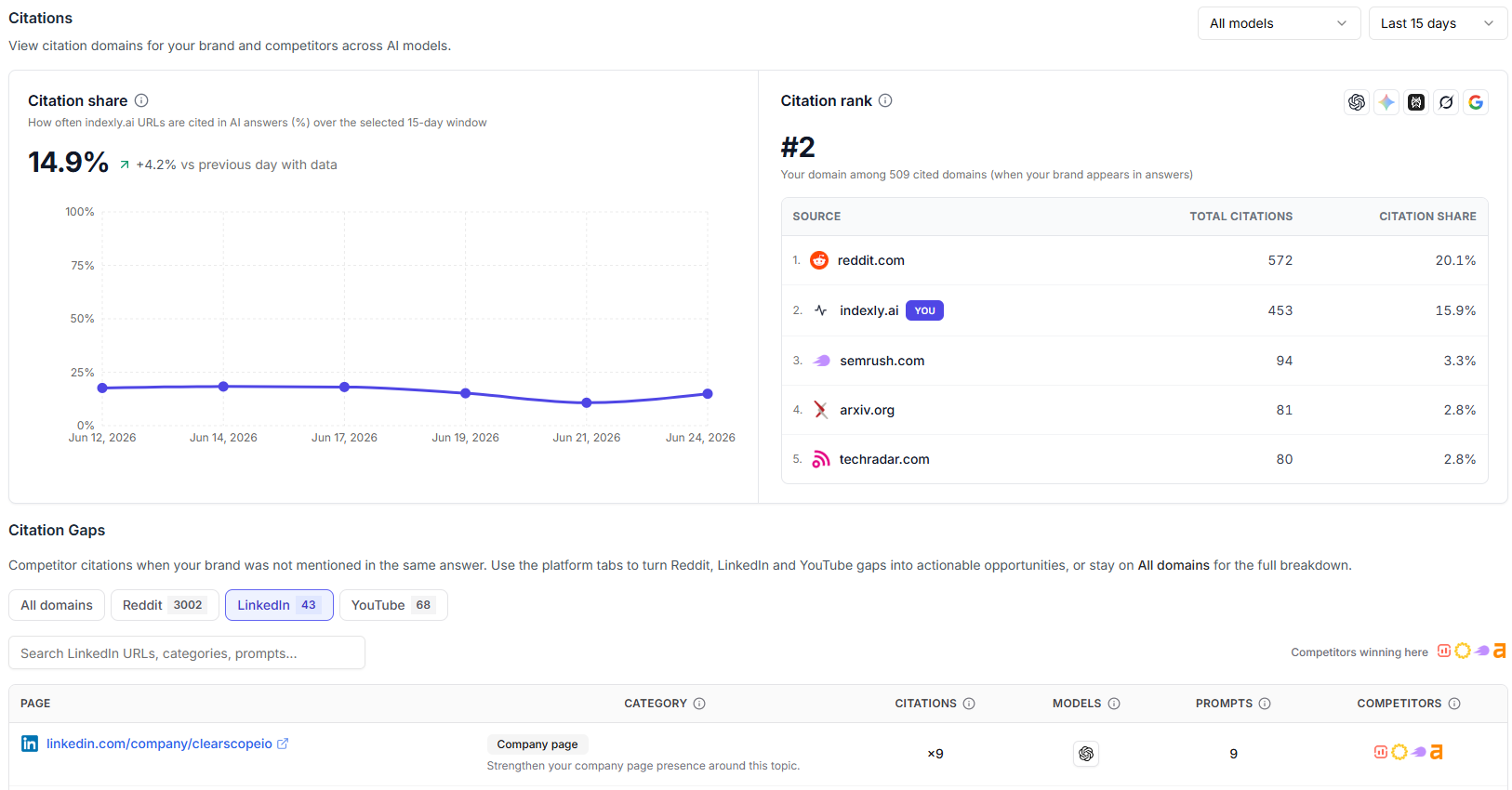
You are setting up an automated tracking system that regularly runs your prompt library across major AI platforms, checks whether your brand or LinkedIn content is cited, and displays the results in one dashboard.
This removes the need for manual testing and helps you track changes in AI visibility over time. Once configured, most of the work becomes ongoing monitoring rather than repeated manual checks.
How to Do It
- Create your Indexly account. Go to indexly.ai and set up your brand profile. Indexly helps monitor how your brand appears across AI-powered search platforms, including ChatGPT, Perplexity, Gemini, Google AI Overviews, and Grok. The platform provides visibility into brand mentions, citations, competitor performance, and AI search trends.
- Import your prompt library. With Indexly, you can track specific prompts that matter most to your business across all AI platforms. Organize prompts by topics, products, verticals, or campaigns using custom tags. Track prompt response evolution over weeks and months to identify patterns.
- Set your competitor brands.
Include two to four direct competitors in your dashboard. This allows Indexly to calculate metrics such as:
- Citation rates
- Share of voice
- Competitor positioning
- Sentiment analysis
- AI Traffic attribution
Competitor tracking provides context for your own performance and highlights areas where competitors are gaining visibility.
4.Enable AI bot analytics. In your dashboard, you can see every hit from GPTBot, ClaudeBot, PerplexityBot, and Google-Extended, which URLs they fetch, how often, and whether the answer cited you. This data shows which pages AI systems are crawling, how frequently they access your content, and which pages are most likely to be used in AI-generated answers.
5.Configure your reporting cadence. Set monthly automated reports as your baseline. Monthly monitoring is recommended for most businesses, with weekly checks during active optimization campaigns, as AI platforms update their training data regularly.
Best Practices
- Use competitor insights to understand which content and pages AI systems are citing instead of yours.
- Connect Indexly to Slack, email, or your CMS to receive alerts when significant citation changes occur.
- Use Indexly's llms.txt generation feature to help AI crawlers better understand your site's structure and preferred content.
Common Mistakes
Using fewer than 20 prompts often produces unstable results that fluctuate significantly between reporting periods.
Aim for at least 25–50 prompts to create a reliable baseline.
What Done Looks Like
Your Indexly dashboard is live with your prompt library imported, competitor brands configured, and your first automated tracking run completed, displaying initial citation rate and share-of-voice data broken down by AI platform.
Step 3: Establish Your LinkedIn Citation Rate Baseline
What You're Doing
You are documenting your current AI citation performance before making any optimizations.
This baseline acts as your "Day Zero" benchmark and gives you a reference point for measuring future improvements. Without a baseline, it's difficult to know whether your content strategy is increasing visibility or whether competitors are gaining ground.
How to Do It
- Run your first full prompt sweep. Allow your tracking tool to complete one full monitoring cycle across all prompts and all platforms before making any content changes. This is your Day Zero snapshot of performance. Do not make content changes during this initial measurement period. The goal is to capture your current performance as accurately as possible.
- Record the four core metrics for each prompt category:
- Citation Rate: Percentage of AI responses that mention your brand or cite your content.
- Citation Share: Your share of total citations compared to competitors for the same prompts.
- Platform Breakdown: Citation performance across ChatGPT, Perplexity, Google AI Mode, and Gemini.
- Citation Context: Whether your brand appears as a primary or secondary source, and if the mention is positive, neutral, or negative.
- Separate mentions from true citations. You must monitor citation rate (how often AI links to you) alongside mention rate (how often AI names you). A high mention rate with a low citation rate signals strong brand recognition but a content authority gap worth closing.
- Document your baseline in a shared report. Export your Day Zero data from your tracking tool and store it in a shared document accessible to your marketing, content, and leadership teams. You'll be comparing against this number for months, so make sure everyone knows what it is.
Example: Citation Baseline Table
| Metric | Your Brand (Baseline) | Top Competitor | Category Average |
|---|---|---|---|
| Overall Citation Rate | 12% | 31% | 18% |
| Citation Rate on ChatGPT | 14% | 38% | 21% |
| Citation Rate on Perplexity | 8% | 22% | 12% |
| Mention Rate (no link) | 28% | 44% | 30% |
| Citation Share (% of all citations) | 19% | 49% | — |
Best Practices
- Track share of voice monthly instead of weekly to reduce short-term fluctuations.
- Compare performance across platforms rather than relying only on overall averages.
- Re-measure your baseline after 60–90 days of publishing and optimization activity.
- Use competitor benchmarks to set realistic visibility goals.
What Done Looks Like
You have a documented baseline report or dashboard view showing your citation rate, citation share, and platform breakdown for each prompt category, with competitor benchmarks filled in and shared across your marketing team for alignment.
Read: how-to-get-your-linkedin-content-cited-by-chatgpt-and-perplexity-in-2026
Step 4: Interpret Citation Share vs. Competitor Brands
What You're Doing
You are analyzing your citation data to compare your visibility against competitors and understand what is driving or limiting your LinkedIn AI presence.
This step turns raw metrics into strategy by showing which content formats, topics, and publishing behaviors actually influence AI citations.
How to Do It
- Identify your ghost citation problem first. A ghost citation is when an AI engine uses your content as a source but never mentions your brand in the response text. Review your prompt responses to find these cases. These ghost citations represent content authority that is not converting to brand recognition.
- Analyze which LinkedIn content types are earning citations. Cross-reference your cited content URLs with the content format. According to the OtterlyAI study, LinkedIn articles and plain text posts are the most frequently cited content types, making up 83% of all citations.
- Examine posting frequency signals. Consistency affects citation rate. The same study found that 75% of cited authors posted five or more times in any given four-week period. AI engines index active publishers differently than dormant accounts, not just because of recency, but because frequent original posting creates more brand-attributed content to draw from.
- Map competitor citation sources. Use your tracking tool's competitor citation analysis to identify which specific LinkedIn articles, company pages, or individual profiles your competitors are citing.
- Assess content length alignment. For LinkedIn articles, the length range that attracts the most AI citations sits between 500 and 2,000 words. Compare this against your published article lengths.
Best Practices
- Engagement is not a reliable signal for citations
- Moderate engagement posts can still be highly cited
- AI citation systems prioritize content structure over likes or reactions
- Focus on original content (not reshares)
- Most citations come from original posts, not reposted material
- Audit your content mix regularly and prioritize:Original analysisCase studiesData-driven posts
What Done Looks Like
You have a monthly competitive gap report that shows your citation share versus two to four key competitors, a documented list of ghost citation instances to resolve, and a content format audit identifying which LinkedIn post types are underperforming in your AI citation data.
Read: how-to-optimize-linkedin-pulse-articles-for-ai-engine-citations.
Step 5: Connect LinkedIn Citation Data to Lead Generation Outcomes
What You're Doing
You are linking LinkedIn AI citation performance to real business results such as leads, demo requests, and pipeline. This step shifts your reporting from visibility metrics to revenue impact and shows how AI-driven discovery contributes to business growth.
How to Do It
- Track AI referral traffic in analytics (GA4 or similar) from platforms like ChatGPT, Perplexity, Gemini, and Claude using referral sources such as chat.openai.com, perplexity.ai, gemini.google.com, and claude.ai.
- Identify which pages AI engines are citing most frequently and ensure those pages have clear, friction-low conversion paths, demo CTAs, gated content offers, or contact forms, so citation-driven visitors have an obvious next step to take.
- Map citation rate changes to lead trends and look for a 2–4 week lag between increases in AI visibility and increases in inbound leads.
- Build a monthly citation-to-pipeline report combining:, Citation rate change, AI referral traffic change, and AI-attributed leads or demo requests.
- Identify which LinkedIn topics and content types generate the highest-converting AI traffic by analyzing prompt-level and content-level performance data.
Example: Citation-to-Lead Attribution Framework
| Month | Citation Rate Change | AI Referral Sessions | AI-Attributed Leads | Key Content Driver |
|---|---|---|---|---|
| Month 1 (Baseline) | — | 340 | 8 | — |
| Month 2 | +6pp | 490 | 14 | LinkedIn article series launched |
| Month 3 | +11pp | 720 | 23 | Executive thought leadership posts |
Best Practices
- Use layered measurement (analytics + citation tools + manual review) for accuracy
- Focus on conversions, not just visibility growth
- Treat AI as a discovery channel influencing top-of-funnel demand
- Compare content types to see which topics drive pipeline, not just traffic
What Done Looks Like
You have a recurring monthly citation-to-pipeline attribution report shared with leadership, showing the direct relationship between your LinkedIn AI citation rate changes and AI-sourced lead volume, with specific content drivers identified for each significant movement.
What to Do After Completing the Setup
Phase 1 — Optimize (Months 1–3): Close Your Citation Gaps
Use baseline data to find where competitors are cited, and you are not. Focus on LinkedIn articles (500–2,000 words) where your citation share is under 20%.
Write clearly structured content; AI systems mirror the language and structure of cited content. Add explicit brand mentions so your name appears in AI-generated answers, not just your ideas.
Phase 2 — Amplify (Months 3–6): Expand to Cross-Platform Authority
LinkedIn alone is not enough. Citations strengthen when your content appears across multiple sources like industry blogs, podcasts, and third-party publications.
Repurpose your best LinkedIn content into external platforms to increase AI citation surface area beyond LinkedIn.
Phase 3 — Scale (Months 6+): Build a Systematic Employee Thought Leadership Program
Named individuals drive most citations, so create a structured internal program where team members publish LinkedIn content consistently.
Troubleshooting Common Issues
Zero Citation Rate Across All Prompts
Cause: AI crawlers can’t access your content (robots.txt blocks, missing llms.txt, or reliance on reshared posts).
Fix: Run a crawlability check (GPTBot, ClaudeBot, PerplexityBot). Ensure llms.txt is set. Focus on original posts — they drive ~95% of citations.
High Mentions, Low Citations
Cause: AI recognizes your brand but prefers competitor sources due to weak content structure.
Fix: Use clear headings, bullet points, and direct-answer openings. Structured, extractable content is far more likely to be cited.
Flat Citation Growth After Posting
Cause: Content not yet indexed or format is not citation-friendly (reshares, low-depth posts).
Fix: Add publication dates, data points, and expert attribution. Expect 4–6 weeks before results stabilize.
Content Used but Brand Not Named (Ghost Citations)
Cause: AI uses your content as evidence but attributes the answer to competitors.
Fix: Embed brand name, products, and frameworks directly in the body of content. Reinforce brand-topic association across platforms, not just LinkedIn.
For more troubleshooting advice, see Your LinkedIn Content Is Getting Cited in AI Search..
Conclusion
Tracking LinkedIn AI citations is the fastest way to understand how visible your brand is inside AI-driven buyer research across tools like ChatGPT, Perplexity, and Gemini. It helps you see which content is being used, where competitors are winning, and how that visibility translates into real demand.
If you want to turn this into an ongoing system instead of manual tracking, Indexly automates the entire workflow: from prompt monitoring and citation tracking to competitor analysis and AI traffic insights, so you always know where your brand stands.
Start tracking with Indexly to build consistent AI visibility and connect LinkedIn performance directly to business outcomes.
FAQ
How do you track LinkedIn AI citation rate for your brand in 2026?
Tracking LinkedIn AI citation rate in 2026 involves building a structured measurement system around real buyer queries. Start by creating a prompt library that reflects how users search in AI tools like ChatGPT, Perplexity, and Gemini. Then run these prompts through a citation tracking tool, establish a baseline, and compare performance over time against competitors. Finally, connect AI referral signals with analytics tools like GA4 to understand how citations contribute to traffic and conversions.
What is a LinkedIn AI citation rate and why does it matter for B2B brands?
LinkedIn AI citation rate measures how often AI systems like ChatGPT or Perplexity link to or reference your LinkedIn content when answering user queries. Unlike simple brand mentions, citations show that your content is being used as a source of information. This matters for B2B brands because AI-driven discovery is becoming a major research channel, influencing vendor shortlists and purchase decisions earlier in the buyer journey.
Which AI platforms cite LinkedIn content most frequently?
Different AI platforms cite LinkedIn content at varying levels depending on how they retrieve and summarize information. ChatGPT with browsing, Google’s AI Overviews, and Perplexity are among the most likely to surface LinkedIn posts or Pulse articles when answering business-related queries.
What LinkedIn content formats get cited most by AI engines?
AI systems tend to prefer LinkedIn content that is structured, informative, and easy to extract. Long-form LinkedIn articles and well-formatted posts with clear headings, lists, and definitions are more likely to be used as sources. Content that directly answers specific professional questions performs better than promotional or vague updates. Consistency and originality also play a key role in increasing the likelihood of being cited by AI systems.
How is AI brand monitoring for LinkedIn different from traditional social listening?
AI brand monitoring for LinkedIn focuses on how often AI systems cite your content when answering user questions, while traditional social listening tracks mentions across social media and the web. Instead of scanning posts or conversations, AI monitoring runs structured prompts through tools like ChatGPT or Perplexity to measure visibility in generated answers. This makes it a more predictive metric for how your brand appears in AI-driven discovery journeys.
How long does it take to see results after improving LinkedIn content for AI citation?
Improvements in AI citation visibility typically take several weeks to become measurable because AI systems update and re-evaluate content over time. Most brands begin to see early movement within 4–8 weeks after improving content structure, clarity, and originality. For reliable trend analysis, a 60–90 day window is usually recommended to account for indexing delays and platform variability across ChatGPT, Perplexity, and Google AI Overviews.
Can small brands or individual LinkedIn profiles earn AI citations, not just large company pages?
Yes, smaller brands and individual LinkedIn profiles can absolutely earn AI citations if their content is relevant and well-structured. AI systems often surface individual-authored content because it tends to be more specific and experience-driven. This means authority is not purely tied to company size or follower count, but to clarity, originality, and how directly the content answers professional or niche queries.
Methodology: This guide was developed using primary research from SEMrush's analysis of 325,000 prompts and 89,000 LinkedIn URLs (January–February 2026), OtterlyAI's LinkedIn AI Citation Study covering 1.31 million citations across six platforms (January–June 2026), Seer Interactive's analysis of 541,213 LLM responses across 20 brands and 6 AI platforms (March 2026), and Meltwater's analysis of 9.5 million AI citations. Platform feature information reflects Indexly's published capabilities as of June 2026. Citation rates, benchmarks, and statistics are drawn from cited third-party studies and may vary by industry, content type, and AI platform model updates. This article is intended for informational and educational purposes and does not constitute a guarantee of specific citation or lead generation outcomes.