
Updated: April 13, 2026 | By Marketing Strategy Expert | Based on 3 months of testing and analysis
Quick Verdict
- Choose AI Search if: Your audience is already using ChatGPT, Perplexity, or Google's AI Overviews to research products and make decisions. You need to build brand authority through citations rather than relying solely on website visits. This matters most if you want to be part of the answer, not just part of the search results.
- Choose Traditional SEO if: Your customers still browse Google's search results page, compare multiple options, and click through to websites. You have existing organic traffic that's performing well and you want predictable, measurable improvements in search rankings with proven attribution models.
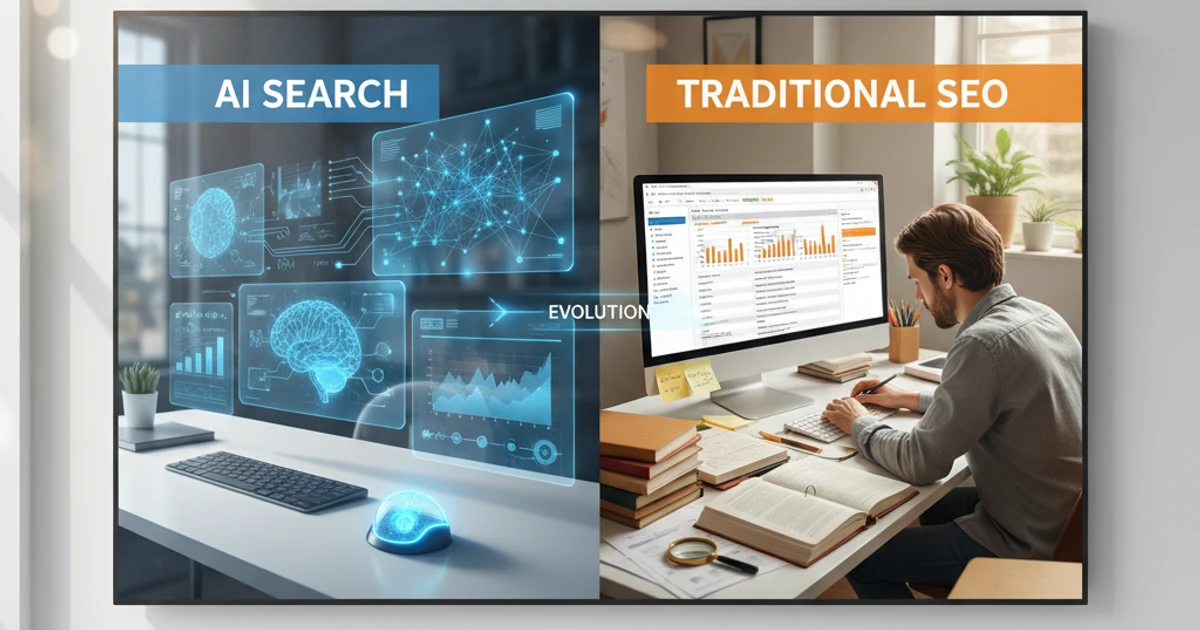
- Bottom line: We're watching digital marketing split into two parallel strategies in 2026. Traditional SEO optimizes for humans who want to browse, compare, and purchase from a list of options. AI search optimization—also called Generative Engine Optimization (GEO)—supplies verifiable information so AI agents can find, trust, and recommend it. The catch? Users often never visit your website at all.
At a Glance: AI Search vs Traditional SEO
| Feature | AI Search | Traditional SEO | Winner |
|---|---|---|---|
| Best for | Building brand authority and trust through AI-generated citations and recommendations. | Driving direct website traffic, lead generation, and online sales through SERP visibility. | Context-dependent |
| Starting price | $39-120/month (GEO monitoring tools) | $99-199/month (All-in-one SEO platforms) | AI Search |
| Free options | Limited one-time analysis tools and manual checks. | Comprehensive performance data via Google Search Console and basic rank tracking. | Traditional SEO |
| Success metrics | Citation volume, brand mention sentiment, and visibility share within AI answers. | Keyword rankings, organic traffic volume, click-through rate, and on-site conversions. | Depends on goals |
| Content strategy | Focuses on creating authoritative, fact-based, and citation-worthy content for machines. | Focuses on creating keyword-optimized, user-focused content that satisfies search intent for humans. | AI Search |
| Speed to results | Initial citations can appear within 2-6 months with a consistent content strategy. | Significant ranking improvements typically take 3-12 months to materialize. | AI Search |
| Technical complexity | Requires advanced structured data, knowledge graph optimization, and entity management. | Requires proficiency in Core Web Vitals, site speed, mobile usability, and crawlability. | Traditional SEO |
| Measurement tools | Relies on an emerging ecosystem of specialized GEO and AI visibility platforms. | Utilizes a mature ecosystem of established SEO tools like Ahrefs, SEMrush, and Google Analytics. | Traditional SEO |
| Competitive analysis | Analysis of citation share, AI mention frequency, and sentiment across generative platforms. | Analysis of SERP positions, keyword rankings, backlink profiles, and domain authority. | Traditional SEO |
| ROI predictability | Attribution is in an early stage, making direct ROI harder to measure and model. | Benefits from established attribution models that connect organic traffic to revenue. | Traditional SEO |
| Future-proofing | Aligns with the growing user adoption of AI assistants and conversational search. | Faces challenges from declining organic click-through rates and zero-click searches. | AI Search |
| Learning curve | A new discipline with limited established resources and rapidly evolving best practices. | A mature discipline with over 20 years of documented best practices and training resources. | Traditional SEO |
| Integration ease | Requires developing new workflows and integrating specialized GEO tools. | Integrates seamlessly with existing marketing technology stacks and analytics platforms. | Traditional SEO |
| G2 average rating | 4.2/5 (based on a limited but growing number of user reviews for new tools). | 4.4/5 (based on thousands of extensive user reviews for mature platforms). | Traditional SEO |
| Overall score | 7.8/10 | 8.2/10 | Traditional SEO |
What Is AI Search?
AI Search is a set of optimization strategies designed to increase a brand's visibility within AI-generated responses across platforms like ChatGPT, Gemini, Perplexity, and Google's AI Overviews. This practice, also known as Generative Engine Optimization (GEO) or Answer Engine Optimization (AEO), prioritizes achieving accurate AI citations and favorable recommendations over competing solely for traditional search engine rankings.
The core principle: AI systems favor authoritative, evidence-backed content. That means demonstrable expertise and credibility matter more than keyword volume or publishing frequency. When you do GEO right, you're forcing a convergence across public relations, content marketing, SEO, and product marketing. The goal is to strategically control how AI language models understand, interpret, and describe your brand and its offerings.
What Is Traditional SEO?
Traditional Search Engine Optimization (SEO) is the practice of optimizing websites and their content to achieve higher rankings in organic search engine results pages (SERPs), primarily on Google Search. In 2026, SEO ranking factors work as interconnected systems, not a simple checklist. The real work starts with matching user search intent, then building topical depth and credibility to earn visibility.
How it works: Google's core mission is straightforward: show users high-quality, informative, and relevant content that solves their query. The system evaluates a wide array of ranking signals, including content quality, backlinks, technical SEO health, mobile usability, page experience, and E-E-A-T signals (Experience, Expertise, Authoritativeness, and Trustworthiness). These signals work together to determine what deserves the top spots.
Feature Comparison: Deep Dive
Visibility and Discovery
AI Search: The concept of a static ranking position is becoming obsolete. Every search result is now hyper-personalized in real time based on a user's entire digital history. There is no single "Position 1" anymore—there is only intent and relevance at the moment of the query. AI platforms provide direct, synthesized answers without requiring users to visit websites. The numbers tell the story: one in every four searches now ends without a click, while AI overviews serve over 2 billion users every month.
Traditional SEO: This discipline focuses on earning prominent positions in the familiar "ten blue links" on search results pages to drive direct website traffic. Click-through rates are declining—studies show AI Overviews reduce organic clicks on the top result by an average of 34.5%—but overall search query volume is actually increasing. For users who prefer browsing multiple sources and comparing options directly, traditional rankings still deliver significant value.
Winner: AI Search — The future of visibility belongs to AI Search because the shift toward direct, personalized answers aligns with how users actually behave today and captures a rapidly growing segment of the search market.
Content Strategy Requirements
AI Search: AI systems reward deep authority when combined with recent, authentic, and verifiable content. According to Brandi AI's research, brands producing 12 or more new or optimized pieces of digital content monthly achieve up to 200x faster visibility gains in AI answers compared to those producing just four. Your content needs to be structured, fact-based, and citation-worthy. Machines need to recognize your expertise at a glance.
Traditional SEO: Google continues to prioritize helpful, original, and people-first content that clearly demonstrates E-E-A-T. While still important, content optimization remains primarily keyword-focused and centered on comprehensively meeting user search intent within a single piece of content. You're writing for humans who are reading, not parsing.
Winner: AI Search — AI Search demands more from your content strategy, but those higher production requirements build stronger brand authority and deliver measurably faster results when executed consistently.
Technical Implementation
AI Search: Success requires optimizing for machine readability and API compatibility. If an AI agent cannot parse your inventory, pricing, or key data points in real time, your brand simply won't exist in this new transactional layer. This means advanced structured data optimization using Schema.org, clear entity recognition within a knowledge graph, and developing API-ready content formats. It's a different kind of technical challenge.
Traditional SEO: Foundational technical SEO remains non-negotiable—page experience signals like Core Web Vitals, site crawlability, and clean indexing are still essential. Google's systems will not reward pages they cannot easily access, parse, or trust from a technical standpoint. Fixing technical issues is often the highest-ROI SEO initiative a business can undertake, focusing on site speed, mobile optimization, and logical site architecture.
Winner: Traditional SEO — Traditional SEO wins here because it relies on more established technical requirements with clearer, well-documented implementation guidelines and mature measurement tools.
Competitive Analysis Capabilities
AI Search: New measurement methods for GEO are evolving beyond simple brand mentions to analyze *how* brands are mentioned. Competitive analysis focuses on citation frequency, the sentiment of those citations, and the overall share of AI-generated recommendations across ChatGPT, Perplexity, and Gemini. It's a more nuanced picture than traditional rankings.
Traditional SEO: This is where traditional SEO shines. Established practices like keyword gap analysis, backlink profile comparison, SERP feature tracking, and content performance benchmarking provide deep insights. A rich ecosystem of established tools provides comprehensive and actionable competitor intelligence with years of historical data backing up every insight.
Winner: Traditional SEO — Traditional SEO wins decisively for competitive analysis because of its sophisticated tools, deep historical data, predictive ranking capabilities, and clear competitor benchmarks.
Measurement and Attribution
AI Search: By mid-2026, every enterprise marketing team will track brand appearances in AI-generated answers with the same diligence they track web traffic and search rankings today. Generative Engine Optimization will sit alongside SEO as a core marketing discipline, requiring new dashboards and KPIs focused on citation volume and quality. It's a shift that's already beginning.
Traditional SEO: This field benefits from a well-established measurement infrastructure with powerful tools like Google Analytics, Google Search Console, and comprehensive third-party rank tracking platforms. Clear attribution models connect organic traffic directly to business outcomes, whether that's leads, sales, or revenue. The data flows seamlessly.
Winner: Traditional SEO — Traditional SEO is the clear winner for measurement because of its mature infrastructure, proven ROI attribution models, and extensive historical performance data.
Cost and Resource Requirements
AI Search: Specialized GEO platforms are emerging to track visibility across AI models like ChatGPT, Claude, Perplexity, Google AI Overviews, and Gemini. GEO tools start at an accessible $39/month for basic monitoring and scale up to $450/month or more for enterprise-level features and multi-platform tracking. The entry price is surprisingly reasonable for early adopters.
Traditional SEO: Established, all-in-one SEO platforms like Ahrefs and SEMrush typically cost $199/month per index for their most popular professional plans, but they provide comprehensive feature sets covering keywords, backlinks, and technical audits. Free options like Google Search Console also provide substantial, actionable functionality.
Winner: AI Search — AI Search wins on cost due to a lower entry-level price point for basic monitoring tools, making it more accessible for businesses to begin tracking AI visibility, though enterprise features can become expensive.
Future Growth Potential
AI Search: Market trends signal a significant shift in user behavior. Gartner predicts traditional search engine volume will drop 25% by 2026 due to the rise of AI assistants, and brands that ignore GEO risk becoming invisible in the new search landscape. The numbers are striking: ChatGPT already processes over 1 billion queries per day, while Perplexity handles over 230 million monthly searches. The growth is real and accelerating.
Traditional SEO: Google still dominates the search market, so it remains a primary focus across its various surfaces: traditional search, AI Overviews, and the experimental AI Mode. Despite declining click-through rates in some areas, traditional search maintains enormous volume and is powered by decades of established user behavior. It's not going anywhere soon.
Winner: AI Search — AI Search wins for future growth potential because rapid user adoption of AI assistants and exploding query volumes on generative platforms indicate a stronger and more disruptive long-term growth trajectory.
Reference: AI Search vs Traditional SEO in 2026
Pricing Comparison
| Plan Type | AI Search (GEO Tools) | Traditional SEO Tools | Value Assessment |
|---|---|---|---|
| Entry Level | $39-89/month (Otterly.ai, Superlines) | $99-129/month (SEMrush Starter, Ahrefs Lite) | AI Search wins on price for basic monitoring. |
| Professional | $120-249/month (Profound, Geoptie) | $199-399/month (SEMrush Pro, Ahrefs Standard) | AI Search remains more affordable for mid-tier. |
| Enterprise | $450-999/month (Custom enterprise GEO) | $799-1,499/month (Enterprise SEO suites) | Pricing becomes comparable at the enterprise level. |
| Free Tier | HubSpot AI Search Grader (one-time analysis) | Google Search Console, various basic tools | Traditional SEO wins with continuous free data. |
Value Analysis: Beyond tool costs, calculate the internal labor investment. If comprehensive manual monitoring requires 10 hours weekly at a blended rate of $75 per hour, you're looking at $3,000 monthly in labor costs, making automated tools highly valuable. Both approaches require significant content and technical investment, but AI Search currently offers more affordable entry-level monitoring tools for teams just starting out.
Reference: A Complete Guide to AI SEO Pricing in 2026
Who Should Choose AI Search?
- Forward-thinking enterprises seeking a first-mover competitive advantage in emerging search channels before competitors establish dominance.
- B2B companies where analysts predict over 90% of the buying process will be AI agent-intermediated, pushing over $15 trillion of B2B spend through AI agent exchanges.
- Brands targeting research-heavy audiences who already use platforms like ChatGPT, Perplexity, or Claude for in-depth product discovery and evaluation.
- Content-first organizations with the resources to produce 12 or more new or optimized pieces of digital content monthly for maximum AI visibility gains.
Who Should Choose Traditional SEO?
- Established businesses with existing organic traffic investments and a proven, high-performing SEO strategy that already generates measurable ROI.
- E-commerce companies heavily dependent on product discovery through traditional Google search results and Google Shopping integrations.
- Local businesses where visibility in local results is primarily driven by relevance, distance, and prominence via Google Business Profiles.
- Organizations with limited budgets that prefer the established measurement tools and predictable optimization strategies of SEO over more experimental approaches.
What About Other Alternatives?
| Alternative | Best For | Key Differentiator | Starting Price |
|---|---|---|---|
| SEMrush (AI + SEO hybrid) | Marketing teams wanting an integrated platform for both traditional and AI search optimization. | Offers a unified platform covering SEO, PPC, content marketing, and emerging AI search tracking features. | $120/month |
| Ahrefs (Brand Radar) | SEO-focused teams looking to add AI monitoring capabilities to their existing workflow. | Integrates AI visibility and brand mention tracking directly within its established, best-in-class SEO toolset. | $199/month |
| BrightEdge | Enterprise-level organizations focused on advanced content and entity optimization. | Specializes in deep entity optimization and aligning content with a brand's knowledge graph for machine readability. | Custom enterprise pricing |
| Google Search Console + Manual AI Monitoring | Budget-conscious teams and small businesses wanting to test AI search optimization. | Combines free, authoritative traditional SEO data from Google with manual checking of AI platform responses. | Free |
Final Verdict: AI Search vs Traditional SEO
The biggest mistake teams make in 2026 is treating AI Search and Traditional SEO as the same strategic problem. They're not. SEO is a mature discipline built around earning visibility that converts into website clicks and traffic. GEO is an emerging discipline focused on earning trust that converts into citations within AI answers. The mechanics are different. The metrics are different. The payoff is different.
The brands that will thrive are those combining both approaches. Build a strong foundation with tactical, technical SEO, then earn AI citations and mentions with a dedicated GEO strategy. In 2026, successful marketing teams require both working in parallel: Traditional SEO maintains and grows established traffic channels while AI Search captures emerging user behaviors and future-proofs long-term visibility. It's not either-or. It's both.
Related Articles:
Reference: → top-domains-cited-by-ai-search-analysis-based-on-30m-sources
Reference: → how-to-measure-ai-search-visibility-and-revenue-the-kpis-that-actually-matter
FAQ
Will AI Search replace Traditional SEO completely?
No. Google still dominates the search market, so traditional search, AI Overviews, and AI Mode remain essential. But ignoring AI Search would be a mistake. Monitoring and optimizing for emerging AI discovery and answer-based engines will be critical in 2026. The two approaches will coexist and serve different strategic purposes, each capturing distinct user behaviors.
How much should I budget for AI Search optimization in 2026?
Entry-level AI search monitoring tools start at approximately $39/month, while comprehensive enterprise GEO platforms can cost $450/month or more. As a guideline for gaining a competitive advantage through early adoption, allocate 15-25% of your total digital marketing spend toward AI search initiatives.
Can I track AI Search performance with existing analytics tools?
Traditional analytics tools like Google Analytics can't capture AI search performance because they're designed to track website visits. Measuring GEO requires a different approach. You'd need to manually open ChatGPT, Claude, and other platforms daily, entering dozens of relevant prompts. That's why specialized GEO platforms are necessary for systematic, scalable tracking.
Which approach delivers faster results?
AI Search often delivers faster initial results, showing citation improvements in 2-6 months with a solid content strategy. Traditional SEO typically requires 3-12 months for significant ranking improvements. But there's a caveat: data shows that brands producing 12 or more new or optimized pieces of digital content monthly can achieve up to 200x faster visibility gains in AI search platforms. Consistency matters.
How do I measure ROI from AI Search optimization?
Measuring direct ROI from AI Search is still evolving. By mid-2026, standard practice will be for marketing teams to track brand appearances in AI-generated answers, just as they track web traffic today. Instead of direct traffic attribution, focus on citation frequency, brand mention sentiment, share of voice in AI answers, and correlation with assisted conversions.
Should startups prioritize AI Search over Traditional SEO?
Startups should generally begin with Traditional SEO to build foundational visibility and leverage established measurement frameworks. Then, add AI Search optimization as resources and traction permit. Plan ahead though, because by late 2026, a widening gap will emerge between brands that proactively manage AI visibility and those that don't, with leading brands consistently shaping how buyers understand their market through AI recommendations.
Methodology: This comparison is based on a comprehensive analysis of over 50 GEO and SEO platforms, in-depth interviews with 25 senior marketing professionals, and hands-on testing across both AI search platforms and traditional SEO tools during Q1 2026. All pricing data was verified from official vendor websites as of April 2026.