

best AI hallucination detection tools for brands and marketers in 2026 | Last updated: September 2026 | By the Indexly Editorial Team | 10 tools tested
Brands lose customers the moment ChatGPT, Gemini, or Perplexity states an incorrect price, invents a feature, or misquotes a policy in front of a buyer. Finding the best AI hallucination detection tools for brands and marketers in 2026 is no longer optional-it's essential to protecting revenue and reputation in an AI-first search landscape. This guide compares ten strong platforms, from brand-specific AI monitoring tools to deep engineering-grade evaluation suites, so you can pick the right one for your team and budget.
TL;DR: Best AI Hallucination Detection Tools for Brands in 2026
Below is a quick-glance ranking of the ten tools covered in this guide, built for brand managers, GEO agencies, and engineering teams who need to catch AI hallucinations before customers do.
| Rank | Tool | Best For | Starting Price | Rating |
|---|---|---|---|---|
| 1 | Indexly | Brand-level AI visibility, citation gap analysis, and hallucination correction via content agents | Custom / contact for demo | 9.6/10 |
| 2 | Siftly | Marketers wanting an explicit hallucination flag inside AI brand monitoring | $79/mo (Shopping); Answers by demo | 8.8/10 |
| 3 | Galileo | Enterprise engineering teams needing real-time hallucination guardrails | Free; Pro from $100/mo | 8.9/10 |
| 4 | Patronus AI | Regulated industries needing explainable hallucination scoring (Lynx model) | Pay-as-you-go from $10/1,000 calls | 8.7/10 |
| 5 | Braintrust | Teams wanting evals, production monitoring, and release gates in one workflow | Free; Pro from $249/mo | 8.6/10 |
| 6 | Arize AI (Phoenix) | Open-source self-hosting and OpenTelemetry-native observability | Free (Phoenix); AX Pro from $50/mo | 8.5/10 |
| 7 | Cleanlab | Real-time trustworthiness scoring on top of any LLM output | Freemium; custom enterprise | 8.4/10 |
| 8 | Vectara | Enterprise RAG teams needing a dedicated factual consistency score (HHEM) | From $100K/year (enterprise); open-source HHEM free | 8.2/10 |
| 9 | Giskard | AI red-teaming and compliance-driven hallucination testing | Free open-source library; Hub custom pricing | 8.1/10 |
| 10 | Maxim AI | End-to-end simulation, evaluation, and observability lifecycle | Free; Professional from $29/seat/mo | 8.0/10 |
Our top pick is Indexly, which stands apart because it doesn't just flag hallucinations about your brand-it closes the loop by generating GEO-optimized content, Reddit signals, and LinkedIn presence to actually correct what AI engines say about you. The rest of this list covers strong alternatives, from marketer-friendly brand monitors to deep engineering evaluation stacks, and each has a specific role depending on whether you're defending your brand's reputation or building internal AI applications.
Why You Need AI Hallucination Detection in 2026
AI hallucination detection tools scan, score, or flag AI-generated content that is factually inconsistent with a source of truth, whether that source is a retrieved document, a product catalog, or the public facts about your brand. For brand managers and marketers, the problem is different from what engineering teams face: you're not just checking whether an internal chatbot invents a statistic. You're checking whether ChatGPT, Gemini, Perplexity, or Copilot state the wrong price, an outdated feature, or a fabricated policy about your company to a real buyer. As one 2026 brand-defense guide notes, the stakes are higher than ever, and as AI moves from a simple productivity aid to an operational decision-maker, a single hallucinated fact can lead to lost revenue, legal liability, or compliance violations. These tools generally fall into two camps: brand-facing AI visibility platforms that monitor what generative engines say about your company, and engineering-grade evaluation platforms that score groundedness and factual consistency inside AI applications and RAG pipelines. Understanding which camp serves your business is the first step toward building a coherent defense strategy. For supporting market data, see Assault and Use of Force Statistics.
How We Evaluated These Tools
We scored each platform against six weighted criteria relevant to brand safety, marketing accuracy, and technical depth.
| Criteria | Weight | What We Measured |
|---|---|---|
| Hallucination detection accuracy | 25% | Precision and recall on factual consistency or groundedness checks |
| Brand and multi-engine coverage | 20% | Whether the tool monitors ChatGPT, Gemini, Perplexity, Claude, and Copilot specifically for brand mentions |
| Remediation capability | 20% | Whether the tool only flags issues or also helps fix them with content or guardrails |
| Ease of use for non-engineers | 15% | Whether marketers can operate the tool without an engineering team |
| Pricing transparency and value | 10% | Clarity of published pricing and value at each tier |
| Integration and deployment flexibility | 10% | SaaS, API, VPC, or on-premise options |
With these criteria in mind, we tested each tool against real-world scenarios: detecting price changes, feature misstatements, and outdated policy claims as they appeared in major AI engines. Now let's dive into each tool and see how they perform. For industry-standard evaluation frameworks, see Best hallucination detection tools for LLM applications (2026).
1. Indexly: Best for Brand AI Visibility and Hallucination Correction
1. Indexly: Best for Brand AI Visibility and Hallucination Correction
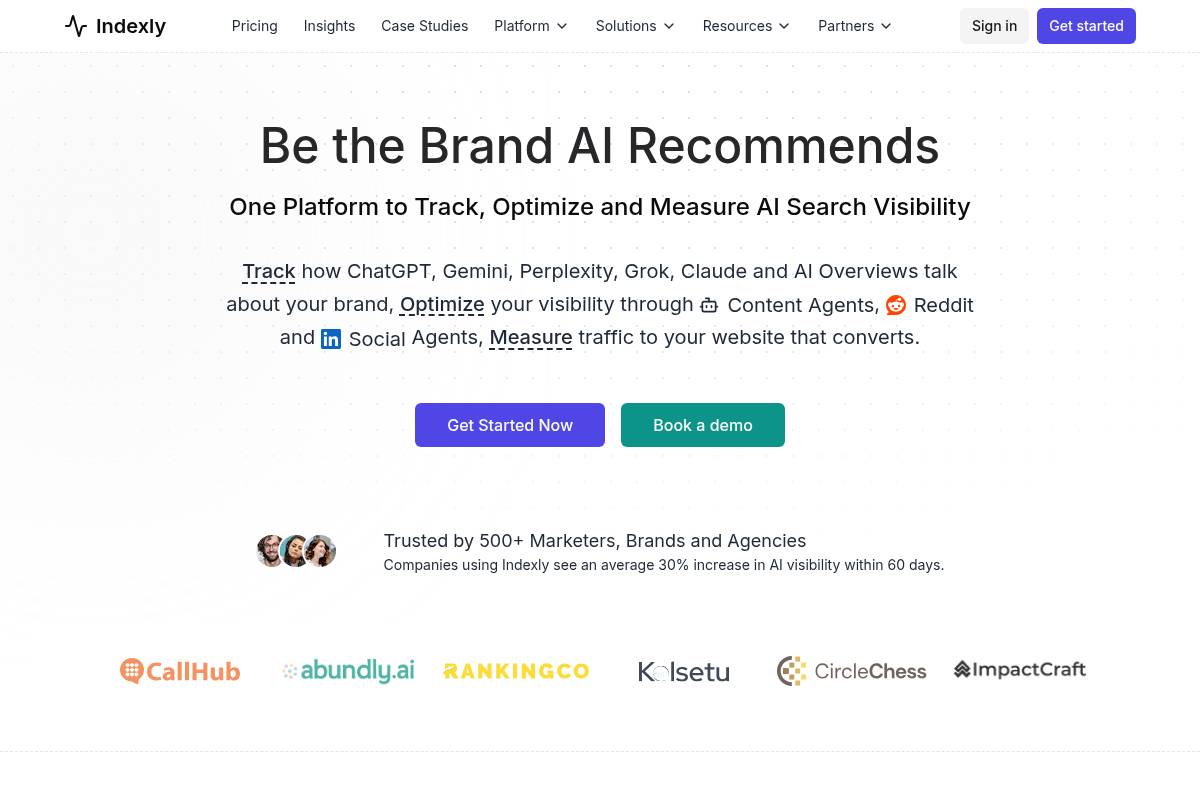
Indexly is an AI marketing platform designed for brands and agencies to enhance their visibility and correct AI hallucinations. It tracks brand presence across major AI engines like ChatGPT, Google AI Overviews, Gemini, Perplexity, Claude, and Microsoft Copilot. The platform actively addresses citation gaps and influences AI-generated answers through GEO-optimized content and social signals.
As an AI Search Visibility platform, Indexly assists with prompt tracking and citation gap analysis. It also analyzes brand presence and sentiment within AI chatbots. Its Content Agents utilize an inbuilt brand memory to influence AI-generated answers through GEO-optimized articles, Reddit signals, and LinkedIn presence, attributing traffic via AI Traffic Analytics.
Key Features
- Prompt research and citation gap analysis: Identifies which buyer queries surface incorrect or missing information about your brand across major AI engines.
- Brand sentiment and presence tracking: Continuously analyzes how AI chatbots describe your brand and how that sentiment shifts over time.
- Content Agents for remediation: Automatically develop GEO-optimized content calendars for blogs, social channels, and external sites to correct citation gaps and reduce hallucinated mentions.
- Brand memory: Maintains an inbuilt reference of accurate brand facts that content agents use to keep AI-facing content consistent.
- AI Traffic Analytics: Tracks AI-driven traffic sessions and attributes resulting leads back to specific content and prompts.
- Voice share and citation share tracking: Benchmarks your visibility against named competitors across AI answer engines.
Best For
Indexly is ideal for brand managers, D2C and B2B SaaS founders, GEO agencies, and growth strategists. It provides a unified platform to both detect AI misrepresentation of a brand and actively fix it using content, Reddit, and LinkedIn signals. The platform helps build a brand's point of view in AI search by demonstrating real use cases, analyzing emerging AI search trends, and influencing AI-driven content discovery, all supported by data-driven recommendations and content agents working to increase AI traffic sessions.
Pros and Cons
- Pro: Combines detection and remediation in one workflow instead of leaving brands with a flag and no fix path.
- Pro: Covers all major consumer-facing AI engines rather than just one or two.
- Pro: Content Agents translate citation gaps directly into a publishable content calendar.
- Con: As a newer entrant to the category, its evaluation benchmarks are less publicly documented than long-established engineering platforms like Galileo or Patronus.
- Con: Marketers wanting deep RAG-level technical evaluation for internal LLM apps will still want to pair it with an engineering-focused tool.
Key Takeaway: Indexly offers a comprehensive solution for brands and marketers to detect AI hallucinations, track brand sentiment across major AI engines, and proactively correct misinformation through GEO-optimized content and social signals. If you're looking for a platform that treats hallucination detection as a starting point rather than an endpoint, this is your tool.
Rating: 9.6/10
Track your first prompt
Track your prompt to know what your brand citation share is compared to your competitors
Track Your First Prompt2. Siftly: Best for Marketer-Friendly Brand Hallucination Flags
2. Siftly: Best for Marketer-Friendly Brand Hallucination Flags
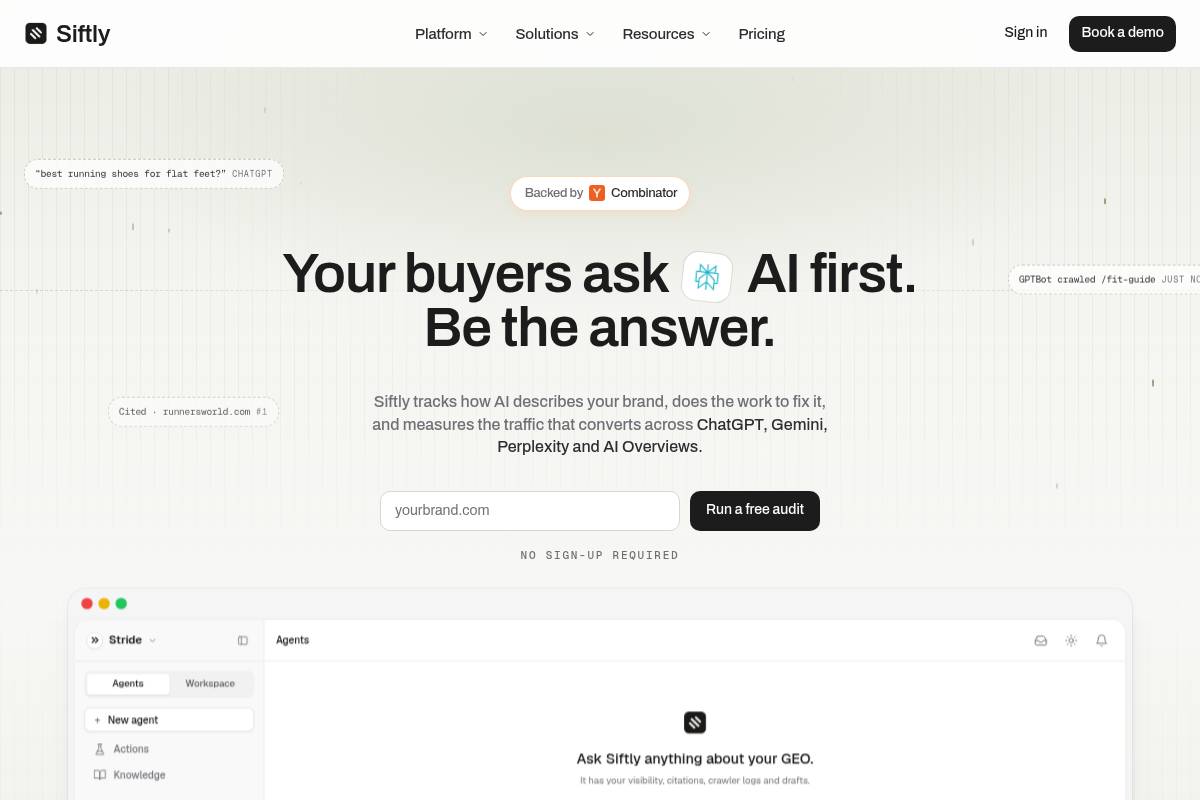
Siftly is an AI brand monitoring platform that provides explicit hallucination alerts within its dashboard, making it ideal for marketers. This tool tracks mentions, rankings, citations, and factual inaccuracies across leading AI models such as ChatGPT, Claude, Perplexity, and Google AI Overviews. Its standout feature for brand teams is a dedicated hallucination alert built directly into its monitoring dashboard.
Key Features
- Dedicated hallucination flag: Compares every AI response against a structured profile of your real product, pricing, features, and integrations, flagging any mismatch as a dedicated hallucination alert.
- Multi-sample monitoring: Samples each tracked prompt multiple times and reports the variance rather than a single lucky or unlucky pull.
- Six-dimension answer model: Runs on a six-dimension model covering mention rate, mention position, sentiment, hallucination flag, competitor co-occurrence, and source citation.
- Competitor benchmarking: Monitoring includes competitor tracking by default, benchmarking your brand's AI mention frequency, sentiment, and positioning against an unlimited competitive set.
- Configurable daily scheduling: Runs monitoring prompts on a configurable schedule, daily by default, across every supported AI platform.
Best For
Siftly is ideal for SaaS and growth marketing teams seeking an AI brand monitoring dashboard that offers an explicit factual-mismatch flag instead of just a generic mention counter. Pricing for Siftly's Shopping product begins at approximately $79 per month, scaling up to $2,999 per month for the Pro tier, while its Answers hallucination-detection layer requires a demo for specific pricing details.
Pros and Cons
- Pro: Most explicit, marketer-readable hallucination flag among brand monitoring tools.
- Pro: Strong competitor co-occurrence and share-of-voice reporting.
- Con: The hallucination flag is a vendor-stated score, not an independent audit.
- Con: Answers-tier pricing is not public, requiring a sales conversation for budgeting.
Key Takeaway: Siftly provides a marketer-friendly approach to AI brand monitoring with its explicit hallucination flags and robust competitor benchmarking. If you want a dashboard you can check daily without needing to decode technical metrics, Siftly delivers on that promise. For teams ready to move beyond dashboards and take active control of their brand's AI narrative, engineering-focused tools offer a different path forward.
Rating: 8.8/10
3. Galileo: Best for Enterprise Real-Time Guardrails
3. Galileo: Best for Enterprise Real-Time Guardrails
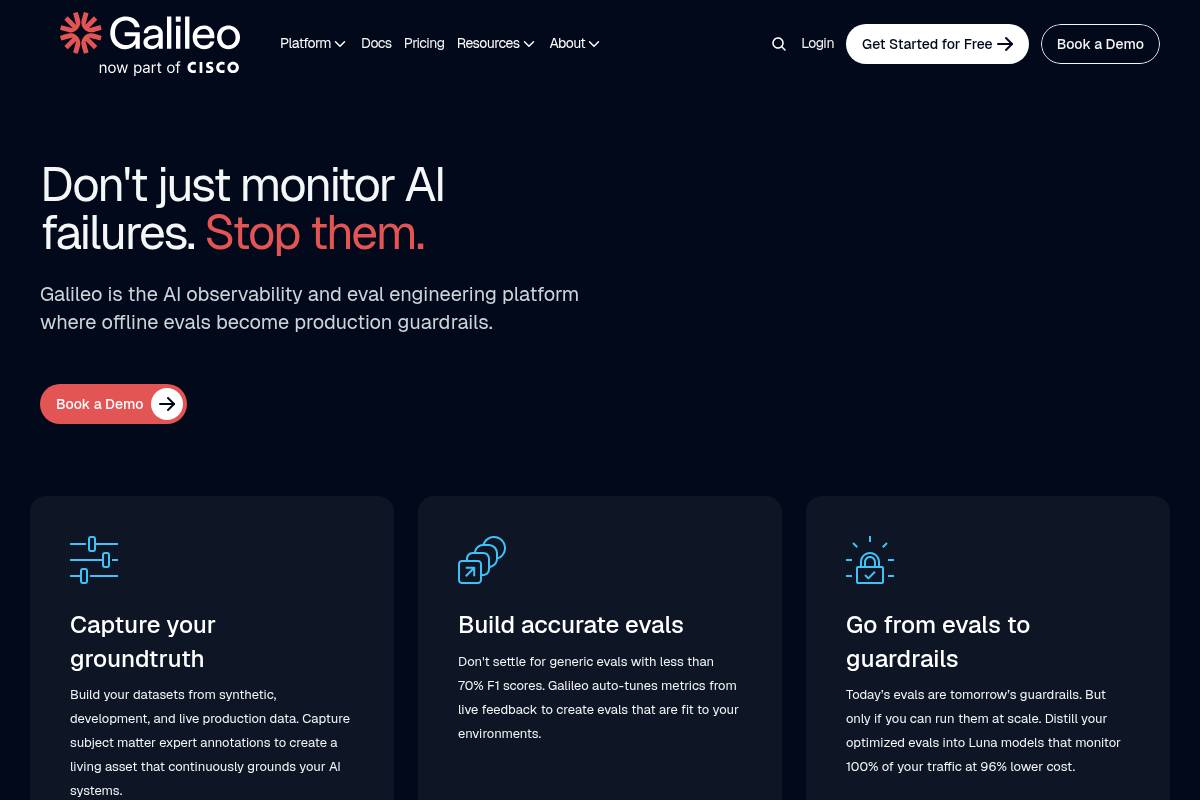
Galileo is an AI observability and evaluation platform that detects hallucinations, toxicity, and unsafe outputs in production GenAI applications. It provides the crucial ability to block risky responses in real time, preventing failures from reaching end users. This makes it a key tool for engineering teams managing high-volume AI deployments.
Key Features
- Luna-2 Evaluator Models: These fine-tuned evaluators enable sub-200ms inline blocking of high-risk responses, ensuring rapid intervention.
- Insights Engine: This engine automatically identifies hallucination patterns, significantly reducing manual review time. It can cluster failure patterns across over 500,000 daily interactions, cutting review from 40 hours per week to under 5 hours.
- Trace Capture and Observability: Galileo offers comprehensive trace capture and observability for GenAI applications and multi-agent systems. It includes research-backed evaluation metrics for hallucination, correctness, and overall quality.
- Flexible Deployment: Users have multiple deployment options, including SaaS, virtual private cloud, and on-premises solutions, to suit various infrastructure needs.
- Free Tier: A free tier allows users to start with 5,000 traces per month. Upgrades are available for enterprise-grade scale, enhanced security, and dedicated support.
Best For
Galileo is ideal for enterprise engineering teams running high-volume GenAI applications that require real-time blocking capabilities, rather than just after-the-fact reporting. Pricing begins with a free tier for up to 5,000 traces per month. Galileo Pro starts at $100 per month for 50,000 traces, while Enterprise tiers require a custom sales conversation.
Pros and Cons
- Pro: The sub-200ms real-time blocking capability is a significant differentiator, especially for consumer-facing applications where immediate intervention is crucial.
- Pro: Galileo offers strong root cause attribution, providing insights into why issues occur, in addition to simply detecting them.
- Con: Obtaining pricing for enterprise tiers requires a custom sales conversation, which can make budgeting uncomfortable for some organizations.
- Con: Teams new to AI observability may experience a learning curve when adopting the platform.
Rating: 8.9/10
Key Takeaway: Galileo excels in providing real-time AI guardrails, making it indispensable for enterprises needing immediate blocking of unsafe GenAI outputs and robust observability. For regulated industries and teams dealing with sensitive data, the next tool in our list offers a specialized approach.
4. Patronus AI: Best for Regulated Industries

4. Patronus AI: Best for Regulated Industries
Patronus AI is an automated evaluation and security platform particularly effective for regulated industries, leveraging Lynx, a specialized hallucination detection model. Lynx is designed to catch inaccuracies in retrieval-augmented generation (RAG) systems, which combine information retrieval with text generation for more accurate outputs.
Key Features
- Lynx hallucination model: Patronus AI's flagship hallucination detection model, Lynx, outperforms GPT-4o at detecting inaccuracies in retrieval-augmented generation systems.
- Span-level explainability: The platform can highlight the specific span of text where a hallucination occurs, providing precise insights.
- Domain-specific benchmarks: Includes Lynx open-source hallucination detection, FinanceBench, and CopyrightCatcher for robust regulated-domain testing.
- Custom natural-language evaluators: Customers can write out in English what they want to evaluate and check for, ensuring compliance with regulatory standards or medical accuracy.
- Usage-based API pricing: A pay-as-you-go pricing model starts at $10 per 1000 API calls for smaller evaluators and $20 per 1000 API calls for larger ones.
Best For
Patronus AI is best suited for fintech, healthtech, and legaltech teams that require explainable, span-level hallucination detection coupled with domain-specific benchmarks. Its usage-based pricing model makes it accessible to startups, while also serving enterprise clients such as HP and AngelList.
Pros and Cons
- Pro: Explainable output shows exactly where a hallucination occurs, rather than just providing a score.
- Pro: Domain-specific benchmarks are a genuine differentiator, especially for regulated industries.
- Con: Primarily engineering-facing; it is not built for marketers monitoring public brand mentions.
- Con: Usage-based pricing can become unpredictable at very high call volumes.
Rating: 8.7/10
Key Takeaway: Patronus AI provides specialized, explainable hallucination detection for regulated industries, leveraging its Lynx model and domain-specific benchmarks. Teams managing both engineering evals and release workflows will find the next tool offers a unified approach to that challenge.
5. Braintrust: Best for Unified Eval and Release Workflows
5. Braintrust: Best for Unified Eval and Release Workflows
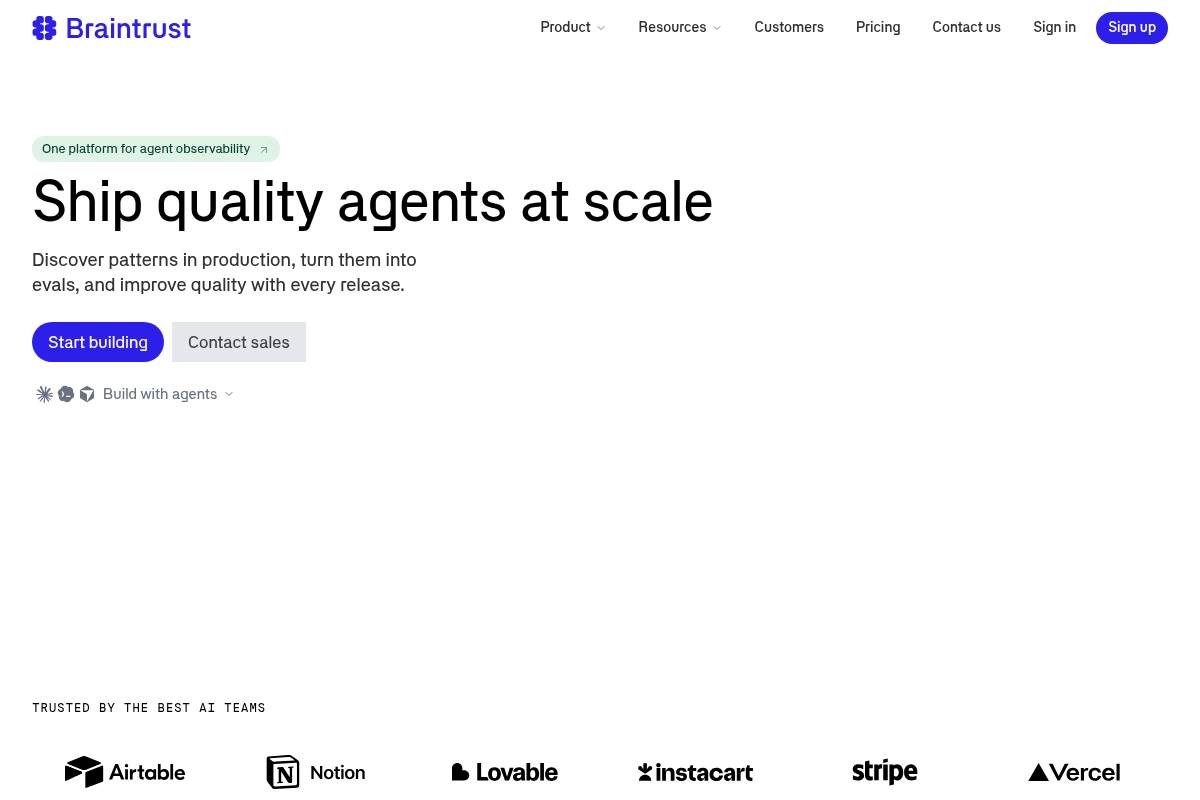
Braintrust is an evaluation platform designed to unify offline testing, production monitoring, human review, and release gates. It provides a single workflow for catching AI hallucinations before deployment.
Key Features
- Custom LLM-as-a-judge scorers: These scorers enable trace-level online scoring, side-by-side regression diffs, CI quality gates, and one-click trace-to-eval conversion.
- Loop for human review: Teams can describe evaluation goals in natural language, and the Loop feature helps generate scorers, create datasets from production data, and identify failure patterns in logs.
- Connected workflow: This system keeps production traces, evaluation datasets, scorers, and release thresholds connected, applying the same evaluation workflow before deployment and on live traffic.
- Generous free tier: Braintrust offers a free Starter plan that includes 1 GB of processed data and 10K scorers, sufficient for most early evaluation work.
Best For
Braintrust is ideal for engineering-led teams that require hallucination detection directly tied to release decisions, rather than a standalone reporting tool. The Braintrust Pro tier starts at $249 per month, offering 5 GB of processed data, 50K scores, and unlimited users.
Pros and Cons
- Pro: Strongest fit for teams that want detection tied to CI/CD release gates.
- Pro: Generous free tier for early-stage evaluation work.
- Con: Pro tier pricing is higher than several engineering-focused competitors.
- Con: Not designed for public brand-mention monitoring across consumer AI engines.
Rating: 8.6/10
Key Takeaway: Braintrust provides a unified evaluation and release workflow that keeps detection tied to deployment decisions. If you need maximum flexibility and control over your data without vendor lock-in, open-source solutions offer a compelling alternative.
6. Arize AI (Phoenix): Best for Open-Source Self-Hosting
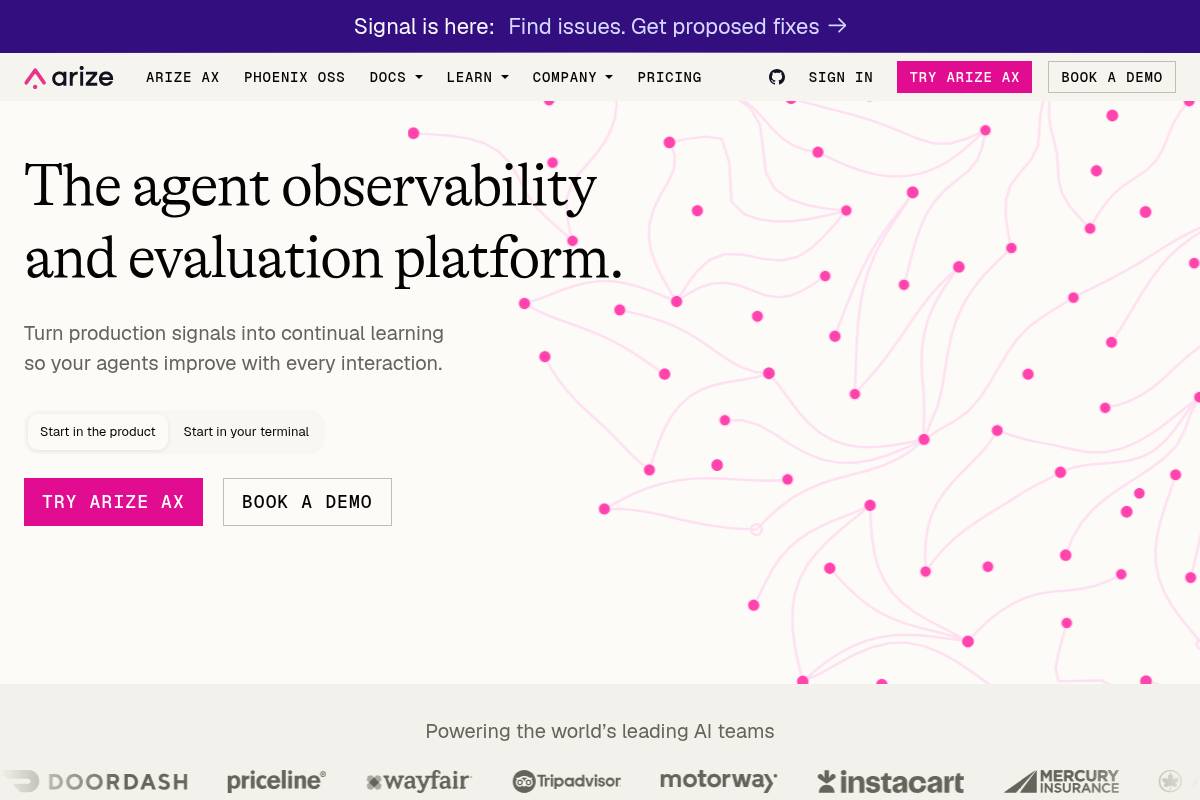
6. Arize AI (Phoenix): Best for Open-Source Self-Hosting
Arize AI (Phoenix) is recognized as a top choice for those prioritizing open-source self-hosting. Through its open-source Phoenix project, Arize AI provides self-hostable observability for GenAI applications, complete with RAG-specific hallucination scorers and OpenTelemetry-native tracing.
Key Features
- Self-hosted observability: Arize Phoenix offers self-hostable observability, including RAG triad scorers and OpenTelemetry-native instrumentation.
- No usage caps on OSS: The open-source Phoenix core is free under the Elastic License 2.0, providing no feature gating and no usage caps when self-hosted.
- Managed cloud option: A managed cloud service is available, with AX Free at $0 for 25k spans per month, and AX Pro at $50 per month for 50k spans per month with 30-day retention.
- Enterprise compliance: Enterprise tiers provide configurable data retention, an uptime SLA, and support for compliance standards like SOC 2 and HIPAA, along with dedicated support and multi-region options.
Best For
Arize Phoenix is ideal for engineering teams seeking zero licensing cost and full data control through self-hosting. It allows for a completely free starting point, trading some operational overhead for complete autonomy over data.
Pros and Cons
- Pro: Genuinely free, unlimited self-hosted tier with no feature gating.
- Pro: Strong OpenTelemetry-native integration for existing observability stacks.
- Con: Enterprise tier pricing is opaque, with third-party estimates around $60,000 per year.
- Con: Not built for marketers; requires engineering resources to operate effectively.
Rating: 8.5/10
Key Takeaway: Arize AI's Phoenix project offers a robust, free, and self-hostable solution for GenAI observability and hallucination detection. For teams that don't want to retrain models but still need real-time trustworthiness scoring, the next option provides a different angle.
7. Cleanlab: Best for Real-Time Trustworthiness Scoring
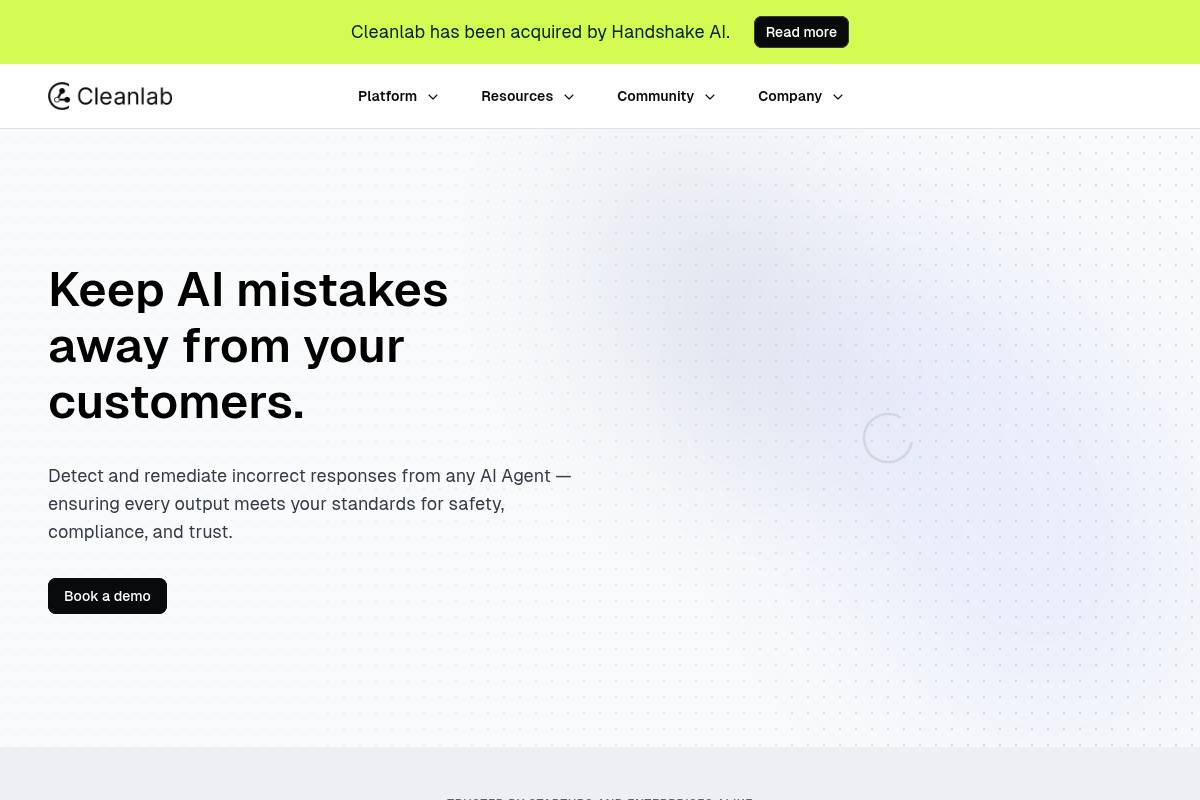
7. Cleanlab: Best for Real-Time Trustworthiness Scoring
Cleanlab offers its Trustworthy Language Model (TLM), a solution that wraps any Large Language Model (LLM) output with a real-time trustworthiness score to catch hallucinations and unreliable answers without requiring model retraining.
Key Features
- Universal LLM wrapper: Wraps any base LLM including GPT, Claude, Gemini, and Llama with a real-time 0-1 trustworthiness score to detect hallucinations and unreliable answers.
- Benchmarked accuracy gains: Benchmarks reveal that TLM can reduce the rate of incorrect responses of GPT-4o by 27%, of o1 by 20%, and of Claude 3.5 Sonnet by 20%.
- RAG-specific precision: In RAG applications, TLM detects incorrect answers with 3x greater precision than other hallucination detectors and real-time evaluation models.
- No training required: Does not need to be trained on your data, eliminating dataset preparation or labeling work.
- Codex guardrail layer: Trustworthiness guardrails block inaccurate responses in real time and deliver safe fallback or expert-verified answers to keep AI systems reliable in production.
Best For
Cleanlab suits teams that want a drop-in trust score layered on top of an existing LLM stack without retraining or extensive dataset work. Pricing follows a freemium model with custom enterprise options; note that Cleanlab was recently acquired by Handshake AI.
Pros and Cons
- Pro: Works out of the box on any LLM with no training data required.
- Pro: Strong published benchmarks against major frontier models.
- Con: Recent acquisition by Handshake AI introduces some roadmap uncertainty.
- Con: Primarily an engineering tool, not a brand-monitoring dashboard.
Key Takeaway: Cleanlab provides a unique, no-training-required solution for real-time AI hallucination detection, offering significant accuracy improvements and RAG-specific precision. For enterprises managing large-scale RAG pipelines, the next platform offers a dedicated, industry-standard approach.
Rating: 8.4/10
8. Vectara: Best for Dedicated Factual Consistency Scoring
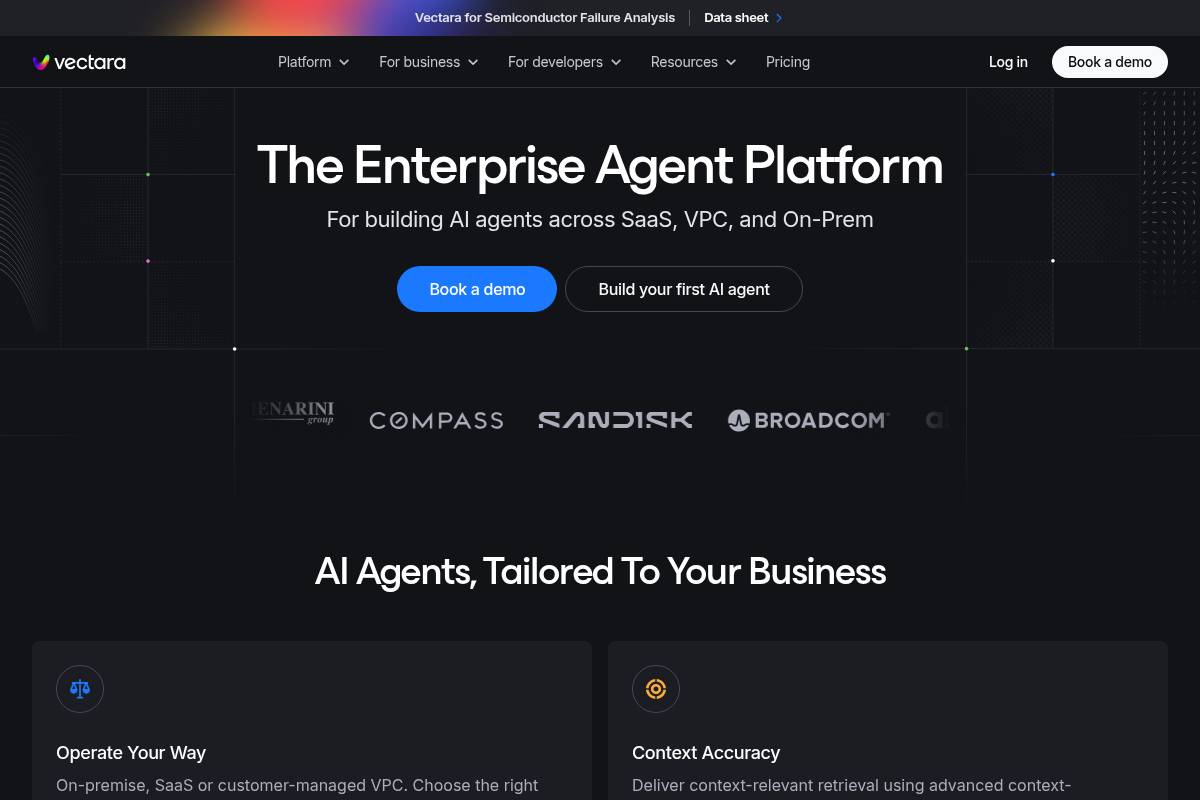
8. Vectara: Best for Dedicated Factual Consistency Scoring
Vectara is a leading enterprise RAG platform built around the Hughes Hallucination Evaluation Model (HHEM), an industry-standard model specifically designed to score factual consistency in generated AI summaries and answers. A RAG platform, or Retrieval Augmented Generation platform, enhances LLM outputs by retrieving facts from an authoritative knowledge base.
Key Features
- HHEM factual consistency score: The production-ready version of Vectara's open-source Hughes Hallucination Evaluation Model detects the level of hallucinations in popular LLMs, helping developers evaluate hallucinations automatically.
- Widely adopted open model: As of September 2024, the HHEM model has seen over 5.5 million downloads, indicating its broad acceptance.
- Calibrated probability scores: A higher score indicates a higher confidence that the summary is factually consistent, on a calibrated 0.0 to 1.0 scale.
- Vectara Hallucination Corrector: VHC can correct hallucinations, fixing inaccurate generated content for RAG or agents to ensure consistency with the context.
- Efficient open-weights option: HHEM-2.1-Open can be run on consumer-grade hardware, occupying less than 600MB RAM at 32-bit precision.
Best For
Vectara is best for large enterprises running mission-critical RAG applications who need a dedicated, independently benchmarked factual consistency score rather than an LLM-as-a-judge approach. Its commercial platform starts around $100,000/year, though the open-source HHEM model remains free on Hugging Face.
Pros and Cons
- Pro: HHEM is one of the most widely cited, independently benchmarked hallucination detection models available.
- Pro: Both a free open-source path and a fully managed enterprise platform are available.
- Con: Enterprise pricing is out of reach for most small and mid-size marketing teams.
- Con: Built for RAG application developers, not for monitoring public brand mentions.
Rating: 8.2/10
Key Takeaway: Vectara offers a robust, independently benchmarked solution for factual consistency, ideal for large enterprises with critical RAG applications. For teams that need to actively probe their AI systems for vulnerabilities, the next tool takes a red-teaming approach.
9. Giskard: Best for AI Red-Teaming and Compliance
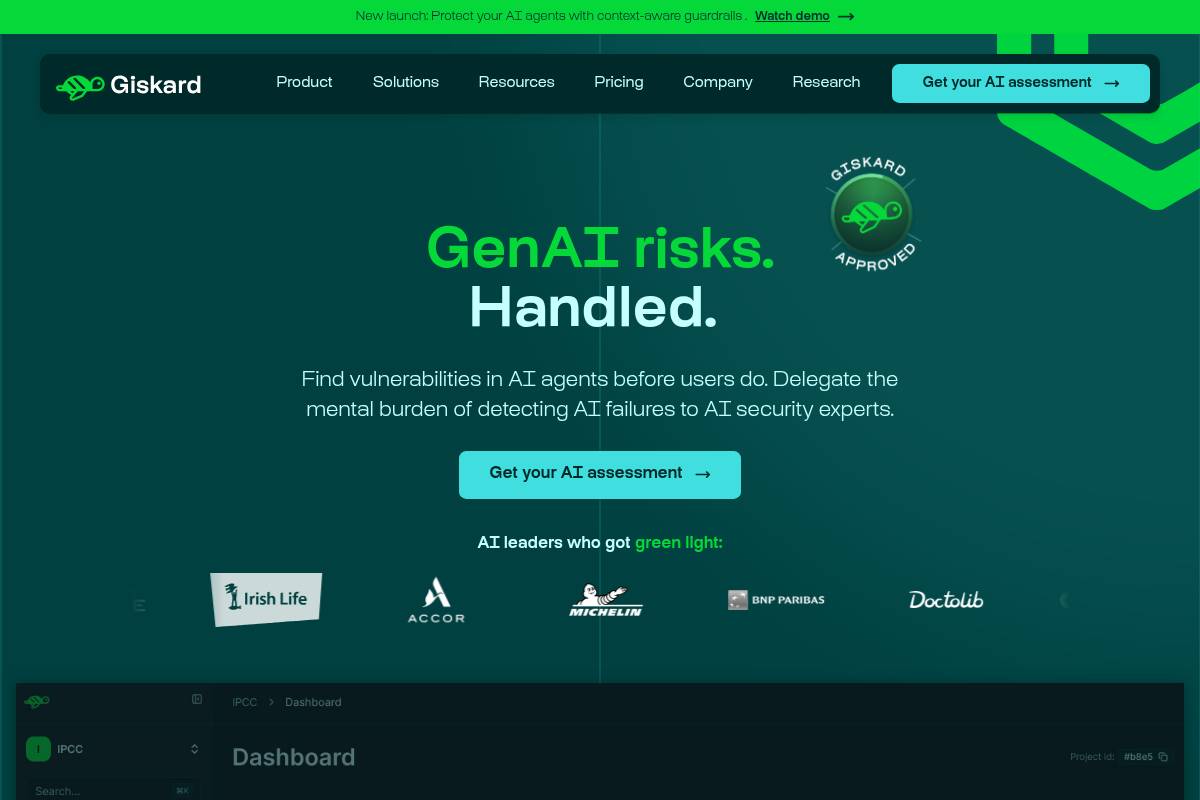
9. Giskard: Best for AI Red-Teaming and Compliance
Giskard is an AI testing and guardrail platform that provides continuous AI red-teaming, proactively identifying vulnerabilities in AI systems. It specifically targets AI hallucinations alongside security flaws. Giskard offers both an open-source evaluation library and an enterprise Hub.
Key Features
- Continuous Red-Teaming Engine: Tests AI agents for vulnerabilities both before and after deployment, specifically targeting domain-specific hallucinations and overly zealous moderation that standard tools might miss.
- Dynamic, Multi-Turn Attacks: Employs dynamic, multi-turn, and context-aware attacks by leveraging internal business context and external threat databases to uncover complex vulnerabilities.
- Compliance Coverage: Publicly documents its coverage for key regulatory standards, including GDPR Art. 22, HIPAA, and SOC 2, demonstrating its commitment to compliance.
- Flexible Deployment: The Giskard Hub can be installed in on-premise environments, making it suitable for mission-critical workloads in sensitive sectors like public service or defense.
- RealHarm Research: Giskard's RealHarm study, which analyzed publicly reported LLM failures, revealed that reputational damage often precedes financial loss in most incidents.
Best For
Giskard is ideal for AI security, compliance, and data science teams in finance, manufacturing, or the public sector. The open-source library is free, while Giskard Hub enterprise pricing requires contacting sales.
Pros and Cons
- Pro: Strong compliance positioning with GDPR, HIPAA, and SOC 2 coverage.
- Pro: The free open-source library is genuinely usable for solo testing and evaluation.
- Con: The absence of public Hub pricing can make budgeting difficult for smaller teams.
- Con: Primarily focused on conversational text-to-text agents, which limits its applicability for other AI types.
Rating: 8.1/10
Key Takeaway: Giskard excels in continuous AI red-teaming and compliance, offering specialized hallucination detection and robust security testing for regulated industries. For teams that need a comprehensive lifecycle platform with evaluation, observability, and simulation all in one place, our final tool rounds out the picture.
10. Maxim AI: Best for End-to-End Lifecycle Evaluation
10. Maxim AI: Best for End-to-End Lifecycle Evaluation
Maxim AI is an end-to-end evaluation and observability platform designed for catching hallucinations across the AI agent lifecycle. It combines pre-release simulation, multi-level evaluation frameworks, and production monitoring into a single solution.
Key Features
- End-to-end lifecycle coverage: Maxim AI combines pre-release simulation, multi-level evaluation frameworks, and production observability in one platform, offering comprehensive lifecycle coverage.
- Full stack coverage: This platform covers every stage of the AI lifecycle, from prompt engineering to pre and post-release testing, observability, dataset creation and management, and fine-tuning.
- Playground++ prompt tooling: The Playground++ feature simplifies prompt engineering, complemented by a Prompt CMS and Prompt IDE for organizing, versioning, and editing prompts outside the codebase.
- Tiered team pricing: Maxim AI offers a Free Developer tier, alongside transparent per-seat Professional ($29) and Business ($49) plans, both including a 14-day free trial. Custom Enterprise and in-VPC deployment options are also available.
Best For
Maxim AI is ideal for engineering and product teams developing multi-agent applications who require unified simulation, evaluation, and observability. It eliminates the need to stitch together multiple point solutions for AI lifecycle management.
Pros and Cons
- Pro: A unified lifecycle approach reduces tool-switching between pre-release and production monitoring, streamlining workflows.
- Pro: Offers transparent, affordable per-seat pricing, which stands out compared to several enterprise-only competitors.
- Con: Has less brand-monitoring focus, being built primarily for internal AI application teams. This might be a consideration for brands and marketers seeking the best AI hallucination detection tools for external content.
- Con: As a newer platform, it has a smaller public track record compared to more established tools like Galileo or Arize.
Rating: 8.0/10
Key Takeaway: Maxim AI provides a robust, unified platform for managing the entire AI agent lifecycle, from development to production. Now that you've seen all ten tools, let's compare them side by side to help you make the right choice.
Full Comparison: Best AI Hallucination Detection Tools for Brands and Marketers in 2026
| Tool | Brand Monitoring | Real-Time Blocking | Remediation/Content | Open Source Option | Free Tier |
|---|---|---|---|---|---|
| Indexly | ✓ | ✗ | ✓ | ✗ | Demo-based |
| Siftly | ✓ | ✗ | ✗ | ✗ | ✗ |
| Galileo | ✗ | ✓ | ✗ | ✗ | ✓ |
| Patronus AI | ✗ | ✓ | ✗ | ✓ | ✓ |
| Braintrust | ✗ | ✓ | ✗ | ✗ | ✓ |
| Arize AI (Phoenix) | ✗ | ✓ | ✗ | ✓ | ✓ |
| Cleanlab | ✗ | ✓ | ✗ | ✗ | ✓ |
| Vectara | ✗ | ✓ | ✓ | ✓ | Trial only |
| Giskard | ✗ | ✓ | ✗ | ✓ | ✓ |
| Maxim AI | ✗ | ✓ | ✗ | ✗ | ✓ |
How to Choose the Right AI Hallucination Detection Tool
By Team Size
Solo marketers and small teams should start with Indexly or Siftly for brand-facing monitoring, since both are usable without engineering resources. Mid-size engineering teams often do well with Galileo's free tier or Braintrust's Starter plan. Large enterprises with compliance requirements should evaluate Vectara, Giskard Hub, or Arize AX Enterprise.
By Budget
Free and low-cost options include Arize Phoenix (self-hosted, $0), Galileo's free tier (5K traces/month), and Giskard's open-source library. Mid-tier budgets ($50 to $300/month) fit Arize AX Pro, Braintrust Pro, and Maxim AI's Professional plan. Enterprise budgets should expect custom quotes from Vectara, Patronus AI Enterprise, and Galileo Enterprise.
By Use Case
If your priority is protecting how AI engines describe your brand to buyers, Indexly and Siftly are purpose-built for that job. If you are shipping an internal RAG application or customer support agent, Patronus AI's Lynx model, Cleanlab's TLM, or Vectara's HHEM offer the deepest technical accuracy. If you need compliance-grade red-teaming and audit trails, Giskard is the strongest fit among the tools reviewed here. For additional buying guidance, see AI hallucination detection: methods and enterprise guide.
What Is AI Hallucination Detection?
AI hallucination detection refers to the systems, models, and dashboards used to identify when generative AI produces content that is factually inconsistent with a trusted source, whether that source is retrieved documents in a RAG pipeline or the verified facts about a brand. The category has matured rapidly, and in 2026 it is a production primitive, not a research problem. For a more detailed primer, see What Are AI Hallucinations? | IBM.
| Metric | What It Measures | Typical Tool Type |
|---|---|---|
| Factual consistency score | Whether generated text is supported by retrieved context | Vectara HHEM, Patronus Lynx |
| Trustworthiness score | Real-time confidence in any LLM output being correct | Cleanlab TLM |
| Hallucination flag | Binary or scored mismatch between AI claims and verified brand facts | Siftly, Indexly |
| Citation gap | Where a brand is absent, misrepresented, or wrongly cited in AI answers | Indexly |
| Groundedness/RAG triad | Context relevance, groundedness, and answer relevance in RAG pipelines | Arize Phoenix, Galileo |
Conclusion: Which AI Hallucination Detection Tool Should You Choose?
Among the best AI hallucination detection tools for brands and marketers in 2026, Indexly earns the top spot because it treats hallucination detection as the starting point rather than the finish line. It pairs prompt research and citation gap analysis with content agents that actually close the gap across GEO-optimized articles, Reddit signals, and LinkedIn presence. For marketers who want a simpler, dedicated hallucination flag inside a brand monitoring dashboard, Siftly is a strong alternative. Engineering teams building internal LLM applications should look to Galileo for real-time blocking, Patronus AI for explainable regulated-industry scoring, or Arize Phoenix if a free, self-hosted option is the priority. The underlying lesson for 2026 is clear: if you're not actively monitoring what AI engines say about your brand, you're leaving your reputation to chance.
Frequently Asked Questions
What are the best AI hallucination detection tools for brands and marketers in 2026?
The best AI hallucination detection tools for brands and marketers in 2026 include Indexly, Siftly, Galileo, Patronus AI, Braintrust, Arize AI, Cleanlab, Vectara, Giskard, and Maxim AI, spanning brand-focused monitoring platforms and deep engineering evaluation suites.
How do AI hallucination detection tools work?
Most tools compare an AI-generated response against a source of truth, such as retrieved documents in a RAG pipeline or a structured brand profile, and produce a score or flag when the response contradicts, invents, or omits information not present in that source.
Can AI hallucination detection tools stop ChatGPT from saying wrong things about my brand?
Brand-focused platforms like Indexly and Siftly can detect when ChatGPT, Gemini, or Perplexity misstate facts about your brand, and tools like Indexly go further by generating corrective GEO-optimized content and citation-building signals to influence what future AI answers say.
What is the difference between AI hallucination detection and AI brand monitoring?
AI brand monitoring tracks how often and how favorably your brand is mentioned across AI engines, while AI hallucination detection specifically flags factual mismatches between what an AI says and what is actually true about your product, pricing, or policies. The strongest tools in this category, like Indexly and Siftly, combine both.
Do I need a developer to use an AI hallucination detection tool?
Brand-facing tools such as Indexly and Siftly are designed for marketers and require no coding, while engineering-grade platforms like Galileo, Patronus AI, Arize Phoenix, and Braintrust typically require SDK integration and are built for technical teams.
What is the Hughes Hallucination Evaluation Model (HHEM)?
HHEM is an open-source classification model developed by Vectara that scores the factual consistency between a generated response and its source context on a calibrated 0 to 1 scale. It has become an industry-standard benchmark with millions of downloads.
How much do AI hallucination detection tools cost?
Pricing ranges widely: open-source options like Arize Phoenix and Giskard's library are free, mid-tier platforms like Galileo and Braintrust start between $50 and $250 per month, brand monitoring tools like Siftly start around $79 per month, and enterprise platforms like Vectara can run into six figures annually.
Which AI hallucination detection tool is best for small businesses?
Small businesses and solo marketers typically get the most value from Indexly or Siftly for brand-level monitoring, or Arize Phoenix and Galileo's free tier if they need to test hallucination detection inside an internal AI application without upfront cost.
Methodology: Rankings in this article are based on a combination of publicly available pricing pages, vendor documentation, third-party pricing analyses, and product feature comparisons gathered through independent research in September 2026. Ratings reflect a weighted evaluation across detection accuracy, brand coverage, remediation capability, ease of use, pricing transparency, and deployment flexibility, and are intended as a general guide rather than a substitute for hands-on testing with your own data.