Marketing Agency Workflow: The Future of SEO Tech Stacks
Marketing agency workflow powered by AI agents, SEO automation, and orchestration to scale SEO workflows and boost brand visibility.


Look inside an SEO agency, and the marketing agency workflow unfolds across every open tab. Multiple tabs are open at once—keyword research tools, content documents, analytics dashboards, technical audit platforms, reporting systems.
Each tool performs its role, but none of them function as a connected system. What appears organized on the surface is often a workflow held together by constant switching, manual coordination, and hidden complexity.
As campaigns scale and expectations increase, this setup starts to slow everything down. Teams spend more time moving data between tools than executing strategy, and small gaps between processes turn into larger inefficiencies. This is why unified workflows are becoming essential.

Accelerate your agency growth with AI-powered SEO & search visibility services. Get a multi-client dashboard, co-branded materials, dedicated support, tiered pricing, and directory exposure to attract more clients.
What is a Marketing Agency Workflow in Modern SEO?
A marketing agency workflow is a unified system that connects every stage of search optimization: research, planning, content execution, technical audits, and performance tracking, into a continuous and intelligent process.
Traditionally, SEO agencies relied on fragmented tech stacks, using multiple tools for different functions. While each tool delivered value, they rarely worked together as a cohesive system. Today, this approach is being replaced by unified workflows powered by AI agents, AI automation, and workflow orchestration.
Why Traditional SEO Tech Stacks Are Breaking
The traditional SEO tech stack was built to solve individual problems, not to support end-to-end workflows. As a result, most marketing agency workflows operate in isolation.
Research is often conducted in one platform, content is managed in another, and performance tracking exists separately. There is little continuity between these stages, which leads to delays and missed opportunities.
The lack of orchestration further compounds the problem. Without a system to connect processes, workflows depend heavily on manual coordination. This introduces delays, increases the risk of errors, and creates inconsistencies in execution.
As more tools are added, operational complexity increases. Integrations become harder to manage, onboarding takes longer, and maintaining the stack requires ongoing effort. Instead of improving efficiency, the tech stack starts to slow down agency operations.
Another critical limitation is human dependency. Most workflows require constant oversight and manual input, making it difficult for SEO agencies to scale efficiently or deliver consistent results across clients.
The Rise of AI-Driven SEO Workflows
The evolution of SEO is being driven by AI-driven strategies, with AI agents playing a central role in transforming how workflows are executed.
AI agents are intelligent systems that can analyze data, make decisions, and perform tasks automatically. In SEO workflows, they can handle activities such as keyword clustering, content generation, optimization, and performance monitoring.
AI automation is already reshaping agency operations. Processes that once required manual effort, such as content automation, reporting, and performance tracking, can now be handled efficiently by AI systems.
Building a Unified Workflow for SEO Agencies
The future of SEO lies in building a unified workflow that integrates every stage into a connected system. This transformation happens step by step, with each layer feeding into the next.
Step 1: Strengthen the Research Foundation
The workflow begins with research, but not in the traditional sense. Keyword discovery is enhanced by entity recognition and knowledge graph mapping, allowing agencies to understand relationships between topics, entities, and search intent. This creates a more structured and context-driven foundation for SEO.
Step 2: Turn Insights into Dynamic Strategy
Once research is connected, strategy becomes more than just planning. By incorporating share of voice analysis and AI-driven strategies, agencies can continuously refine their direction based on real-time data. Strategy shifts from being static to adaptive, evolving as new insights emerge.
Step 3: Execute with Alignment and Scale
Execution is where strategy takes shape. With content automation and streamlined content execution, agencies can produce and optimize content at scale while maintaining consistency. Every piece of content is aligned with both strategic goals and search intent, reducing gaps between planning and delivery.
Step 4: Integrate Continuous Optimization
Optimization is no longer a separate phase. Technical audits and performance tracking are built directly into the workflow, enabling continuous monitoring and improvement. Data flows across the system, allowing for real-time adjustments instead of delayed fixes.
Step 5: Create a Continuous Workflow Loop
As each stage connects, the workflow becomes a loop rather than a sequence. Research informs strategy, strategy drives execution, and execution feeds back into optimization. This transforms SEO workflows into continuous systems where every step strengthens the next.
SEO Beyond Rankings: GEO, AEO, and Brand Visibility
Search is evolving rapidly, expanding beyond traditional rankings into AI-driven ecosystems.
Generative engine optimisation focuses on optimizing content for AI-generated responses. Instead of simply ranking pages, the goal is to influence how content is used in generative search outputs.
At the same time, answer engine optimisation is becoming critical. Users increasingly rely on direct answers provided by search engines and AI assistants, reducing the need to navigate multiple pages.
In this environment, brand visibility depends on more than rankings. It requires strong entity recognition, inclusion in knowledge graphs, and consistent presence across AI-generated responses.
SEO agencies must adapt their workflows to account for this shift, ensuring that content is structured, contextual, and aligned with how modern search systems operate.
The Missing Layer: Orchestration
Despite advancements in AI automation, many SEO workflows remain disconnected. This is where orchestration becomes essential.
Workflow orchestration connects research, execution, and optimization into a unified system. It ensures that data flows seamlessly between stages and that processes operate continuously rather than independently.
Without orchestration, automation can lead to faster execution but not better outcomes. Tasks may be completed more quickly, but the overall workflow remains fragmented.
With orchestration, marketing agency workflows become more predictable, scalable, and efficient. It transforms isolated activities into a coordinated system that can adapt and improve over time.
The Impact on Agency Growth and Performance
A unified marketing agency workflow has a direct impact on performance. When workflows are connected, execution becomes faster, more consistent, and easier to scale.
Agencies can improve share of voice and strengthen brand visibility by applying strategies more effectively across campaigns. SEO workflows become more reliable because they are driven by systems rather than manual processes.
This also transforms agency operations. Teams spend less time managing tools and more time focusing on strategy and optimization. As a result, agencies can handle more clients without increasing operational complexity.
How Indexly Helps SEO Agencies Build SEO + AI Visibility
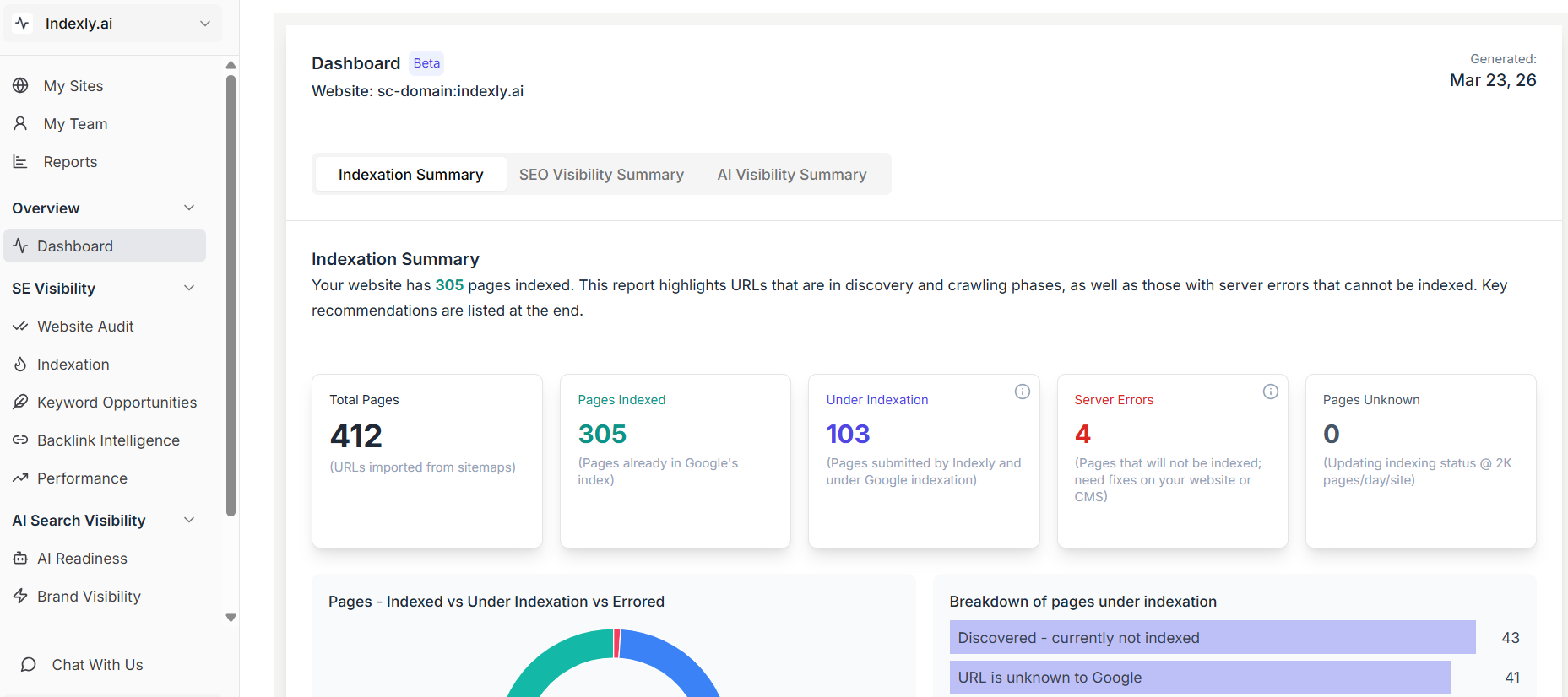
Indexly combines SEO workflows with AI visibility, helping agencies not just rank but actively track and build brand visibility across modern search environments.
It enables SEO agencies to monitor how brands appear in AI-driven systems through AI visibility and prompt tracking, while brand sentiment tracking provides insights into perception across search and AI-generated responses.
Citation tracking further strengthens authority and supports entity recognition within knowledge graphs, while AI readiness audits ensure content is aligned with generative engine optimisation and answer engine optimisation.
At the same time, Indexly improves core SEO workflows by enhancing indexation, providing website performance insights, tracking backlinks, and identifying keyword opportunities to improve share of voice.
This makes Indexly a unified platform for SEO + AI visibility, allowing agencies to manage both performance and brand presence within a single, connected marketing agency workflow.
Conclusion
SEO agencies are moving from fragmented tech stacks to unified marketing agency workflows that connect research, content execution, technical audits, and performance into a single system.
With AI agents, AI automation, and orchestration, SEO workflows are becoming faster, more scalable, and more consistent. At the same time, shifts like generative engine optimisation and answer engine optimisation are redefining success around brand visibility, entity recognition, and knowledge graph presence.
The future is not about adding more tools. It is about building a unified marketing agency workflow that turns SEO into a connected, intelligent system.
If you’re looking to streamline your agency operations and build a truly connected workflow, platforms like Indexly are designed to help SEO agencies scale efficiently by bringing execution, indexing, and tracking into one unified system.
FAQs
1. What is a marketing agency workflow in modern SEO?
A marketing agency workflow is a unified workflow that connects research, strategy, content execution, technical audits, and performance tracking into a continuous system. Unlike traditional SEO workflows that rely on disconnected tools, modern workflows use AI agents, AI automation, and workflow orchestration to streamline agency operations and improve efficiency.
2. How do AI agents improve SEO workflows for agencies?
AI agents enhance SEO workflows by automating repetitive and data-heavy tasks such as keyword clustering, content automation, technical audits, and performance tracking. This allows SEO agencies to reduce manual work, improve accuracy, and execute AI-driven strategies at scale within a unified workflow.
3. Why are traditional SEO tech stacks no longer effective?
Traditional tech stacks are built as separate tools for research, content, and analytics, which leads to fragmented agency operations. Without proper orchestration, these tools create inefficiencies, slow down execution, and make it difficult for SEO agencies to scale. A unified workflow solves this by connecting all processes into one system.
4. What role do generative engine optimisation and answer engine optimisation play in SEO?
Generative engine optimisation (GEO) and answer engine optimisation (AEO) focus on improving brand visibility in AI-driven search environments. Instead of just rankings, SEO agencies now optimize for entity recognition, knowledge graph inclusion, and AI-generated responses, helping brands increase their share of voice across modern search platforms.
5. How does a unified workflow improve content execution and SEO performance?
A unified workflow aligns research, content execution, and technical audits into a continuous loop. With SEO automation and content automation, agencies can produce optimized content faster while maintaining consistency. This leads to better performance, improved share of voice, and more scalable SEO workflows.