
AI Prompt Tracking: Boost SEO & Brand Visibility

Discover how AI prompt tracking helps Australian brands, agencies and SEO teams boost rankings, AI search visibility and brand consistency.

AI Prompt Tracking: Boost SEO & Brand Visibility

Your team is producing more AI-generated content than ever, but rankings, clicks, and brand consistency aren’t keeping pace. Sound familiar? The problem usually isn’t the models you’re using—it’s the lack of visibility into the prompts driving that content.

AI prompt tracking gives Australian brands, agencies, and SEO professionals the missing layer of control: which prompts perform, which dilute your tone of voice, and which enhance visibility across search and AI-powered experiences. By understanding how prompts shape keyword relevance, brand language, and on-page performance, you can refine your workflows over time and turn AI content into a measurable asset, not a guessing game.

If you’re not tracking your AI prompts, you’re leaving your SEO to chance and your brand story to a robot’s memory—smart Australian marketers are already treating prompts like high-value keywords, not throwaway commands.

Reference: Win Every Search. From Traditional SEO to AI Discovery

Understanding AI Prompt Tracking and Its Role in SEO

What is AI prompt tracking?

AI prompt tracking is the structured logging and analysis of every instruction you feed into tools like ChatGPT, Gemini, or Jasper for content, metadata, and campaign assets. Instead of one-off experimentation, marketing teams record the exact prompt, output, and where that output is used across blogs, landing pages, or ads.

By tying prompts to metrics such as organic traffic, rankings, and on-page engagement, teams can see which instructions consistently produce content that performs. For example, an agency might learn that prompts specifying “Australian statistics from 2023” drive higher engagement for B2B posts targeting Sydney and Melbourne audiences.

How AI prompt tracking connects to AI search optimisation

AI search optimisation focuses on how content is interpreted and surfaced in features like Google’s AI Overviews and Bing Copilot. Prompt tracking links the quality and structure of your instructions to how often your content is cited, summarised, or recommended in these AI-driven experiences.

For instance, tracking may reveal that prompts requiring schema-ready FAQs and concise definitions help pages win more visibility in AI summaries, while vague prompts lead to generic outputs that rarely appear. SEO teams can then refine prompts to align with both traditional ranking factors and AI-generated answer patterns.

The shift from traditional SEO to AI-powered search experiences

Search results now blend classic blue links with conversational answers and AI summaries, changing how users scan and click. Reports from Similarweb showed traffic drops of over 20% for some publishers after early AI Overviews tests in the US, highlighting how user journeys are being rerouted.

Brands can no longer optimise only for ten blue links; they must consider how content is quoted and paraphrased by AI systems. Prompt tracking helps shape content that is scannable, well-structured, and rich in entity-level detail, improving the odds of inclusion in AI-led experiences.

Why prompt performance analysis matters for modern brands

Analysing prompt performance ensures AI outputs stay on-brand, accurate, and aligned with commercial goals such as lead quality or e‑commerce conversion rate. A Brisbane agency, for example, might discover that prompts enforcing a “conversational yet authoritative” tone reduce client edits by 40% and speed up publishing.

By benchmarking different prompt templates against rankings, dwell time, and assisted conversions, marketing leaders can demonstrate ROI of AI tools to stakeholders. At the same time, poor-performing prompts can be retired, reducing the risk of off-brand content that erodes trust or damages search visibility across key Australian markets.

Mapping AI Prompts Across Your Marketing & SEO Workflows

Identifying where prompts are used in content, SEO, and brand touchpoints

Before improving prompts, you need a clear view of where they already power your marketing. Map every spot AI touches content: blog drafting, landing-page wireframes, title tags, meta descriptions, and LinkedIn posts. For example, an Australian SaaS brand might use ChatGPT to outline weekly blog posts, then Claude to refine SEO titles and meta for each piece.

Extend the audit to customer touchpoints. Document prompts behind Drift or Intercom chatbots, Klaviyo email flows, and Zendesk or Help Scout support macros. Internally, record prompts for keyword clustering, content-gap analysis, and technical SEO checks, inspired by the full-funnel approach in 5 Powerful AI Prompts to Transform Your SEO Strategy in 2025.

Categorising prompts: informational, transactional, navigational, and branded

Once your audit is complete, classify prompts by intent so teams stop using one generic prompt for every job. Informational prompts support top-of-funnel education, like “Explain how Australian SMEs can claim R&D tax incentives” for a Sydney accounting firm targeting awareness queries.

Transactional prompts focus on conversions: “Write a comparison section persuading users to switch from Xero to MYOB Business with a 30-day trial.” Navigational prompts help users reach specific assets (“Guide users to our NDIS pricing calculator page”), while branded prompts lock in tone, such as: “Write in Canva’s friendly, design-led voice for Australian creatives.”

Differentiating prompts for human-facing vs. machine-facing content

Not all prompts create content for people to read. Human-facing prompts generate articles, landing pages, nurture emails, and ad copy that shape user perception and engagement. A Melbourne agency might prompt Gemini for a 1,200-word guide on “SEO for Australian eCommerce brands,” tailored to local spelling, regulations, and search behaviour.

Machine-facing prompts target search engines and AI systems: schema markup, JSON-LD FAQs, internal linking rules, and XML sitemap explanations. For example, ask: “Generate FAQPage schema for our ‘home loan rates Australia’ page.” Distinguishing these streams helps you see how prompts influence both rankings and how AI assistants summarise your brand.

Building a simple prompt inventory and taxonomy for your organisation

To avoid teams reinventing the wheel, build a central prompt inventory in tools like Notion or Confluence. Log each prompt with purpose, channel (SEO blog, Google Ads, HubSpot email), and best-practice examples. Agencies often start with 30–50 “golden prompts” that cover 80% of recurring work.

Tag prompts by funnel stage (TOFU, MOFU, BOFU), objective (traffic, leads, retention), and audience segment (SME owners, CMOs, franchisees). Implement a naming convention such as “SEO_INF_Blog_KeywordCluster_AU” so prompts are searchable and reusable across clients, reducing inconsistencies in voice and speeding execution.

Defining Success Metrics for Prompt Performance Analysis

Defining Success Metrics for Prompt Performance Analysis

Defining Success Metrics for Prompt Performance Analysis

For SEO and AI search teams, prompt performance only matters if it moves measurable outcomes. Defining the right success metrics lets you compare prompts, justify AI investment, and align content workflows with traffic and revenue goals.

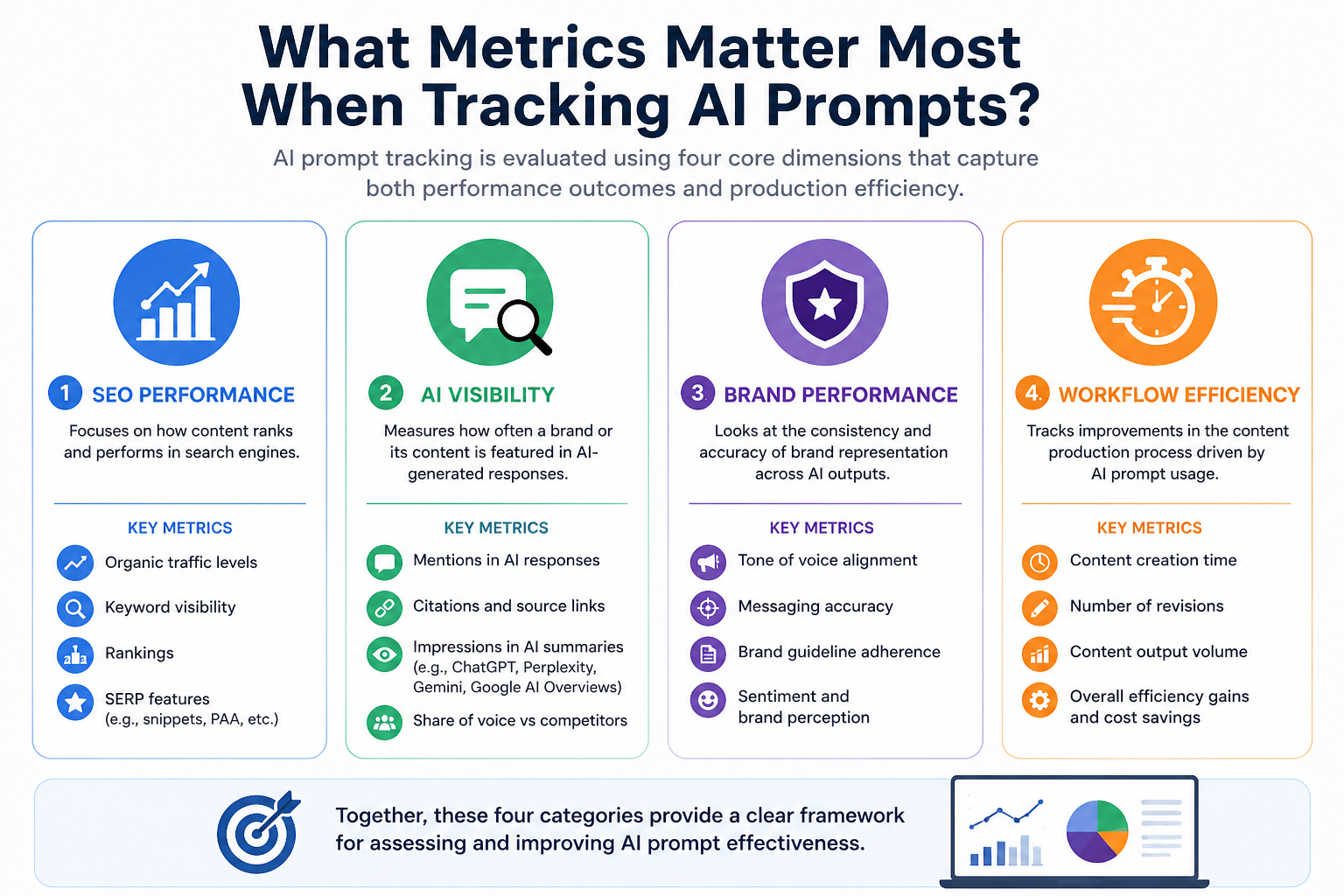
These metrics should span traditional SEO, AI search visibility, brand perception, and operational efficiency so you can see the full impact of prompt engineering on marketing performance.

Core SEO metrics: rankings, clicks, impressions, and rich result visibility

Core SEO metrics show whether AI-assisted content actually wins more search real estate. When you change or test prompts, track the impact on rankings, clicks, and SERP features at the page and query level.

In Google Search Console, create query filters mapped to content produced with specific prompts. For example, an Australian retailer could compare product guides written with Prompt A versus Prompt B and see if Prompt B lifts average position from 12 to 7 and clicks by 30% over 60 days.

Rich result visibility is equally important. Monitor whether FAQ prompts help content appear in FAQ rich results or featured snippets. For instance, health content optimised with structured Q&A prompts may start capturing snippets for “symptoms of iron deficiency” and drive a noticeable rise in impressions even before rankings dramatically improve.

AI-specific metrics: answer inclusion in AI overviews and generative snippets

As Google, Microsoft, and Perplexity expand AI-driven SERPs, you need metrics showing when your content powers those answers. High-performing prompts often create clearer, more structured explanations that AI systems prefer to summarise.

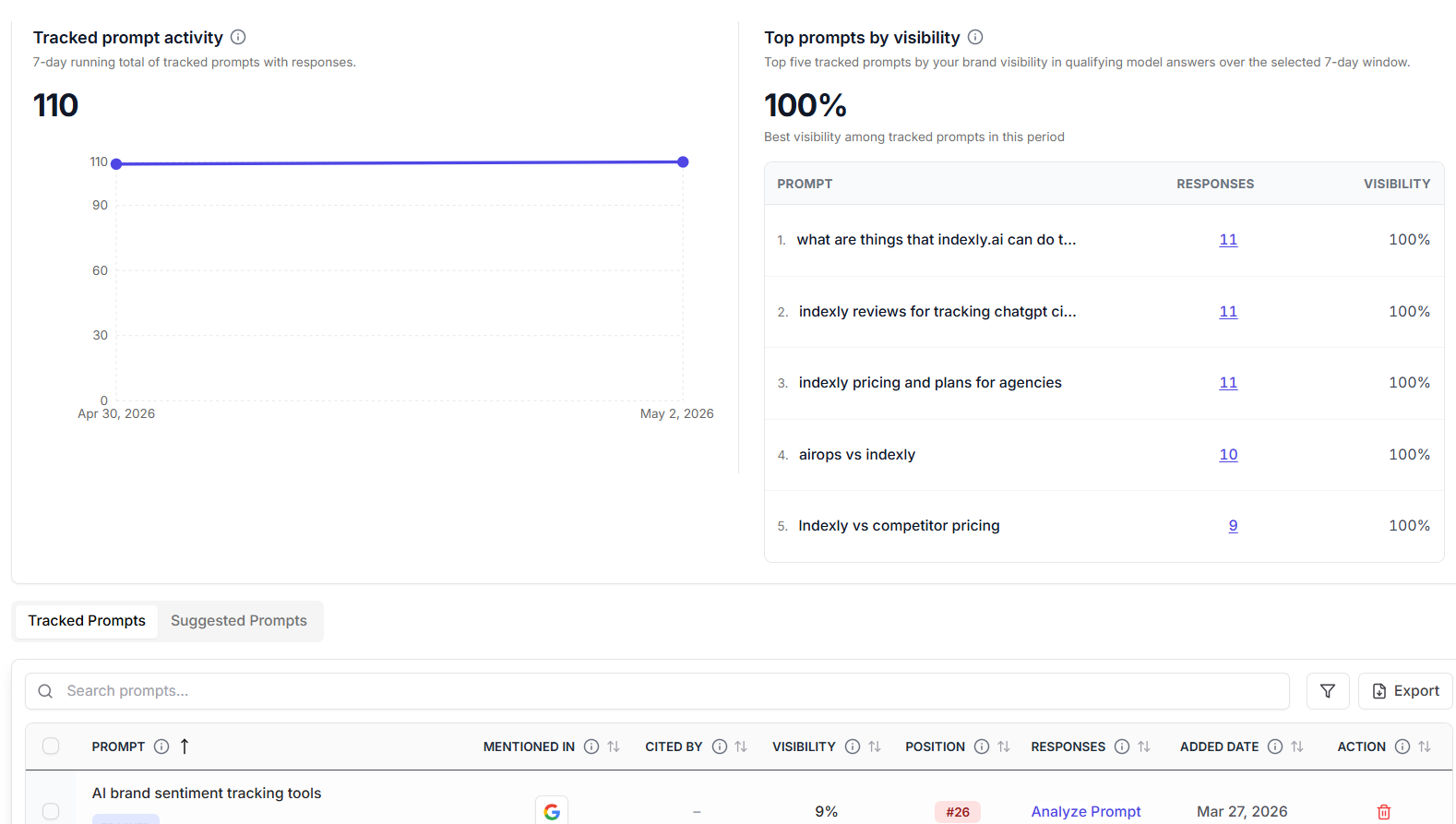
Track inclusion in Google’s AI Overviews and Bing’s generative answers by running a fixed set of test queries weekly. For example, an Australian fintech brand might monitor 50 “how to invest” queries and record how often their domain is cited beneath AI Overviews, aiming to grow coverage from 10% to 25% across the set.

Specialist tools such as Similarweb, seoClarity, or enterprise rank trackers are starting to flag generative result visibility. Use these to benchmark which prompt styles (e.g., bullet-led explanations vs narrative walkthroughs) are most likely to be surfaced in AI panels for your category.

Brand visibility tracking: mentions, sentiment, and share of voice in AI results

Prompt performance is not just about traffic; it also shapes how AI systems talk about your brand. Consistent, well-structured content gives AI clearer signals when generating comparative or informational responses.

Test how ChatGPT, Claude, Perplexity, and Gemini describe your brand vs competitors for key topics. For example, an Australian energy provider could log monthly how often it appears in “best green energy provider in Australia” AI answers and whether descriptions emphasise sustainability or price.

Use manual reviews and social listening platforms like Brandwatch or Meltwater to tag sentiment (positive, neutral, negative) and accuracy of AI-generated mentions. Over time, treat share of voice within AI responses—such as being named in 3 out of 5 key AI answers for “NBN business plans”—as a leading indicator of brand authority.

Operational metrics: time saved, consistency, and error reduction

Operational metrics reveal whether better prompts make your content team faster and safer, not just more visible. Track these alongside SEO outcomes to understand true ROI.

Log average time from brief to publish before and after prompt improvements. A mid-sized Sydney agency, for example, might cut production time for blog drafts from 4 hours to 2.5 hours per piece while maintaining quality scores in client reviews. That time saving compounds across dozens of monthly briefs.

Audit a sample of AI-assisted articles each month for tone, structure, and factual accuracy. Use checklists or tools like Grammarly and Originality.ai. If prompt refinements reduce compliance edits for a regulated finance client by 40% and factual corrections by 20%, you have clear evidence that prompt performance is improving operational reliability as well as rankings.

Reference: Define success criteria and build evaluations - Claude API Docs

Setting Up an AI Prompt Tracking Framework

Choosing a tracking structure: prompt IDs, versions, and naming conventions

A structured tracking framework lets you analyse which prompts actually drive rankings, clicks, and conversions. It mirrors the systematic persona and constraint mapping process outlined in Prompt Research for AI SEO: Complete Strategy Guide 2026, but focuses on how prompts are catalogued over time.

Assign each prompt a unique ID such as PRM-SEO-0123 so you can link outputs and performance data in Google Analytics 4 or Looker Studio. When a blog brief for a "Sydney SEO agency" cluster is generated, that ID should follow the copy through drafts, uploads, and performance dashboards.

Version prompts as you refine them. For example, PRM-SEO-0123-v3 might introduce tighter constraints on word count and schema markup. Clear naming like "BLOG_Local-SEO_Sydney_2026-02" helps teams instantly see channel, objective, and date, avoiding mix-ups between paid search, blog, and email prompts.

Aligning prompt tracking with your analytics and reporting tools

Prompt tracking only creates value when it is connected to your reporting stack. Map each prompt ID to URLs, campaigns, and target keywords inside GA4, Google Search Console, and ad platforms so you can trace AI-assisted copy through the full funnel.

Use UTM parameters such as utm_content=PRM-SEO-0123-v3 on Meta and Google Ads to attribute performance back to specific prompts. Custom dimensions in GA4 can flag "AI-generated" versus "human-only" content, allowing side-by-side ROI comparisons on SEO landing pages and blog posts.

In dashboards, create filters that clearly distinguish AI-assisted from non-AI content. Agencies in Australia often present this split in client reports to show how structured prompt research contributes to organic visibility and engagement.

Creating standard operating procedures (SOPs) for prompt usage and updates

SOPs prevent prompt chaos as more marketers adopt AI. Document when staff should use approved prompt libraries, and when they must request a new prompt aligned with defined personas and constraints from the AI SEO prompt research guide.

Define rules for modifying, testing, and retiring prompts. For instance, require A/B testing of two prompt versions for high-traffic service pages, and retire any that underperform on click-through rate or on-site engagement over a 30-day window.

Embed these SOPs into onboarding for marketing and SEO teams via Confluence or Notion playbooks. Include real examples such as how a Brisbane eCommerce client improved product page time-on-page by 18% after switching to a refined product-description prompt.

Governance and quality control for brand-safe AI prompt deployment

Governance ensures AI outputs remain brand-safe and compliant in Australia. Establish approval workflows so new prompts affecting public content are reviewed by marketing leads, legal advisers, or compliance officers before going live.

Set guardrails for sensitive topics such as financial advice, health claims, or regulated sectors under ASIC and TGA rules. Prompts for superannuation, for example, should explicitly instruct the AI to avoid personal financial advice and include mandatory disclaimers.

Schedule quarterly reviews of your prompt library to check alignment with brand voice, legal requirements, and ethical standards. Use learnings from structured prompt research, like those outlined in the Complete Strategy Guide 2026, to continuously refine prompts that feed your SEO and content programs.

Reference: How to Set Up AI Prompt Tracking for AI Search Visibility

Tools and Techniques for AI Prompt Tracking and Analysis

Tools and Techniques for AI Prompt Tracking and Analysis

Tools and Techniques for AI Prompt Tracking and Analysis

Using spreadsheets and databases for lightweight prompt performance tracking

Spreadsheets are often the fastest way for Australian teams to start tracking AI prompts without new software. A structured Google Sheets or Excel file with columns for prompt ID, version, use case, channel, and metrics such as CTR, time on page, and conversions keeps experimentation organised.

For example, a Brisbane agency might log variations of product-description prompts for The Iconic, then compare which version drives higher add-to-cart rates in Shopify analytics. Filters and pivot tables can quickly surface high performers by topic or funnel stage.

As prompt volume scales into hundreds or thousands, tools like Airtable or a PostgreSQL database become more practical. These allow proper relationships between prompts, pages, and campaigns, and support SQL queries to answer questions like “Which prompts improved organic click-through for ‘NBN plans’ by more than 10% over three months?”

Leveraging analytics platforms for AI search optimisation insights

Connecting prompt experiments to analytics platforms reveals how AI-generated content performs in organic search. In Google Search Console, you can map prompt IDs to landing-page URLs using UTM parameters or custom dimensions in Google Analytics 4, then correlate impressions, clicks, and average position with specific prompt versions.

An Australian telco optimising support articles could compare how a revised prompt for “how to reset NBN modem” content affects click-through rate and rich-result visibility over a four-week window. Behaviour metrics such as scroll depth, bounce rate, and assisted conversions in GA4 then show whether the AI-assisted copy actually helps users complete tasks.

Specialist tools like AlsoAsked, AnswerThePublic, and Semrush’s “People Also Ask” reports highlight questions that frequently appear in generative answers. While dedicated “AI search” dashboards are still emerging, these tools hint at topics and entities your prompts should target to improve inclusion in AI-generated overviews on Google and Bing.

Integrating prompt logs with SEO tools and dashboards

Bringing prompt logs into your SEO stack creates a unified view of content performance. By linking prompt IDs to rank trackers such as Semrush, Ahrefs, or STAT, teams can see which prompts correlate with gains for priority keywords across Australian markets like Sydney, Melbourne, and Perth.

Custom Looker Studio dashboards can blend prompt logs, GSC data, and GA4 metrics. One tab might highlight prompts used on pages that gained featured snippets for queries like “ATO tax bracket 2024,” while another surfaces prompts behind FAQs that improved organic conversions by more than 5%.

Where possible, use tools like Zapier, Make, or native APIs to automate data flows from prompt repositories into BI tools such as Power BI or Tableau. This reduces manual reporting overhead and keeps SEO teams focused on analysing which prompt patterns repeatedly deliver stronger rankings and engagement.

Privacy, compliance, and data security considerations for Australian brands

Australian brands must align prompt logging with the Privacy Act 1988 and the Australian Privacy Principles (APPs). That means clearly defining what data is captured in prompts and outputs, where it is stored, and how long it is retained, especially if prompts touch on customer issues or internal processes.

Teams should avoid entering personally identifiable information, Medicare numbers, MyGov details, or card data into third-party AI tools like ChatGPT or Gemini. Many major Australian banks publicly state that staff must redact customer identifiers before using external generative AI, and marketing teams should apply the same discipline.

Implement role-based access controls in tools such as Confluence, Notion, or internal Git repositories to store prompt libraries securely. Document retention policies that purge logs after a defined period, and ensure any offshore processing is covered by appropriate data-transfer clauses in line with OAIC guidance.

Reference: Top 5 AI Prompt Management Tools of 2025

Applying Prompt Insights to Improve SEO & Brand Visibility

Turning high-performing prompts into reusable templates and playbooks

Once a prompt consistently produces content that ranks and converts, treat it as an internal asset, not a one-off win. Capture it as a standard template for blogs, landing pages, and metadata so teams don’t keep reinventing the wheel.

For example, an agency might formalise a “programmatic suburb page” prompt for Australian real-estate clients, locking in sections for local stats, schools, and transport. This keeps every new suburb page aligned with search intent and structure that already performs.

Turn these into playbooks that live in Notion or Confluence. Document prompt examples, variations for different funnels, and do/don’t guidelines. Encourage SEO, content, and paid teams to share winning prompts so meta descriptions, ad copy, and blog intros all improve together.

Iterating prompts to improve rankings, CTR, and AI-generated visibility

Prompt optimisation should mirror A/B testing in SEO and CRO. Create controlled prompt variants that target different angles of search intent, then compare metrics like average position, CTR, and dwell time in Google Search Console.

For instance, test a prompt that emphasises “benefits first” H2s for a Sydney SaaS landing page against one that leads with pricing and case studies. Review changes in CTR and whether content is pulled into Google’s AI Overviews for priority keywords.

Feed performance data back into your prompts. If pages with clear FAQs and concise summaries are more likely to appear in generative snippets, hard-code instructions like “include a 60–80 word TL;DR and 3–5 FAQ questions with short answers” into your templates.

Aligning prompts with E‑E‑A‑T and brand voice guidelines

Strong prompts don’t just chase keywords; they bake in experience, expertise, authoritativeness, and trust. Include instructions such as “reference real campaigns we’ve run in Australia” or “cite ABS or ACCC data where relevant” to lift credibility signals.

Brand and localisation rules also belong directly in the prompt. A Melbourne-based retailer, for instance, can specify “use Australian spelling, reference AUD, and mention local delivery timeframes” so content resonates with local searchers.

Ask explicitly for citations, outbound links to reputable .gov.au or .edu.au sources, and a note for human expert review. This makes it easier for editors to validate claims and supports E‑E‑A‑T signals that influence both rankings and user trust.

Case-style scenarios: before-and-after examples of prompt optimisation

A generic prompt like “Write an article about NBN plans” often produces thin, list-like content. After refining the prompt to “compare NBN 50 vs NBN 100 for remote workers in Brisbane, include real speed benchmarks from Ookla, and structure with pricing tables,” an ISP’s content team can generate pages that attract more specific, transactional searches.

Several agencies report higher inclusion in AI Overviews after adding instructions for concise definitions, schema-friendly FAQs, and clearly labelled pros/cons sections. One Sydney agency saw a 12% CTR lift on a key software review page after revising the prompt to prioritise user scenarios and objection handling in headings.

Brands that tighten prompt governance also reduce off-brand messaging. By centralising approved prompts with guardrails on tone, legal disclaimers, and product naming, a national bank’s marketing team can avoid conflicting rate claims across channels and maintain consistent, compliant messaging at scale.

Reference: Prompt Engineering Just Changed SEO Forever — Here's ...

Embedding AI Prompt Tracking into Team Workflows

Embedding AI Prompt Tracking into Team Workflows

Embedding AI Prompt Tracking into Team Workflows

Training marketing and SEO teams to create and document effective prompts

To embed AI prompt tracking into daily work, teams need shared fundamentals on how prompts actually drive SEO and content outcomes. Short, practical training sessions help marketers understand how prompt structure impacts rankings, click-through rates, and brand tone in AI-assisted content.

Run hands-on workshops covering prompt engineering basics, using tools like ChatGPT, Jasper, and Claude to draft meta descriptions, blog outlines, and product copy. For example, an Australian retailer could compare prompts for “Sydney running shoes sale” and measure how different instructions affect keyword use and readability.

Teach staff to log prompts, outputs, and results in a central system such as Notion, Confluence, or Airtable. Each entry should capture the prompt, target keyword, channel (blog, PPC, email), and performance metrics so patterns are easy to spot across campaigns.

Support teams with prompt templates tailored to Australian sectors such as financial services, higher education, and tourism. A Brisbane-based university, for instance, could maintain templates for international student landing pages focused on “study in Australia” keywords, ensuring consistent structure and compliance.

Collaboration between content, SEO, and brand teams on prompt governance

Prompt tracking is most valuable when content, SEO, and brand teams operate from a shared rulebook. Clear governance ensures AI outputs reflect search strategy, tone of voice, and regulatory needs in sectors like healthcare and finance.

Establish cross-functional working groups that meet monthly to refine prompt standards and naming conventions. These groups can define mandatory elements, such as including primary and secondary keywords, internal linking cues, and audience personas for each prompt template.

Maintain a shared prompt library in tools like Google Drive, Notion, or a headless CMS, embedding brand style guides, E-E-A-T requirements, and industry disclaimers. For example, an Australian bank should bake ASIC and AUSTRAC considerations into prompts for advice-style content.

Encourage feedback loops where copywriters and SEO specialists share which prompts improved rankings or reduced editing time. Agencies working with brands on Google Australia search could showcase monthly “prompt wins” that lifted organic traffic or improved featured snippet capture.

Setting review cadences for prompt performance analysis and updates

Without regular reviews, even strong prompts become stale as algorithms, competitors, and user behaviour shift. Structured cadences keep your AI workflows aligned with live SEO performance and campaign priorities.

Schedule monthly or quarterly reviews of top- and bottom-performing prompts using analytics from Google Search Console, GA4, and rank tracking tools like Semrush or Ahrefs. Look at metrics such as impressions, average position, and conversion rate from pages created with specific prompt templates.

Align these reviews with content calendars and seasonal campaigns, such as EOFY, Black Friday, or major sporting events. Australian ecommerce teams can prioritise prompts tied to “EOFY sale” or “Boxing Day deals” keywords that historically drive higher revenue.

Prioritise updates for prompts connected to high-value keywords or strategic initiatives, such as “NDIS provider Sydney” or “solar panels Brisbane.” Refresh instructions to emphasise local search intent, schema markup cues, and trust signals like reviews and case studies.

Reporting prompt impact to stakeholders and leadership

Leadership teams care less about prompt syntax and more about measurable impact on revenue, pipeline, and brand visibility. Translating AI prompt tracking into clear business metrics helps secure ongoing investment and buy-in.

Report changes in organic traffic, rankings, and content production speed for pages generated with optimised prompts. For instance, an Australian SaaS company might show that refining prompts for “accounting software for tradies” increased organic leads by 18% in one quarter.

Use simple visuals to highlight improvements: line charts for rankings, bar charts for content volume per month, and tables showing time saved on drafting and editing. Include before-and-after examples of AI-assisted articles that captured featured snippets or People Also Ask results.

Share specific cases where prompt optimisation drove tangible outcomes, such as a Sydney-based travel brand improving visibility for “Great Barrier Reef tours” queries. Even if internal data is limited, be transparent and focus on directional trends and learnings rather than exaggerated claims.

Reference: From Prompts to Workflows: Embedding AI in Real Project ...

Conclusion: Turning AI Prompt Tracking into a Competitive Advantage

Recap of how AI prompt tracking underpins AI search optimisation

AI prompt tracking is shifting from a niche analytics task to a foundation of AI search optimisation. When prompts and outcomes are logged consistently, teams can see which inputs earn stronger placement in Google’s AI Overviews, Bing Copilot, or Perplexity answers.

For example, an Australian retailer testing structured prompts for product explainers in Jasper or ChatGPT can compare click-through rates and AI snippet inclusion before and after prompt changes. Those insights turn prompts into a core SEO lever, guiding content briefs, entity coverage, and internal linking.

Key takeaways: measurement, iteration, governance, and brand safety

Effective programs rest on measurement and iteration. Defining clear metrics—such as AI snippet share of voice, branded mention sentiment, and conversion rate from AI-assisted content—lets marketing leaders see real uplift over quarterly cycles.

Governance matters just as much. Australian financial brands, like CommBank and NAB, already apply strict content review rules; the same rigour should cover prompts, with approval workflows, template libraries, and compliance checks to avoid off-brand or non-compliant AI outputs.

The strategic value of brand visibility tracking in AI-driven search results

Tracking brand visibility inside AI summaries reveals how systems describe and position you versus competitors. Tools such as BrightEdge, seoClarity, and enterprise log exports can show when ChatGPT, Claude, or Google AI Overviews recommend your brand for category queries.

An Australian SaaS provider seeing Atlassian and Canva repeatedly cited ahead of them for “best collaboration software” can respond by strengthening E‑E‑A‑T signals, publishing expert guides, and securing more authoritative mentions on .gov.au or .edu.au domains.

Next steps: start small, standardise prompts, and scale your tracking framework

The most practical path is to start with one pilot, such as FAQ content or location pages, and standardise prompts in a shared library. Use simple structures like “Goal, Audience, Tone, Entities, Output format” and log them in Notion, Airtable, or Confluence.

Once you see consistent improvements in AI-driven traffic or brand mentions, expand standards to blog content, programmatic landing pages, and ad creative. Over time, this scaled framework becomes a defensible competitive advantage for Australian brands competing in AI-shaped search results.

FAQs About AI Prompt Tracking, SEO, and Brand Visibility

How does AI prompt tracking actually improve my SEO performance?

Prompt tracking connects the exact instructions you give AI tools with measurable SEO results. By tagging outputs by prompt, you can see which structures consistently lift rankings, organic traffic, and on-page engagement for priority keywords.

For example, an agency working on “NDIS provider Brisbane” could compare two prompts in Jasper or ChatGPT and see one version lifting click-through rate from 3.1% to 5.4% in Google Search Console. That data tells you which prompt format to standardise across similar service pages.

Why is prompt performance analysis important if I already track content metrics?

Traditional content metrics show which landing pages perform, but they rarely explain which creative or structural decisions caused the lift. Prompt analysis lets you isolate variables like tone, outline depth, or FAQ inclusion and see their direct impact.

A Melbourne SaaS brand might learn that prompts demanding “schema-ready FAQs and comparison tables” outperform simple blog-style prompts for competitive terms. Those insights become reusable templates for blogs, product pages, and AI Overviews optimisation across the entire site.