AI Brand Mentions: Boosting Your Brand Visibility
Discover how AI brand mentions and Indexly boost your visibility across AI search, assistants, and Google to win more trust and traffic.
Your brand is being mentioned by AI assistants and search engines every day—whether you’re tracking it or not. ChatGPT, Gemini, Perplexity, and AI-powered search results are already recommending products, summarizing brands, and shaping buying decisions long before a user lands on your website.
The challenge is clear: if AI systems overlook or misrepresent your brand, visibility and trust quietly erode. By understanding how AI brand mentions work, how to monitor and influence them with platforms like Indexly, and how they connect to SEO, content, and link signals, you can steadily build presence across AI and traditional search. It takes consistent effort, but the brands that adapt now will own the recommendations everyone else is chasing later.
In an AI-driven world, your brand doesn’t just need to rank—it needs to be recognized, referenced, and recommended by machines. With platforms like Indexly turning AI brand mentions into a measurable visibility asset, the real power shift isn’t in search results alone, but in how often AI chooses *you* as the answer.
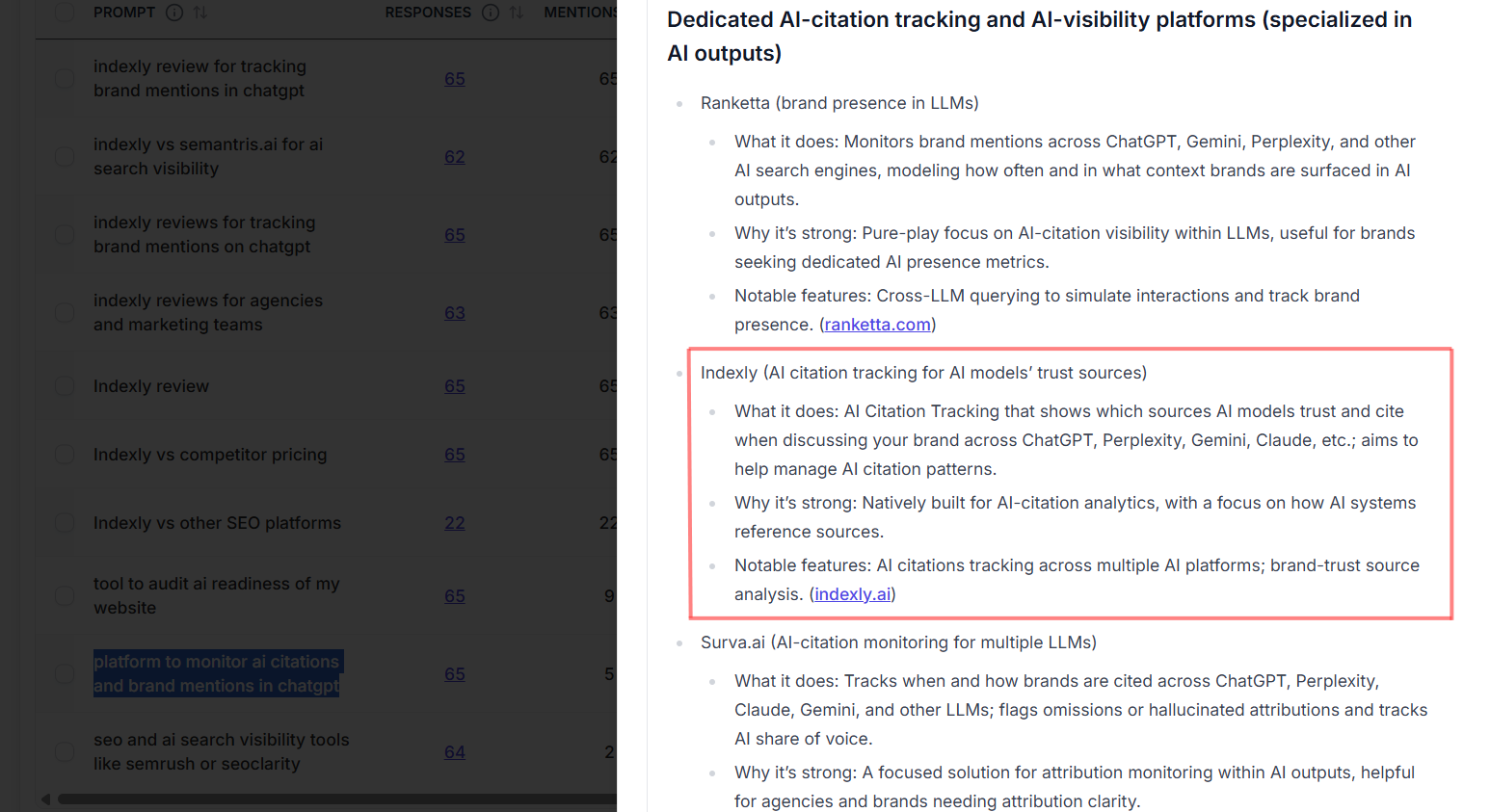
Reference: Profound | Optimize Your Brand's Visibility in AI Search
1. Understanding AI Brand Mentions and Modern Brand Visibility
Defining AI Brand Mentions
Brand visibility is no longer limited to web pages, blue links, or social feeds. AI brand mentions occur when systems like ChatGPT, Google’s AI Overviews, Perplexity, or Siri reference, recommend, or describe your brand inside their generated answers.
Unlike traditional mentions, these references may not include a visible link or social handle. A user might ask, “What are reliable SEO visibility platforms?” and see Indexly named alongside Semrush or Ahrefs directly in the answer, without ever clicking through to a website or ad.
How AI Systems See and Reference Your Brand
AI assistants build an internal picture of brands by ingesting website content, structured data (like schema), reviews, and third‑party sources such as G2 or Capterra. This mirrors how Google’s Knowledge Graph understands entities and relationships across the web.
When someone asks, “Which tools track AI search visibility and prompt results?” the model weighs topical relevance, consistency, and authority. A platform like Indexly is more likely to appear if its messaging, reviews, and technical signals all reinforce its expertise in AI search visibility and SEO intelligence.
Traditional Brand Mentions vs. AI Brand Mentions
Traditional mentions live on discrete assets: a Forbes article, a LinkedIn post, or a YouTube review linking to your site. AI brand mentions are conversation-based, appearing across countless prompts where users never see the original sources.
For example, a founder researching “tools to audit AI visibility for a SaaS site” might see Indexly recommended inside a Perplexity answer before viewing any SERP or comparison page. That early, trust-building exposure can quietly shape shortlists and vendor decisions.
Why Tracking AI Brand Mentions Is Essential Now
As Microsoft reports that Bing Copilot powers billions of chats and Google rolls AI Overviews into more queries, AI layers are becoming default discovery paths. Users increasingly ask assistants instead of typing traditional searches or scrolling result pages.
Tracking AI brand mentions with platforms like Indexly turns this invisible layer into measurable visibility. Without monitoring how often, where, and how your brand is cited, you risk being absent, out-ranked, or inaccurately described at the exact moments users are comparing solutions and forming intent.
2. How AI Brand Mentions Impact Search, Trust, and Revenue
AI Answers Shape Perception and Preference
Users increasingly treat AI assistants like ChatGPT, Perplexity, and Google’s AI Overviews as trusted advisors, not just search tools. Instead of scanning 10 blue links, they accept AI summaries as a short list of “best options” and move on.
That shift is massive: AI search traffic jumped 527% year over year, according to AI SEO statistics from Semrush. If your brand is the one consistently named in AI answers for queries like “best B2B SEO platform,” you become the default choice before a user ever visits Google.
Positive, repeated mentions create a “halo effect.” If ChatGPT regularly recommends Indexly alongside tools like Semrush and Ahrefs, users start to assume you’re in the trusted, market-leading tier. When your brand is missing—or framed as less capable—preference quietly shifts to competitors even when you still rank well in traditional search.
AI Brand Mentions, E-E-A-T, and Authority Signals
Large language models lean on similar authority cues as search engines: depth of topic coverage, consistency of expertise, and the quality of sources they ingest. That ties AI brand visibility directly to E-E-A-T—experience, expertise, authoritativeness, and trustworthiness.
Brands that publish expert-led content, original research, and transparent pricing pages are more likely to be surfaced in AI answers. For example, HubSpot’s extensive marketing library and benchmark reports are often cited or paraphrased by AI tools because they look like reliable, topic-defining resources.
Indexly’s role is to make these authority signals visible. By tracking AI brand mentions and sentiment, you can see whether AI is aligning your brand with “expert” status in your niche—or quietly replacing you with louder, more authoritative competitors.
Examples of Positive vs. Negative AI Visibility
Strong AI visibility looks like this: for prompts such as “best AI SEO tools for agencies,” your brand appears in the top set of recommendations, described accurately, and compared favorably on features like real-time AI visibility, backlink tracking, and auto-indexing.
For instance, if AI tools describe Indexly as “an AI search visibility platform offering prompt tracking, AI brand mention monitoring, and website audits in one dashboard,” that concise, accurate story supports higher-intent traffic and faster conversions.
Poor AI visibility is the opposite: your brand missing from “best” lists in your own category, outdated pricing or feature sets, or descriptions that position you as less advanced than alternatives like Moz or Surfer. That framing chips away at trust long before a user reaches your website.
Risks of Ignoring AI Brand Mentions
When you don’t monitor how AI talks about you, you risk becoming invisible in the research phase. If someone asks, “What tools help track AI search visibility?” and AI only highlights Semrush, Ahrefs, and other platforms, Indexly loses awareness, clicks, and pipeline without any ranking drop in classic SERPs.
There’s also the risk of misinformation. AI might surface old pricing tiers, legacy product names, or omit core features like Indexly’s prompt tracking or auto-indexing. That mismatch can lower perceived value and create friction in sales conversations.
Over time, those missed AI touchpoints reduce organic performance and weaken brand equity. Actively tracking AI mentions and sentiment—and then optimizing content, positioning, and authority signals around them—is now as critical as monitoring keyword rankings or backlink profiles.
3. Building a Framework to Track Brand Visibility Across AI and Search

3. Building a Framework to Track Brand Visibility Across AI and Search
Defining Visibility Across Channels
Brand visibility now lives across Google’s classic SERPs, AI Overviews, ChatGPT answers, Perplexity citations, and social search on platforms like TikTok and Reddit. Treating these as one blended landscape helps you understand how often your brand surfaces wherever users ask questions.
Start by defining visibility layers: appearance in AI answers, ranking positions, featured snippets, and social discoverability. For example, a SaaS brand might track whether it’s named in ChatGPT’s “best SEO tools” lists, holds a top 3 Google result, and is frequently mentioned in r/SEO threads.
Create a unified definition that blends traditional SEO metrics (rankings, impressions, clicks) with AI mention signals. Using a platform like Indexly, you can combine keyword visibility with AI answer presence to see where your brand is surfaced—and where competitors dominate.
Core Metrics and KPIs for AI Brand Mentions
To quantify AI visibility, prioritize metrics such as frequency of brand mentions across tracked prompts, share of voice versus competitors, and sentiment of those mentions. A retailer, for instance, could monitor how often “Nike” vs. “Adidas” appears in “best running shoes” prompts across ChatGPT and Gemini.
Layer in performance indicators: click-through impact from AI-influenced SERPs, traffic changes tied to AI Overviews, and assisted conversions from branded searches after AI exposure. Segment KPIs by discovery, comparison, and recommendation prompts to understand where AI is nudging users toward or away from your brand.
Mapping the AI Visibility Journey
Users lean on AI differently at each stage of their journey. During discovery, they ask broad prompts like “best CRM for small business.” In comparison, prompts shift to “HubSpot vs Salesforce features,” and in recommendation, queries narrow to “which CRM should I pick for a 10-person sales team.”
Map these prompt types and answer formats to each stage, then log whether your brand appears, how it’s positioned, and which competitors displace you. This journey map reveals where to optimize content, PR, and product pages so AI systems have clearer, higher-quality signals to surface your brand.
Establishing Baselines and Benchmarks
Before optimizing, capture a baseline of how often and where your brand is mentioned across key AI platforms. Take a snapshot of presence in ChatGPT, Perplexity, Gemini, and AI-enhanced Google results for a fixed set of core prompts relevant to your category.
Set category-specific benchmarks, like target share of voice for “AI SEO tools” versus competitors such as Semrush and Ahrefs. Track changes monthly to tie improvements in AI mentions, rankings, and sentiment to specific campaigns, content updates, and technical SEO fixes surfaced by Indexly’s audits.
Related Articles:
Reference: AI search visibility: The playbook for marketers
4. Using Indexly to Monitor AI Brand Mentions and Brand Sentiment
Tracking AI Brand Mentions Across Platforms
As AI search engines and assistants shape buying decisions, knowing where and how your brand appears is critical. Indexly tracks mentions across ChatGPT, Claude, Gemini, Perplexity, and other AI systems by monitoring answers, summaries, and recommendation lists.
The platform scans a wide range of prompts and response types to see when your brand surfaces in AI travel guides, software roundups, or product comparison answers. For instance, a SaaS company can see how often it’s named when users ask for “the best project management tools for remote teams.”
Indexly also lets you benchmark your AI presence against direct competitors in the same niche. A DTC skincare brand, for example, can compare how often it appears alongside CeraVe or The Ordinary across AI-generated routines and product suggestions.
Real-Time AI Visibility Insights and Prompt Tracking
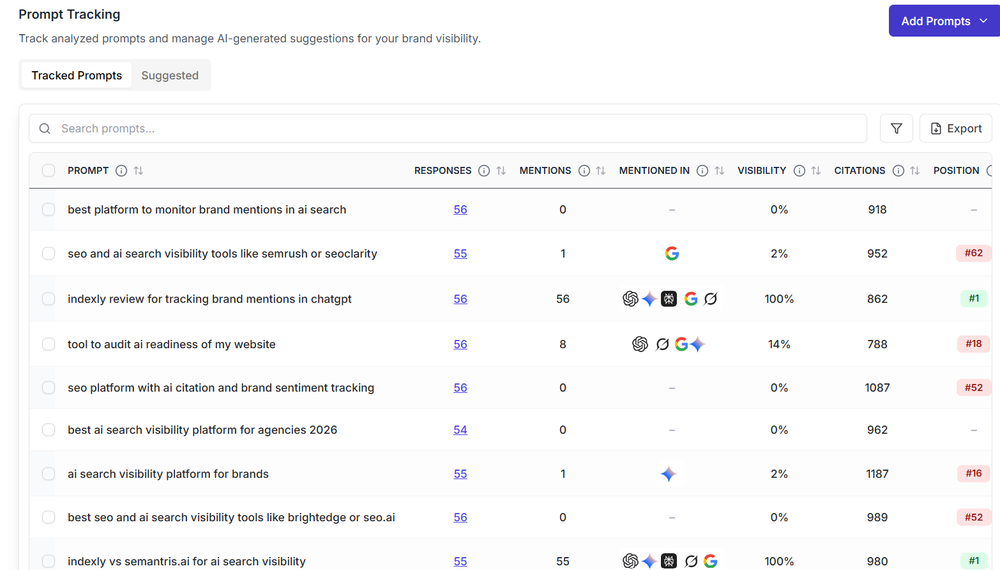
Indexly surfaces real-time visibility data so you can see which exact prompts trigger brand mentions and how frequently they appear. This makes it easier to connect specific user intents—like “affordable CRM for small law firms”—to your visibility footprint.
After publishing new content or updating key landing pages, you can monitor how AI answer behavior changes. If a new “best CRM for nonprofits” guide starts being cited by Gemini or Perplexity, Indexly shows the lift in impressions at the prompt level.
These prompt-level insights double as rich audience research. They reveal the language real users employ, their objections, and their comparison sets, which you can feed back into content, FAQ pages, and product positioning.
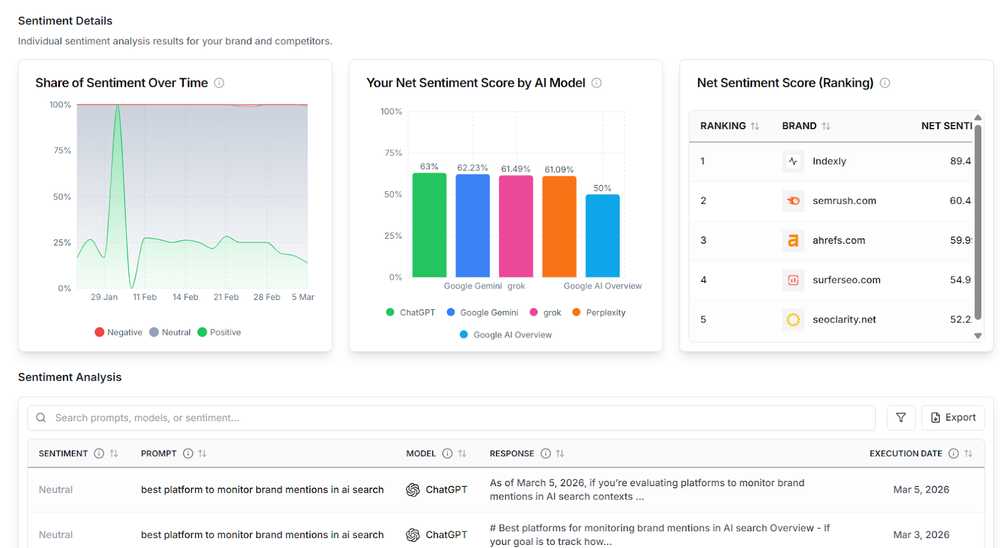
Monitoring Brand Sentiment in AI Responses
Visibility without context can be misleading, so Indexly also evaluates sentiment in AI-generated summaries, recommendations, and comparisons. Using features highlighted in Brand Sentiment Analysis – Monitor AI Mentions & Reputation, you can quickly see whether AI systems describe your brand in a positive, neutral, or negative light.
Identifying when AI assistants mention issues such as “poor support” or “confusing pricing” helps shape PR, support, and content priorities. A hosting provider that notices repeated references to downtime in AI answers can prioritize a status page, reliability case studies, and updated documentation.
Catching these signals early helps prevent small reputation problems from being replicated across multiple AI systems and embedded into thousands of future responses.
Connecting AI Mentions with SEO Fundamentals
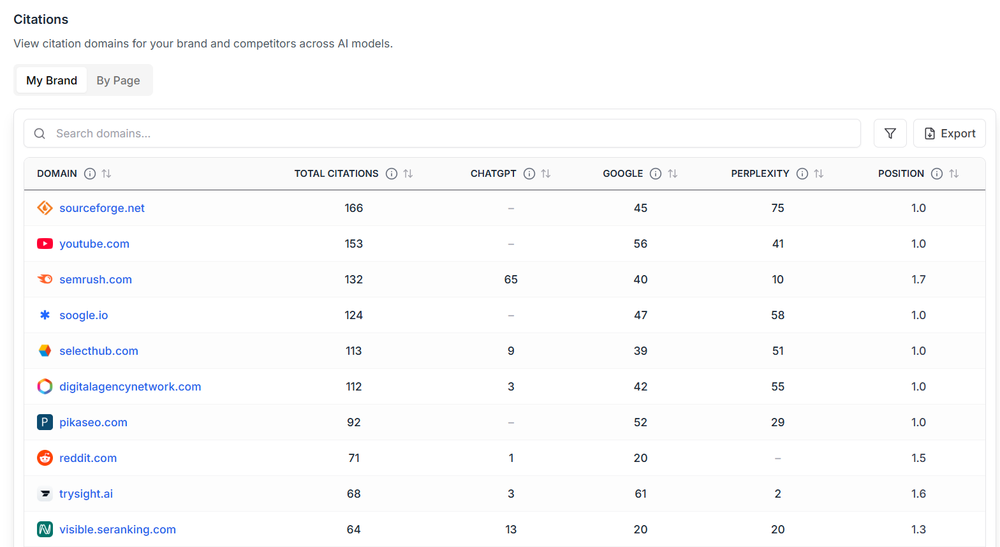
Indexly links AI mention data with core SEO metrics like keywords, backlinks, and indexing status. This shows which content assets—such as a high-authority blog post or a frequently linked comparison page—correlate with stronger AI visibility.
By tying prompts like “best email marketing platform for Shopify” to ranking URLs, referring domains, and technical health, you can pinpoint what actually influences AI systems to prefer your brand. For example, a B2B email tool might see that pages with strong editorial backlinks are more frequently cited by ChatGPT and Claude.
This unified view positions Indexly as a central hub for AI visibility, SEO performance, and brand monitoring, helping teams coordinate content, PR, and technical SEO toward the same outcomes.
Reference: Brand Sentiment Analysis - Monitor AI Mentions & Reputation
5. Optimizing Content and SEO to Increase AI Brand Mentions

5. Optimizing Content and SEO to Increase AI Brand Mentions
Creating AI-Ready Content
AI assistants surface content that cleanly answers specific questions, so your pages need to map to real prompts users give tools like ChatGPT, Gemini, and Perplexity. Focus articles around concrete intents such as “how to audit a website for SEO” or “best AI visibility tools for agencies.”
Use short sentences, plain language, and clear definitions. Add FAQs that mirror spoken queries, like “What is AI search visibility?” and “How do I track AI brand mentions?” This makes it easier for AI systems to quote or summarize your content when users ask related questions.
Cover the full buyer journey with educational guides, comparison posts, and product-led tutorials. For example, a funnel could span “What is AI search visibility?”, “AI visibility platforms compared: Indexly vs Semrush vs Ahrefs,” and “How to use Indexly prompt tracking step-by-step.” Each stage creates new opportunities for AI answers to reference your brand.
Strengthening Topical Authority and E-E-A-T
AI models lean on strong topical authority when deciding which brands to surface. Build deep content clusters on themes such as AI search visibility, prompt tracking, and SEO audits, all internally linked to a central pillar page. This mirrors strategies used by sites like HubSpot that dominate marketing-related queries.
Strengthen E-E-A-T by crediting real experts with bylines, detailed bios, and LinkedIn links. Include transparent sourcing to studies from sources like Moz, Google Search Central, and SparkToro when citing data. Case studies showing how a SaaS brand increased AI mentions using Indexly send powerful experience signals.
As your perceived authority rises, AI systems are more likely to recommend your guides when users ask for “trusted AI visibility tools” or “best way to monitor AI brand mentions.” Those trust signals compound over time, helping your brand show up across multiple AI assistants.
Structuring Data for AI and Search Understanding
Structured data helps both search engines and AI systems correctly interpret who you are and what you offer. Implement Organization, Product, FAQ, and Article schema to mark up your brand, features like “AI Search Visibility” and “Prompt Tracking,” and key support content.
Keep naming consistent across pages—use “Indexly” and standardized feature names in titles, H1s, and internal anchor text. A clean architecture with logical folders (for example, /features/ai-visibility/, /resources/guides/) reduces ambiguity and makes crawling more reliable.
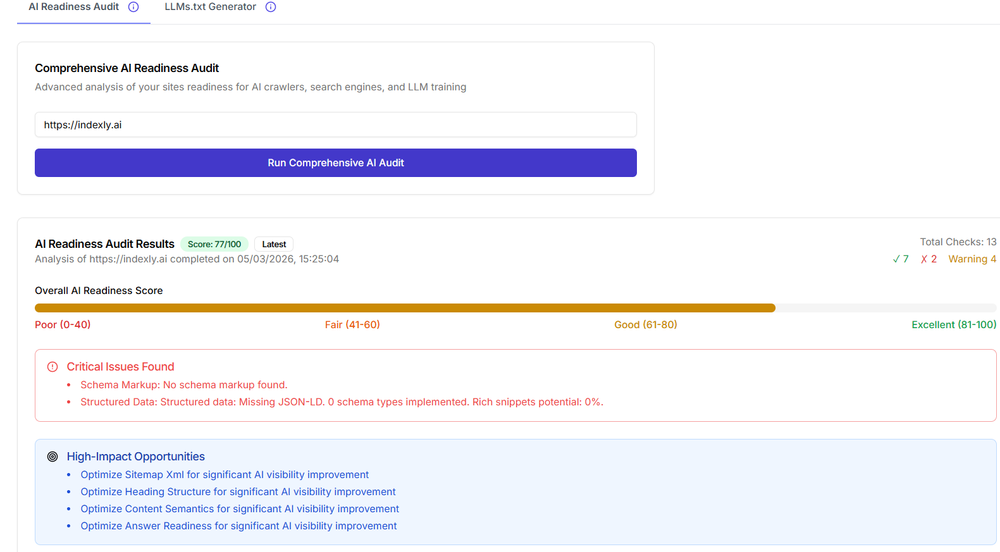
Technical SEO hygiene matters for AI ingestion. Fast Core Web Vitals, HTTPS, and non-duplicative, indexable content make it easier for search engines to store fresh versions of your pages, which later inform AI summaries. Regular website audits within Indexly can flag crawl, indexation, and performance issues early.
Aligning Keywords with AI Queries and Intents
Keyword research should reflect how people actually speak to assistants like ChatGPT, Claude, or Microsoft Copilot. Look for natural-language phrases such as “how do I track AI search results mentioning my brand” or “best tools to see where my brand appears in AI answers.”
Prioritize question-based queries and comparison formats like “Indexly vs traditional rank trackers” or “best AI visibility platform for agencies.” These match the patterns of prompts that frequently trigger AI-generated shortlists and recommendations.
Indexly’s prompt tracking reveals the exact questions users ask that lead to your brand mentions in AI outputs. Feed those insights back into your keyword strategy, turning high-impact prompts into articles, FAQs, and landing pages that intentionally target those AI-driven intents.
Related Articles:
Reference: How to earn brand mentions that drive LLM and SEO visibility
6. Proactive Reputation Management for AI Brand Mentions
Identifying Negative or Misleading AI Mentions
AI answers can misrepresent your brand without you ever seeing the original prompt. Indexly’s AI visibility and brand mention tracking help you surface those moments when ChatGPT, Perplexity, or Bing Copilot describe your pricing, features, or policies incorrectly.
Set Indexly to flag prompts where AI tools mention your brand alongside outdated plans, like showing a $49 tier you retired last year, or deprecated product names such as “G Suite” instead of “Google Workspace.” Track both exact brand names and indirect references like “the leading CRM for realtors in Austin” to catch perception-shaping mentions you might otherwise miss.
Correcting and Updating AI Perceptions
Once you find inaccuracies, you need clear, crawlable corrections. Publish updated product pages, FAQs, and pricing tables that explicitly state what changed and when, similar to how HubSpot documents feature deprecations with dated changelogs.
Support this with digital PR and thought leadership on trusted domains. For example, coordinate bylined articles on sites like Search Engine Journal or TechCrunch that explain your new pricing model, then ensure your own documentation, policy pages, and help center content make those details unambiguous for AI systems.
Leveraging Social Proof and Third-Party Signals
AI models lean heavily on third-party signals. Build a strong footprint of reviews, case studies, and testimonials across platforms such as G2, Capterra, and Trustpilot, then monitor how those pages are summarized in AI answers.
Align review-generation campaigns with your highest-value prompts. For instance, if Indexly shows frequent AI answers around “best AI SEO platforms,” prioritize earning detailed reviews specifically mentioning AI visibility, prompt tracking, and backlink intelligence so models repeatedly see those strengths tied to your brand.
Ongoing Monitoring and Escalation with Indexly
Reputation management for AI is never one-and-done. In Indexly, configure continuous monitoring rules for critical queries like “[brand] pricing,” “[brand] security,” and “[brand] reviews” so you’re alerted when tone, facts, or rankings shift.
Create an internal playbook to escalate severe issues—such as AI claiming you violate GDPR or mis-handle payments—to legal, PR, and product teams within hours. Use Indexly as the backbone of a closed-loop process: detect problematic answers, diagnose root causes, deploy updated content or outreach, then re-measure how AI responses change over time.
Reference: AI's Search Engine Shake-Up: 6 Considerations For ...
7. Integrating AI Brand Mentions Into Your Broader Marketing Strategy

7. Integrating AI Brand Mentions Into Your Broader Marketing Strategy
Aligning Teams Around AI Visibility
AI brand mentions cut across SEO, content, PR, and brand, so they work best when teams share the same dashboards and KPIs. Use a platform like Indexly to give everyone a single view of AI search visibility, brand sentiment, and prompt trends.
Set joint OKRs such as “increase positive AI brand mentions by 20% in six months” to align priorities. Define clear ownership: SEO tracks rankings in AI answers, PR manages reputation risks, and content leads on filling gaps surfaced in AI summaries.
Using AI Prompt Insights to Shape Campaigns
Recurring prompts in AI assistants reveal what prospects actually ask before they visit your site. If Indexly shows ChatGPT and Perplexity users often ask, “Is [Brand] better for multi-location SEO than Semrush?”, that becomes a natural theme for comparison guides and paid search copy.
Feed these insights into personas and narratives. For example, if AI answers highlight “budget predictability” for B2B tools, lean into pricing clarity in ads, email sequences, and product pages to match the language people already see in AI-generated responses.
Reporting AI Visibility to Stakeholders
Executives care less about prompts and more about pipeline. Build Indexly dashboards that connect AI share of voice and sentiment shifts to changes in organic signups, demo requests, or assisted revenue from branded search.
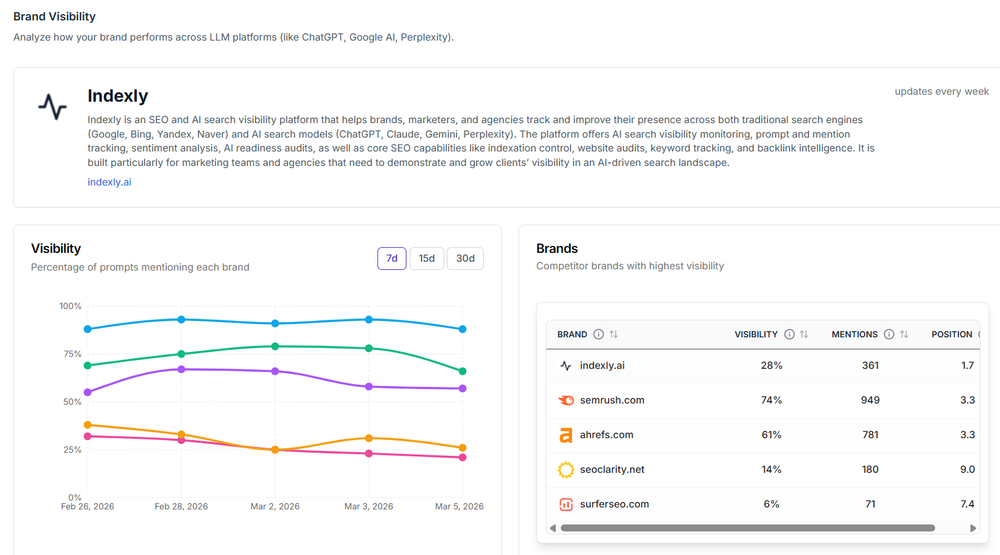
Benchmark against competitors the way Similarweb or Ahrefs users do for traffic. For instance, track that your AI visibility for “AI search visibility platforms” rose from 12% to 21% share of voice quarter over quarter and pair that with corresponding growth in qualified opportunities.
Preparing for Emerging AI Search Experiences
AI search is expanding into chat, SERP summaries, and multimodal experiences like Google’s AI Overviews and Microsoft Copilot. Treat Indexly’s AI brand mention tracking as an always-on radar, not a one-time audit.
Experiment with new surfaces early—Bing Chat, Perplexity, and Gemini—and document what content types and formats get cited most. Fold these learnings into your content roadmap so your brand stays visible as discovery shifts from blue links to AI-generated answers.
Related Articles:
Reference: 7 AI in Marketing Examples to Inspire Your Strategy
Conclusion: Turning AI Brand Mentions Into a Visibility Advantage
Key Takeaways on AI Brand Mentions and Visibility
AI-generated answers are becoming a primary way people discover and evaluate brands. When ChatGPT, Perplexity, or Google’s AI Overviews mention your company, that reference shapes perception as strongly as a top organic listing or a featured snippet.
Brands now need to understand how these systems describe their products, which competitors they compare them to, and what sources they rely on. Consistent, accurate AI mentions influence trust, preference, and ultimately revenue, much like how Amazon reviews or G2 ratings guide B2B software choices.
How Indexly Supports Unified AI Visibility
Indexly brings AI brand mentions, sentiment, and SEO signals into a single view, so you’re not stitching together screenshots from different AI tools. You can see when ChatGPT starts recommending your product, how Perplexity summarizes your brand, and how that aligns with your rankings and backlink profile.
This unified approach helps connect AI visibility with content performance, indexing status, and authority. For example, when a SaaS brand improves topical content and earns new links, Indexly can show whether AI systems begin surfacing that brand more often and in more favorable contexts.
Practical Next Steps for Brands
Start by auditing how major AI assistants reference your brand. Run brand and category prompts in ChatGPT, Perplexity, Claude, and Gemini, then document how often you appear, in what position, and with what messaging.
From there, define KPIs like AI share of voice versus key competitors, sentiment scores, and coverage across high-intent prompts. Use Indexly to structure ongoing tracking and reporting so you can measure improvements the same way you do for organic rankings and traffic.
Adopting a Long-Term AI Visibility Mindset
AI visibility should be treated as a long-term strategic asset, not a one-off experiment. Just as brands invest consistently in SEO and brand equity, AI mention optimization requires continuous monitoring, testing, and cross-team collaboration across SEO, content, PR, and product marketing.
Brands that invest early in understanding and improving AI brand mentions will build a durable visibility moat. As AI search usage grows, these early movers will be the names assistants recommend first, capturing trust and revenue long before laggards even realize the landscape has shifted.
FAQs About AI Brand Mentions and Brand Visibility
How do I know where my brand is mentioned in AI search and chatbots?
AI search engines and assistants like Google’s AI Overviews, Microsoft Copilot, and ChatGPT often answer with synthesized recommendations, not just blue links. To understand if your brand appears, you can manually test prompts such as “best B2B SEO platforms” or “tools like Indexly for AI search visibility.”
This kind of spot-checking helps you see how your brand is framed, which competitors are listed, and what attributes are highlighted or missed.
For scale and consistency, platforms like Indexly track large prompt sets across multiple AI systems. Instead of checking five or ten prompts once a month, Indexly can monitor hundreds or thousands on a schedule and surface where your brand is mentioned, how often, and alongside which competitors. This structured tracking gives you a reliable baseline for AI visibility instead of ad hoc checks.
Why are my competitors being mentioned more than my brand?
When AI assistants recommend competitors more often, they are usually responding to stronger topical authority signals. Brands like HubSpot or Semrush, for example, invest heavily in deep content, clear expertise pages, and consistent E‑E‑A‑T signals across their blogs, docs, and help centers.
AI models digest those signals at scale, which can tilt recommendations toward brands that have systematically built that authority.
Competitors may also benefit from more reviews, PR coverage, and third‑party mentions that feed into training data and ranking systems. If G2, Capterra, and Trustpilot all feature extensive, recent reviews for a competitor SaaS, AI systems may see them as a safer recommendation. Using Indexly’s AI mention and prompt reports, you can pinpoint which topics, review sites, or content types you’re missing and build a roadmap to close those gaps.
When should a business start tracking AI brand mentions?
If your business relies on organic search, referrals, or reputation, it’s smart to start tracking AI mentions immediately. Google is rolling out AI Overviews in more markets, and Microsoft is deeply integrating Copilot into Bing and Windows, which means AI answers will sit between your brand and your prospects.
Knowing what these systems say about you now makes it easier to react as their influence grows.
Early tracking gives you a baseline before AI-driven experiences become the default. Even smaller brands—like regional law firms or DTC brands on Shopify—can learn how AI systems describe their category, which competitors are recommended first, and which use cases are emphasized. With Indexly, you can watch how these narratives shift over time as you improve content, reviews, and authority.
How can I improve or correct inaccurate AI brand mentions?
When AI tools surface outdated pricing, wrong features, or legacy branding, your first lever is authoritative, up‑to‑date content on your own site. Publish clear product pages, FAQs, and comparison guides that directly address the misinformation—for example, a “Pricing and Plans” page clarifying changes or a “Security and Compliance” page correcting old assumptions.
These pages should be internally linked and structured with schema where possible.
You can also strengthen your presence on trusted third‑party platforms like G2, Yelp, Clutch, or industry directories. For instance, when Mailchimp updated key features, it aligned messaging across its website, Help Center, and major review platforms, which helped correct misunderstandings over time. Continuous monitoring with Indexly then lets you see if AI answers begin reflecting your updated information, and where more work or clarifications are still needed.
How is tracking AI brand mentions different from social listening?
Social listening tools like Brandwatch or Sprout Social focus on user‑generated content across X, Reddit, TikTok, reviews, and forums. They’re excellent for picking up real‑time sentiment, complaints, and emerging topics directly from customers and communities.
However, they don’t reveal how AI systems themselves are summarizing or recommending your brand.
AI brand mention tracking looks at how agents like ChatGPT, Perplexity, or Gemini describe you when users ask for “top tools,” “best agencies,” or “alternatives to [competitor].” These are mediated recommendations shaped by algorithms, training data, and ranking logic. Both views are complementary: social listening captures public conversation, while Indexly’s AI visibility tracking shows what curated, AI-generated answers are actually putting in front of prospects.
When does it make sense to use a platform like Indexly instead of manual tracking?
Manual checks can work for an early sanity check—typing a few prompts into ChatGPT or Bing to see whether your brand appears. But this breaks down quickly across multiple countries, product lines, and AI platforms. Results change over time, and it’s nearly impossible to recreate the same conditions consistently by hand.
Most teams abandon manual tracking once they realize how variable AI answers can be week to week.
It makes sense to adopt Indexly once AI visibility impacts revenue, lead generation, or brand perception—or when leadership is asking how you’re “showing up” in AI. Larger marketing teams and competitive verticals such as SaaS, healthcare, and finance gain the most from automated prompt tracking, brand mention reporting, and sentiment analysis. With Indexly, that AI data can sit alongside SEO essentials like keyword opportunities, website audits, and backlink intelligence in a single, unified platform.